111576341538


Kunawarritji (Canning Stock Route Well 33)

Kunawarritji is an important site in the Great Sandy Desert where multiple stories and histories intersect. Originally a spring water and major Martu pujiman (traditional, desert dwelling) camping site, at the turn of the 20th century Kunawarritji was converted into a well along the Canning Stock Route. Each year throughout the 1930-50s, the well became a site of contact between the drovers, their cattle, and desert families like Nungabar’s (dec.). Nungabar was born near Lipuru (Libral Well, Canning Stock Route Well 37), north east of Kunawarritji. She grew up in the Country between these sites, and from an early age she and her family had encounters with drovers along the Canning Stock Route.

Long before colonial history entered this Country, however, other stories dominated this site. Primarily, Kunawarritji features in the Minyipuru (Jakulyukulyu, Seven Sisters) Jukurrpa (Dreaming). Minyipuru is a central Jukurrpa narrative for Martu, Ngaanyatjarra, Pitjantjatjara and Yankunytjatjara people that is associated with the seasonal Pleiades star constellation. Beginning in Roebourne on the west coast of Western Australia, the story morphs in its movement eastward across the land, following a group of women as they walk, dance, and even fly from waterhole to waterhole. As they travelled the women left markers in the landscape and create landforms that remain to this day. During the entirety of their journey the women are pursued by a lustful old man, Yurla, although interactions with other animals, groups of men, and spirit beings are also chronicled in the narrative.

The Minyipuru travelled to Kunawarritji from Nyipily (Nyipil, Nibil, Canning Stock Route Well 34), and transformed themselves into a distinctive group of trees that remain in the area between these two sites. From Kunawarritji Yurla followed the sisters to Pangkapirni, where he finally caught one of the women. 

Today, Kunawarritji is a site of return, a place where people came back to continue their life in the desert with the formation of Kunawarritji Aboriginal community in the early 1980s. The community’s cultural significance endures, with the population swelling up to 1000 during cultural business. In her late years Nungabar relocated to her homelands at Kunawarritji, though she continued to travel regularly between Kunawarritji, Balgo and Mulan. Nungabar was a custodian of a great deal of cultural knowledge about the Kunawarritji area, much of which is referred to in her extensive body of work.

116482232607


The Void I

This work was birthed out of a season of great loss and speaks of the emptiness in the absence of loved ones. It is the start of my journey through the mourning process for a lady who was my aunty but I called her and loved her like a mum and also for a granny (who was a two) that my nephew and his partner lost in early stages of the pregnancy. We may not have been able to meet the little one but will always feel the loss and I will always think of the little one we never got to meet. They will both forever be in my heart.

116482293277


The Void III

“When losing someone very important to me I often turn to my art to get through the darkest of days. When completing the first artwork in this series I looked at it and realised I had more emotions about the loss that I had to put onto canvas before I had any real thoughts of healing. So that is when ‘The Void’ series came to be. At first it was a way to work through my grief about losing mum. As the series started to progress, I realised that it was also a beautiful way to pay tribute to her. She was loving caring strong proud and always willing to go out of her way to help others. She was also a well-established Yindjibarndi artist and elder. In small communities a lot of people find it hard to process grief. They turn to other vices to numb the pain. The outcome I want to achieve with my series is to help anyone who walks into this exhibition to process and work through any grief and loss that they may have gone through themselves. Losing someone can bring so many emotions to light. My Journey into The Void began with anger, confusion, guilt and pain. I used these strong feelings to work out my thoughts on canvas. The first work in my series was very dark, with black paint on black paint. With each artwork more colour was introduced as I worked through my feelings. Sometimes the textural marks are harsh and sharp. My hand worked out the frustration. This third artwork in my series shows a glimpse of hope and light seeping through, slowly bringing back a sense of normalcy back into my life. I have painted four works in the series so far. I don’t know how many works will be in the series yet but I know I will feel when to stop.

116482293258


The Void II

This work was birthed out of a season of great loss and speaks of the emptiness in the absence of loved ones. It is the start of my journey through the mourning process for a lady who was my aunty but I called her and loved her like a mum and also for a granny (who was a two) that my nephew and his partner lost in early stages of the pregnancy. We may not have been able to meet the little one but will always feel the loss and I will always think of the little one we never got to meet. They will both forever be in my heart.

220182388115


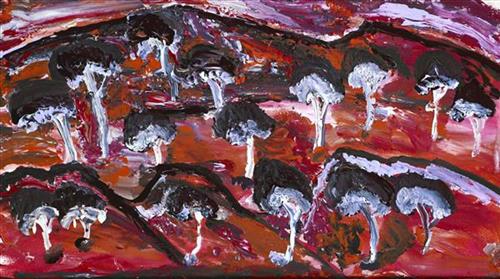
Yalpirakinu

Yalpirakinu is Adrian’s mother’s country. Adrian’s mother is the late Eunice Napangardi, a well known painter herself. His artworks consistently refer to the desert mountains, ridges and trees which are part of Yalpirakinu. Using a restricted colour palette, Adrian’s  brushwork is loaded with energy, drama and memories. He is a deliberate and thoughtful painter; reworking, pushing and pulling the image to completion.

377810582395760


Kunkurra (Spiral Wind) Cargo Pant

Hand made by young women during the Young Daluk sewing program in 2023. Presented in the 2023 Country to Couture Runway. 

Made in Maningrida.

‘My designs, they are all alive living up in my head’- Janet Marawarr

Janet Marawarr has depicted kunkurra, the spiralling wind associated with several sites in the Kardbam clan. On one level, this design can be interpreted as a depiction of the kinds of mini-cyclones common during the wet season in Arnhem Land, where the artist lives. Kunkurra also relates specifically to a site called Bilwoyinj, near Mankorlod, on the artist’s clan estate.

At this site, two of the most important Kuninjku creation beings, a father and son known as na-korrkko, are believed to have hunted and eaten a goanna. They left some of the goanna fat behind at the site, which turned into the rock that still stands there today.

Bilwoyinj site is also a ceremonial ground for a ceremony called Yabbaduruwa, a major ceremony owned by the Yirridja patrimoiety. The Yabbaduruwa ceremony is primarily concerned with initiation, land ownership and promoting the cyclical regeneration of the human and natural worlds.