Journey
A collection of small works created by Kaiela Arts artists during a series of workshops. Artists have used Posca pens and acrylic paint to create colourful designs that represent country, traditions and culture.

A collection of small works created by Kaiela Arts artists during a series of workshops. Artists have used Posca pens and acrylic paint to create colourful designs that represent country, traditions and culture.

Bayadherra is my totem and Bayaherra means Long Neck turtle in Yorta-Yorta language.


Bayadherra is my totem and Bayaherra means Long Neck turtle in Yorta-Yorta language.


Bayadherra is my totem and Bayaherra means Long Neck turtle in Yorta-Yorta language.


Bayadherra is my totem and Bayaherra means Long Neck turtle in Yorta-Yorta language.

Bayadherra is my totem and Bayaherra means Long Neck turtle in Yorta-Yorta language.


Bayadherra is my totem and Bayaherra means Long Neck turtle in Yorta-Yorta language.


“This is a descendant of (people call it) Martu Romeo and Juliet, because in those days penalty was death when you married wrong skin. This is a love story. They was hiding. They lived in the dessert for long time and people all think that they’re still out there. In the drought season, they weren’t sure if they were still alive. He (Ilyala Stewart) is famous but not in the white fella way. And it is my job as an artist to lift people like him up. Make him well know because he’s part of Australia history. Martu people know him as the last nomad so it’s got to be in the Australian story.”
– Owen Biljabu
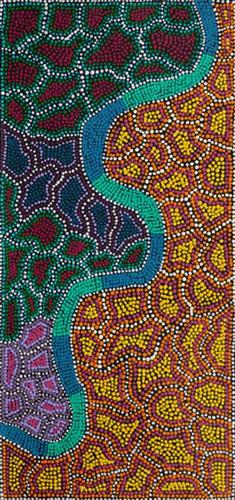
“That’s the dessert and the water where I grew up. I miss it.”
-Olivia Wilson
“When Martu paint, it’s like a map. Martu draw story on the ground and on the canvas, and all the circle and line there are the hunting areas and different waters and tracks where people used to walk, and [some you] can’t cross, like boundaries. So nowadays you see a colourful painting and wonder what it is, but that’s how Martu tell story long ago. It’s not just a lovely painting, it’s a story and a songline and a history and everything that goes with it.”
– Ngalangka Nola Taylor and Joshua Booth
This work portrays an area of Country that can be interpreted in multiple ways. Firstly, the image may be read as an aerial representation of a particular location known to the artist- either land that they or their family travelled, from the pujiman (traditional, desert dwelling) era to now. During the pujiman period, Martu would traverse very large distances annually in small family groups, moving seasonally from water source to water source, and hunting and gathering bush tucker as they went. At this time, one’s survival depended on their intimate knowledge of the location of resources; thus physical elements of Country, such as sources of kapi (water), tali (sandhills), different varieties of warta (trees, vegetation), ngarrini (camps), and jina (tracks) are typically recorded with the use of a use of a system of iconographic forms universally shared across the desert.
An additional layer of meaning in the work relates to more intangible concepts; life cycles based around kalyu (rain, water) and waru (fire) are also often evident. A thousands of year old practice, fire burning continues to be carried out as both an aid for hunting and a means of land management today. As the Martu travelled and hunted they would burn tracts of land, ensuring plant and animal biodiversity and reducing the risk of unmanageable, spontaneous bush fires. The patchwork nature of regrowth is evident in many landscape works, with each of the five distinctive phases of fire burning visually described with respect to the cycle of burning and regrowth.
Finally, metaphysical information relating to a location may also be recorded; Jukurrpa (Dreaming) narratives chronicle the creation of physical landmarks, and can be referenced through depictions of ceremonial sites, songlines, and markers left in the land. Very often, however, information relating to Jukurrpa is censored by omission, or alternatively painted over with dotted patterns.
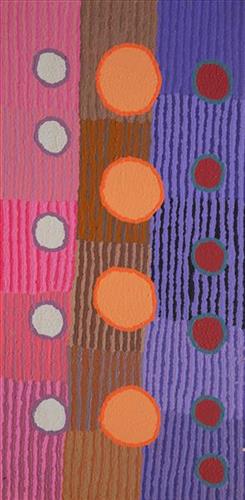
This work depicts a waterhole within the artists’ ngurra (home Country, camp), typically represented with circular forms. Waterholes are sites that require maintenance, including digging to increase flow, clearing out surrounding growth, and cleaning up after sullying by camels or cattle.
During the pujiman (traditional, desert dwelling) period, knowledge of water sources was critical for survival, and today Martu Country is still defined in terms of the location and type of water. Each of the hundreds of claypans, rockholes, waterholes, soaks and springs found in the Martu desert homelands is known through real life experience and the recounting of Jukurrpa (Dreaming) narratives by name, location, quality and seasonal availability. This encyclopedic knowledge extends even to the nature and movement of arterial waterways, and sustained Martu as they travelled across their Country, hunting and gathering, visiting family, and fulfilling ceremonial obligations. They would traverse very large distances annually, visiting specific areas in the dry and wet season depending on the availability of water and the corresponding cycles of plant and animal life on which hunting and gathering bush tucker was reliant.