111582172735


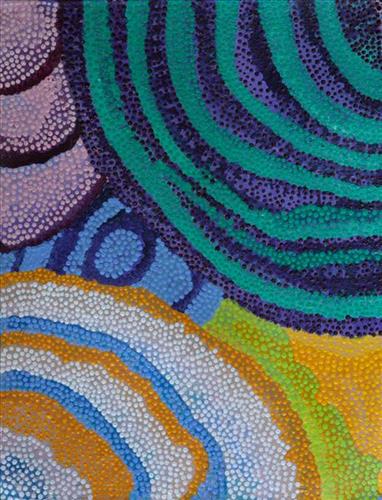
Kurturarra

“Kurturarra is my Grandmother’s Country. Warla (lake) with a spring. Tali (sandhills) all around.”

 – Beverley Rogers

This site lies within Beverley’s ngurra (home Country, camp) through her grandmother. Kurturarra is a yinta (permanent spring) located within the largest of the salt lakes in the Percival Lakes region, and surrounded by acacia trees. The Percival Lakes form a string of ephemeral salt lakes in the north of Western Australia, extending across a distance of 350km. They lie at the southern region of the Great Sandy Desert and east of the Karlamilyi (Rudall River) region.

The region surrounding Kurturarra was formed by Wirnpa, one of the most powerful of the ancestral jila (snake) men and the last to travel the desert during the Jukurrpa (Dreaming). Wirnpa is a rainmaking jila who lived and hunted in the Percival Lakes area. His travels are described in the songs and stories of many language groups across the Western Desert, even those far removed from his home site. In his epic travels, Wirnpa met and feasted with many other ancestral beings, exchanged ceremonial objects, and created a series of different laws and ceremonies. When he finally returned home, he searched for his many children only to discover that they had already died. They had laid down and become the salt springs of the Percival Lakes. Wirnpa wept for his children before himself transforming into a snake and entering the soak where he still resides.

111582172734


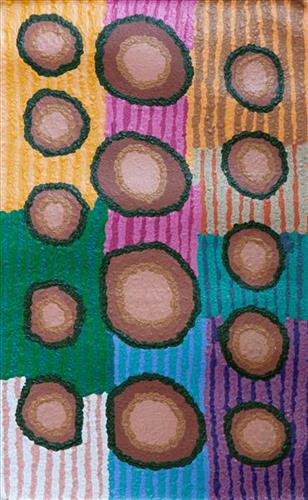
Wildflowers

“When Martu paint, it’s like a map. Martu draw story on the ground and on the canvas, and all the circle and line there are the hunting areas and different waters and tracks where people used to walk, and [some you] can’t cross, like boundaries. So nowadays you see a colourful painting and wonder what it is, but that’s how Martu tell story long ago. It’s not just a lovely painting, it’s a story and a songline and a history and everything that goes with it.” 

– Ngalangka Nola Taylor and Joshua Booth

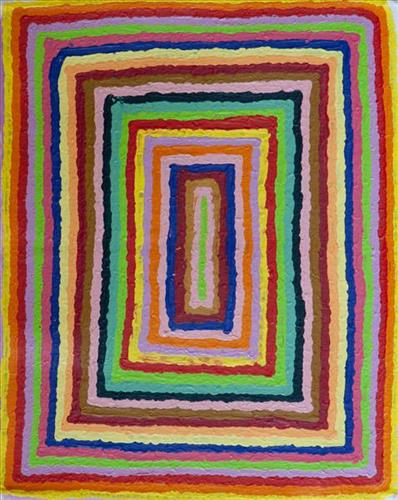
This work portrays an area of Country that can be interpreted in multiple ways. Firstly, the image may be read as an aerial representation of a particular location known to the artist- either land that they or their family travelled, from the pujiman (traditional, desert dwelling) era to now. During the pujiman period, Martu would traverse very large distances annually in small family groups, moving seasonally from water source to water source, and hunting and gathering bush tucker as they went. At this time, one’s survival depended on their intimate knowledge of the location of resources; thus physical elements of Country, such as sources of kapi (water), tali (sandhills), different varieties of warta (trees, vegetation), ngarrini (camps), and jina (tracks) are typically recorded with the use of a use of a system of iconographic forms universally shared across the desert. 

An additional layer of meaning in the work relates to more intangible concepts; life cycles based around kalyu (rain, water) and waru (fire) are also often evident. A thousands of year old practice, fire burning continues to be carried out as both an aid for hunting and a means of land management today. As the Martu travelled and hunted they would burn tracts of land, ensuring plant and animal biodiversity and reducing the risk of unmanageable, spontaneous bush fires. The patchwork nature of regrowth is evident in many landscape works, with each of the five distinctive phases of fire burning visually described with respect to the cycle of burning and regrowth.  

Finally, metaphysical information relating to a location may also be recorded; Jukurrpa (Dreaming) narratives chronicle the creation of physical landmarks, and can be referenced through depictions of ceremonial sites, songlines, and markers left in the land. Very often, however, information relating to Jukurrpa is censored by omission, or alternatively painted over with dotted patterns.

111582172732


Wantili (Warntili, Canning Stock Route Well 25)

Wantili (Warntili, Canning Stock Route Well 25) is a large round jurnu (soak) and linyji (claypan) near Well 25 on the Canning Stock Route. The area is dominated by claypans surrounded by tuwa (sandhills), and Nyilangkurr, a prominent yapu (hill) is located on the edge of the claypan. Following rain the typically dry claypans are filled with water, with the overflow from nearby waterholes flowing to Wantili. At that time, Wantili becomes an important place for obtaining fresh water for drinking and bathing. Wantili is significant for the fact that at this site Kartujarra, Manyjilyjarra, Putijarra and Warnman people would all come together for ceremonies during the pujiman (traditional, desert dwelling) era. Many jiwa (stones used by women for grinding seeds) from these times can still be found there today. 

Wantili is an incredibly important cultural site, ‘where the creation started.’ (Cyril Whyoulter). In this creation story, the world was initially dark, and people were like rocks, with no arms or legs. Following the sun’s first rising, life-forms become increasingly complex while particular features in the land were created. Beyond these details much of the Jukurrpa (Dreaming) narrative relating to Wantili is ngurlu (sacred, taboo), and only for Martu, but the site is open, and anyone can go there. 

Wantili is also one of the many sites featured in the epic Minyipuru (Jakulyukulyu, Seven Sisters) Jukurrpa story. Minyipuru is a central Jukurrpa narrative for Martu, Ngaanyatjarra, Pitjantjatjara and Yankunytjatjara people that is associated with the seasonal Pleiades star constellation. Relayed in song, dance, stories and paintings, Minyipuru serves as a creation narrative, a source of information relating to the physical properties of the land, and an embodiment of Aboriginal cultural laws. The story follows the movement of a group of women travelling all the way across the desert, beginning at Roebourne on the coast of Western Australia, as they are pursued by Yurla, a lustful old man. As the women travelled, they stopped to rest at many sites to eat, dance, rest and sing, on the way leaving behind an assortment of articles that became formations in the land, such as groupings of rocks and trees, grinding stones and seeds. The sisters rested at Wantili before throwing seeds, then continued their journey far to the east and beyond Martu Country, stopping at various sites through central and South Australia.

The intersection of the Canning Stock Route with Wantili also made this a site of early contact with Europeans for many Martu then living a pujiman life in the desert. Following the route’s construction, Martu encountered Europeans and other Martu working as cattle drovers as they would travel up and down the Stock Route from water source to water source. Increasingly, pujimanpa (desert dwellers) followed the route to newly established ration depots, mission and pastoral stations. They were drawn to the route in search of food, by a sense of curiosity, or by loneliness. By the late 1950s and early 1960s, most of the desert family groups had left the desert. Eventually, these factors combined with an extreme and prolonged drought in the 1960s to prompt the few remaining pujimanpa to move in from the desert.

37781054002000


Status: Stock


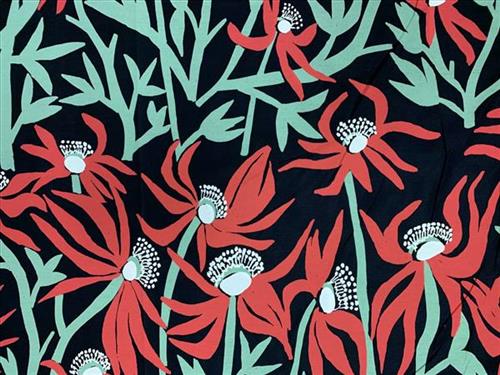
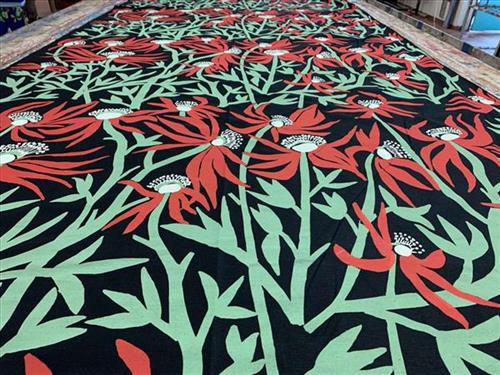
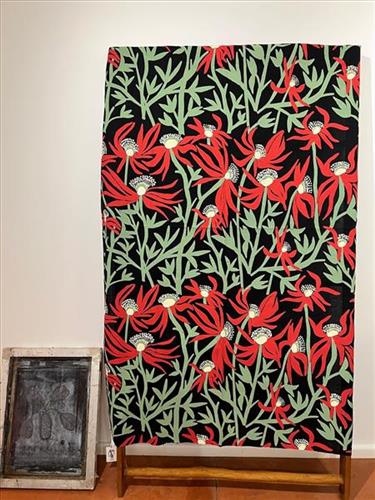
Manwak by Deborah Wurrkidj – sold per metre

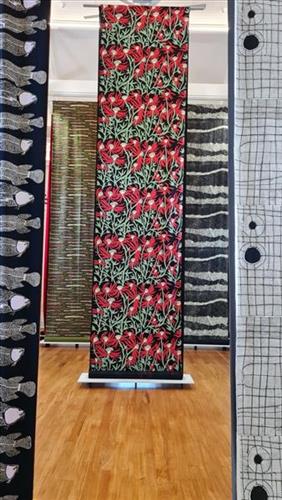
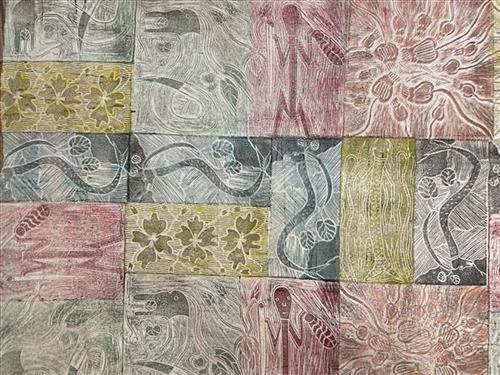
Manwak grows near Mumeka creek, on the artist’s homeland. This beautiful large flower blooms during the mandjelk (wet season). It has deep green petals with a central red kernel which swells to the size of a berry. It is known for its long, sweeping petals which seem to dance in the winds.

By dry season, the inside kernel resembles a strawberry in appearance and flavour, but is also very spicy so it burns our mouth. Kids and adults pick these berries enthusiastically when walking or going hunting on my country. The inside of the flowers are eaten fresh, a favourite manme (bush food) of our people.

“When I was painting this Manwak story, I was painting in Maningrida. In my head I was dreaming of being on my homeland, eating ripe Manwak berries”- Deborah Wurrkidj

Black linen with red, white and mint green ink. 

Printed by Publisher textiles, Sydney

111581653425


Wantili

Wantili, which forms the focus of much of Bugai’s work, is a large round jurnu (soak) and lyinji (claypan) near Well 25 on the Canning Stock Route. It lies close to Bugai’s birthplace, and is her ngurra (home country). The area is dominated by claypans surrounded by tuwa (sandhills). Following rain the typically dry claypans are filled with water, with the overflow from nearby waterholes flowing to Wantili. At that time, Wantili becomes an important place for obtaining fresh water for drinking and bathing. Wantili is significant for the fact that at this site Kartujarra, Manyjilyjarra, Putujarra and Warnman people would all come together for ceremonies. Manyjiwa (stones used by women for grinding seeds) from these times can still be found there today.

(As translated by Bugai’s grandson, Cyril Whyoulter) “Bugai always tells about Wantili because she grew up around Wantili. Her family would travel between Wantili, Kaalpa, Juntujuntu, Raarki, and Wuranu Wells along the Canning Stock Route. She paints around Wantili. She saw whitefellas there for the first time, Canning mob when they were travelling up and down the stock route with the bullock. She was a young girl walking around at Wantili. Big mob of people they been walking around there. Canning and his drovers were travelling, making the road. They were running away from those whitefellas, watching them from a long distance. She was a teenager when she was travelling around there with her four mothers and one daddy. They used to travel around in family groups, Bugai and Jakayu [Biljabu], and Jakayu’s nyupa (partner) Phillip Biljabu.” Bugai returned to the Wantili area as a young woman, when she worked driving cattle along the Stock Route.

Wantili is an incredibly important cultural site, ‘‘where the creation started.’ The jukurrpa (dreamtime narrative) related to the creation at Wantili are just for Martu, but the site is open and anyone can go there. Wantili is also one of the many sites featured in the epic Minyipuru (Seven Sisters) jukurrpa. The story follows the movement of a group of women travelling all the way across the desert, beginning at Roebourne on the coast of Western Australia, as they are pursued by Yurla, a lustful old man. As the women travelled they stopped to rest at many sites to eat, dance, rest and sing, on the way leaving behind an assortment of articles that became formations in the land. The sisters rested at Wantili before throwing seeds, then continued their journey on to Tiwa, Juntujuntu, and then Pangkapini, where they finally escaped Yurla by flying into the sky to become the Pleaides constellation of stars.

377810282172497


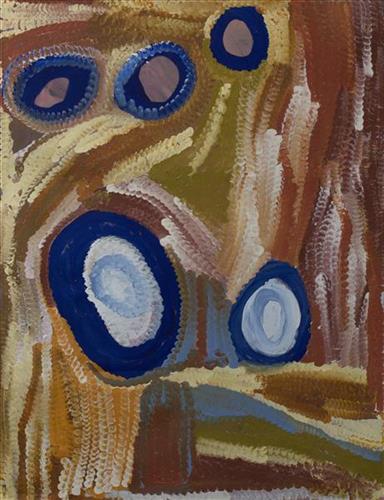
Puli Mankurpa (Uluru, Kata Tjuta & Atila)

Nyangatja puli Ulurunya, nganampa ngura Tjukurpa pulka tjara. Kala painting tjuta palyalpai-amilapai Culture Centre-ngka, minga tjuta nganampa nguraku nintiringkula kulintjaku.’

 ‘This is the rock known as Uluru, our home with its powerful law. We do our paintings at the Culture Centre so tourists can learn about our country, understand and respect it.’

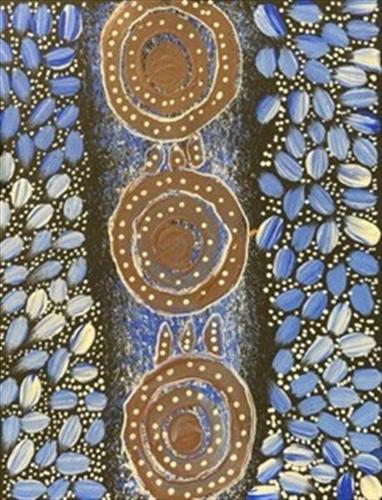
In this painting the artist has painted the three prominent land formations of the central desert region; Uluru (Ayers Rock), Kata Tjuta (The Olgas) and Atila (Mt Conner). They are puli mankurpa (three rocks). The artist has described the land forms, similar to a map from an aerial perspective, demonstrating their intricate knowledge of the land walked by the Ancestors.

From a very young age children learn from their grandparents and parents as they talk and tell their stories using the fine red sand of the desert as a canvas to illustrate and explain their teachings. These stories and images now inspire their art and Anangu are proud to not only make a living for themselves and their families through it but to educate in turn their own children.

Within the traditions of Tjukurpa or Creation Law are coded life survival skills. There is inma (ceremony) associated with each of the stories which are to teach and celebrate; for people to learn where they fit within both the environmental and social systems. Anangu feel strongly about continuing to teach and learn Tjukurpa, and their art is important and vital work. It sustains them economically, physically and culturally. It keeps the stories and traditions alive.

Walkatjara Art is the Aboriginal owned and governed art centre belonging to Mutitjulu community, located in the Uluru-Kata Tjuta national Park, NT.

www.facebook.com/walkatjara   @ walkatjara   www.walkatjara.com

377810282172491


Irmangka Irmangka (Bush Medicine)

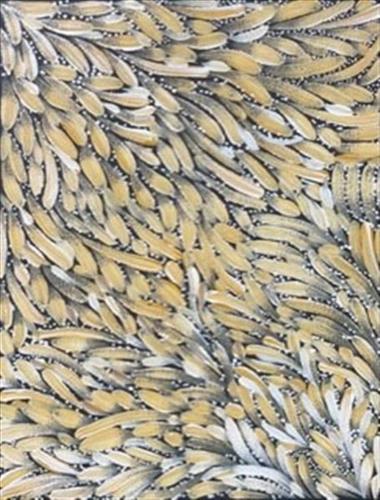
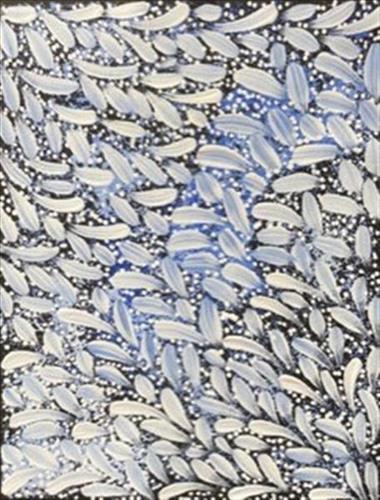
In this painting the artist, has depicted imagery of Irmangka Irmangka, a plant which has been used in traditional medicine in Anangu culture for thousands of years, and continues to be used today.

Irmangka Irmangka was used traditionally to help relieve muscle soreness and the symptoms of colds and flus.

It is the tiny leaf from the bush that is harvested, then ground on a stone and mixed with animal fat or oils and applied to the body when needed. The leaves can also be steeped in water and taken as a medicine orally.

Anangu feel strongly about continuing to teach and learn traditional ways and their art is important and vital work. It sustains them economically, physically and culturally. It keeps the stories and traditions alive.

Walkatjara Art is the Aboriginal owned and governed art centre belonging to Mutitjulu  community, located in the Uluru-Kata Tjuta national Park, NT.

www.facebook.com/walkatjaraart    www.walkatjara.com  

377810282172489


Irmangka Irmangka (Bush Medicine)

In this painting the artist, has depicted imagery of Irmangka Irmangka, a plant which has been used in traditional medicine in Anangu culture for thousands of years, and continues to be used today.

Irmangka Irmangka was used traditionally to help relieve muscle soreness and the symptoms of colds and flus.

It is the tiny leaf from the bush that is harvested, then ground on a stone and mixed with animal fat or oils and applied to the body when needed. The leaves can also be steeped in water and taken as a medicine orally.

Anangu feel strongly about continuing to teach and learn traditional ways and their art is important and vital work. It sustains them economically, physically and culturally. It keeps the stories and traditions alive.

Walkatjara Art is the Aboriginal owned and governed art centre belonging to Mutitjulu  community, located in the Uluru-Kata Tjuta national Park, NT.

www.facebook.com/walkatjaraart    www.walkatjara.com  

377810582172486


Ngalyod and Buluwana

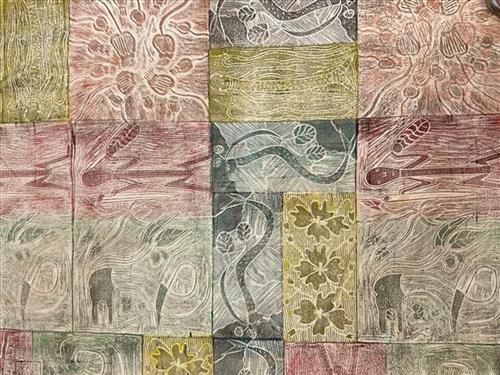
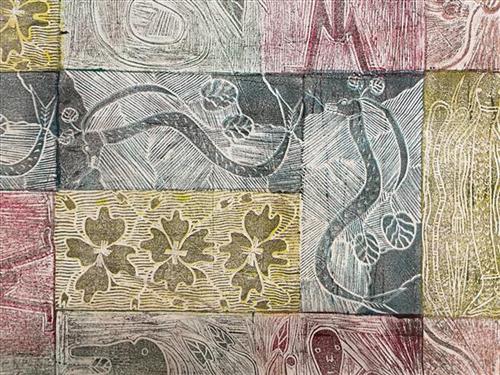
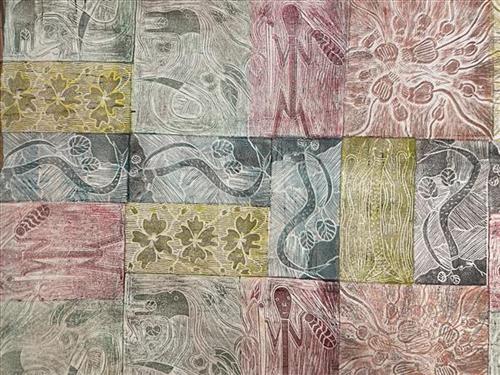
A collaboration between mother and daughter. 

Bush Dye by Deborah Wurrkidj 

Ngalyod (Rainbow serpent)

Rainbow spirit coming from billabong.

Rainbow serpent dreaming.  Coming from billabong, that place we call billabong where that ngalyod (rainbow serpent) lives.

All that wayuk (waterlily), all them kundalk (grass) and pandanus, making skirt.

That’s the story now. – Jennifer Wurrkidj


.Rainbow serpent, daughter of the Mother One Rainbow Yingarna. The rainbow serpent is a central figure in traditional Bininj religion. She is the creator of places and is active during the wet season and is asssociated with rain and bodies of water. Rainbow serpents live in deep waterholes and rivers. Marrkidjbu are able to discern their presence and control them.’

Source – https://www.njamed.com/

377810582172484


Ngalyod and Buluwana

A collaboration between mother and daughter. 

Bush Dye by Deborah Wurrkidj 

Ngalyod (Rainbow serpent)

Rainbow spirit coming from billabong.

Rainbow serpent dreaming.  Coming from billabong, that place we call billabong where that ngalyod (rainbow serpent) lives.

All that wayuk (waterlily), all them kundalk (grass) and pandanus, making skirt.

That’s the story now. – Jennifer Wurrkidj

Rainbow serpent, daughter of the Mother One Rainbow Yingarna. The rainbow serpent is a central figure in traditional Bininj religion. She is the creator of places and is active during the wet season and is asssociated with rain and bodies of water. Rainbow serpents live in deep waterholes and rivers. Marrkidjbu are able to discern their presence and control them.’

Source – https://www.njamed.com/