TBC
TBC
TBC

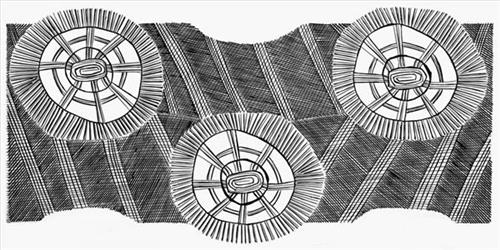
Deborah Wurrkidj is a Kuninjku artist from the Kurulk clan whose country lies around the outstation of Mumeka in central Arnhem Land. She is an accomplished artist working across mediums including painting, sculpture, weaving and textile design. For this design, Deborah Wurrkidj has depicted Marebu (woven pandanus mats).
Works in fibre from the Maningrida region are widely recognised as some of the finest in Australia. Artists confidently push the boundaries of fibre craft and cultural expression, adapting traditional techniques and forms to produce strikingly inventive and aesthetically exquisite artworks.
Artists weave many different kinds of mats. Conical mats were traditionally used to shield babies from mosquitoes. Long flat mats were used for blocking creeks so that fish would be diverted into fish traps. A small triangular mat made of pandanus fibre used to be worn by women during ceremonial gatherings, tied around their back and covering them at the front. Mats are also used for wrapping and rinsing food in water.
Artists usually use kundayarr, pandanus spiralis, to weave decorative round or oblong mats, as well as the less common triangular and conical shapes. Weaving is physically hard work, now done only by women. They colour the pandanus using natural dyes made from the roots, leaves or flowers of plants within the weaver’s clan estate.
The radial woven patterns of the finest round mats appear to vibrate with colour, sometimes regarded as an aesthetic manifestation of deep cultural meaning, as there is a significant spiritual dimension to pandanus mats.
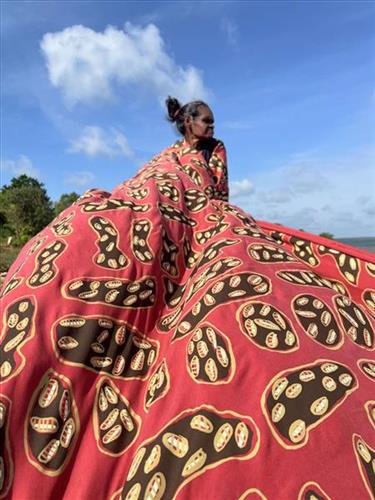
Status: Stock
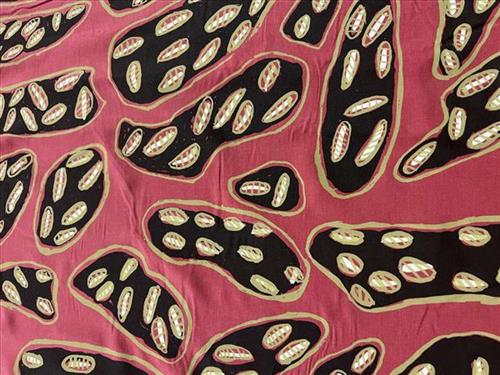
“This river we call Mangabo. It is near Gudjarrngarrl homeland of my daughters, Deborah and Jennifer Wurrkidj. We cross that river when travelling to Munmoy outstation. In the wet season, that water comes up and covers over those rocks, and when you look down there are rocks all under the water.”
– Helen Lanyinwanga
This fabric has been hand printed in Sydney by Publisher Textiles. Earthy tones on a burnt red 30% Linen 70% Tencel blend. Sold Per Meter
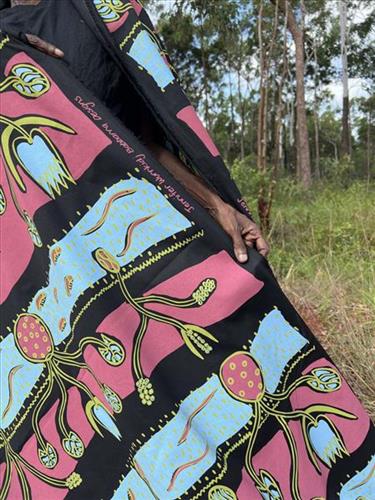
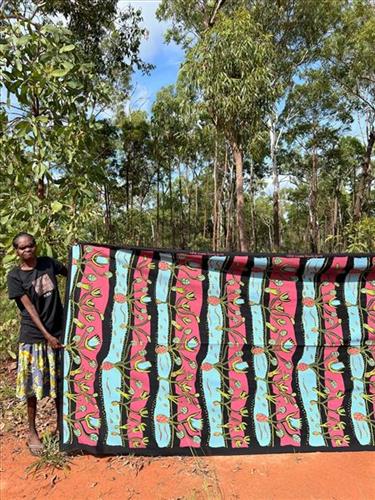
Status: Stock
Karrinung kukurlk kare, karrijare manme (we are going underground looking for food).
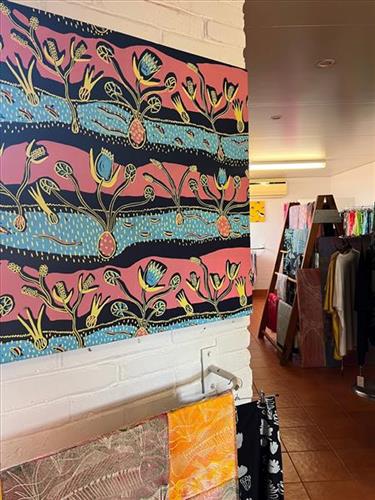
“This is my country. In this painting, I’m looking at her little bit different way. This is what we see when we’re kukurlk kare (going underground)
Man-kurndalh (Black plum) I call mother. It is my mother’s Djang (dreaming). The bush onion (kulumuduk) is white, the same as onions you buy at the store. We don’t eat this one though, it’s poison.
Wayuk is the water lily, with the big root growing in the earth. This is when that water is drying up a bit. There are worms and beetles- this is what we see underground, when we are digging for manme (bush food).”
-Jennifer Wurrkidj
Hand Screen Printed by Publisher, Sydney Australia 100% Cotton Drill – Sold Per Meter
Janet Marawarr has depicted kunkurra, the spiralling wind associated with several sites in the Kardbam clan. On one level, this design can be interpreted as a depiction of the kinds of mini-cyclones common during the wet season in Arnhem Land, where the artist lives. Kunkurra also relates specifically to a site called Bilwoyinj, near Mankorlod, on the artist’s clan estate.
At this site, two of the most important Kuninjku creation beings, a father and son known as na-korrkko, are believed to have hunted and eaten a goanna. They left some of the goanna fat behind at the site, which turned into the rock that still stands there today. The word Bilwoyinj, which is the name of this site, also refers to the fat of the goanna. Bilwoyinj site is also a ceremonial ground for a ceremony called Yabbaduruwa, a major ceremony owned by the Yirridja patrimoiety. The Yabbaduruwa ceremony is primarily concerned with initiation, land ownership and promoting the cyclical regeneration of the human and natural worlds.
Deborah Wurrkidj is a Kuninjku artist from the Kurulk clan whose country lies around the outstation of Mumeka in central Arnhem Land. She is an accomplished artist working across mediums including painting, sculpture, weaving and textile design. For this design, Deborah Wurrkidj has depicted Marebu (woven pandanus mats).
Works in fibre from the Maningrida region are widely recognised as some of the finest in Australia. Artists confidently push the boundaries of fibre craft and cultural expression, adapting traditional techniques and forms to produce strikingly inventive and aesthetically exquisite artworks.
Artists weave many different kinds of mats. Conical mats were traditionally used to shield babies from mosquitoes. Long flat mats were used for blocking creeks so that fish would be diverted into fish traps. A small triangular mat made of pandanus fibre used to be worn by women during ceremonial gatherings, tied around their back and covering them at the front. Mats are also used for wrapping and rinsing food in water.
Artists usually use kundayarr, pandanus spiralis, to weave decorative round or oblong mats, as well as the less common triangular and conical shapes. Weaving is physically hard work, now done only by women. They colour the pandanus using natural dyes made from the roots, leaves or flowers of plants within the weaver’s clan estate.
The radial woven patterns of the finest round mats appear to vibrate with colour, sometimes regarded as an aesthetic manifestation of deep cultural meaning, as there is a significant spiritual dimension to pandanus mats.
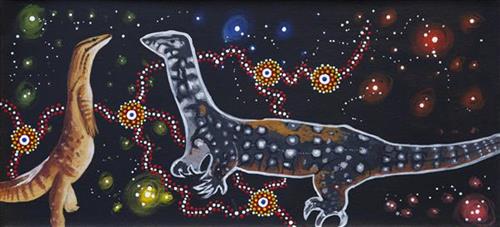
“When we was little kids, used to tell us this story. It was told by many generations – repeated. We still tell it today. One place to another, they keep on going. This one only we know – kids form the 80’s or 90’s. We grew up on the story, I’m bringing it back. White people have three little pigs, we have this one:
So in the beginning there was this black goanna called yalpara. He was plain black, no colour and he was looking at himself in the reflection of the water… “I’m not pretty enough!” He wanted to look good.
He came across this goanna and asked him for a favour – “if you could paint my back I can paint you black.” So, goanna did all the dots very unique, concentrating closely to the design. When yalpara looked into the reflection he said “oh he did a good job!”
Goanna gave yalpara the stick and said “paint me,” but yalpara was in a hurry so he just scribbled on his back. Yalpara didn’t do a good job, he just scribbled on his back. And that’s how the Yalpara got his spots.
– Owen John Biljabu
The term Jukurrpa is often translated in English as the ‘dreaming’, or ‘dreamtime’. In this case, Nyirti Jukurrpa can be understood in English as children’s stories, nyirti meaning ‘the littlest one’ in Martu language. Jukurrpa refers generally to the period in which the world was created by ancestral beings, who assumed both human and nonhuman forms. These beings shaped what had been a formless landscape; creating waters, plants, animals, and people. At the same time they provided cultural protocols for the people they created, as well as rules for interacting with the natural environment. At their journey’s end, the ancestral beings transformed themselves into important waters, hills, rocks, and even constellations.
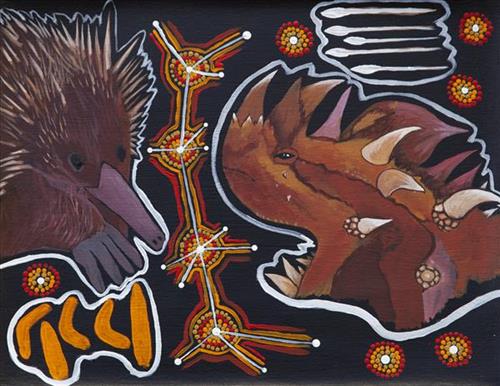
“When we was little kids, used to tell us this story. It was told by many generations – repeated. We still tell it today. One place to another, they keep on going. This one only we know – kids form the 80’s or 90’s. We grew up on the story, I’m bringing it back. White people have three little pigs, we have this one. They had a big fight. The echidna (minguwa) had no spikes. The lizard (kata puta) had no crown. The lizard had thousands of spears (kurlata). Echidna had a baton (jurna). He hit him really hard and that is why he got a big lump on him. So he threw all the spears really quickly and he got all the spikes on him”
– Owen John Biljabu
The term Jukurrpa is often translated in English as the ‘dreaming’, or ‘dreamtime’. In this case, Nyirti Jukurrpa can be understood in English as children’s stories, nyirti meaning ‘the littlest one’ in Martu language. Jukurrpa refers generally to the period in which the world was created by ancestral beings, who assumed both human and nonhuman forms. These beings shaped what had been a formless landscape; creating waters, plants, animals, and people. At the same time they provided cultural protocols for the people they created, as well as rules for interacting with the natural environment. At their journey’s end, the ancestral beings transformed themselves into important waters, hills, rocks, and even constellations.
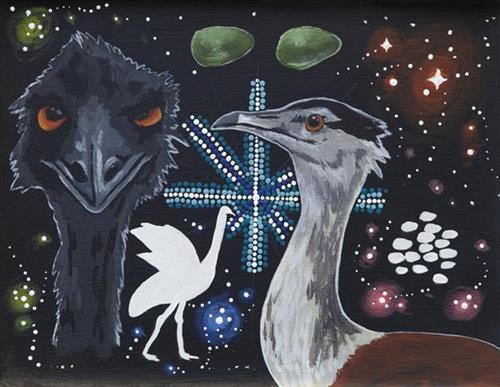
“When we was little kids, used to tell us this story. It was told by many generations – repeated. We still tell it today. One place to another, they keep on going. This one only we know – kids form the 80’s or 90’s. We grew up on the story, I’m bringing it back. White people have three little pigs, we have this one:
In the beginning like in the dreamtime the emu (karlaya) was the biggest flying bird. One day turkey (kipara) came across and saw him and he got jealous – he wanted to be the biggest bird flying. So he was thinking how I gonna make him cut off his wings. He make a little trick on him, Turkey folded his arms to make him look like wings. ‘look I can run really fast, cut off your wings they make you slow!’ Showing off saying ‘I can run, see,’ running around. Emu believed him.. ‘Okay, I’ll copy you,’ so he cut himself. He cut his wings off.
One day, Emu saw Turkey and he saw that he still had his wings so he figured out that he tricked him… Turkey didn’t see emu, so he was thinking ‘I’ve got to trick him back’ because he already cut off his wings. He told Emu, if you only have 2 eggs it’s make your life more easy. Back then Turkey had more eggs than emu. So emu showed him that if you have two eggs you don’t have to work, only have to look after two. So he made the Turkey bust all his eggs – one or two left… and that’s why he make only one or two eggs. The oldest kids story.”
– Owen John Biljabu
The term Jukurrpa is often translated in English as the ‘dreaming’, or ‘dreamtime’. In this case, Nyirti Jukurrpa can be understood in English as children’s stories, nyirti meaning ‘the littlest one’ in Martu language. Jukurrpa refers generally to the period in which the world was created by ancestral beings, who assumed both human and nonhuman forms. These beings shaped what had been a formless landscape; creating waters, plants, animals, and people. At the same time they provided cultural protocols for the people they created, as well as rules for interacting with the natural environment. At their journey’s end, the ancestral beings transformed themselves into important waters, hills, rocks, and even constellations.
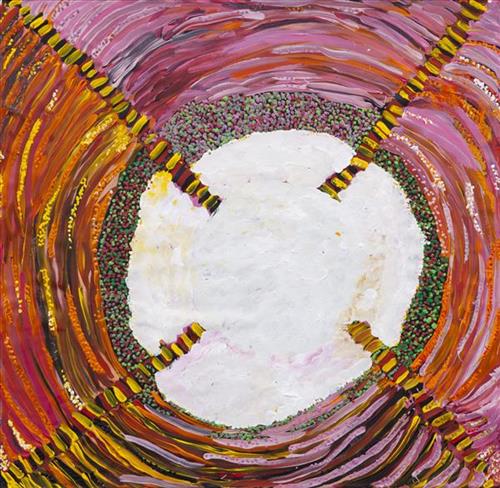
“Savoury Creek, near Jigalong. Pigs and kangaroos and bullock. Water other side, rain water other side – its flat old Mundawindi this side. We been there a lot of times, take the kids out for holiday. Careful of the pigs! Mummy, daddy look after you – big pigs – cheeky ones. Still there is some [pigs] but might be shooting. Same creek on the other side, no crocodiles just rain water. People from Newman go there with boats, they fish. Might be dry now, palya. It’s good now.” – Helen Dale Samson Kupayura (Kupayiyura, Savory Creek) is a creek located between the Little Sandy and Gibson Deserts of Western Australia that drains into the south western end of Kumpupirntily (Kumpupintily, Lake Disappointment). Kupayura features in the Martu Ngayurnangalku (ancestral cannibal beings) Jukurrpa (Dreaming). The Ngayurnangalku are said to resemble people in their appearance, except for their fangs and the long, curved, knife like fingernails they use to catch and hold their human victims. These beings continue to live beneath the crust of Kumpupirntily in an underground world lit by their own sun, and surface only to feed on human flesh. The Ngayurnangalku stopped at Kupayura as they journeyed to Kumpupirntily for an important meeting during the Jukurrpa. At Kupayura and in their journey through to Kumpupirntily they created many soaks as they urinated along the way. Despite their origins, these soaks are sources of good drinking water.