

377810582148391
Bolung
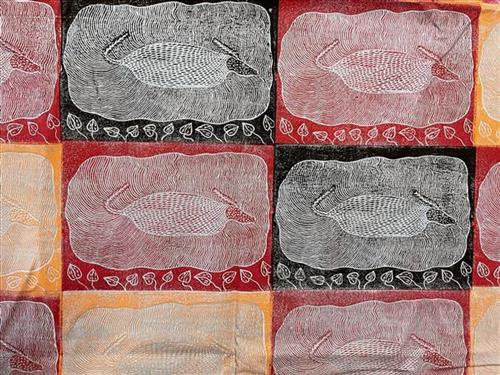
Bolung (Rainbow Serpent) is from the sacred country of Dukala- Djarranj. This is the country of Jay’s grandparent and a place of great significance, as Bolung, the Rainbow Serpent, travelled through the landscape. Rock art in the area depicts a rotund Bolung.

377810582148389
Jin-merduwa and Dolphin
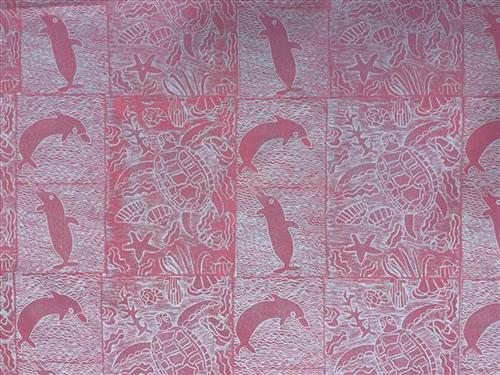
A beautiful, one-off, linocut, hand printed design by Elizabeth Wullunmingu depicting the story of Jin-merduwa. Sometimes she also includes her Garriwa turtle print.
My niece, Stephanie James, is singing a song called Diyama, and it is about Jin-merduwa. She is in the Ripple Effect Band. They are now famous in Maningrida and everywhere. Her great grandmother told her about the Jin-merduwa living at Gupanga. I heard the story before Stephanie. Now I hear her singing the story about that place. I am very proud of her. We have the same country. Our stories match. She is singing the story, and I am making artwork about the story.
My lino print shows the Jin-merduwa who live at Gupanga. Gupanga is located at the mouth of the Blyth River. It is a saltwater place. There must be more than one Jin-merduwa living there? They eat fish, shellfish and seaweed. Sometimes they travel to the end of the river to find food in the ocean, but they don’t go far and always swim back to their home.
Gupanga is a beautiful place. The sand is golden, there are mangroves, and the water is cloudy. It is good hunting in that area. When we lived there, we got lots of barramundi, mud crabs, shellfish, everything!
This is a bit of a dangerous story. I can’t say too much about this sacred place. The Rangers help to look after this place, but they also know they must be careful.
Kuninjku people call mermaids yawkyawk. Yawkyawk are freshwater. In my language, Burarra, we call mermaids Jin-merduwa. Jin-merduwa are a bit different to yawkyawk but are also a type of mermaid.
I love to make lino print fabric showing Jin-merduwa. I like using bright colours, but sometimes I print using black and white.
Ripple Effect Band – Diyama Song
https://rippleeffectband.bandcamp.com/track/diyama
This song was written by Stephanie James in her language of Burarra. It is about the mermaids that live in the river in her country of Kupanga.
Her father sings the Kun-borrk traditional music from the Diyama song cycle to link his daughter’s music to the past.
Credits
from Wárrwarra, released July 5, 2018
Written by Stephanie James, D. Maxwell (father for Stephanie)
Produced by Paul Mac, Jodie Kell, Clint Bracknell
Audio Engineer: Campbell Barnes
Guitar: Jodie Kell, Jolene Lawrence
Bass guitar: Tara Rostron
Drums: Jolene Lawrence
Keys: Patricia Gibson
Lead Vocals: Stephanie James
Back up Vocals: Jodie Kell
Diyama vocals: D. Maxwell
A beautiful, one-off, linocut, hand printed design by Elizabeth Wullunmingu depicting the story of Jin-merduwa. Sometimes she also includes her turtle print.

377810582148387
Djomi
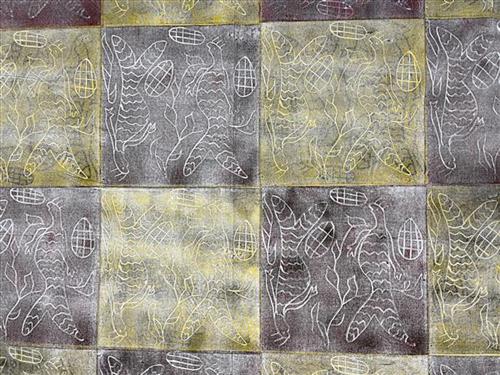
This design depicts the story of the artist’s ancestral dreaming, the Djomi fresh water spirit mermaid.
The Djomi figure is a mermaid like spirit with fish tail that lives in the fresh water stream that flows out to the sea cliff near Maningrida. Djomi is a known to be a very powerful fertility symbol.
‘If you go there you can get pregnant easily. Djomi has babies, and they can give others babies too. The Djomi spirit is so powerful, that women can end up with multiple babies at once, twins or sometimes even more. The Djomi spirits lay eggs near the sacred freshwater stream in Maningrida. Inside the eggs are human babies as well as young Djomi.
Men do not go near that swamp, because Djomi is so powerful that men might get pregnant there too. So men, they are too scared of that Djomi. When we visit the Djomi freshwater spring, we can hear young Djomi crying. They sound like normal babies crying, those Djomi spirits. They are looking for a mother.
This Djomi is my dreaming, I got permission from my djunguys to paint this Djomi design. For me I always ask my djunguy permission to paint, because that is our cultural way.
This design also depicts the fresh water lily leaves, and seaweed from the base of the sea floor.

377810582148386
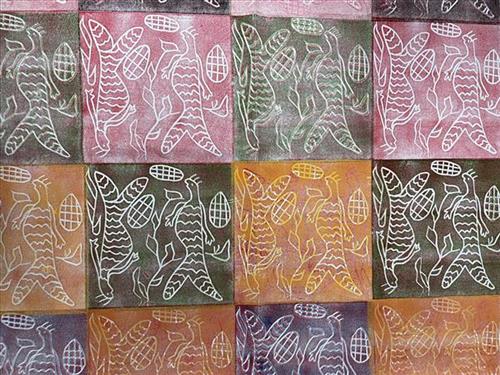
Djomi
This design depicts the story of the artist’s ancestral dreaming, the Djomi fresh water spirit mermaid.
The Djomi figure is a mermaid like spirit with fish tail that lives in the fresh water stream that flows out to the sea cliff near Maningrida. Djomi is a known to be a very powerful fertility symbol.
‘If you go there you can get pregnant easily. Djomi has babies, and they can give others babies too. The Djomi spirit is so powerful, that women can end up with multiple babies at once, twins or sometimes even more. The Djomi spirits lay eggs near the sacred freshwater stream in Maningrida. Inside the eggs are human babies as well as young Djomi.
Men do not go near that swamp, because Djomi is so powerful that men might get pregnant there too. So men, they are too scared of that Djomi. When we visit the Djomi freshwater spring, we can hear young Djomi crying. They sound like normal babies crying, those Djomi spirits. They are looking for a mother.
This Djomi is my dreaming, I got permission from my djunguys to paint this Djomi design. For me I always ask my djunguy permission to paint, because that is our cultural way.
This design also depicts the fresh water lily leaves, and seaweed from the base of the sea floor.

377810582148384
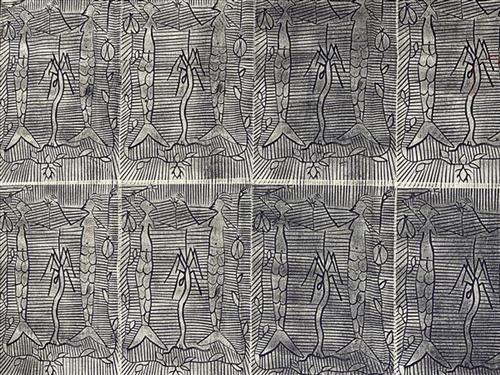
Djomi
This design depicts the story of the artist’s ancestral dreaming, the Djomi fresh water spirit mermaid.
The Djomi figure is a mermaid like spirit with fish tail that lives in the fresh water stream that flows out to the sea cliff near Maningrida. Djomi is a known to be a very powerful fertility symbol.
‘If you go there you can get pregnant easily. Djomi has babies, and they can give others babies too. The Djomi spirit is so powerful, that women can end up with multiple babies at once, twins or sometimes even more. The Djomi spirits lay eggs near the sacred freshwater stream in Maningrida. Inside the eggs are human babies as well as young Djomi.
Men do not go near that swamp, because Djomi is so powerful that men might get pregnant there too. So men, they are too scared of that Djomi. When we visit the Djomi freshwater spring, we can hear young Djomi crying. They sound like normal babies crying, those Djomi spirits. They are looking for a mother.
This Djomi is my dreaming, I got permission from my djunguys to paint this Djomi design. For me I always ask my djunguy permission to paint, because that is our cultural way.
This design also depicts the fresh water lily leaves, and seaweed from the base of the sea floor.

377810582148383
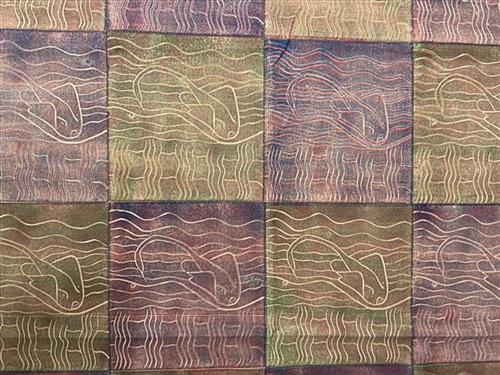
Stingray

377810582148380
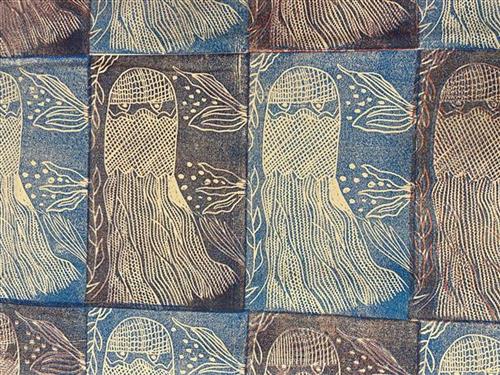
Mábbarla (Jelly Fish)

377810582148378
Jin-merduwa
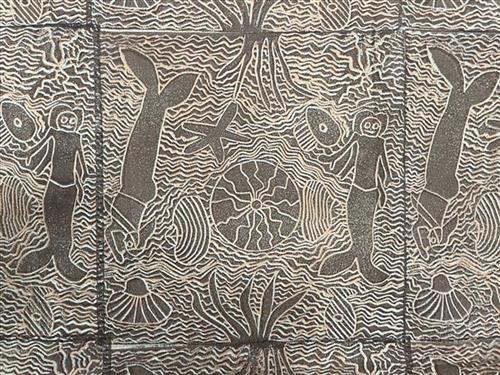
A beautiful, one-off, linocut, hand printed design by Elizabeth Wullunmingu depicting the story of Jin-merduwa. Sometimes she also includes her Garriwa turtle print.
My niece, Stephanie James, is singing a song called Diyama, and it is about Jin-merduwa. She is in the Ripple Effect Band. They are now famous in Maningrida and everywhere. Her great grandmother told her about the Jin-merduwa living at Gupanga. I heard the story before Stephanie. Now I hear her singing the story about that place. I am very proud of her. We have the same country. Our stories match. She is singing the story, and I am making artwork about the story.
My lino print shows the Jin-merduwa who live at Gupanga. Gupanga is located at the mouth of the Blyth River. It is a saltwater place. There must be more than one Jin-merduwa living there? They eat fish, shellfish and seaweed. Sometimes they travel to the end of the river to find food in the ocean, but they don’t go far and always swim back to their home.
Gupanga is a beautiful place. The sand is golden, there are mangroves, and the water is cloudy. It is good hunting in that area. When we lived there, we got lots of barramundi, mud crabs, shellfish, everything!
This is a bit of a dangerous story. I can’t say too much about this sacred place. The Rangers help to look after this place, but they also know they must be careful.
Kuninjku people call mermaids yawkyawk. Yawkyawk are freshwater. In my language, Burarra, we call mermaids Jin-merduwa. Jin-merduwa are a bit different to yawkyawk but are also a type of mermaid.
I love to make lino print fabric showing Jin-merduwa. I like using bright colours, but sometimes I print using black and white.
Ripple Effect Band – Diyama Song
https://rippleeffectband.bandcamp.com/track/diyama
This song was written by Stephanie James in her language of Burarra. It is about the mermaids that live in the river in her country of Kupanga.
Her father sings the Kun-borrk traditional music from the Diyama song cycle to link his daughter’s music to the past.
Credits
from Wárrwarra, released July 5, 2018
Written by Stephanie James, D. Maxwell (father for Stephanie)
Produced by Paul Mac, Jodie Kell, Clint Bracknell
Audio Engineer: Campbell Barnes
Guitar: Jodie Kell, Jolene Lawrence
Bass guitar: Tara Rostron
Drums: Jolene Lawrence
Keys: Patricia Gibson
Lead Vocals: Stephanie James
Back up Vocals: Jodie Kell
Diyama vocals: D. Maxwell
A beautiful, one-off, linocut, hand printed design by Elizabeth Wullunmingu depicting the story of Jin-merduwa. Sometimes she also includes her turtle print.

377810582148377

Jin-merduwa (Mermaid)
Elizabeth Wullunmingu – Jin-merduwa (Mermaid) from Gupanga
My niece, Stephanie James is singing a song called Diyama and it is about Jin-merduwa. She is in the Ripple Effect Band. They are now famous in Maningrida and everywhere. Her great grandmother told her about the Jin-merduwa living at Gupanga/ Kupanga (sp?). I heard the story before Stephanie. Now I hear her singing the story about that place. I am very proud of her. We have the same country. Our stories match. She is singing the story and I am making artwork about the story.
My lino print shows the Jin-merduwa who live at Gupanga. Gupanga is located at the mouth of the Blyth River. It is a saltwater place. There must be more than one Jin-merduwa living there? They eat fish, shellfish and seaweed. Sometimes they travel to the end of the river to find food in the ocean, but they don’t go far and always swim back to their home.
Gupanga is a beautiful place. The sand is golden, there are mangroves, and the water is cloudy. It is good hunting in that area. When we lived there, we got lots of barramundi, mudcrabs, shellfish, everything!
This is a bit of a dangerous story. I can’t say too much about this sacred place. The Rangers help to look after this place, but they also know they must be careful.
Kuninjku people call mermaids yawkyawk. Yawkyawk are freshwater. In my language, Burarra we call them Jin-merduwa. Jin-merduwa are a bit different to yawkyawk but are also a type of mermaid.
I love to make lino print fabric showing Jin-merduwa. I like using bright colours but sometimes I print using black and white.
Ripple Effect Band – Diyama Song
https://rippleeffectband.bandcamp.com/track/diyama
This song was written by Stephanie James in her language of Burarra. It is about the mermaids that live in the river at her country of Kupanga.
Her father sings the Kun-borrk traditional music from the Diyama song cycle to link his daughter’s music to the past.
Credits
from Wárrwarra, released July 5, 2018
Written by Stephanie James, D. Maxwell (father for Stephanie)
Produced by Paul Mac, Jodie Kell, Clint Bracknell
Audio Engineer: Campbell Barnes
Guitar: Jodie Kell, Jolene Lawrence
Bass guitar: Tara Rostron
Drums: Jolene Lawrence
Keys: Patricia Gibson
Lead Vocals: Stephanie James
Back up Vocals: Jodie Kell
Diyama vocals: D. Maxwell