377810582144591


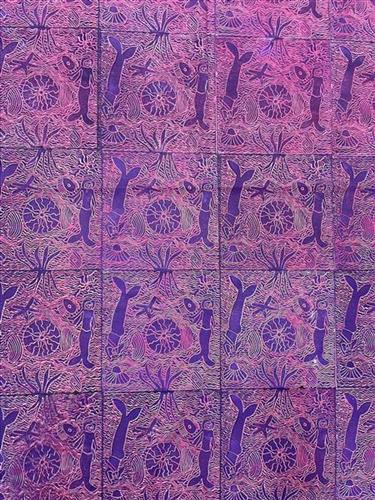
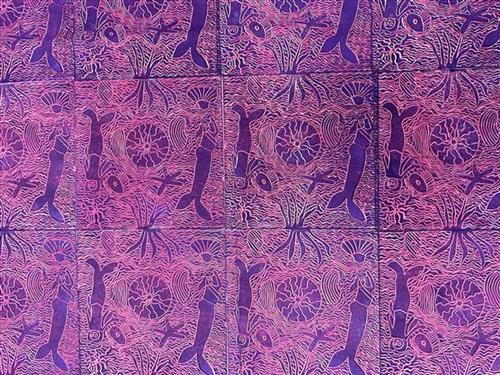
Jin-merduwa (Mermaid) – Elizabeth Wullunmingu

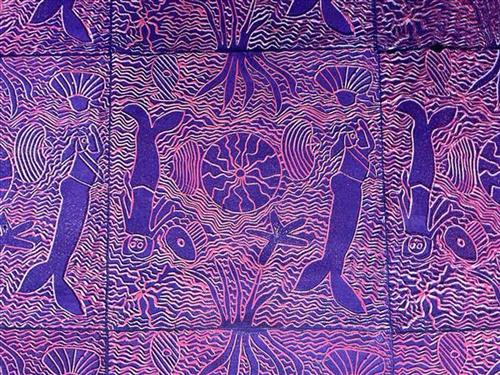
Jin-merduwa (Mermaid) from Gupanga

My niece, Stephanie James is singing a song called Diyama and it is about Jin-merduwa. She is in the Ripple Effect Band. They are now famous in Maningrida and everywhere. Her great grandmother told her about the Jin-merduwa living at Gupanga/ Kupanga (sp?).  I heard the story before Stephanie.  Now I hear her singing the story about that place.  I am very proud of her. We have the same country.  Our stories match.  She is singing the story and I am making artwork about the story. 

My lino print shows the Jin-merduwa who live at Gupanga.  Gupanga is located at the mouth of the Blyth River.  It is a saltwater place.  There must be more than one Jin-merduwa living there?  They eat fish, shellfish and seaweed.  Sometimes they travel to the end of the river to find food in the ocean, but they don’t go far and always swim back to their home.

Gupanga is a beautiful place.  The sand is golden, there are mangroves, and the water is cloudy.  It is good hunting in that area.  When we lived there, we got lots of barramundi, mudcrabs, shellfish, everything!

This is a bit of a dangerous story.  I can’t say too much about this sacred place. The Rangers help to look after this place, but they also know they must be careful.   

Kuninjku people call mermaids yawkyawk.  Yawkyawk are  freshwater.  In my language, Burarra we call them Jin-merduwa.  Jin-merduwa are a bit different to yawkyawk but are also a type of mermaid.

I love to make lino print fabric showing Jin-merduwa. I like using bright colours but sometimes I print using black and white.

Ripple Effect Band – Diyama Song

https://rippleeffectband.bandcamp.com/track/diyama

This song was written by Stephanie James in her language of Burarra. It is about the mermaids that live in the river at her country of Kupanga.


Her father sings the Kun-borrk traditional music from the Diyama song cycle to link his daughter’s music to the past.

Credits

from Wárrwarra, released July 5, 2018
Written by Stephanie James, D. Maxwell (father for Stephanie)
Produced by Paul Mac, Jodie Kell, Clint Bracknell
Audio Engineer: Campbell Barnes
Guitar: Jodie Kell, Jolene Lawrence
Bass guitar: Tara Rostron
Drums: Jolene Lawrence
Keys: Patricia Gibson
Lead Vocals: Stephanie James
Back up Vocals: Jodie Kell
Diyama vocals: D. Maxwell
111982144483


Kunkurra (The Spiralling Wind)

‘Kunkurra’, the spiralling wind is associated with several sites in the Kardbam clan estate. On one level, this painting can be interpreted as a depiction of the kinds of mini-cyclones common during the wet season in Arnhem Land, where the artist lives. In this painting, Kunkurra also relates specifically to a site called Bilwoyinj, near Mankorlod.

At this site, two of the most important Kuninjku creation beings, a father and son known as na-korrkko, are believed to have hunted and eaten a goanna. They left some of the goanna fat behind at the site, which turned into the rock that still stands there today. The word Bilwoyinj, which is the name of this site, also refers to the fat of the goanna. Bilwoyinj site is also a ceremonial ground for a ceremony called Yabbaduruwa, a major ceremony owned by the Yirridja patrimoiety. The Yabbaduruwa ceremony is primarily concerned with initiation, land ownership and promoting the cyclical regeneration of the human and natural worlds.

111982144473


Clapsticks

Clapsticks are carved from ironwood and are made to accompany the didjeridu, used for ceremony and dancing. The distinctive sound of the clapsticks can be heard played ceaselessly into the night to honour the funeral rites of Aboriginal people in Arnhem Land. Arnhem Land and the Top End of the Northern Territory is the traditional home of the didjeridu, the only wind instrument of the Aborigines.

111982144472


Clapsticks

Clapsticks are carved from ironwood and are made to accompany the didjeridu, used for ceremony and dancing. The distinctive sound of the clapsticks can be heard played ceaselessly into the night to honour the funeral rites of Aboriginal people in Arnhem Land. Arnhem Land and the Top End of the Northern Territory is the traditional home of the didjeridu, the only wind instrument of the Aborigines.

111982144471


Clapsticks

Clapsticks are carved from ironwood and are made to accompany the didjeridu, used for ceremony and dancing. The distinctive sound of the clapsticks can be heard played ceaselessly into the night to honour the funeral rites of Aboriginal people in Arnhem Land. Arnhem Land and the Top End of the Northern Territory is the traditional home of the didjeridu, the only wind instrument of the Aborigines.

111982144470


Clapsticks

Clapsticks are carved from ironwood and are made to accompany the didjeridu, used for ceremony and dancing. The distinctive sound of the clapsticks can be heard played ceaselessly into the night to honour the funeral rites of Aboriginal people in Arnhem Land. Arnhem Land and the Top End of the Northern Territory is the traditional home of the didjeridu, the only wind instrument of the Aborigines.

111982144469


Clapsticks

Clapsticks are carved from ironwood and are made to accompany the didjeridu, used for ceremony and dancing. The distinctive sound of the clapsticks can be heard played ceaselessly into the night to honour the funeral rites of Aboriginal people in Arnhem Land. Arnhem Land and the Top End of the Northern Territory is the traditional home of the didjeridu, the only wind instrument of the Aborigines.

111982144468


Clapsticks

Clapsticks are carved from ironwood and are made to accompany the didjeridu, used for ceremony and dancing. The distinctive sound of the clapsticks can be heard played ceaselessly into the night to honour the funeral rites of Aboriginal people in Arnhem Land. Arnhem Land and the Top End of the Northern Territory is the traditional home of the didjeridu, the only wind instrument of the Aborigines.