Status: Stock
Enamel Pin designer Joanne Wheeler
Design by Joanne Wheeler
Status: Stock
Design by Joanne Wheeler
Status: Stock
Design by Joanne Wheeler

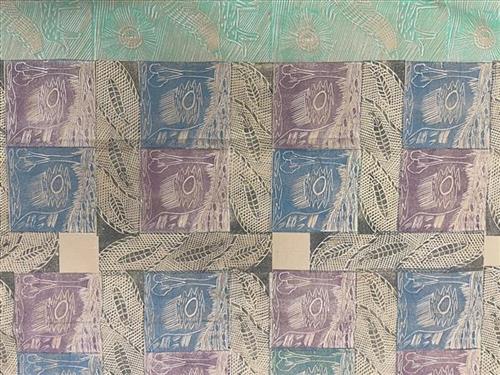
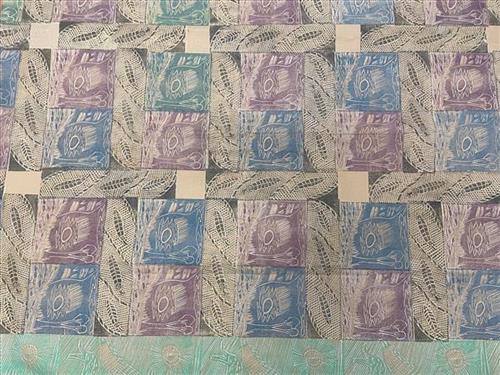
Kunred in Kuninjku is also home, place, country, ‘hearth’, living area. Janet has illustrated the rocks and landscape around Mankorlod outstation where she lived from the age of 14 as a young married women. Janet has fond memories of the country and the stories and history is captured in her Lino design.
This design also depicts Janet’s djang (ancestral dreaming story) of Rolk (maggot).

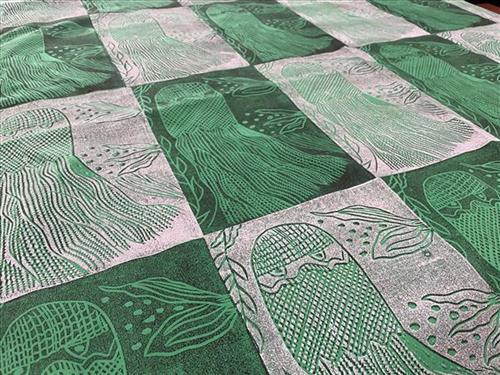
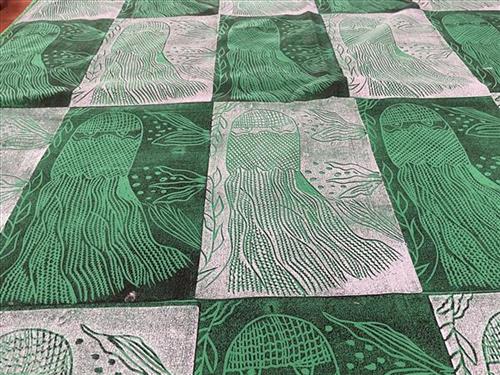
Mábbarla means Jelly Fish in Joy’s language of Ndjebbana.

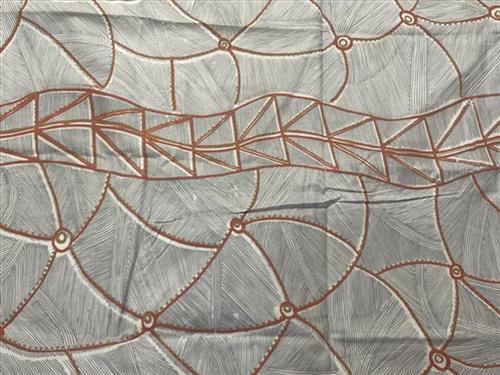
‘My designs, they are all alive living up in my head’- Janet Marawarr
Janet Marawarr has depicted kunkurra, the spiralling wind associated with several sites in the Kardbam clan. On one level, this design can be interpreted as a depiction of the kinds of mini-cyclones common during the wet season in Arnhem Land, where the artist lives. Kunkurra also relates specifically to a site called Bilwoyinj, near Mankorlod, on the artist’s clan estate.
At this site, two of the most important Kuninjku creation beings, a father and son known as na-korrkko, are believed to have hunted and eaten a goanna. They left some of the goanna fat behind at the site, which turned into the rock that still stands there today.
Bilwoyinj site is also a ceremonial ground for a ceremony called Yabbaduruwa, a major ceremony owned by the Yirridja patrimoiety. The Yabbaduruwa ceremony is primarily concerned with initiation, land ownership and promoting the cyclical regeneration of the human and natural worlds.

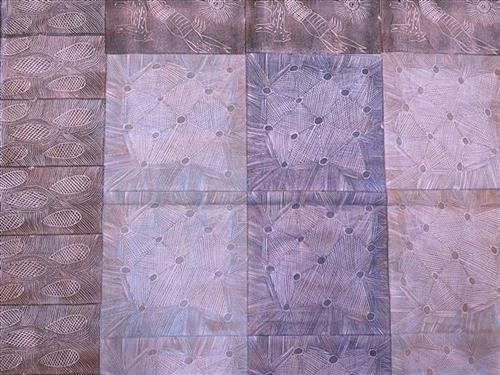
‘My designs, they are all alive living up in my head’- Janet Marawarr
Janet Marawarr has depicted kunkurra, the spiralling wind associated with several sites in the Kardbam clan. On one level, this design can be interpreted as a depiction of the kinds of mini-cyclones common during the wet season in Arnhem Land, where the artist lives. Kunkurra also relates specifically to a site called Bilwoyinj, near Mankorlod, on the artist’s clan estate.
At this site, two of the most important Kuninjku creation beings, a father and son known as na-korrkko, are believed to have hunted and eaten a goanna. They left some of the goanna fat behind at the site, which turned into the rock that still stands there today.
Bilwoyinj site is also a ceremonial ground for a ceremony called Yabbaduruwa, a major ceremony owned by the Yirridja patrimoiety. The Yabbaduruwa ceremony is primarily concerned with initiation, land ownership and promoting the cyclical regeneration of the human and natural worlds.

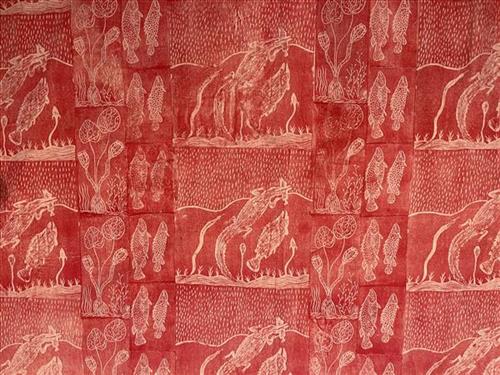
‘This is a true story. My great great grandfather and my father told this story and I tell it to my children. It’s about a freshwater crocodile called Modjarrkki. One day an unmarried man who was camping with his brother and his brothers wife went walking by himself. He came to a creek where he found a crocodile. He went back to camp and said to his brother ‘hey I found a croc, lets go kill it!’. He tried to kill the crocodile but the crocodile bit his brother. He bit his guts, his hand, his legs and he died. Modjarrkki was an angry crocodile but today Modjarkki doesn’t bite people, he’s only a little crocodile and he eats barramundi. He is still alive and he lives in rock country, Karrabarda, which is in Gorlobidahdah.’ Jay Rostron Jurrupula

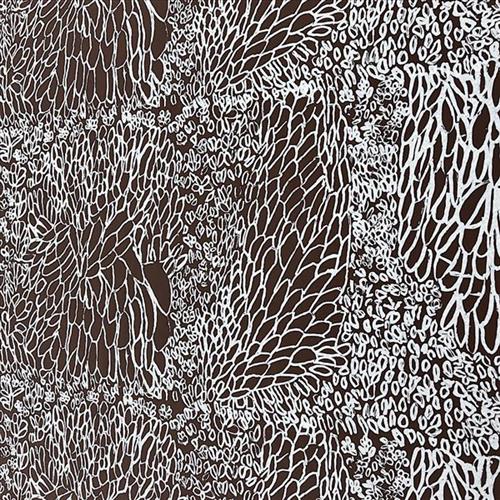
This design depicts the patterns of the freshwater mud ripples, which emerge after strong monsoonal wet seasons on the Djinkarr and Nangak flood plains.
These ripples form on the earth’s surface in delicate repetitive and shifting patterns. The mud ripples move, crack, disappear and re-emerge in response to the changing wind, rains and new sun.
The mud ripples depicted in this design are on Elizabeth’s homeland, the Djinkarr and Nangak floodplains south of Maningrida in Arnhem Land.

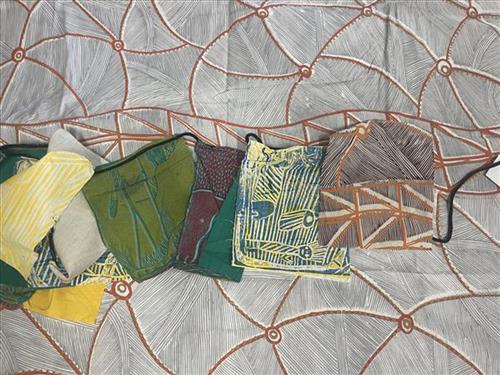
Sewn at Babbarra Designs by Elmara Campion. Various fabric designs used.

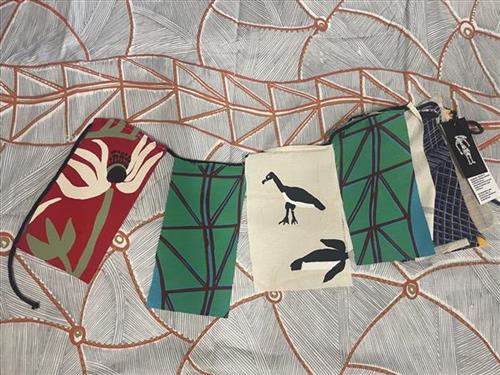
Sewn at Babbarra Designs by Elmara Campion. Various fabric designs used.