377810582132996


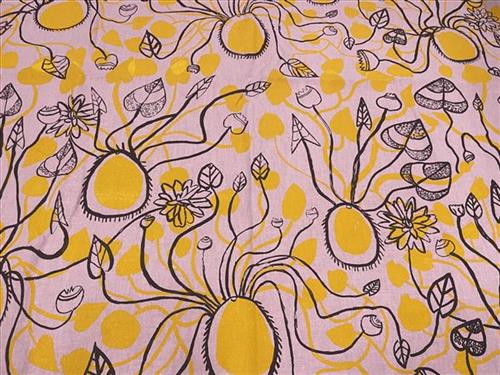
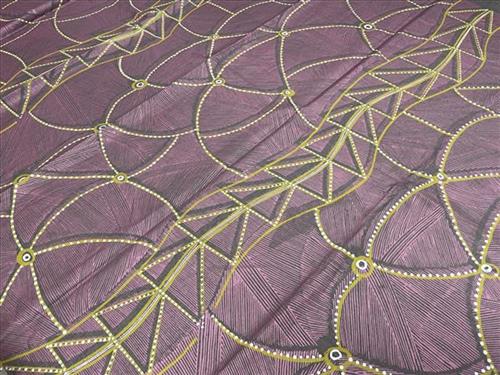
Kunkurra

‘My designs, they are all alive living up in my head’- Janet Marawarr

Janet Marawarr has depicted kunkurra, the spiralling wind associated with several sites in the Kardbam clan. On one level, this design can be interpreted as a depiction of the kinds of mini-cyclones common during the wet season in Arnhem Land, where the artist lives. Kunkurra also relates specifically to a site called Bilwoyinj, near Mankorlod, on the artist’s clan estate.

At this site, two of the most important Kuninjku creation beings, a father and son known as na-korrkko, are believed to have hunted and eaten a goanna. They left some of the goanna fat behind at the site, which turned into the rock that still stands there today.

Bilwoyinj site is also a ceremonial ground for a ceremony called Yabbaduruwa, a major ceremony owned by the Yirridja patrimoiety. The Yabbaduruwa ceremony is primarily concerned with initiation, land ownership and promoting the cyclical regeneration of the human and natural worlds.

377810582132994


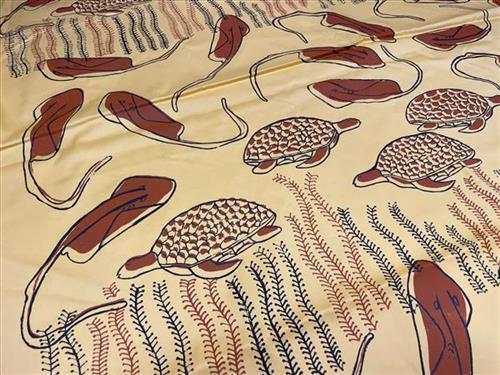
Mabbúlarr

Mabbúlarr is the Ndjébbana word describing calm and stillness – both regarding people and the ocean.

This design tells the story of underwater life in the shallows. The turtle we call marláddja (green turtle, Chelonia mydas) and the stingray we call marnandjúbba (Cowtail Stingray, Pastinachus sephen).

‘When strong wind blows the sea is rough, when there’s no wind the sea is calm. We call that mábbularr. You can see through the water and look at the turtle and stingray eating karlómerr (sea grass) and dancing underwater to find their mate. When we go on the boat hunting, we go at times of mábbularr.

In the old days men used to hunt with a canoe and with traditional made harpoon.  Guided by our ancestors’ spirits they would paddle all day to find sea turtle and dugongs in the right places. The men had to be smart for the tide and know the weather to balance their canoes. They would go at times of mábbularr (calm), early morning in daytime or at night-time when there is no moon and the water glows. We call the night-time glimmer of phosphorescence mílarrng-milarrng. Today people still go hunting, it brings a lot of families together and they share eating down the beach.

We have songline for sea turtle, also men paint turtle on their back and dance turtle in the Míddjarn the same way turtle dance underwater. It is very important we look after our country and songline passed on from many generations’. Josephine James 2021

377810582132981


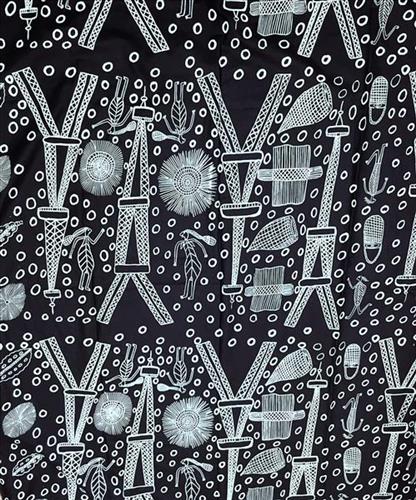
Eiffel tower and the Maladj spirit

“I want to tell you about my design, that Eiffel tower one.

This year it was my first time going to Paris. I didn’t know that place, nothing. We travelled around the world to get there, we flew underneath the world in an aeroplane.

Paris was a big, crowded city. They speak a different language there, just like here in Maningrida with all our different languages.

The Bábbarra artists and Ingrid, we were all walking around, like tourists. We went on the boat in the Paris river. There was a film crew taking videos of us. We saw so many beautiful buildings covered with black string (iron balconies) and big statues. We’d never seen things like that before.

I remember when we got off that boat and I looked up and saw that tower. When I first looked up at that tower, it made me happy- it’s so long up into the sky. We walked towards it. I was standing there watching that tower and thinking, ‘wow, first time for me seeing a tower like that’.

Then I was thinking, and I said to myself, when I go back to my own country, I’m going to paint that tower.

We came to Maningrida, I started to draw. I drew that tower from France, but also I drew maladj (stone country orphan spirit), women’s sacred woven mat, fish traps and rolk (insects). I also put round kunngol (clouds) in the design, those circles. That maladj spirit, it’s standing there next to the Eiffel tower, looking at the dancing lights at night. The tower is from Paris, but everything else in my design I took from my mother’s country and my father’s country.

Maybe one day I’ll travel back to France, and take my design with me to show them, all the French mob.” Janet Marawarr

377810582132943


Wayuk

‘I always follow the footpath of my grandmother. I have too many stories of my grandmother. We went to the bush and ate bushtucker like yam, yabbie, barra, catfish and magpie goose. We didn’t come into town often, we were staying at Barrihdjowkkeng outstation. I learned how the old people used to live. I always think about my family out there and I keep going. My grandmother asked me to work with her for many years. I watched her making lino and screen printing. That’s why I stay in this job and I’m for the women’s centre’.  Roseanna Bonson 2021

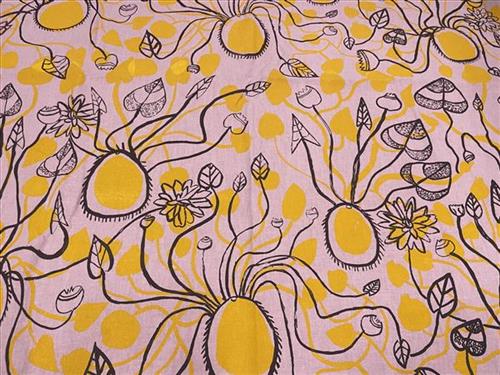
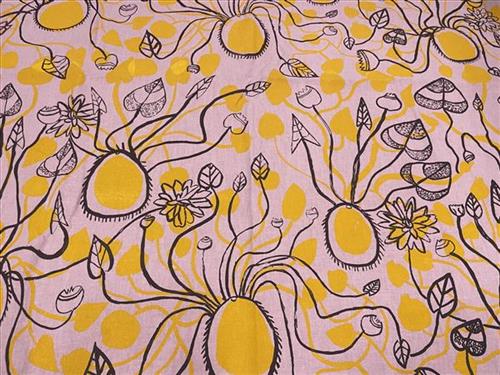
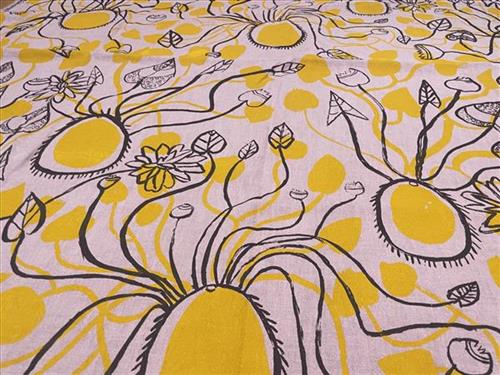
Roseanna’s first design is a 2 colour waterlily design. Wayuk (waterlily) *kuninjki grow in the swamps around Barrihdjowkkeng.

‘The flowers of the waterlily are white and yellow and I like that kind of colour.’ Roseanna Bonson 2021

377810582132947


Wayuk

‘I always follow the footpath of my grandmother. I have too many stories of my grandmother. We went to the bush and ate bushtucker like yam, yabbie, barra, catfish and magpie goose. We didn’t come into town often, we were staying at Barrihdjowkkeng outstation. I learned how the old people used to live. I always think about my family out there and I keep going. My grandmother asked me to work with her for many years. I watched her making lino and screen printing. That’s why I stay in this job and I’m for the women’s centre’.  Roseanna Bonson 2021

Roseanna’s first design is a 2 colour waterlily design. Wayuk (waterlily) *kuninjki grow in the swamps around Barrihdjowkkeng.

‘The flowers of the waterlily are white and yellow and I like that kind of colour.’ Roseanna Bonson 2021

377810582132945


Wayuk

‘I always follow the footpath of my grandmother. I have too many stories of my grandmother. We went to the bush and ate bushtucker like yam, yabbie, barra, catfish and magpie goose. We didn’t come into town often, we were staying at Barrihdjowkkeng outstation. I learned how the old people used to live. I always think about my family out there and I keep going. My grandmother asked me to work with her for many years. I watched her making lino and screen printing. That’s why I stay in this job and I’m for the women’s centre’.  Roseanna Bonson 2021

Roseanna’s first design is a 2 colour waterlily design. Wayuk (waterlily) *kuninjki grow in the swamps around Barrihdjowkkeng.

‘The flowers of the waterlily are white and yellow and I like that kind of colour.’ Roseanna Bonson 2021

377810582132944


Wayuk

‘I always follow the footpath of my grandmother. I have too many stories of my grandmother. We went to the bush and ate bushtucker like yam, yabbie, barra, catfish and magpie goose. We didn’t come into town often, we were staying at Barrihdjowkkeng outstation. I learned how the old people used to live. I always think about my family out there and I keep going. My grandmother asked me to work with her for many years. I watched her making lino and screen printing. That’s why I stay in this job and I’m for the women’s centre’.  Roseanna Bonson 2021

Roseanna’s first design is a 2 colour waterlily design. Wayuk (waterlily) *kuninjki grow in the swamps around Barrihdjowkkeng.

‘The flowers of the waterlily are white and yellow and I like that kind of colour.’ Roseanna Bonson 2021

377810582132788


Gunga (Pandanus)

Gunga refers to the weaving and production of goods from pandanus leaves and natural fibres. This design depicts fibre art from her homeland Galiwinku, Elcho Island.

The fish trap, basket, string bag and pandanus mats are objects as well as ancestral spirits and are significant to the artists as together they relate to her djang (Aboriginal religious belief).

Fish traps are woven by hand using the milirl (Burney vine, Trophis scandens) from the jungle, which is soaked overnight to make it soft. Fish traps are used by both saltwater and freshwater hunters. Baskets and pandanus mats are made from pandanus leaves, which are collected using long hooks, stripped, dried, boiled in natural dye, then woven.

377810582132787


Sea Shells and Dilly Bags

‘Sometimes when we go down to the beach in Maningrida we pick all these shells up. Some family make necklaces and earrings. In the olden days they used to collect shells and put them in the dilly bags. The old people used to carry dilly bags when they went hunting. They used the dilly bag for bush food. My design shows mud muscle and long bum and cockles.’ Belinda Kernan 2022

Belinda’s mother is from Eastern Arrernte country near Alice Springs, the community of Ltyentye Apurte (Santa Teresa), and her father’s country is Maningrida. Belinda speaks languages from both sides of her family, as well as various languages belonging to Central Arnhem Land. She lives in Maningrida and prints lino at the women centre. Belinda is also a strong leader for young people in her community.

377810582132786


Wubbunj (Paperbark Canoe)

“Wubbunj is our traditional canoe. This design is the old history story of how people came to live in this place we call Maningrida. Two old people were staying on the other side of the saltwater, in Narlarrambarr area. The old people slept in a paper bark shelter and hunted on the water using their canoe.

A long time ago our people carved these canoes from the big paperbark trees. They had paddles with one person at the front, one at back, and other kids and passengers in the middle. Kunkot (paper bark) was used to make the sails which they would stand up and catch the wind.

One day these old people saw a new boat in their waters, which belonged to the Makassans (Indonesians). Those two old men saw the big Makassan boat coming in, and decided to paddle their canoe from Narlarrambarr to the other side (modern day Maningrida). We were scared of the Makassans, they gave us tobacco and tea, but they took many of our women.

When those two old people tasted that water at Maningrida from the Djomi spring, it was sweet freshwater and they decided to stay here. People here had no clothes in those time, we were just wearing string morkoi (loin cloths). Seven tribes were here then, but now in Maningrida there are lots more languages.” – Raylene Bonson