111982131442


Warraburnburn

In Burarra and Gun-nartpa languages the figure represented in this artwork is generally known as a wangarra ‘ghost spirit’. For the Warrawarra clan ghost spirits have their own particular characteristics and their own name – Warraburnburn.

The Warraburnburn and the closely related Galabarrbarr spirit (owned by the Balkarranga clan) are also manikay song topics.  The spirits are related to each other as maternal grandparent and grandchild, just as the people of Warrawarra and Balkarranga are. The dancing of the two ghost spirit figures forms the finale performance for funerals, and is the final goodbye to a deceased family member.

In many ways the Warraburnburn and Galabarrbarr ghost spirits are like people. They emerge from the patches of jungle on Warrawarra and Balkarranga country in the late afternoon and go hunting in family groups of men, women and children. They stay in contact with each other by calling out as the men hunt for fish and the women walk with their dillybags looking for vegetable food. 

The ghost spirits are associated closely with white ochre and artists commonly paint the bodies of carved figures in white. Different types of ghost spirit wear different patterns. Warraburnburn is decorated with uniform white dots while others are painted white all over. Some ghost spirits are shown with a design painted on their chest infilled with rarrk ‘cross-hatching’, the same designs that are painted onto japi an-guyinda ‘male initiations’. 

They also have supernatural characteristics including superhuman size (jarra anbaykarda ‘super tall’). They know the country intimately – some are malevolent towards humans and will lead people astray, taking them to unfamiliar and dangerous places. These malevolent spirits are likened to an-muburda ‘sorcerers’ and can conduct dangerous rituals that cause harm to people. Others are benign and will lead humans back to familiar paths and their own camps.

 

377810582131390


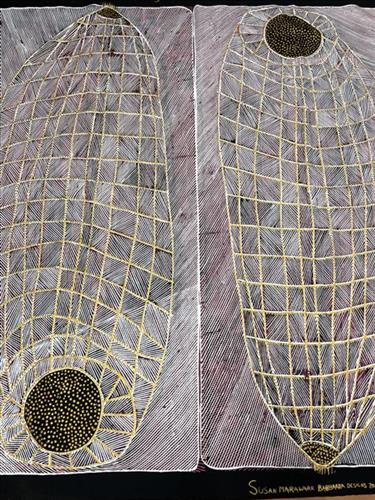
Mandjabu

“In old times people would make these mandjabu (fish traps) to go fishing. They are made with vine we find in the jungle. That old man, Anchor Gulunba, he showed me how to make these fish traps. I would sit there and watch him making them. We catch barramundi, catfish, all kinds of fish.” – Helen Lanyinwanga

Kuninjku people traditionally make two sorts of conical fish traps. One called mandjabu made from a vine called milil, and another smaller one called manylik mandjabu, made from the grass manylik. The mandjabu conical fish trap is bigger and stronger and used in tidal reaches of creeks to catch large fish. The smaller, lighter manylik trap is used in freshwater flowing creeks to catch smaller fish and freshwater prawns. Traditionally, only men were involved in the construction of the large fish traps, but children would often crawl inside and assist.

To make fish traps and fish net fences artists firstly get vine (milil) from the jungle and they put it in water for one night to make it soft. Next they start weaving it; they make rings for the inside to keep the fish trap’s shape. Artists work for three or four weeks on the fish trap. They also make string from kurrajong (burdaga) to attach the hibiscus (bardainy) rings and to tie the conical end of the fish trap. This fish trap is used in saltwater and freshwater. People also use fish net fences called mun-dirra. A long time ago they would put the mun-dirra across rivers and creeks. In the middle they would place the an-gujechiya. They also used small things like sticks, rocks, mud and grass to block the fish from going through. People would then catch fish like saltwater barramundi rajarra, freshwater barramundi (janambal), small black freshwater catfish (buliya), bonefish (an-guwirrpiya), and sand bass (dalakan) in these fish traps.

377810582131380


Wirndilk

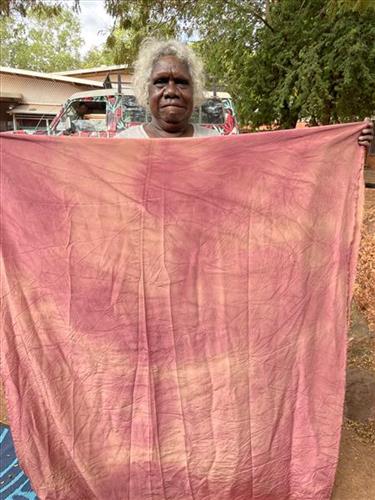
Wirndilk, haemodorum coccineum is a tropical grass growing in the well draining and sandy soil around the stony country. Commonly known as scarlet bloodroot, the bright red bulb can achieve shimmering red or rust dye tones.

The seeds of wirndilk can make a beautiful and bright purple-pink colour.

Wirndilk continues to be used women of Arnhem Land to dye pandanus for dilly bags and woven baskets. 

111982131292


Djomi

There are two Dreaming ladies at Bábbarra billabong – Djómi and Bábbarra. These two are sisters: one freshwater ‘mermaid’ and one saltwater one. Big long head, big stomach and very skinny legs that Bábbarra.

Their mother is the crocodile who lives in the Bábbarra billabong.

Both sisters will give people babies through the drinking water at Bábbarra. That’s why men stay away and Bábbarra is a sacred women’s site. Too strong our Dreaming – even men can get that baby in their tummies!

When it rains at Bábbarra, or when a cyclone comes, it’s because our Dreaming is too strong. There are lots of women spirits. When the storms come, the spirits go in the underground rivers and hide safely.

If you go fishing in our country, you have to be careful not to catch the Bábbarra and Djómi ‘mermaids’. Some people catch them thinking they are barramundi, but they are actually the ‘mermaid’ spirits. You will know, because they have white hair.

Lena Djabibba, djungkay (mother’s country and ceremonial manager of Bábbarra) and Joy Garlbin (landowner for Bábbarra)

Text courtesy of Bábbarra Women’s Centre copyright 2017

111982131290


Djomi

There are two Dreaming ladies at Bábbarra billabong – Djómi and Bábbarra. These two are sisters: one freshwater ‘mermaid’ and one saltwater one. Big long head, big stomach and very skinny legs that Bábbarra.

Their mother is the crocodile who lives in the Bábbarra billabong.

Both sisters will give people babies through the drinking water at Bábbarra. That’s why men stay away and Bábbarra is a sacred women’s site. Too strong our Dreaming – even men can get that baby in their tummies!

When it rains at Bábbarra, or when a cyclone comes, it’s because our Dreaming is too strong. There are lots of women spirits. When the storms come, the spirits go in the underground rivers and hide safely.

If you go fishing in our country, you have to be careful not to catch the Bábbarra and Djómi ‘mermaids’. Some people catch them thinking they are barramundi, but they are actually the ‘mermaid’ spirits. You will know, because they have white hair.

Lena Djabibba, djungkay (mother’s country and ceremonial manager of Bábbarra) and Joy Garlbin (landowner for Bábbarra)

Text courtesy of Bábbarra Women’s Centre copyright 2017

111982131289


Djomi

There are two Dreaming ladies at Bábbarra billabong – Djómi and Bábbarra. These two are sisters: one freshwater ‘mermaid’ and one saltwater one. Big long head, big stomach and very skinny legs that Bábbarra.

Their mother is the crocodile who lives in the Bábbarra billabong.

Both sisters will give people babies through the drinking water at Bábbarra. That’s why men stay away and Bábbarra is a sacred women’s site. Too strong our Dreaming – even men can get that baby in their tummies!

When it rains at Bábbarra, or when a cyclone comes, it’s because our Dreaming is too strong. There are lots of women spirits. When the storms come, the spirits go in the underground rivers and hide safely.

If you go fishing in our country, you have to be careful not to catch the Bábbarra and Djómi ‘mermaids’. Some people catch them thinking they are barramundi, but they are actually the ‘mermaid’ spirits. You will know, because they have white hair.

Lena Djabibba, djungkay (mother’s country and ceremonial manager of Bábbarra) and Joy Garlbin (landowner for Bábbarra)

Text courtesy of Bábbarra Women’s Centre copyright 2017

111982131287


Djomi

There are two Dreaming ladies at Bábbarra billabong – Djómi and Bábbarra. These two are sisters: one freshwater ‘mermaid’ and one saltwater one. Big long head, big stomach and very skinny legs that Bábbarra.

Their mother is the crocodile who lives in the Bábbarra billabong.

Both sisters will give people babies through the drinking water at Bábbarra. That’s why men stay away and Bábbarra is a sacred women’s site. Too strong our Dreaming – even men can get that baby in their tummies!

When it rains at Bábbarra, or when a cyclone comes, it’s because our Dreaming is too strong. There are lots of women spirits. When the storms come, the spirits go in the underground rivers and hide safely.

If you go fishing in our country, you have to be careful not to catch the Bábbarra and Djómi ‘mermaids’. Some people catch them thinking they are barramundi, but they are actually the ‘mermaid’ spirits. You will know, because they have white hair.

Lena Djabibba, djungkay (mother’s country and ceremonial manager of Bábbarra) and Joy Garlbin (landowner for Bábbarra)

Text courtesy of Bábbarra Women’s Centre copyright 2017

111982131286


Djomi

There are two Dreaming ladies at Bábbarra billabong – Djómi and Bábbarra. These two are sisters: one freshwater ‘mermaid’ and one saltwater one. Big long head, big stomach and very skinny legs that Bábbarra.

Their mother is the crocodile who lives in the Bábbarra billabong.

Both sisters will give people babies through the drinking water at Bábbarra. That’s why men stay away and Bábbarra is a sacred women’s site. Too strong our Dreaming – even men can get that baby in their tummies!

When it rains at Bábbarra, or when a cyclone comes, it’s because our Dreaming is too strong. There are lots of women spirits. When the storms come, the spirits go in the underground rivers and hide safely.

If you go fishing in our country, you have to be careful not to catch the Bábbarra and Djómi ‘mermaids’. Some people catch them thinking they are barramundi, but they are actually the ‘mermaid’ spirits. You will know, because they have white hair.

Lena Djabibba, djungkay (mother’s country and ceremonial manager of Bábbarra) and Joy Garlbin (landowner for Bábbarra)

Text courtesy of Bábbarra Women’s Centre copyright 2017

111982131285


Djomi

There are two Dreaming ladies at Bábbarra billabong – Djómi and Bábbarra. These two are sisters: one freshwater ‘mermaid’ and one saltwater one. Big long head, big stomach and very skinny legs that Bábbarra.

Their mother is the crocodile who lives in the Bábbarra billabong.

Both sisters will give people babies through the drinking water at Bábbarra. That’s why men stay away and Bábbarra is a sacred women’s site. Too strong our Dreaming – even men can get that baby in their tummies!

When it rains at Bábbarra, or when a cyclone comes, it’s because our Dreaming is too strong. There are lots of women spirits. When the storms come, the spirits go in the underground rivers and hide safely.

If you go fishing in our country, you have to be careful not to catch the Bábbarra and Djómi ‘mermaids’. Some people catch them thinking they are barramundi, but they are actually the ‘mermaid’ spirits. You will know, because they have white hair.

Lena Djabibba, djungkay (mother’s country and ceremonial manager of Bábbarra) and Joy Garlbin (landowner for Bábbarra)

Text courtesy of Bábbarra Women’s Centre copyright 2017

111982131284


Djomi

There are two Dreaming ladies at Bábbarra billabong – Djómi and Bábbarra. These two are sisters: one freshwater ‘mermaid’ and one saltwater one. Big long head, big stomach and very skinny legs that Bábbarra.

Their mother is the crocodile who lives in the Bábbarra billabong.

Both sisters will give people babies through the drinking water at Bábbarra. That’s why men stay away and Bábbarra is a sacred women’s site. Too strong our Dreaming – even men can get that baby in their tummies!

When it rains at Bábbarra, or when a cyclone comes, it’s because our Dreaming is too strong. There are lots of women spirits. When the storms come, the spirits go in the underground rivers and hide safely.

If you go fishing in our country, you have to be careful not to catch the Bábbarra and Djómi ‘mermaids’. Some people catch them thinking they are barramundi, but they are actually the ‘mermaid’ spirits. You will know, because they have white hair.

Lena Djabibba, djungkay (mother’s country and ceremonial manager of Bábbarra) and Joy Garlbin (landowner for Bábbarra)

Text courtesy of Bábbarra Women’s Centre copyright 2017