115682386988


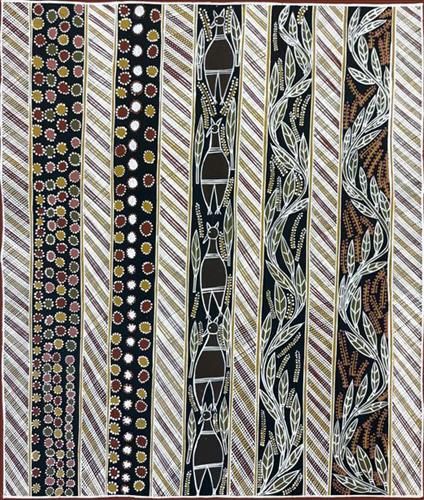
Warrnyu Dhawu (Flying Fox Story)

Back in the Creation time, Warrnyu (Flying Foxes) once lived, like men, in the cave at the place called Kurrki Warrnyu Yirri Djaringal (they also lived in caves called Wadatilmurr & Gurngurmirrngu). Warrnyu lived in these caves for many years and then one day Djanyarr (The Dog), an ancestral being in the form of a man, came along. He was looking around for a place to live. Djanyarr heard the sound of a Flying Fox screaming. He went down to the cliff and pushed the rock and the water came out at the Ganalbingu place called Gurrkawakarrmurr. He then went into the cave and into the sacred hole, frightening all the Flying Fox away. When he went into the hole he left his dilly bag in the tree and went out on the other side of the sacred cave and leaving his spear and woomera. He sat there for a long time. The Dog made three streams and the water went inside the cave. Two of these streams are good drinking water. In the middle it is a sacred water. No-one drinks from the middle of the stream. Children, men, women, young boys or girls are not allowed to drink from the middle of the stream. If they drink the water from the middle of the stream they will go grey too early.

At Kurrki Warrnyu Yirri Ngilaya Djaringal, the Flying Fox made himself into a young man… that’s what Aboriginal people do today. They have ceremonies and dances to make the young boys into men. The songs are called Yirrarwu, Gulumu, Rruburra and Burryun. Dhapi (initiation ceremony) happen today because the Warrnyu (Flying Fox) people performed them a long time ago before the Yolngu people. It was the Warrnyu people who first performed circumcision of the young boys to make them into men. It all happened at Kurrki Warrnyu Yirri Ngilaya Djaringal, this is how this place got its name.

Leaving behind the cave at Kurrki Warrnyu Yirri Djaringal, the Dog travelled west across the Arafura Swamp and came to Djalkulmurr (Mount Delight). From there he travelled north and came to Dunganda (a hill situated a few kilometres east of Ramingining). There he met a female Dog, then they both headed north and came to a place called Garanydjirrmurr where they spoke the Mildjingi language. From Garanydjirrmurr they changed their direction and went west through Guliny’barra, Burgumara and onto the plains. When they reached the plains they smelled something cooking, way up in the north – at Wessel Islands. The aroma they smelt was so enticing that they decided to go there. Lungurrma (the north-east wind) was carrying the smell. One Dog headed north again, but the other Dog decided not to go with him and went back the opposite way. The first Dog that went to Malwanatharra (Sandy Point) went into the sea following its nose to wherever the smell was coming from. It is believed that this Dog still lives in the sea…
225182394350


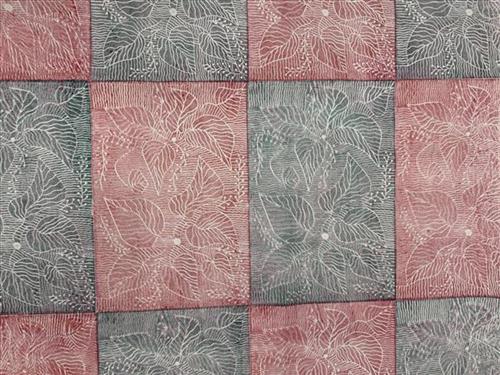
Kakan (Black Palm) Basket Weaving

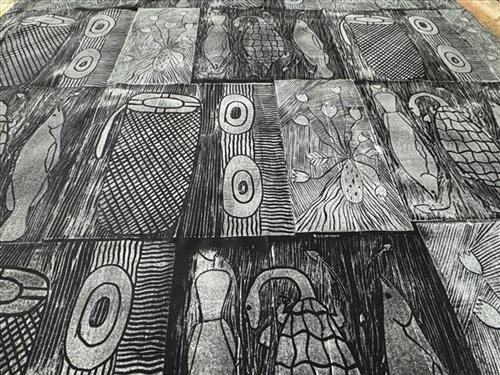
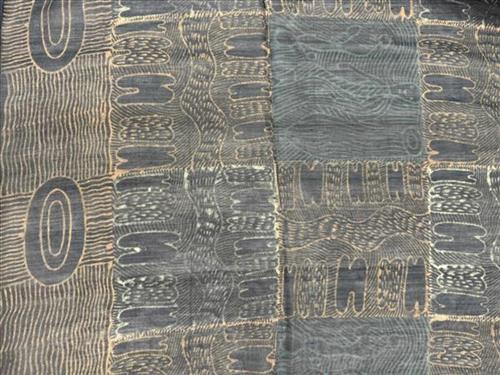
This design shows how the bottom part of a black palm basket is woven. My grandmothers and aunties used to make them. They cut off the young palm leaves in the centre, stripped and scrapped them. Then they would put the strips in freshwater to make them soft and keep them straight for weaving.

111982395270


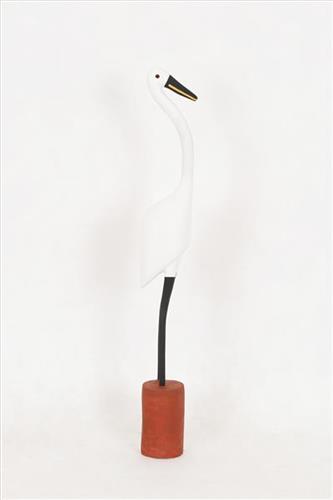
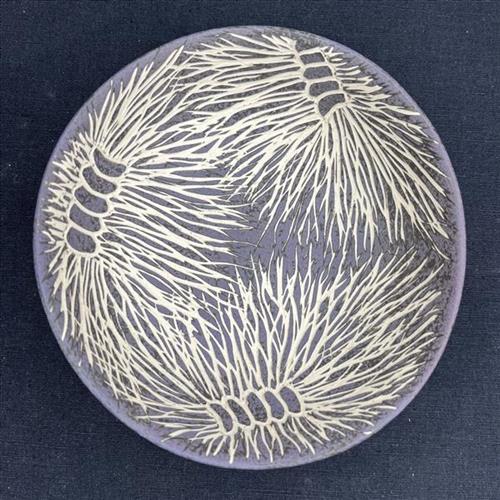
Gomarla (Egret bird)

The artist has carved the ‘Gomarla’, which in the Burarra word for Egret. This bird is native to the country of Yilan, which is the coastal region North West of Maningrida Community. 

People use feathers from gomarla to make ceremonial regalia for Yirrichinga. Many Yirrichinga groups own manikay ‘song’ for gomarla.

Gomarla mun-baparrurr Gopungorra. Jin-gubatbatcha jin-banga jiny-yorkiya. Gomarla waykin makukuya mu-guyinda.

The egret belongs to the Gopungorra clan. It always eats grasshoppers. The egret is high in a nest (builds its nest in the tree).

377810582395240


Kunmadj

Kunmadj is the Kuninjku term for large woven collecting baskets, known as dillybags.

They are often made from the burney vine (Malaisia scandens), a strong, pliable plant that grows along the ground and into the canopy of monsoon vine thickets. The baskets are used to collect a variety of heavy foods, such as fish caught in conical fish traps or a good harvest of yams. As well as being of practical use, dillybags are of cultural significance to Arnhem Land people. Dillybags are totemic objects and they are associated with particular sites in the landscape.

111582396358


Untitled

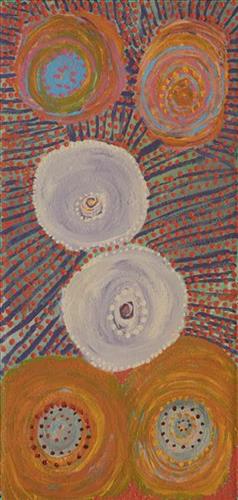
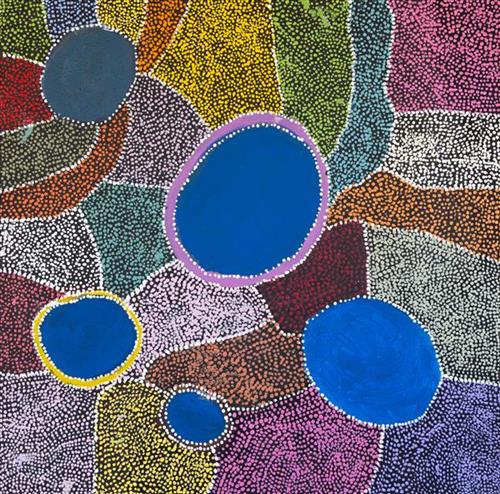
This is Dale’s Country- her ‘ngurra’ (home Country, camp). People identify with their ngurra in terms of specific rights and responsibilities, and the possession of intimate knowledge of the physical and cultural properties of one’s Country. Painting ngurra, and in so doing sharing the Jukurrpa (Dreaming) stories and physical characteristics of that place, has today become an important means of cultural maintenance. Dale’s ngurra encompasses her birthplace, Jigalong, and the Country that her family walked in the pujiman (traditional, desert-dwelling) era, including Puntawarri, Raarki (Canning Stock Route Well 27), Kularti, Kumpupirntily , Mirtikanya, (Kumpupintily, Lake Disappointment), and Mukurtu.

Portrayed in this work are features of Dale’s family’s ngurra, such as the striking salt lakes, dominant permanent red tali (sandhills), warta (trees, vegetation), and the individually named water sources they camped at. Rock holes, waterholes, soaks and springs were all extremely important sites for Martu people during the pujiman period, and are generally depicted with circular forms. 

The encyclopaedic knowledge of the location, quality and seasonal availability of the hundreds of water bodies found in one’s Country sustained Martu as they travelled across their Country, hunting and gathering, visiting family, and fulfilling ceremonial obligations. They would traverse very large distances annually, visiting specific areas in the dry and wet season depending on the availability of water and the corresponding cycles of plant and animal life on which hunting and gathering bush tucker was reliant. As they travelled and hunted they would also burn areas of Country, generating a greater diversity of plant and animal life.

111582397411


Wirlarra (Wilarra)

Wirlarra, the site depicted in this painting, lies on the eastern edge of a large salt lake, Nyayartakujarra (Lake Dora), near Punmu Aboriginal community. A distinctive group of small salt water pools are clustered together here. The water from these pools is known for its’ powerful healing properties, and the pools are still visited today by Martu to bathe cuts and sores. 

Wirlarra is also a term for ‘moon’ in Manyjilyjarra, and through the site’s Jukurrpa (Dreaming) narrative, the site is united with the moon in significance. It is said that at Wirlarra, the moon called to a family of dingoes; a mother, father and their large litter of dingo pups. The dingoes gathered at Wirlarra, where the moon cared for them and created a windbreak for the family to shelter. Here the dingoes scratched at the surface of the salt lake and created the cluster of salt water pools located there today. They lay down there. After a time, the dingoes continued travelling eastward toward the rising moon until they reached Kinyu (Well 35 on the Canning Stock Route), where they remained until all of the dingo pups had grown up. From Kinyu the family travelled further east with the moon.

111582397410


Wirnpa

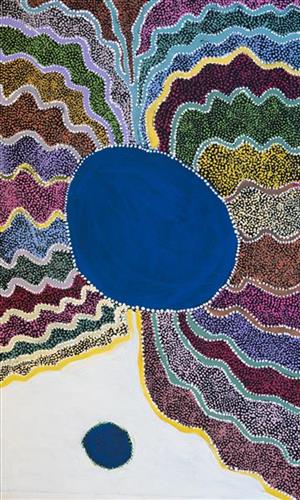
Wirnpa is an extremely significant cultural site and a soak surrounded by a cluster of salt springs and located within a salt lake at the northern end of the Percival Lakes region. Wirnpa lies in Yulparija Country, in a region dominated by dramatic salt lakes and corrugations of permanent red tali (sandhills).

The soak at Wirnpa is named after one of the most powerful of the ancestral jila (snake) men and the last to travel the desert during the Jukurrpa (Dreaming). The Western Desert term jila is used interchangeably to describe springs considered to be ‘living’ waters and snakes, both of which play a central role in Martu culture and Jukurrpa. Wirnpa is a rainmaking jila who lived and hunted in the Percival Lakes area. His travels are described in the songs and stories of many language groups across the Western Desert, even those far removed from his home site. In his epic travels, Wirnpa met and feasted with many other ancestral beings, exchanged ceremonial objects, and created a series of different laws and ceremonies. When he finally returned home, he searched for his many children only to discover that they had already died. They had laid down and become the salt springs of the Percival Lakes. Wirnpa wept for his children before himself transforming into a snake and entering the soak where he still resides.  

Jila sites like Wirnpa must be entered respectfully; particular rituals are practiced, such as lighting fires, sweeping the ground with branches, approaching in single file, and calling out to the site’s jila to announce one’s arrival and introduce people who are new to the jila. Those who do not follow these guidelines are in danger of becoming sick, or even being killed.

377810582397393


River, rocks, yawkyawk (young woman spirit)

“This river we call Mangabo. It is near Gudjarrngarrl homeland of my daughters, Deborah and Jennifer Wurrkidj. We cross that river when travelling to Munmoy outstation. In the wet season, that water comes up and covers over those rocks, and when you look down there are rocks all under the water.” 

– Helen Lanyinwanga