Baltji (Yam)
This painting depicts Baltji (Yam) which has been a reliable food source for Yolngu people for many centuries. Baltji can be found across the different landscapes of East Arnhem Land and are only harvested seasonally.


This painting depicts Baltji (Yam) which has been a reliable food source for Yolngu people for many centuries. Baltji can be found across the different landscapes of East Arnhem Land and are only harvested seasonally.

The Yolngu people of Arnhem Land originate from a spiritual source, fixed in a particular place in their land or the sea. These ‘Spiritual Reservoirs’ are often in the form of special waterholes made by Wangarr (Creative Beings) long ago close to the beginning of time.
The creator beings moved across the country side, shaping the land and implanting in each tract of country, the spiritual life force for the people who were to own it. These Creative Spirits took many forms. When they gave the land to each group they also gave songs, dances, ceremony, the associated laws and language. The Creation story for Ganalbingu people took place near the middle section of the Glyde River where it becomes the Goyder River. Their land, Ngaliyindi, sits astride the Arafura Swamp in Central Arnhem Land.
In this painting, the artist has depicted Gumang (magpie geese) and Banda (long necked turtle) , which are sacred to the Ganalbingu people. To the east of the Arafura Swamp is a freshwater billabong which is said to have been made by the Goose Spirit and is in the shape of a goose nest. As a result, geese, their eggs and their nests are sacred.


‘Kungkarrangkalpa’ (The Seven Sisters / Pleiades) is an important Tjukurrpa (Dreaming) across the Ngaanyatjarra Lands. Many families hold knowledge for different parts of this story, and each community paints its own chapter according to Country and ancestral responsibility.
Angela’s paintings focus on the celestial aspect of the story — the moment the sisters move from the earth into the sky. The star cluster becomes the seven bright forms she paints: six surrounding one, often arranged like a shield pattern. This reflects the way the sisters move together, protect each other, and travel as a tight group while fleeing Wati Nyiru, who appears in the sky as Orion’s Belt.
Nyiru follows the sisters across Country, disguising himself with magic — turning into kampurarrpa (bush tomato), a yirli (wild fig), or even a tree — trying to tempt them. But the sisters see through his tricks, outwit him, and keep running. When the chase becomes too much, they rise into the sky, forming the Pleiades. Nyiru follows them, always behind, never close enough.
Angela expresses this story using bold, high-contrast colours and strong circular forms. Her shield-like shapes represent the sisters’ strength and unity, while the central star often marks the eldest sister — the one the others protect along the journey. Through her palette and composition, Angela brings the energy, movement, and brightness of the sky-world into her canvas.
This painting is a contemporary interpretation of a cultural story carried across generations, connecting sky, Country, and ancestral memory.


The Anangu people travelled vast desert landscapes, following the seasons for food and shelter, deeply attuned to the rhythms of the land. This resilience and wisdom embedded in traditional bush foods that sustained them across generations.
Maku (Witchety Grubs), with their creamy, nutty flavour, represent survival and the resourcefulness to draw nourishment from deep within tree roots. Kampurarrpa (Desert Raisins), small and tangy, add brightness and essential nutrients to desert diets, thriving under intense sun.
Ipalu (Bush Banana), a climbing vine with crisp, slender fruits, offers fibre and hydration—a refreshing staple in arid climates. Ili (Bush Figs), with their mild sweetness, grow from rugged trees, offering a delicate treat in the harsh terrain.
Through vibrant colours and intricate designs, these bush foods embody the spirit of Ngaanyatjarra culture, each a testament to the land’s gifts and the knowledge passed through generations.

Yolŋu weavers of Arnhem Land create utilitarian, ceremonial, and decorative pieces using naturally sourced materials. This Bathi (Pandanus Basket) is made from young Pandanus spiralis leaves, harvested with a wooden hook, stripped of prickles, and dried to create strong, resilient fibres. These fibres are then twisted, coiled, or woven using various techniques to produce both functional and decorative baskets.
Typically, Bathi are made using a coiling technique which was adapted from techniques used by Indigenous women throughout Southeast Australia. Introduced to Arnhem Land weavers in the 1930’s as Missionaries began commissioning pieces in this style.
Bula’bula weavers exclusively use natural dyes, derived from locally sourced roots, leaves and grasses. These pigments are extracted and infused into pandanus fibres by boiling over an open fire, producing the rich, vibrant colours characteristic of contemporary Yolŋu weavings.

Yolŋu weavers of Arnhem Land craft both utilitarian and ceremonial objects using naturally sourced materials, with more recent works also including decorative pieces, such as this woven barramundi.
The primary material used in this piece is the young, green leaves of the Pandanus spiralis tree, that are harvested using a long wooden hook. The leaves are stripped of their prickles, with the smaller fibres being dried to produce a strong, resilient material. These fibres are then twisted, coiled, or combined using various techniques to create this motif of a barramundi, a vital and abundant food source for Yolŋu people.
Bula’bula weavers exclusively use natural dyes, derived from locally sourced roots, leaves and grasses. These pigments are extracted and infused into pandanus fibres by boiling over an open fire, producing the rich, vibrant colours characteristic of contemporary Yolŋu weavings.

This story is about a young boy who had no parents and was neglected.
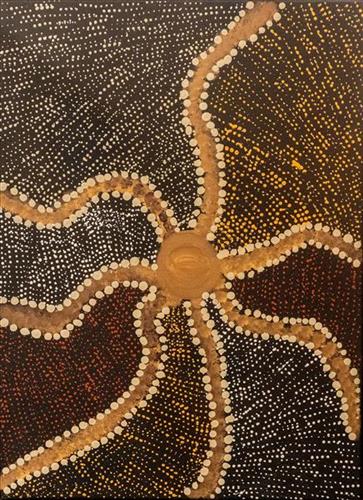
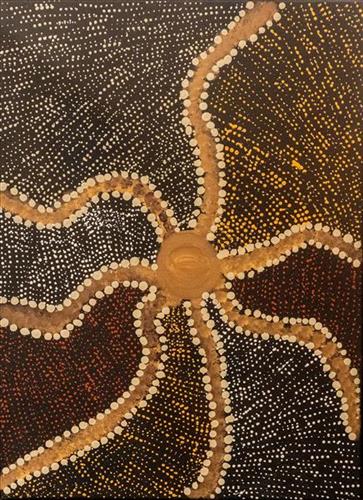
There were two men (the boy’s uncles) and one young boy camping at Walu Rockhole, an important water site in the Gibson Desert, northwest of the tri-state border between Western Australia, the Northern Territory and South Australia.
The men went hunting and the boy stayed behind waiting. The men returned with an emu and pulled out its heart. The boy was holding the heart and blood spilt out onto the rocks. He ran away with the heart and turned into a big whirlwind. The big whirlwind. came up and swept the families away. Today you can still see the emu’s blood trail where it stained the rocks.
Walu rock hole is a special place north of Papulankutja (Blackstone) where traditionally Yarnangu families would gather when water was available in the holes found in a flat rocky area.


These are the rockholes round about Blackstone. Nyuku Ngurra (my home).
This is a well, we used to pump the water from the hill but it broke, long time ago. On the other side of the hill is the water tank. This (painting) is before that pump broke. Kapi Pulkana. We travelled from rockhole to rockhole.