377815582394760


Kulyakartu

“I paint about Kulyukartu. It’s my grandmother’s Country. I love painting about that Country. I went on a trip doing fire burning, cleaning the waterholes, and walking around looking where my grandmothers carved the rocks and things. I went with my mum Emily, and SJ (Nuriah Jadai). You turn before 80 Mile Beach and just go straight.

I feel good when I’m there — it feels like home when I paint it. I learnt to paint from my grandfather (Wokka Taylor, dec.). When we went to 33 (Kunawarritji, Well 33) and back to Punmu, we were just watching them. He told me to get a brush, and then he told me to start painting. I think him and Dunjan (Thelma Judson) were painting a big one, and I came to help him. He told me, ‘One day you should go to Kulyukartu,’ and so I went there.”
 – Kiarah Mandijalu-Jadai

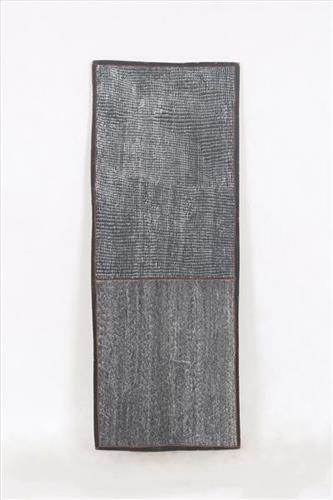
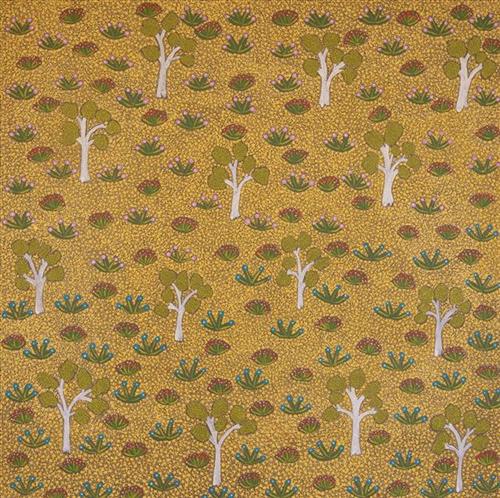
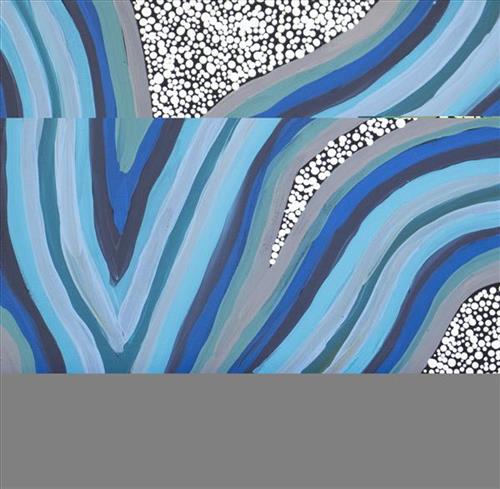
This artwork shares the story of Kulyakartu, a vast and peaceful area north-east of the community, on the edge of Nyangumarta and Martu Country. Kulyakartu is a place of wide open skies, long claypans, sandhills and soft grasses that come alive after rain.

Families remember camping there, visiting waterholes, looking for goanna and bush foods, watching birds, and travelling with old people who knew every dune, track and soak. The painting celebrates the beauty and calm of Kulyakartu, often shown through soft lines and dots that follow the movement of water and sand. It honours the knowledge of where to find water, how to move across Country, and the deep belonging felt when returning to ancestral places.

Through this work, the artist invites viewers to feel that stillness and connection — the strength of Country, memory and family.
377815582394725


Kulyakartu

“I paint about Kulyukartu. It’s my grandmother’s Country. I love painting about that Country. I went on a trip doing fire burning, cleaning the waterholes, and walking around looking where my grandmothers carved the rocks and things. I went with my mum Emily, and SJ (Nuriah Jadai). You turn before 80 Mile Beach and just go straight.

I feel good when I’m there — it feels like home when I paint it. I learnt to paint from my grandfather (Wokka Taylor, dec.). When we went to 33 (Kunawarritji, Well 33) and back to Punmu, we were just watching them. He told me to get a brush, and then he told me to start painting. I think him and Dunjan (Thelma Judson) were painting a big one, and I came to help him. He told me, ‘One day you should go to Kulyukartu,’ and so I went there.”
 – Kiarah Mandijalu-Jadai

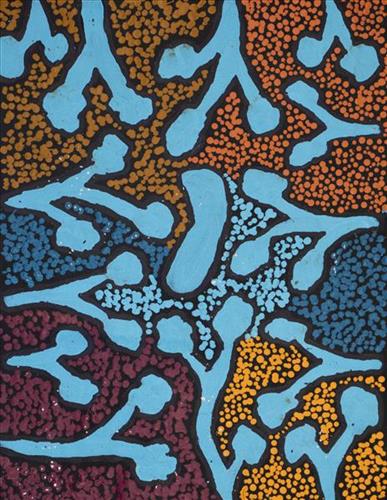
This artwork shares the story of Kulyakartu, a vast and peaceful area north-east of the community, on the edge of Nyangumarta and Martu Country. Kulyakartu is a place of wide open skies, long claypans, sandhills and soft grasses that come alive after rain.

Families remember camping there, visiting waterholes, looking for goanna and bush foods, watching birds, and travelling with old people who knew every dune, track and soak. The painting celebrates the beauty and calm of Kulyakartu, often shown through soft lines and dots that follow the movement of water and sand. It honours the knowledge of where to find water, how to move across Country, and the deep belonging felt when returning to ancestral places.

Through this work, the artist invites viewers to feel that stillness and connection — the strength of Country, memory and family.
111982395285


Mimih Spirit

The mimih spirit exists in a realm that runs parallel to and mirrors many facets of human life, demonstrating the deep sense of time and place understood by Aboriginal and Torres Strait Islander people. Such spirits feature importantly in relation to Aboriginal spirituality, cosmology, social and moral tales as well as ritual. As is true with the multiple mediums employed by artists of West Arnhem Land, the development of artistic style and form is in line with an awareness by the artist that the work produced is predominantly made for a broader audience. Whether shown in a national or international context these works communicate and exist in a particular space that is cross-cultural and simultaneously particular to the Arnhem region.

The mimih sits within a complex pedagogical and religious body of knowledge which links Kuninjku people to their distinctive escarpment homelands. Young Kuninjku artists, or apprentices, employ the mimih as an important exercise for the practice of the rarrk technique, as it could be achieved on a smaller surface area before being attempted in larger scale on pieces of bark. The mimih serves a purpose for those young artists first learning to carve in a social space of sharing and innovating. The initial mimih manifestation was a large form that almost mirrored the anatomy of a human and at this stage the sculptures have been likened to mokuy carvings visible in eastern Arnhem Land. Contemporaneously, mimih are depicted in a refined, slender, even emaciated form with a broad range of facial expressions giving both individual character to, and denoting the potential volatility and humour that mimih spirits are notable for in their interaction with bininj (humans). The sculptures are frequently carved from the thin trunks of softwoods such as kapok (bombax ceiba or cottonwood) kurrajong, beach hibiscus or leichardt and are painted with earth pigments for their colouring and design.

A leading figure engaging the spirit in visual storytelling was Crusoe Kuningbal, a Kuninjku man, who while traveling was familiarised with carving styles from the east of Arnhem at the mission in Milingimbi pre-dating World War II. The connection and development of art forms informed by cross cultural dialogues within northern Aboriginal language groups is notable. The mimih became a valued inclusion in performance and public ceremony by Kuninjku people like Kuningbal. At times these ceremonies were performed for extended language groups in the local region. 

Now a familiar and broadly depicted figure of iconography, it is important to acknowledge the development of this quite recent sculptural tradition. The depiction of this particular spirit being, once used as an addition to the sharing of song cycles and ceremony, has since been elevated to a prominent form and subject of contemporary sculpture. Variation in the creation of mimih acts as an indication of the individualism of each artist and their stylistic markers. Additionally significant to note is that in the space of the past thirty years the mimih has begun being produced by multiple language groups residing in the Maningrida area including the traditional owners of Maningrida, the Ndjébbana, speaking Kunibidji as well as Gurrgoni people who have strong ties to Kuninjku. 

________
*Maningrida Arts & Culture acknowledge the work of many academic and non-academic voices when writing on this topic, it is important to note Luke Taylor, who’s broad research has informed this text.

111982395283


Mimih Spirit

The mimih spirit exists in a realm that runs parallel to and mirrors many facets of human life, demonstrating the deep sense of time and place understood by Aboriginal and Torres Strait Islander people. Such spirits feature importantly in relation to Aboriginal spirituality, cosmology, social and moral tales as well as ritual. As is true with the multiple mediums employed by artists of West Arnhem Land, the development of artistic style and form is in line with an awareness by the artist that the work produced is predominantly made for a broader audience. Whether shown in a national or international context these works communicate and exist in a particular space that is cross-cultural and simultaneously particular to the Arnhem region.

The mimih sits within a complex pedagogical and religious body of knowledge which links Kuninjku people to their distinctive escarpment homelands. Young Kuninjku artists, or apprentices, employ the mimih as an important exercise for the practice of the rarrk technique, as it could be achieved on a smaller surface area before being attempted in larger scale on pieces of bark. The mimih serves a purpose for those young artists first learning to carve in a social space of sharing and innovating. The initial mimih manifestation was a large form that almost mirrored the anatomy of a human and at this stage the sculptures have been likened to mokuy carvings visible in eastern Arnhem Land. Contemporaneously, mimih are depicted in a refined, slender, even emaciated form with a broad range of facial expressions giving both individual character to, and denoting the potential volatility and humour that mimih spirits are notable for in their interaction with bininj (humans). The sculptures are frequently carved from the thin trunks of softwoods such as kapok (bombax ceiba or cottonwood) kurrajong, beach hibiscus or leichardt and are painted with earth pigments for their colouring and design.

A leading figure engaging the spirit in visual storytelling was Crusoe Kuningbal, a Kuninjku man, who while traveling was familiarised with carving styles from the east of Arnhem at the mission in Milingimbi pre-dating World War II. The connection and development of art forms informed by cross cultural dialogues within northern Aboriginal language groups is notable. The mimih became a valued inclusion in performance and public ceremony by Kuninjku people like Kuningbal. At times these ceremonies were performed for extended language groups in the local region. 

Now a familiar and broadly depicted figure of iconography, it is important to acknowledge the development of this quite recent sculptural tradition. The depiction of this particular spirit being, once used as an addition to the sharing of song cycles and ceremony, has since been elevated to a prominent form and subject of contemporary sculpture. Variation in the creation of mimih acts as an indication of the individualism of each artist and their stylistic markers. Additionally significant to note is that in the space of the past thirty years the mimih has begun being produced by multiple language groups residing in the Maningrida area including the traditional owners of Maningrida, the Ndjébbana, speaking Kunibidji as well as Gurrgoni people who have strong ties to Kuninjku. 

________
*Maningrida Arts & Culture acknowledge the work of many academic and non-academic voices when writing on this topic, it is important to note Luke Taylor, who’s broad research has informed this text.

111982395273


Ngalkodjek Yawkyawk

This artwork depicts the Ngalkodjek Yawkyawk of Barrihdjowkkeng country.

“This story is very old. That old man [my father Crusoe Kuningbal] when he was alive, told that story to me, to all of us. He told us about the yawkyawk (mermaid) spirit women called Ngalkodjek who lives in the billabong on my country. He told us how they call out loudly, how they call out as they walk along.

That is what they do, calling out. They walked around eating bush foods like those little bush yams. They would pound the yams into a pulp and eat them. That is their traditional food which they eat.

When they walk down from the bush, they follow a set path that belongs to them and they walk along calling out. That is their path which they take. It is an old traditional route.

They placed a woman’s breast into the country. That rock was not there originally, but it was a woman’s breast. It is the breast of those women.

They put that djang [sacred place] there, and then at the time when non-Aboriginal people arrived in the region, then the breast turned to stone. Now it has turned solid into rock.”

– Owen Yalandja

111982395269


Gomarla (Egret bird)

The artist has carved the ‘Gomarla’, which in the Burarra word for Egret. This bird is native to the country of Yilan, which is the coastal region North West of Maningrida Community. 

People use feathers from gomarla to make ceremonial regalia for Yirrichinga. Many Yirrichinga groups own manikay ‘song’ for gomarla.

Gomarla mun-baparrurr Gopungorra. Jin-gubatbatcha jin-banga jiny-yorkiya. Gomarla waykin makukuya mu-guyinda.

The egret belongs to the Gopungorra clan. It always eats grasshoppers. The egret is high in a nest (builds its nest in the tree).

377810582395258


Yawkyawk dja Wayuk (young woman spirit and waterlily)

Deborah Wurrkidj is a Kuninjku artist from the Kurulk clan whose country lies around the outstation of Mumeka in central Arnhem Land. This image depicts a female water spirit, or Yawkyawk, from a creek in the rock country near Yikkarakal. The Yawkyawk is a story of the Duwa moiety that Deborah learnt to paint from her father.

Yawkyawk are water spirits (mermaids) and also young women. This design is Yawkyawk in the billabong near Yikkarakal. Yawkyawk move like women, the one on the left is the old woman and on the right is the young woman. They are mother and daughter. Sometimes you can hear Yawkyawk talking at night. My grandmother told me a story that they heard those Yawkyawk and when they looked out with their torch at night, all the women saw the Yawkyawk tails flapping and disappearing in the water. The water is very cold in that billabong and the sand is soft, you might fall down there in the mud. There are also wayuk (water lilies) in this design, and other grasses. Sometimes when they are cold, the Yawkyawk get out of the water to lie in the sun, but when they hear our footsteps they quickly jump back in.When were were on the outstation our elders would tell us this story of the Yawkyawk. They look after my place. They also give a baby to you. – Deborah Wurrkidj


377810582395231


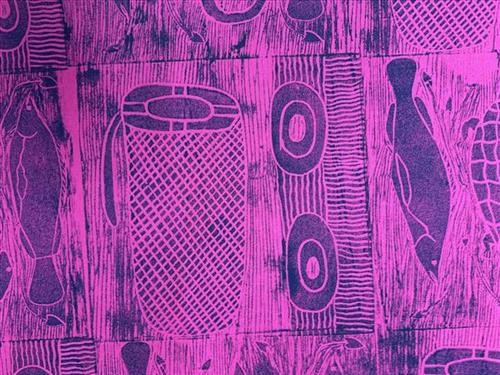
Djenj (fish) and mandjabu (fishtrap)

This fabric was created using the linocut fabric printing technique, which has been refined at Bábbarra Women’s Centre since it was introduced in the mid-1990s.

The Lino tile is carved by the artist at Bábbarra Designs. It is printed on fabric by hand using a variety of colours and layers. The linocut technique ensures each textile is a one-off, limited edition piece.

The fabric is colour-safe and can be thrown into a washing machine. Repeated use will soften the fabric, and some fading will occur over time. 

Bábbarra Women’s Centre supports the economic independence of Indigenous women in the Arnhem Land community of Maningrida, Northern Territory, Australia. Designs created by the women at Bábbarra reflect strong cultural knowledge, which is passed down to younger generations through their textile design practice.

‘Themes in our artwork almost exclusively come from our Country and cultural connection. Our deep relationship with the land and seas of our customary clan estates strongly defines and governs the social, cultural, spiritual and territorial aspects of our lives.’

Bábbarra Designs Artist Statement

220982396024


Alana Ngwarraye Holmes – My Country

I was born in Ali Curung, my father was Cigarette George, he was a drover and my Mother is Edie Kemarre Holmes.  My mother taught me to paint, I watched her when I was small, she is an important artist who was involved in the Utopia Batik movement and now paints at Ampilatwatja.  I spent my childhood around Murray Downs.

My paintings are influenced by my Fathers country. I was taught to hunt bush tucker, sugar bags, Kangaroo and Goanna when I was little.

I travel to my Mothers country on Antarrengeny outstation and I teach my kids and grandchildren to go hunting. 

I like to get busy on painting, it feels good.

The artists of Ampilatwatja made a conscious decision not to paint altyerr (dreaming stories). The artists paint their country where those stories sit.

111582396165


Linyji (Claypan)

“This linyji (claypan) story, it’s about when the old people used to be living in the desert, a long, long time ago- thousands of years ago. They used to make a hole in the linyjii for the wilyki (seed), using the wind to separate the seed [from the husk; winnowing]. Also, when we used to be sick, old people used to wet the parna (sand/soil/earth) with the kapi (water), [then] mix it and use on burns. For headaches, they put it on the kata (head). Like a Band-Aid, or Panadol – pujiman (traditional, desert dwelling) way!“

– Kuru Gladys Bidu

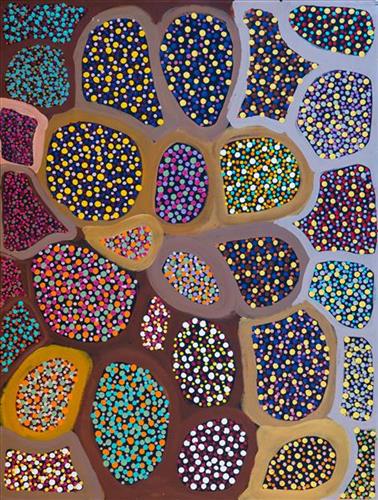
This work depicts a linyji (claypan) within the artists’ ngurra (home Country, camp), typically represented with circular forms. Claypans were visited more often during the wet seasons as they filled with water. As Kuru here describes, besides being a valuable water source, claypans were also ingeniously utilized for the removal of husks from seeds before consumption. Additionally, the clay itself was applied topically for its healing properties, aiding in the treatment of burns and soothing headaches.

During the pujiman (traditional, desert dwelling) period, knowledge of water sources was critical for survival, and today Martu Country is still defined in terms of the location and type of water. Each of the hundreds of claypans, rockholes, waterholes, soaks and springs found in the Martu desert homelands is known through real life experience and the recounting of Jukurrpa (Dreaming) narratives by name, location, quality and seasonal availability. This encyclopedic knowledge extends even to the nature and movement of arterial waterways, and sustained Martu as they travelled across their Country, hunting and gathering, visiting family, and fulfilling ceremonial obligations. They would traverse very large distances annually, visiting specific areas in the dry and wet season depending on the availability of water and the corresponding cycles of plant and animal life on which hunting and gathering bush tucker was reliant.