377815582405534


Seasons


“Rain, dry, hot, cold.
In the wet season everything goes green. When we were young we would go hunting for goanna and turkey. You go fishing in the river — you can catch barramundi when the river is running from the rain. They call it Warrampa, in Luma side.

Dry season, Lulga season. Hot season. After the water has settled you can go swimming. Catch the same thing. And Jarrumpa (cherabin, freshwater prawn).

The flowers come out after the rain, between the hot and cold.”
– Rose (Glenys) Butt

This artwork reflects the changing seasons across Country, showing how life shifts with the dry and wet. In Bidyadanga and the surrounding desert and coastal lands, the rhythm of the year guides movement, gathering, hunting, and time spent with family on Country.

As the dry season arrives, the land opens up again — red dunes, salt flats, and long beaches shining in the heat. Winds change, tides get bigger, and rangers burn Country to look after it, clearing grass, making space for new growth, and keeping the land healthy. Bush turkeys, goannas, fish, stingray, turtle, and shellfish are hunted, and families camp, share stories, and travel between desert and coast.

When the wet season return, big clouds roll in, storms build over the sea, and lightning cracks across the land. Country comes alive — water fills the waterholes and claypans, flowers and grasses grow, and birds, bush foods, and animals become abundant.

Through colour, pattern, and rhythm, the artist captures the cycle of seasons and the knowledge passed down — knowing when to gather certain foods, when animals are fat, when storms are coming, and how to care for Country through fire and everyday living. The work celebrates the constant relationship between people, weather, land, and sea, honouring the strength and continuity of cultural life.

377815582405518


Seasons

“Rain, dry, hot, cold.

In the wet season everything goes green. When we were young we would go hunting for goanna and turkey. You go fishing in the river — you can catch barramundi when the river is running from the rain. They call it Warrampa, in Luma side.

Dry season, Lulga season. Hot season. After the water has settled you can go swimming. Catch the same thing. And Jarrumpa (cherabin, freshwater prawn).

The flowers come out after the rain, between the hot and cold.”
– Rose (Glenys) Butt

This artwork reflects the changing seasons across Country, showing how life shifts with the dry and wet. In Bidyadanga and the surrounding desert and coastal lands, the rhythm of the year guides movement, gathering, hunting, and time spent with family on Country.

As the dry season arrives, the land opens up again — red dunes, salt flats, and long beaches shining in the heat. Winds change, tides get bigger, and rangers burn Country to look after it, clearing grass, making space for new growth, and keeping the land healthy. Bush turkeys, goannas, fish, stingray, turtle, and shellfish are hunted, and families camp, share stories, and travel between desert and coast.

When the wet season return, big clouds roll in, storms build over the sea, and lightning cracks across the land. Country comes alive — water fills the waterholes and claypans, flowers and grasses grow, and birds, bush foods, and animals become abundant.

Through colour, pattern, and rhythm, the artist captures the cycle of seasons and the knowledge passed down — knowing when to gather certain foods, when animals are fat, when storms are coming, and how to care for Country through fire and everyday living. The work celebrates the constant relationship between people, weather, land, and sea, honouring the strength and continuity of cultural life.

115682405586


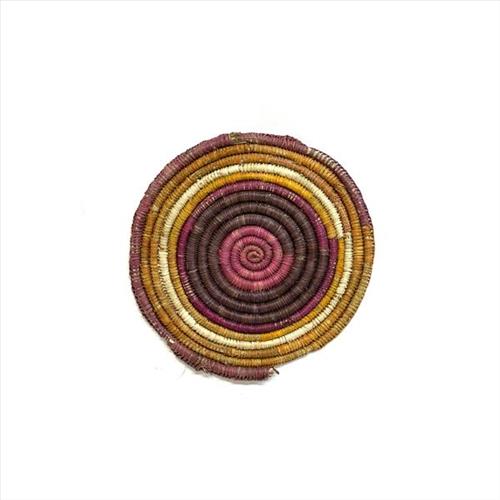
Woven Place Mat

Yolŋu weavers of Arnhem Land craft both utilitarian and ceremonial objects using naturally sourced materials, with more recent works also including decorative pieces. The choice of fibre depends on the intended function of each piece.

One of the primary materials is the young, green leaves of the Pandanus spiralis tree, harvested with a long hook. The leaves are stripped of their prickles, and the smaller fibres are dried to produce a strong, resilient material. These fibres can be twisted, coiled, or combined using various techniques to create baskets (Bathi), dillybags (Mindirr), and mats—both in the modern flat style and the traditional conical style (Nganiyal).

For more flexible, open-weave designs, weavers use the bark of the kurrajong tree. This material is particularly suited for dillybags (Mindirr) and ceremonial objects, such as Matjka (body adornments) and Malka (headwear).

Bula’bula weavers exclusively use natural dyes, derived from locally sourced roots, leaves and grasses. These pigments are extracted and infused into pandanus fibres by boiling over an open fire, producing the rich, vibrant colours characteristic of contemporary Yolŋu weavings.

115682405561


Bathi (Pandanus Basket)

Yolŋu weavers of Arnhem Land create utilitarian, ceremonial, and decorative pieces using naturally sourced materials. This Bathi (Pandanus Basket) is made from young Pandanus spiralis leaves, harvested with a wooden hook, stripped of prickles, and dried to create strong, resilient fibres. These fibres are then twisted, coiled, or woven using various techniques to produce both functional and decorative baskets.

Typically, Bathi are made using a coiling technique which was adapted from techniques used by Indigenous women throughout Southeast Australia. Introduced to Arnhem Land weavers in the 1930’s as Missionaries began commissioning pieces in this style.

Bula’bula weavers exclusively use natural dyes, derived from locally sourced roots, leaves and grasses. These pigments are extracted and infused into pandanus fibres by boiling over an open fire, producing the rich, vibrant colours characteristic of contemporary Yolŋu weavings.

115682405542


Woven Mat

Yolŋu weavers of Arnhem Land create utilitarian, ceremonial, and decorative pieces using naturally sourced materials. This mat is made from young Pandanus spiralis leaves, harvested with a wooden hook, stripped of prickles, and dried to create strong, resilient fibres. These fibres are then twisted, coiled, or woven using traditional techniques to produce both functional and decorative mats.

Bula’bula weavers exclusively use natural dyes, derived from locally sourced roots, leaves and grasses. These pigments are extracted and infused into pandanus fibres by boiling over an open fire, producing the rich, vibrant colours characteristic of contemporary Yolŋu weavings.

Traditionally, Nganiyal (conical mats) functioned as insect screens when erected and as seating mats when folded, playing an important role in both daily life and ceremonial practices. Today, Yolŋu artists create a variety of shapes, including flat, round, and oblong mats. These non-traditional styles and the use of bright colours became more common after Missionaries began commissioning pieces in this style.

220982405460


Joyrene Ngwarraye Holmes – Wildflowers

When I go hunting for aker arlkerl (echidna) around the sandhills of Ampilatwatja I always spot the wild flowers and honey flowers.  We tap the Bankias against our hand and get the honey, it is sweet to taste.

 After the rain and bushfires all the new flowers pop up around me. My favourite time of the year is winter when it is cooler to walk and hunt. 

The community of Ampilatwatja made a conscious decision not to paint altyerr (dreaming stories). The artists paint their country where those stories sit.


220982405457


Kathleen Nanima Rambler – My Fathers Country

I paint the country of my Father and Mother and where they grew up, near Barrow Creek.

This is the painting of my Father’s country, where I grew up. When we would go hunting, we always climbed those hills. We would take the kids hunting too and take photos of the hills.

I use bright colours and beautiful attention to detail expresses the love and joy that I have for the country closest to my heart.

The community of Ampilatwatja made a conscious decision not to paint altyerr (dreaming stories). The artists paint their country where those stories sit.

377815582405467


Wildflowers at Kulyakartu

“Kulyakartu is my ancestor ngurra (home) through my grandmother and my great-great-grandfather and grandmother. Going out on Country with Nola and Muuki and hearing their stories of Kulyakartu touched my heart — listening to them talk about travelling through Kulyakartu with their mum and dad.

It was an experience for me to see the Country for the first time and to listen to their stories about travelling through the Great Sandy Desert. When I paint about Kulyakartu, it’s like an image in my mind from when I went there. That’s what I paint — the colours and the surrounding sand dunes around Kulyakartu.

I went on a chopper with Muuki, and now I picture the landscape from the air.”
 – Jenny Butt

This artwork shares the story of Kulyakartu, a vast and peaceful area north-east of the community, on the edge of Nyangumarta and Martu Country. Kulyakartu is a place of wide open skies, long claypans, sandhills and soft grasses that come alive after rain.

Families remember camping there, visiting waterholes, looking for goanna and bush foods, watching birds, and travelling with old people who knew every dune, track and soak. The painting celebrates the beauty and calm of Kulyakartu, often shown through soft lines and dots that follow the movement of water and sand. It honours the knowledge of where to find water, how to move across Country, and the deep belonging felt when returning to ancestral places.

Through this work, the artist invites viewers to feel that stillness and connection — the strength of Country, memory and family.

377815582405470


Country

“My mother’s, my great-grandmother’s and my grandfather’s Country. When we go out on Country, you can feel Country — and Country feels you. I feel blessed for such a beautiful Country. It’s emotional, hearing stories about my old people.

I love painting desert colours because that’s where our old people were walking around and were born — hunting and camping. I feel good painting Country. I like hearing the stories and painting about it.”
– Jessica Jadai

This artwork shares the story of Kulyakartu, a vast and peaceful area north-east of the community, on the edge of Nyangumarta and Martu Country. Kulyakartu is a place of wide open skies, long claypans, sandhills and soft grasses that come alive after rain.

Families remember camping there, visiting waterholes, looking for goanna and bush foods, watching birds, and travelling with old people who knew every dune, track and soak. The painting celebrates the beauty and calm of Kulyakartu, often shown through soft lines and dots that follow the movement of water and sand. It honours the knowledge of where to find water, how to move across Country, and the deep belonging felt when returning to ancestral places.

Through this work, the artist invites viewers to feel that stillness and connection — the strength of Country, memory and family.

This artwork honours Mangala Country and the families who carry its stories — walking, camping, hunting and gathering across desert edges, river systems and claypans. It remembers old people moving between soaks and sandhills, and later travelling to La Grange Mission (now Bidyadanga), keeping language, law and family strong.

Patterns trace tracks of animals and people; dots and lines follow water after rain; maps, camps, soaks and sandhills. The work also reflects the way caring for Country continues today — through ranger work and community leadership that bring together cultural knowledge and science to look after land and water.

114182405450


Kungkarrangkalpa (Seven Sisters)

‘Kungkarrangkalpa’ (The Seven Sisters or Pleaides) is significant Tjukurrpa (dreamtime). Its origins you may be familiar with in astronomy and its connection to ‘Wati Nyiru’ (Magic Man or Orion).  The roots of this dreaming stems across indigenous groups around the world. The Australian Aboriginal songline is one part to the whole dreaming which can be traced all around the world. The ladies of the Ngaanyatjarra Lands depict their significant chapter and understanding of the journey of the sisters. The different versions of this story depend on where you live and the significance’s of local Tjukurrpa places.

Nyiru fell in love with the sisters but he was of the wrong skin group to marry, but he still pursued them on their journey. The sisters travel across the land to escape Nyiru’s unwanted attentions, but he is persistent and always finds them. There are significant land forms which can be sited today that evidence this dreaming. As Nyiru is chasing the sisters he tries to catch them by using magic to turn into the most tempting kampurarrpa (bush tomato) and the most beautiful Yirli (wild fig tree), for them to eat and camp under. However, the sisters are knowledgeable of his magic and too clever for Nyiru who they outwit again and again. They go hungry and run through the night rather than be caught by him. As the journey continues, Nyiru gets so frustrated at the wit of the sisters that he uses his magic to make the oldest sister sick to try and get closer to her. The other sisters rescue the big sister and nurse her back to health. It is said he also captures the youngest sister, but with the help of the oldest sister, she escapes back to her sisters who are waiting for her. Eventually, the sisters fly into the sky to escape Nyiru, forming the constellation. Nyiru felt lonely, longing for the sisters who were so far away. Nyiru used his magic to go to the sky, forever in pursuit.