111982441990


Mimih Spirit

The mimih spirit exists in a realm that runs parallel to and mirrors many facets of human life, demonstrating the deep sense of time and place understood by Aboriginal and Torres Strait Islander people. Such spirits feature importantly in relation to Aboriginal spirituality, cosmology, social and moral tales as well as ritual. As is true with the multiple mediums employed by artists of West Arnhem Land, the development of artistic style and form is in line with an awareness by the artist that the work produced is predominantly made for a broader audience. Whether shown in a national or international context these works communicate and exist in a particular space that is cross-cultural and simultaneously particular to the Arnhem region.

The mimih sits within a complex pedagogical and religious body of knowledge which links Kuninjku people to their distinctive escarpment homelands. Young Kuninjku artists, or apprentices, employ the mimih as an important exercise for the practice of the rarrk technique, as it could be achieved on a smaller surface area before being attempted in larger scale on pieces of bark. The mimih serves a purpose for those young artists first learning to carve in a social space of sharing and innovating. The initial mimih manifestation was a large form that almost mirrored the anatomy of a human and at this stage the sculptures have been likened to mokuy carvings visible in eastern Arnhem Land. Contemporaneously, mimih are depicted in a refined, slender, even emaciated form with a broad range of facial expressions giving both individual character to, and denoting the potential volatility and humour that mimih spirits are notable for in their interaction with bininj (humans). The sculptures are frequently carved from the thin trunks of softwoods such as kapok (bombax ceiba or cottonwood) kurrajong, beach hibiscus or leichardt and are painted with earth pigments for their colouring and design.

A leading figure engaging the spirit in visual storytelling was Crusoe Kuningbal, a Kuninjku man, who while traveling was familiarised with carving styles from the east of Arnhem at the mission in Milingimbi pre-dating World War II. The connection and development of art forms informed by cross cultural dialogues within northern Aboriginal language groups is notable. The mimih became a valued inclusion in performance and public ceremony by Kuninjku people like Kuningbal. At times these ceremonies were performed for extended language groups in the local region. 

Now a familiar and broadly depicted figure of iconography, it is important to acknowledge the development of this quite recent sculptural tradition. The depiction of this particular spirit being, once used as an addition to the sharing of song cycles and ceremony, has since been elevated to a prominent form and subject of contemporary sculpture. Variation in the creation of mimih acts as an indication of the individualism of each artist and their stylistic markers. Additionally significant to note is that in the space of the past thirty years the mimih has begun being produced by multiple language groups residing in the Maningrida area including the traditional owners of Maningrida, the Ndjébbana, speaking Kunibidji as well as Gurrgoni people who have strong ties to Kuninjku. 

________
*Maningrida Arts & Culture acknowledge the work of many academic and non-academic voices when writing on this topic, it is important to note Luke Taylor, who’s broad research has informed this text.
111982441989


Mimih Spirit

The mimih spirit exists in a realm that runs parallel to and mirrors many facets of human life, demonstrating the deep sense of time and place understood by Aboriginal and Torres Strait Islander people. Such spirits feature importantly in relation to Aboriginal spirituality, cosmology, social and moral tales as well as ritual. As is true with the multiple mediums employed by artists of West Arnhem Land, the development of artistic style and form is in line with an awareness by the artist that the work produced is predominantly made for a broader audience. Whether shown in a national or international context these works communicate and exist in a particular space that is cross-cultural and simultaneously particular to the Arnhem region.

The mimih sits within a complex pedagogical and religious body of knowledge which links Kuninjku people to their distinctive escarpment homelands. Young Kuninjku artists, or apprentices, employ the mimih as an important exercise for the practice of the rarrk technique, as it could be achieved on a smaller surface area before being attempted in larger scale on pieces of bark. The mimih serves a purpose for those young artists first learning to carve in a social space of sharing and innovating. The initial mimih manifestation was a large form that almost mirrored the anatomy of a human and at this stage the sculptures have been likened to mokuy carvings visible in eastern Arnhem Land. Contemporaneously, mimih are depicted in a refined, slender, even emaciated form with a broad range of facial expressions giving both individual character to, and denoting the potential volatility and humour that mimih spirits are notable for in their interaction with bininj (humans). The sculptures are frequently carved from the thin trunks of softwoods such as kapok (bombax ceiba or cottonwood) kurrajong, beach hibiscus or leichardt and are painted with earth pigments for their colouring and design.

A leading figure engaging the spirit in visual storytelling was Crusoe Kuningbal, a Kuninjku man, who while traveling was familiarised with carving styles from the east of Arnhem at the mission in Milingimbi pre-dating World War II. The connection and development of art forms informed by cross cultural dialogues within northern Aboriginal language groups is notable. The mimih became a valued inclusion in performance and public ceremony by Kuninjku people like Kuningbal. At times these ceremonies were performed for extended language groups in the local region. 

Now a familiar and broadly depicted figure of iconography, it is important to acknowledge the development of this quite recent sculptural tradition. The depiction of this particular spirit being, once used as an addition to the sharing of song cycles and ceremony, has since been elevated to a prominent form and subject of contemporary sculpture. Variation in the creation of mimih acts as an indication of the individualism of each artist and their stylistic markers. Additionally significant to note is that in the space of the past thirty years the mimih has begun being produced by multiple language groups residing in the Maningrida area including the traditional owners of Maningrida, the Ndjébbana, speaking Kunibidji as well as Gurrgoni people who have strong ties to Kuninjku. 

________
*Maningrida Arts & Culture acknowledge the work of many academic and non-academic voices when writing on this topic, it is important to note Luke Taylor, who’s broad research has informed this text.

111982442042


Ngokngok (Owl)

Ngokngok or mun-ngokngok is the Southern Boobook owl. Their clan is Warrawarra and the are connected to traditional healers.


116182159451


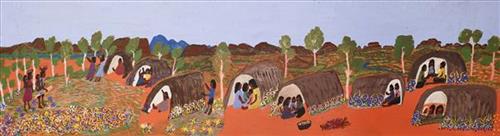
In-Between Days

Some men gone hunting. The women stay at the camp. They collect bush tucker. This is south west (Petermann Ranges) way. My family.  Start of in-between days. Aṉangu living in wiltja.


Dimensions: 400 x 1480 mm acrylic on linen

116182348925


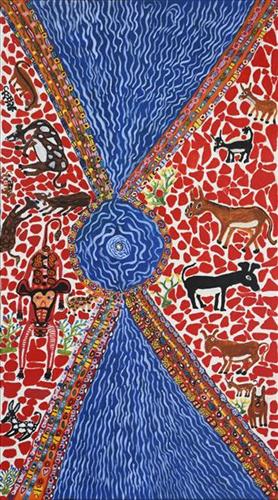
Donkeys all around Chambers Pillar

‘All the donkey in that desert Country south of Titjikala. Those three circles are Chambers Pillar, Castle Rock, and her poor mother trailing behind. We call Chambers Pillar Iterrkewarre [pronounced it-turk-kar-wara]. He’s knob-tailed gecko man. He came up from Finke River [down south] and travels all over the area before his family banished him for marrying up a girl. But she’s his mother-in-law. That’s against our Law.’

Following his banishment, the couple retreated into the desert, Iterrkewarre raging in fury, the girl facing away from him in deep shame. Among the dunes they rested and turned into prominent rocky formations – Iterrkewarre into the Pillar, the girl into Castle Rock. They are trailed by the girl’s mother, known as Window Rock.


Dimensions: 660 x 1170 mm

116182356124


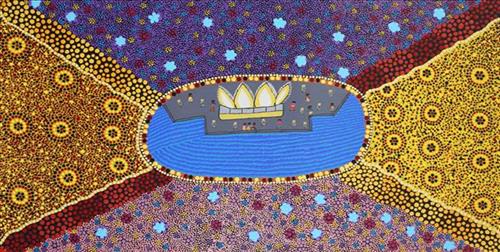
Sydney Opera House

Sydney Opera House. Artists Sally and Marlene travelled to Sydney, they had an exhibition there. All the school kids watching the harbour bridge. All the Aboriginal people stay there for long time in Sydney, lots of tourists hanging around taking photo. 

Sally M Nangala Mulda and Marlene Rubuntja had their artworks projected onto the Sydney Opera House as a part of the exhibition, Badu Gili: Wonder Women. 


Dimensions: 660 x 1220 mm

116182393577


Emu dreaming

Emu looking around for water. This is a Dreaming story from my father’s country, other side of Yuendumu. Past Mandarin Station, through there and other side. Emu looking round for water, they are three waterholes. I’ve painted the country side after big rain, flowers everywhere. The emu is looking for yellow fruit to eat, with seed. The snake is in the waterholes.

Dimensions: 560 x 560 mm

116182395190


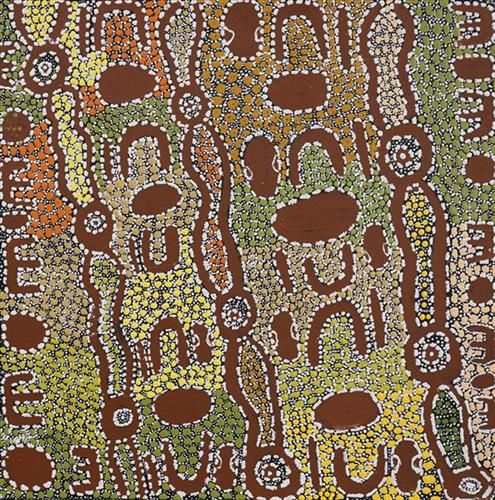
Wardapi Jukurrpa

‘This painting is about the way women hunt Wardapi – that sand goanna. He digs holes in the dunes, makes his nest deep inside. Many of the holes all join up. Women hunt Wardapi in the dunes by digging out the holes. Sometimes cover one, and Wardapi runs out other one. Need to hunt him together. Find all the holes. Dig them at the same time. Someone going to get him that way.’

The Wardapi Jukurrpa [Varanus Gouldii Goanna] belongs to the Spencer Sisters. It comes from Yarripilangku [aka Yinyiripalangu], south-west of Yuendumu. A group of Warlpiri Karnta [women] are sitting down in a circle when a Japangardi Wati [man] from Puturlu [Mt Theo], called Wamaru came upon them. He wants to take one of them, named Yurlkurinyi, of Nungarrayi skin, which is the wrong skin for him. He takes the Nungarrayi woman up a hill, where they make love. In response, the earth on top of the hill turns to Ngunjungunju [white ochre], and yellow and red ochre. The yellow is for Karnta and the red for Wati. The ochre is used by Warlpiri people for love magic and ceremonial decoration. The Wati turns all the Karnta and himself into Wardapi, aka Varanus Gouldii goannas. This Jukurrpa belongs to the Napaljarri/Japaljarri and Nungarrayi /Jungarrayi subsections, and the Japanangka/Napanangka, Japangardi/Napangardi subsections of Puturlu. The women are often represented by ‘U’ shapes. Concentric circles may illustrate Wardapi holes, or their droppings left behind them, and Wardapi tracks are usually represented by ‘W’ shapes and wavy lines.


Dimensions: 660 x 660 mm Acrylic on Linen

116182402926


Watiyawarnu

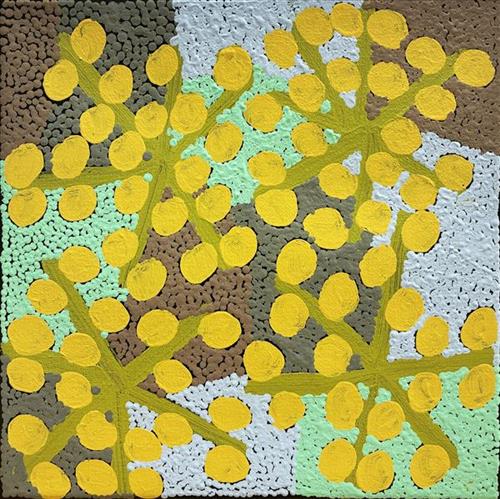
Women collecting Watiyawarnu (Acacia tenuissima). Back at camp after collecting the seeds they make large windbreaks for shelter and winnow the seed in the late afternoon. Immature watiyawarnu seed is ground into a paste and can be used to treat upset stomachs. There is an important ceremony for this Tjukurrpa. 


Dimensions: 300 x 300 mm

116182410102


Women Collecting Bush Food

Women talking about collecting bush food – where the best places are and the best times, whether seasonal or dependent on rain events – All the women sit with their digging sticks and piti’s [coolamons] around the hearth to talk about these aspects of collecting bush food.


Dimensions: 510 x 510 mm