111582385258


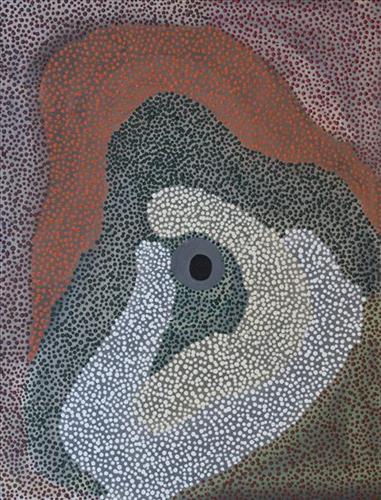
Punmu waterholes – Marianne Burton

“Punmu, I went there when I was a young girl, a teenager with my mother and father before my mother passed. Big mob of people was there. No building, just little cubby houses [bough shelters]. Long time I been there. 

These here are the waterholes around Punmu; Rawa spring- Rawa means ‘long time’, Tuu-tuu, Jila-jila, Wirlarra and Yilyara. That is my ngurra (home Country, camp). We grew up in Punmu around all these water holes. I still live here with my grandkids, [we share the] same stories for all these places.” 

 – Marianne Burton


Punmu refers to a region and an Aboriginal community within its vicinity, located 670km North-East of Newman. Created during the return to Country movement of the 1980s, with the recognition of Martu land rights and native title, the community was named after a nearby Jukurrpa (Dreaming) story. As described by Marianne, Punmu is her ngurra; she grew up in this region with her parents. 

Punmu community sits on the edge of a large salt lake known as Nyayartakujarra, or Lake Dora. The lake runs south into Karlamilyi River (Rudall River). Surrounding Punmu are numerous fresh water soaks and the red tali (sandhills) typical of the area. The most frequently visited yinta (permanent springs) around Punmu include Wirlarra, Rawa, Yilyara, Jila-jila and Tuu-tuu.

The Country around Punmu features in several Jukurrpa stories. Of particular importance is the story of the Jila Kujarra (Two Snakes), one of the key Jukurrpa narratives for the Martu. Though the story belongs to Warnman people, it is shared across the Western Desert with several other language groups. The narrative centres on the travels of two snakes as they are pursued by the Niminjarra, spiritual ancestors of the Warnman people. 

Before transforming themselves into snakes, the Jila Kujarra were young brothers. As snakes, they began travelling home to their mother, but were intercepted by the Niminjarra, who tracked the Jila Kujarra to Paji, east of Nyayartakujarra (Lake Dora). Though the Jila Kujarra eluded their pursuers here by escaping under the lake at Paji, they were soon after speared and injured by two Pukurti (initiates with bundled hair) at Nyayartakujarra, who returned with the Niminjarra to cook the snakes at the site of Kumpupirntily (Kumpupintily, Lake Disappointment). As the Niminjarra cut down the length of the Jila Kujarra, the snake’s bladders were pierced, causing an explosion of scalding hot urine in which the Niminjarra all perished and became black rocks at the site. The spirits of the Jila Kujarra returned to their mother at Nyayartakujarra, where the mother and her sons entered the ground below Nyayartakujarra and remain to this day.
111582385257


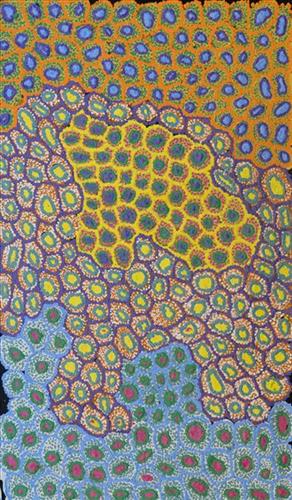
Ngurra (home Country, camp) – Roxanne Newberry

“Ngurra (home Country, camp) is a very special Country- where we grew up. We go mostly out on Country and camp out. We go swimming and looking for honey on the trees. We would hunt turkey, emu, kangaroo, look for bardi (witchetty grub), honey ants, yellow berries. It’s an outstation. We call it home. We grew up there. Good memories of that place.” 

– Roxanne Newberry 

The Western Desert term ‘ngurra’ is hugely versatile in application. Broadly denoting birthplace and belonging, ngurra can refer to a body of water, a camp site, a large area of Country, or even a modern house. People identify with their ngurra in terms of specific rights and responsibilities, and the possession of intimate knowledge of the physical and cultural properties of one’s Country. This knowledge is traditionally passed intergenerationally through family connections. Country for Martu is full of memory; not just the memory of their own movement through it, but also of their family. As summarised by Ngalangka Nola Taylor, “painting the ngurra, they do it to remember their connections.” 

Painting ngurra, and in so doing sharing the Jukurrpa (Dreaming) stories and physical characteristics of that place, has today become an important means of cultural maintenance. Physical maintenance of one’s ngurra, like cultural maintenance, ensures a site’s wellbeing, and is a responsibility of the people belonging to that area.

111582385256


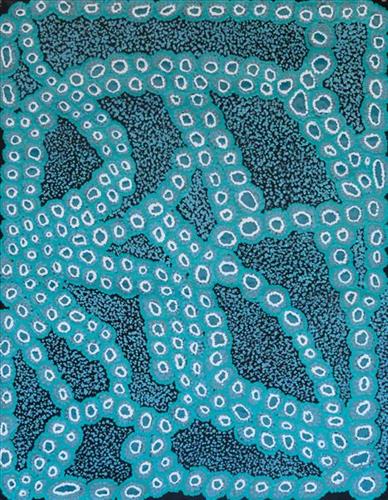
Kapi (Water)

“Martu people know how to find water in the desert, they know the Country looks different where there is water under the ground.”

– Corban Clause Williams

Depicted in this work are sources of kapi (water) within the artists’ ngurra (home Country, camp), typically represented with circular forms. During the pujiman (traditional, desert dwelling) period, knowledge of water sources was critical for survival, and today Martu Country is still defined in terms of the location and type of water. Each of the hundreds of claypans, rockholes, waterholes, soaks and springs found in the Martu desert homelands is known through real life experience and the recounting of Jukurrpa (Dreaming) narratives by name, location, quality and seasonal availability. This encyclopedic knowledge extends even to the nature and movement of arterial waterways, and sustained Martu as they travelled across their Country, hunting and gathering, visiting family, and fulfilling ceremonial obligations. They would traverse very large distances annually, visiting specific areas in the dry and wet season depending on the availability of water and the corresponding cycles of plant and animal life on which hunting and gathering bush tucker was reliant.

111582385255


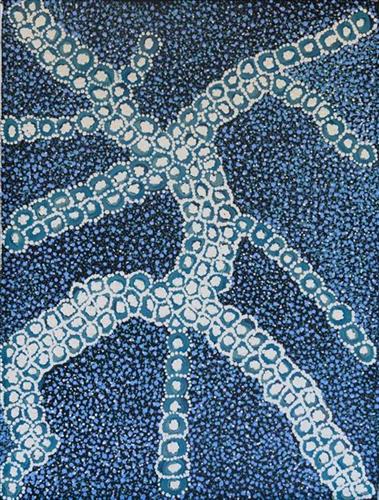
Kapi (Water)

“Martu people know how to find water in the desert, they know the Country looks different where there is water under the ground.”

– Corban Clause Williams

Depicted in this work are sources of kapi (water) within the artists’ ngurra (home Country, camp), typically represented with circular forms. During the pujiman (traditional, desert dwelling) period, knowledge of water sources was critical for survival, and today Martu Country is still defined in terms of the location and type of water. Each of the hundreds of claypans, rockholes, waterholes, soaks and springs found in the Martu desert homelands is known through real life experience and the recounting of Jukurrpa (Dreaming) narratives by name, location, quality and seasonal availability. This encyclopedic knowledge extends even to the nature and movement of arterial waterways, and sustained Martu as they travelled across their Country, hunting and gathering, visiting family, and fulfilling ceremonial obligations. They would traverse very large distances annually, visiting specific areas in the dry and wet season depending on the availability of water and the corresponding cycles of plant and animal life on which hunting and gathering bush tucker was reliant.

377810582385187


Manbirrbbirr (small bush flowers)

In Kuninjku the name manbirrbbirr is used for a number of densely flowering shrubs and small trees including Verticordia cunninghamii, yellow-flowering Austromyrtus species and also Acacia platycarpa which also has dense white flowers.

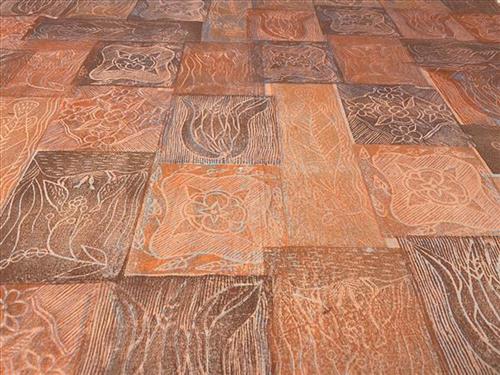
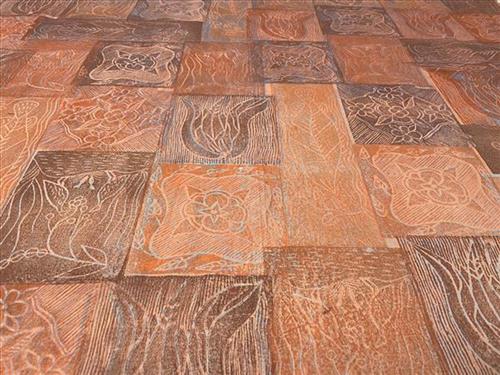
A multicoloured cloth with interlocking designs in a patchwork repeat. This cloth was printed by hand using the linocut technique. 


377810582385186


Manbirrbbirr (small bush flowers)

n Kuninjku the name manbirrbbirr is used for a number of densely flowering shrubs and small trees including Verticordia cunninghamii, yellow flowering Austromyrtus species and also Acacia platycarpa which also has dense white. This design is a patchwork of small Lino tiles representing various flowers in Arnhem Land. Abigail has incorporated the designs of her late mother. The cloth was hand dyed by Abigail’s aunt Deborah Wurrkidj. The striking yellow – orange hue comes from the root of the man-kurdudjumuk plant (coelospermum reticulatum) which has been harvested from the sandy country near the flood plains. This laborious and tiring process requires digging up the entire shrub. The root is shaven into a pot of water and the colour is released into water through the boiling process. Ashes have been added to soften the yellow into more of a peach orange tone.

37781464004631


Status: Stock


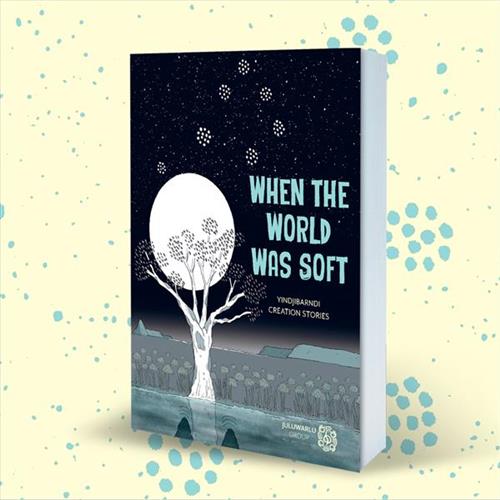
When the World Was Soft

A ground-breaking graphic novel sharing the stories of Yindjibarndi Creation-times in an immediate and engaging way for a contemporary audience.

FEATURES

  • QR code to listen to a reading of the book and educational resources.
  • Glossary of Yindjibarndi words and their English translations
  • 6 compelling Yindjibarndi Creation Stories 
  • Can be purchased with wings that invite children to immerse themselves in Creation Stories where the birds play a vital role

ABOUT

Yindjibarndi believe all creation is written in our landscape and was sung long ago, filling our Ngurra (Country) with sacred meanings and deep religious significance. At the dawn of time, Ngurra Nyujunggamu, the world was soft as clay and the sky was very low. Our Creator, Minkala, sang the songs from which all life and Ngurra evolved. These are some of our stories.

‘An extraordinary project, an invitation to share in a deep and sacred understanding of Country. When the World Was Soft imparts a sense of responsibility towards the young, and to Country, and is a testament to the power of communities telling their own stories.’ Books+Publishing

Dynamically illustrated by Alex Mankiewicz with striking artwork by members of the Juluwarlu Art Group, When the World Was Soft is a powerful gift of culture for young and old.

Juluwarlu Group Aboriginal Corporation is based in Roebourne and Ngurrawaana Community, in WA’s Pilbara region. Its purpose is to collect and promote knowledge of Yindjibarndi culture – our Ngurra, plants and animals; our language, genealogy, mythology, social history, and biography – to sustain our Yindjibarndi identity, giving self-esteem, respect, and other values we consider vital to our lives, our well-being, and our culture’s future. We do this for our children and our future generations so that they too, are inspired to contribute to our Australian national community. 

107581981246


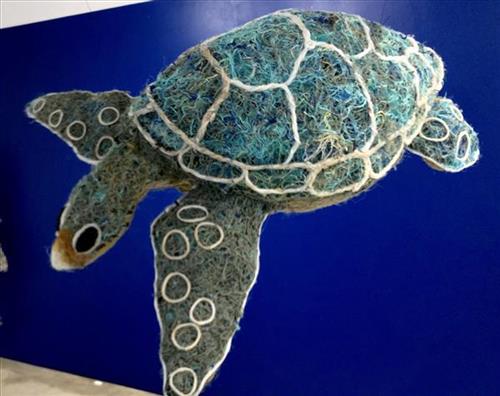
Kebi Neur

The turtle is significant to the people of Erub both as a tribal totem and as a traditional source of food for feastings and celebrations. A number of varieties of turtles nest and breed on the shores of the Torres Strait. Turtles are important to Torres Strait Islanders in so many different ways. It is one of their traditional tribal totems and it has been part of their customs to hunt turtles as one of their main food sources. In Australia, abandoned fishing nets (also known as ghost nets) from boats are washed ashore, trapping marine species such as turtles and dugongs. Sadly, these turtles make up 80 percent of the marine life found caught in these nets. As an environmental project, Erub Artists are utilising these abandoned ghost nets in an attempt to clean up the oceans. Their objective is to raise awareness about the negative impacts of ghost nets by creating art such as this turtle out of reclaimed fishing nets. We must respect the ocean because we need to make sure that we have turtles for the future. We only take what we need.

115982094708


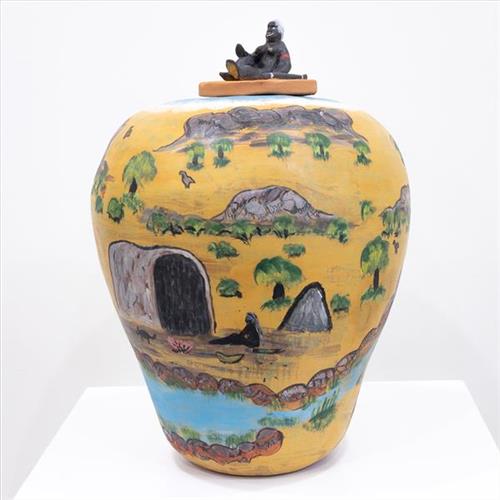
Hunting Story

A husband is out hunting kangaroo while his partner cooks damper back at the camp.