
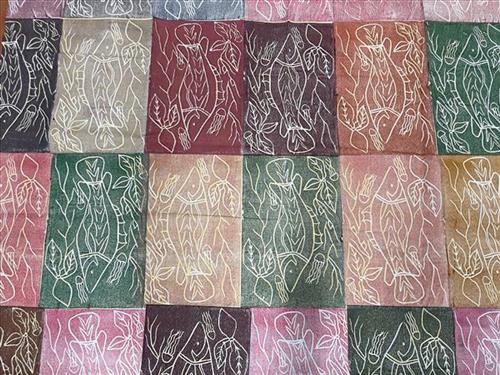

377810582149737
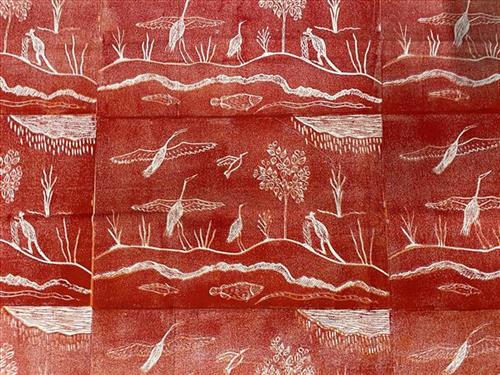
Ngalkordow, Djenj, Kunj
Brolga, fish and Kangaroo

377810582149679
Djomi
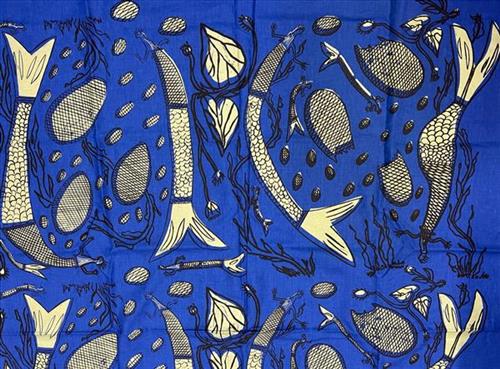
This design depicts the story of the artist’s ancestral dreaming, the Djomi fresh water spirit mermaid.
The Djomi figure is a mermaid like spirit with fish tail that lives in the fresh water stream that flows out to the sea cliff near Maningrida. Djomi is a known to be a very powerful fertility symbol.
‘If you go there you can get pregnant easily. Djomi has babies, and they can give others babies too. The Djomi spirit is so powerful, that women can end up with multiple babies at once, twins or sometimes even more. The Djomi spirits lay eggs near the sacred freshwater stream in Maningrida. Inside the eggs are human babies as well as young Djomi.
Men do not go near that swamp, because Djomi is so powerful that men might get pregnant there too. So men, they are too scared of that Djomi. When we visit the Djomi freshwater spring, we can hear young Djomi crying. They sound like normal babies crying, those Djomi spirits. They are looking for a mother.
This Djomi is my dreaming, I got permission from my djunguys to paint this Djomi design. For me I always ask my djunguy permission to paint, because that is our cultural way.
This design also depicts the fresh water lily leaves, and seaweed from the base of the sea floor.

377810582149678
Wak Wak
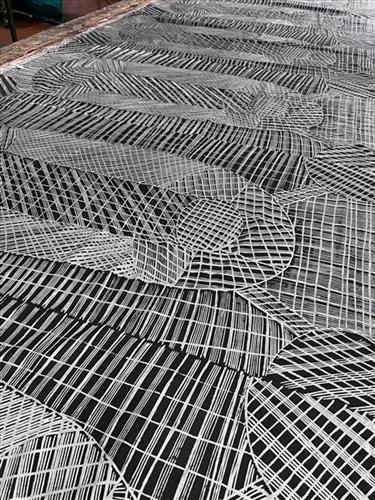
This design depicts a sacred site at ‘Kurrurldul’, an outstation south of Maningrida.
The ‘rarrk’, or abstract crosshatching, on this work represents the design for the crow totem ancestor called ‘Djimarr’. Today this being exists in the form of a rock, which is permanently submerged at the bottom of Kurrurldul Creek. The ‘Djimarr’ rock in the stream at Kurrurldul is said to move around and call out in a soft hooting tone at night. Both the stone itself and the area around it are considered sacred.
Finally, the pattern used here is also the crow design used in the sacred ‘Mardayin’ ceremony, which is a large regional patri-moiety ceremony now rarely conducted in central and eastern Arnhem Land.

377810582149673
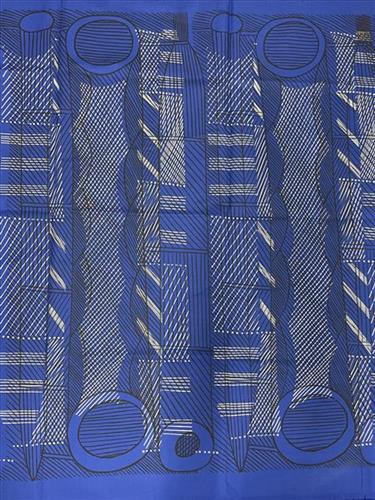
Lorrkon – Jennifer Wurrkidj
Before, a long time ago, when old people would die they would put their bones inside the lorrkkon and leave it outside. It is part of ceremony. The old people remembering and thinking about that person who passed away, there is lots of talking about where that lorrkkon needs to go.
My father, James Iyuna, taught me how to paint, to paint that rarrk. That memory is from him, he taught my sister Deborah and me. This story is from him, this design. When he was painting and drawing we would watch and we would learn.
Jennifer Wurrkidj
Jennifer is a Kuninjku artist from the Kurulk clan whose country lies around the outstation of Mumeka in central Arnhem Land. She has depicted lorrkkon (hollow-log coffin), kun-karninj (digging stick) and mandjabu (fishtrap) in this design.
The Lorrkkon or hollow-log coffin ceremony is the final ceremony in a sequence of mortuary rituals celebrated by the people of Arnhem Land. This ceremony might take place many years after the person has died, and involves the placing of the deceased’s bones into a hollow log that is decorated with painted clan designs and ceremonially placed into the ground where it slowly decays over many years.
The lorrkkon (hollow-log coffin) is made from the trunk of a termite-hollowed manbuluduk (stringybark tree, Eucalyptus tetradonta) and is decorated with totemic emblems. The western Arnhem Land version of the Lorrkkon ceremony involves the singing of sacred songs to the accompaniment of karlikarli, a pair of sacred boomerangs used as rhythm instruments. During the final evening of the ceremony, dancers decorate themselves with kapok down or, today, cotton wool, and conduct much of the final segments of the ceremony in the secrecy of a restricted men’s camp. The complete ceremony may stretch over a period of two weeks, but on the last night the bones of the deceased, which have been kept in a bark container, or today wrapped in cloth and kept in a suitcase, are taken out, and are painted with red ochre and placed inside the hollow-log coffin.
At first light on the final morning of the Lorrkkon ceremony, the men appear, coming out of their secret bush camp carrying the lorrkkon towards the women’s camp. The two groups call to each other using distinct ceremonial calls. The women have prepared a hole for the lorrkkon to be placed into, and when it is stood upright, women in particular kinship relationships to the deceased dance around the lorrkkon in a jumping/shuffling motion. It is then often covered with a tarpaulin and left to slowly decay.

377810582149669
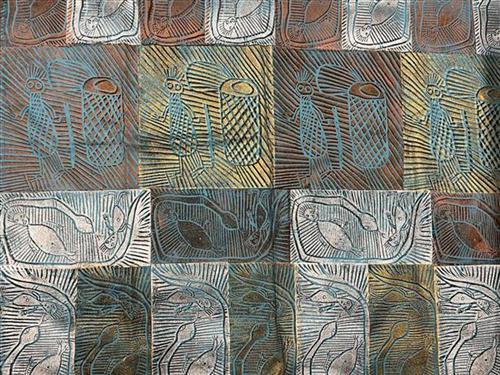
Bawáliba (Stone Country Mimih)
‘Bawáliba is the djang (Dreaming) of my mother and my uncles. They are good spirits, they protect us and they recognise families. They are really tall- just like human beings, like us. They dance late at night and have a lot of hair.
In olden times, long long long time ago Bawáliba were here, before people were on the land. Bawáliba used to go out hunting and care for country. They hunt carrying fish traps and digging sticks, near the homeland Djinkarr. They go out hunting on the floodplains with dilly bags and digging sticks. They collect a lot of bush foods, and sleep together with one bark shelter.
Sometimes now they still come alive when we sleep, they might come to our houses and peep through the window. At night, they cover themselves with white clay and red cloth tied around their waist. If we hear them, we jump out of bed and get up to look -but they have disappeared, they’re just too quick. Bawáliba might knock on the window to remind us they are there looking out for us.If you listen deeply you can hear them whisper, sometimes they talk about us and might say, ‘why are those people making camp here?’ then they realise ‘Oh they are family from here, it’s ok, they are just sleeping here for the night’.
During the day they always turn into stone and they sleep. We still know that green rock covered in moss near Djinkarr, that’s Bawáliba sleeping.
Some of my ancestors used to speak the same language as the Bawaliba, but all those old people are passed away now. It’s a little bit sad for us, because no one now can speak that Bawaliba language anymore.’ Lucy Yarawanga 2019

377810582149667
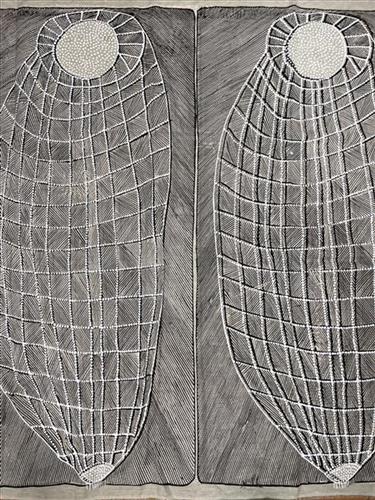
Mandjabu (discounted due to small burn)
Kuninjku people traditionally make two sorts of conical fish traps. One is called mandjabu and is made from a strong, durable vine called milil, and a smaller one is called manylik mandjabu, and made from the grass manylik. The mandjabuconical fish trap is bigger and stronger and used in tidal reaches of creeks to catch large fish. The smaller, lighter manyliktrap is used in freshwater flowing creeks to catch smaller fish and freshwater prawns. In earlier times, only men were involved in the construction of the large fish traps, but children would often crawl inside and assist.
To make mandjabu, weavers firstly harvest milil (burney vine, Malaisia scandens) and put it in water overnight to make it soft. Then they start weaving it; they make rings for the inside to keep the fish trap’s shape. People also make string from the bark of burdaga (kurrajong) to attach the bardainy (hibiscus) rings and to tie the conical end of the fish trap. It’s hard work and it can take three or four weeks to make a fish trap. People also use fish-net fences called kunkarlewabe. They would put the kunkarlewabe across rivers and creeks. In the middle they would place the mandjabu. They also used small things like sticks, rocks, mud and grass to block the fish from going through. This way we would catch fish such as saltwater barramundi rajarra, ngaldadmurrng (freshwater barramundi), small black freshwater catfish (buliya), bonefish (an-guwirrpiya), and sand bass (dalakan) in the mandjabu.

377810582149658
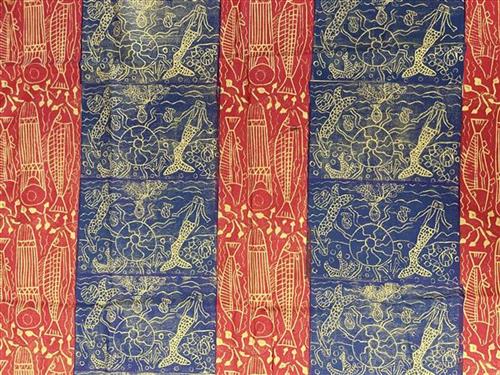
– Elizabeth Wullunmingu
Elizabeth Wullunmingu – Jin-merduwa (Mermaid) from Gupanga
My niece, Stephanie James is singing a song called Diyama and it is about Jin-merduwa. She is in the Ripple Effect Band. They are now famous in Maningrida and everywhere. Her great grandmother told her about the Jin-merduwa living at Gupanga/ Kupanga (sp?). I heard the story before Stephanie. Now I hear her singing the story about that place. I am very proud of her. We have the same country. Our stories match. She is singing the story and I am making artwork about the story.
My lino print shows the Jin-merduwa who live at Gupanga. Gupanga is located at the mouth of the Blyth River. It is a saltwater place. There must be more than one Jin-merduwa living there? They eat fish, shellfish and seaweed. Sometimes they travel to the end of the river to find food in the ocean, but they don’t go far and always swim back to their home.
Gupanga is a beautiful place. The sand is golden, there are mangroves, and the water is cloudy. It is good hunting in that area. When we lived there, we got lots of barramundi, mudcrabs, shellfish, everything!
This is a bit of a dangerous story. I can’t say too much about this sacred place. The Rangers help to look after this place, but they also know they must be careful.
Kuninjku people call mermaids yawkyawk. Yawkyawk are freshwater. In my language, Burarra we call them Jin-merduwa. Jin-merduwa are a bit different to yawkyawk but are also a type of mermaid.
I love to make lino print fabric showing Jin-merduwa. I like using bright colours but sometimes I print using black and white.
Ripple Effect Band – Diyama Song
https://rippleeffectband.bandcamp.com/track/diyama
This song was written by Stephanie James in her language of Burarra. It is about the mermaids that live in the river at her country of Kupanga.
Her father sings the Kun-borrk traditional music from the Diyama song cycle to link his daughter’s music to the past.
Credits
from Wárrwarra, released July 5, 2018
Written by Stephanie James, D. Maxwell (father for Stephanie)
Produced by Paul Mac, Jodie Kell, Clint Bracknell
Audio Engineer: Campbell Barnes
Guitar: Jodie Kell, Jolene Lawrence
Bass guitar: Tara Rostron
Drums: Jolene Lawrence
Keys: Patricia Gibson
Lead Vocals: Stephanie James
Back up Vocals: Jodie Kell
Diyama vocals: D. Maxwell

377810582149657
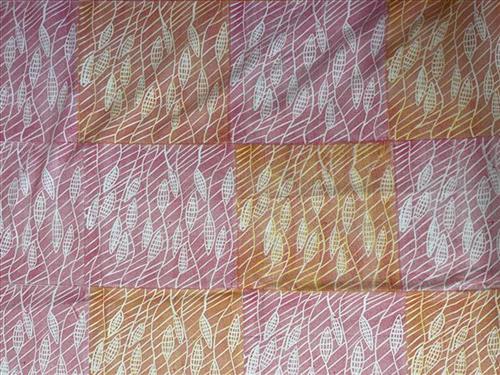
Bush Yam

377810582149654
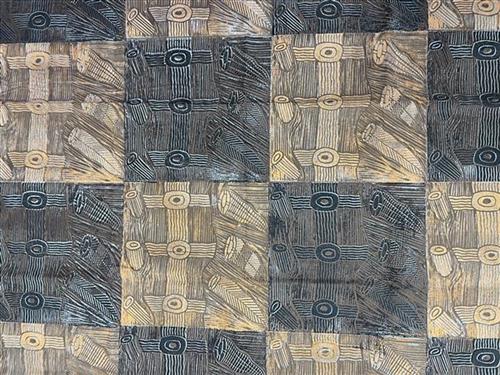
Marebu
Deborah Wurrkidj is a Kuninjku artist from the Kurulk clan whose country lies around the outstation of Mumeka in central Arnhem Land. She is an accomplished artist working across mediums including painting, sculpture, weaving and textile design. For this design, Deborah Wurrkidj has depicted Marebu (woven pandanus mats).
Works in fibre from the Maningrida region are widely recognised as some of the finest in Australia. Artists confidently push the boundaries of fibre craft and cultural expression, adapting traditional techniques and forms to produce strikingly inventive and aesthetically exquisite artworks.
Artists weave many different kinds of mats. Conical mats were traditionally used to shield babies from mosquitoes. Long flat mats were used for blocking creeks so that fish would be diverted into fish traps. A small triangular mat made of pandanus fibre used to be worn by women during ceremonial gatherings, tied around their back and covering them at the front. Mats are also used for wrapping and rinsing food in water.
Artists usually use kundayarr, pandanus spiralis, to weave decorative round or oblong mats, as well as the less common triangular and conical shapes. Weaving is physically hard work, now done only by women. They colour the pandanus using natural dyes made from the roots, leaves or flowers of plants within the weaver’s clan estate.
The radial woven patterns of the finest round mats appear to vibrate with colour, sometimes regarded as an aesthetic manifestation of deep cultural meaning, as there is a significant spiritual dimension to pandanus mats.