
377810582149475


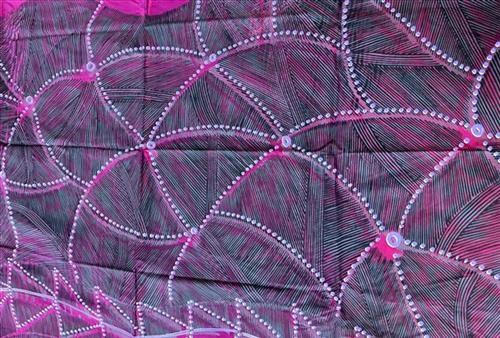
Kunkurra (Spiral Wind)

‘My designs, they are all alive living up in my head’- Janet Marawarr

Janet Marawarr has depicted kunkurra, the spiralling wind associated with several sites in the Kardbam clan. On one level, this design can be interpreted as a depiction of the kinds of mini-cyclones common during the wet season in Arnhem Land, where the artist lives. Kunkurra also relates specifically to a site called Bilwoyinj, near Mankorlod, on the artist’s clan estate.

At this site, two of the most important Kuninjku creation beings, a father and son known as na-korrkko, are believed to have hunted and eaten a goanna. They left some of the goanna fat behind at the site, which turned into the rock that still stands there today.

Bilwoyinj site is also a ceremonial ground for a ceremony called Yabbaduruwa, a major ceremony owned by the Yirridja patrimoiety. The Yabbaduruwa ceremony is primarily concerned with initiation, land ownership and promoting the cyclical regeneration of the human and natural worlds.

377810582149474


Gurrpurdu (Diving Bird)

A design by emerging textile designer, Charmaine Pascoe.

‘My Gurrpurdu (diving bird) was white. She flew from Gan Gan to Gapuwiyak and then to Yathalamarra. And then she flew to Gartji.

At Gartji two fresh water seaweed shoots, one long and one short were trying to keep diving bird down. They were saying, “Don’t go away you belong to this country”.  Diving bird said “No! I’m going to travel around to other country”.  She was flapping her wings and then those two seaweed shoots let her go.

Then diving bird flew to make water hole at Gamurra Gu-yurra. She tasted the water but it was salty not fresh water. Then she put her poo like white clay on the ground at Gamurra Gu-yurra. The while clay was used for painting, funerals and ceremonies.

Then she continued to fly to Ji-balbal where she put the white clay again and then from Ji-balbal she dived underwater to Gochan Jiny-jirra. When she got there she got out of the water and was flapping her wings. At the same time she was singing. She was using her wings to dry out so that she could fly to Nangak.’ Charmaine Pascoe 2020

377810582149472


Gurrpurdu (Diving Bird)

A design by emerging textile designer, Charmaine Pascoe.

‘My Gurrpurdu (diving bird) was white. She flew from Gan Gan to Gapuwiyak and then to Yathalamarra. And then she flew to Gartji.

At Gartji two fresh water seaweed shoots, one long and one short were trying to keep diving bird down. They were saying, “Don’t go away you belong to this country”.  Diving bird said “No! I’m going to travel around to other country”.  She was flapping her wings and then those two seaweed shoots let her go.

Then diving bird flew to make water hole at Gamurra Gu-yurra. She tasted the water but it was salty not fresh water. Then she put her poo like white clay on the ground at Gamurra Gu-yurra. The while clay was used for painting, funerals and ceremonies.

Then she continued to fly to Ji-balbal where she put the white clay again and then from Ji-balbal she dived underwater to Gochan Jiny-jirra. When she got there she got out of the water and was flapping her wings. At the same time she was singing. She was using her wings to dry out so that she could fly to Nangak.’ Charmaine Pascoe 2020

377810582149469


Gurrpurdu (Diving Bird)

A design by emerging textile designer, Charmaine Pascoe.

‘My Gurrpurdu (diving bird) was white. She flew from Gan Gan to Gapuwiyak and then to Yathalamarra. And then she flew to Gartji.

At Gartji two fresh water seaweed shoots, one long and one short were trying to keep diving bird down. They were saying, “Don’t go away you belong to this country”.  Diving bird said “No! I’m going to travel around to other country”.  She was flapping her wings and then those two seaweed shoots let her go.

Then diving bird flew to make water hole at Gamurra Gu-yurra. She tasted the water but it was salty not fresh water. Then she put her poo like white clay on the ground at Gamurra Gu-yurra. The while clay was used for painting, funerals and ceremonies.

Then she continued to fly to Ji-balbal where she put the white clay again and then from Ji-balbal she dived underwater to Gochan Jiny-jirra. When she got there she got out of the water and was flapping her wings. At the same time she was singing. She was using her wings to dry out so that she could fly to Nangak.’ Charmaine Pascoe 2020

377810582149343


Gunga (Pandanus)

Gunga refers to the weaving and production of goods from pandanus leaves and natural fibres. This design depicts fibre art from her homeland Galiwinku, Elcho Island.

The fish trap, basket, string bag and pandanus mats are objects as well as ancestral spirits and are significant to the artists as together they relate to her djang (Aboriginal religious belief).

Fish traps are woven by hand using the milirl (Burney vine, Trophis scandens) from the jungle, which is soaked overnight to make it soft. Fish traps are used by both saltwater and freshwater hunters. Baskets and pandanus mats are made from pandanus leaves, which are collected using long hooks, stripped, dried, boiled in natural dye, then woven.

377810582149305


Kunwardde dja Karrbarda (Rocks and Yam Vine)

Susan Marawarr is a Kuninjku artist from the Kurulk clan whose country lies around the outstation of Mumeka in central Arnhem Land. In this design, she has depicted karrbarda (long yam) on her traditional country, the kunwardde (stone country).

The large stones represent the kunwardde rocky outcrops, which are elevated above the flat floodplains. The vines creeping around the large rocks are from the karrbarda. Women dig up karrbarda with kungarrndutj (digging sticks) and they are then cooked in the ashes of the fire to be eaten.

These yams are purple on the saltwater side of country and on inland freshwater country they are white. Karrbarda are an important manme (bush food) that are collected during the wet and dry seasons.

377810582149304


Kunwardde dja Karrbarda (Rocks and Yam Vine)

Susan Marawarr is a Kuninjku artist from the Kurulk clan whose country lies around the outstation of Mumeka in central Arnhem Land. In this design, she has depicted karrbarda (long yam) on her traditional country, the kunwardde (stone country).

The large stones represent the kunwardde rocky outcrops, which are elevated above the flat floodplains. The vines creeping around the large rocks are from the karrbarda. Women dig up karrbarda with kungarrndutj (digging sticks) and they are then cooked in the ashes of the fire to be eaten.

These yams are purple on the saltwater side of country and on inland freshwater country they are white. Karrbarda are an important manme (bush food) that are collected during the wet and dry seasons.

377810582149467


Eiffel tower and the Maladj spirit

“I want to tell you about my design, that Eiffel tower one.

This year it was my first time going to Paris. I didn’t know that place, nothing. We travelled around the world to get there, we flew underneath the world in an aeroplane.

Paris was a big, crowded city. They speak a different language there, just like here in Maningrida with all our different languages.

The Bábbarra artists and Ingrid, we were all walking around, like tourists. We went on the boat in the Paris river. There was a film crew taking videos of us. We saw so many beautiful buildings covered with black string (iron balconies) and big statues. We’d never seen things like that before.

I remember when we got off that boat and I looked up and saw that tower. When I first looked up at that tower, it made me happy- it’s so long up into the sky. We walked towards it. I was standing there watching that tower and thinking, ‘wow, first time for me seeing a tower like that’.

Then I was thinking, and I said to myself, when I go back to my own country, I’m going to paint that tower.

We came to Maningrida, I started to draw. I drew that tower from France, but also I drew maladj (stone country orphan spirit), women’s sacred woven mat, fish traps and rolk (insects). I also put round kunngol (clouds) in the design, those circles. That maladj spirit, it’s standing there next to the Eiffel tower, looking at the dancing lights at night. The tower is from Paris, but everything else in my design I took from my mother’s country and my father’s country.

Maybe one day I’ll travel back to France, and take my design with me to show them, all the French mob.” Janet Marawarr

377810582149466


Eiffel tower and the Maladj spirit

“I want to tell you about my design, that Eiffel tower one.

This year it was my first time going to Paris. I didn’t know that place, nothing. We travelled around the world to get there, we flew underneath the world in an aeroplane.

Paris was a big, crowded city. They speak a different language there, just like here in Maningrida with all our different languages.

The Bábbarra artists and Ingrid, we were all walking around, like tourists. We went on the boat in the Paris river. There was a film crew taking videos of us. We saw so many beautiful buildings covered with black string (iron balconies) and big statues. We’d never seen things like that before.

I remember when we got off that boat and I looked up and saw that tower. When I first looked up at that tower, it made me happy- it’s so long up into the sky. We walked towards it. I was standing there watching that tower and thinking, ‘wow, first time for me seeing a tower like that’.

Then I was thinking, and I said to myself, when I go back to my own country, I’m going to paint that tower.

We came to Maningrida, I started to draw. I drew that tower from France, but also I drew maladj (stone country orphan spirit), women’s sacred woven mat, fish traps and rolk (insects). I also put round kunngol (clouds) in the design, those circles. That maladj spirit, it’s standing there next to the Eiffel tower, looking at the dancing lights at night. The tower is from Paris, but everything else in my design I took from my mother’s country and my father’s country.

Maybe one day I’ll travel back to France, and take my design with me to show them, all the French mob.” Janet Marawarr

377810582149465


Eiffel tower and the Maladj spirit

“I want to tell you about my design, that Eiffel tower one.

This year it was my first time going to Paris. I didn’t know that place, nothing. We travelled around the world to get there, we flew underneath the world in an aeroplane.

Paris was a big, crowded city. They speak a different language there, just like here in Maningrida with all our different languages.

The Bábbarra artists and Ingrid, we were all walking around, like tourists. We went on the boat in the Paris river. There was a film crew taking videos of us. We saw so many beautiful buildings covered with black string (iron balconies) and big statues. We’d never seen things like that before.

I remember when we got off that boat and I looked up and saw that tower. When I first looked up at that tower, it made me happy- it’s so long up into the sky. We walked towards it. I was standing there watching that tower and thinking, ‘wow, first time for me seeing a tower like that’.

Then I was thinking, and I said to myself, when I go back to my own country, I’m going to paint that tower.

We came to Maningrida, I started to draw. I drew that tower from France, but also I drew maladj (stone country orphan spirit), women’s sacred woven mat, fish traps and rolk (insects). I also put round kunngol (clouds) in the design, those circles. That maladj spirit, it’s standing there next to the Eiffel tower, looking at the dancing lights at night. The tower is from Paris, but everything else in my design I took from my mother’s country and my father’s country.

Maybe one day I’ll travel back to France, and take my design with me to show them, all the French mob.” Janet Marawarr