


377810582397474
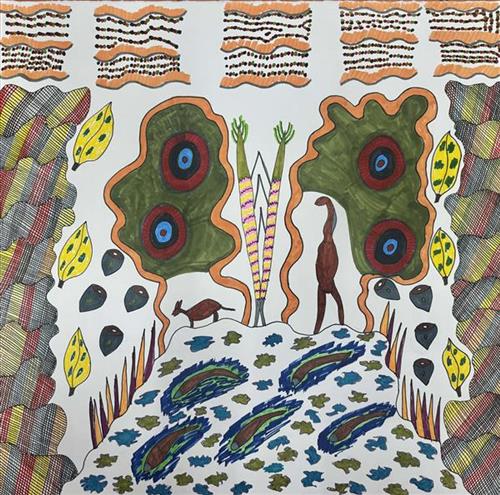
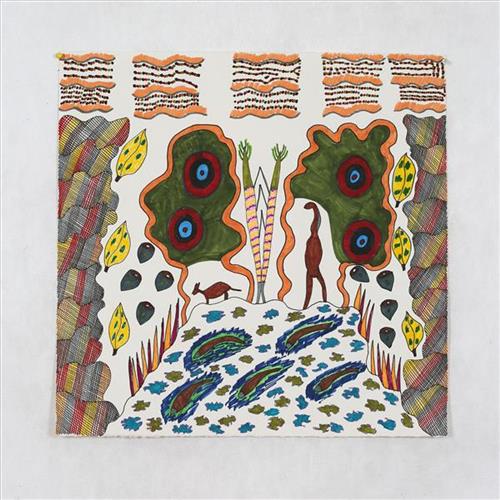
Djarnbokkorn and kulabbarl (sacred dog and billabong) – Work 4
Work 4 of 9 drawings in series Ngaldjorlhbo (Mother of Everything)
Artist short statement:
(And the old lady Ngaldjorlhbo says:) ‘then I made this’
She was carrying her own dillybag and was walking slowly and she kept looking at Country. She made the rocks, the rivers. In the same way she made the fish and she also made the animals and the butterflies. She kept on creating all this while walking.
She made the water spirit mermaids from the sea so she kept on walking while creating all the things. She also made the mimih spirits – the spirit of the rocks. She also created Djarnbokkorn, the sacred dog. And then she created Ngalng, the yabby. Then she made the Namorrorddo – the shooting star spirit, who lives inside the hill. Then she made the freshwater mermaids and she kept on going and she made Ngalyod (rainbow serpent). Then she named those two humans, Kodjok and Kamanj. So she made all the humans and those two put themselves there.That is the right order, it is the order in which the old woman spirit created everything.
BKRLCC_ translations, transcriptions and spell check by Claudia Cialone and Jill Nganjmirra,Bàbbarra_narrating voice – Janet Marawarr, recorded by Jessica Rosalie Stalenberg.
377810582397473

Ngaldjorlhbo (Mother of Everything)
Ngaldjorlhbo is a powerful woman who created the spiritual and tangible world for the Aboriginal people in Western Arnhem Land. In creating the land and environment, she endowed Kuninjku people with the ability to create art, and with their culture, to share with future generations. Ngaldjorlhbo gives women the cultural knowledge and deep links to country, identity and ancestor spirits.
Ngaldjorlhbo created daluk (women) When she started walking she started talking and telling stories. She create, came together as one. She was walking, thinking and writing with her hand creating all the animals and trees. Creating mountains and rivers. Came together and made a beautiful flowing wind and river to the coming of the land. From fresh water to the salt water river, all the fish, all kinds of fish she created .From little bird, big bird she created. She came all the way from east, west, north and south. She knows all the places from this land. She was speaking, she was telling, she was creating the country, this world. She was carrying kunmadj and digging stick and she created yawkyawk. So that’s the story about Ngaldjorlhbo.’ JM 2022
(And the old lady Ngaldjorlhbo says:) ‘then I made this’
She was carrying her own dillybag and was walking slowly and she kept looking at Country. She made the rocks, the rivers. In the same way she made the fish and she also made the animals and the butterflies. She kept on creating all this while walking.
She made the water spirit mermaids from the sea so she kept on walking while creating all the things. She also made the mimih spirits – the spirit of the rocks. She also created Djarnbokkorn, the sacred dog. And then she created Ngalng, the yabby. Then she made the Namorrorddo – the shooting star spirit, who lives inside the hill. Then she made the freshwater mermaids and she kept on going and she made Ngalyod (rainbow serpent). Then she named those two humans, Kodjok and Kamanj. So she made all the humans. JM 2026
377810582415005

Wayuk (Waterlily)
Wayuk (Waterlily) Nymphaea violacea.
The stem of wayuk is a popular bushfood and the beautiful flower is enjoyed across Arnhem Land.
This fabric was created using the linocut printing technique. The lino tile has been carved by the artist in Maningrida, and has been printed by hand using a variety of colours and layers. The linocut technique ensures each textile piece is a one-off, limited edition piece. Bábbarra Women’s Centre supports the economic independence of Indigenous women in the Arnhem Land community of Maningrida, Northern Territory, Australia. Designs created by the women at Bábbarra reflect strong cultural knowledge, which is passed down to younger generations through their textile design practice.
377810582415101

Mandjabu (Fish Trap)
Kuninjku people traditionally make two sorts of conical fish traps. One is called mandjabu and is made from a strong, durable vine called milil, and a smaller one is called manylik mandjabu, and made from the grass manylik. The mandjabuconical fish trap is bigger and stronger and used in tidal reaches of creeks to catch large fish. The smaller, lighter manyliktrap is used in freshwater flowing creeks to catch smaller fish and freshwater prawns. In earlier times, only men were involved in the construction of the large fish traps, but children would often crawl inside and assist.
To make mandjabu, weavers firstly harvest milil (burney vine, Malaisia scandens) and put it in water overnight to make it soft. Then they start weaving it; they make rings for the inside to keep the fish trap’s shape. People also make string from the bark of burdaga (kurrajong) to attach the bardainy (hibiscus) rings and to tie the conical end of the fish trap. It’s hard work and it can take three or four weeks to make a fish trap. People also use fish-net fences called kunkarlewabe. They would put the kunkarlewabe across rivers and creeks. In the middle they would place the mandjabu. They also used small things like sticks, rocks, mud and grass to block the fish from going through. This way we would catch fish such as saltwater barramundi rajarra, ngaldadmurrng (freshwater barramundi), small black freshwater catfish (buliya), bonefish (an-guwirrpiya), and sand bass (dalakan) in the mandjabu.

377810582415035

Mankorlod Kunred (country)
A major work by Janet Marawarr that is a djang history story about Mankorlod country.
‘In the middle that’s the waterhole. It’s the story – in the red and the green one. It’s got red water hold and kundalk – razer grass. This is Mankorlod country with Rarrk (crosshatching) in the middle. The yellow one is footprints.
This is the design that we show the people how to walk a long time ago. Kunwarrde, rocks is there too in red, cut in pieces. People were there at Mankorlod and they talk to each other.’ Janet Marawarr 2025

377810582415004

Wayuk (Waterlily)
Wayuk (Waterlily) Nymphaea violacea.
The stem of wayuk is a popular bushfood and the beautiful flower is enjoyed across Arnhem Land.
This fabric was created using the linocut printing technique. The lino tile has been carved by the artist in Maningrida, and has been printed by hand using a variety of colours and layers. The linocut technique ensures each textile piece is a one-off, limited edition piece. Bábbarra Women’s Centre supports the economic independence of Indigenous women in the Arnhem Land community of Maningrida, Northern Territory, Australia. Designs created by the women at Bábbarra reflect strong cultural knowledge, which is passed down to younger generations through their textile design practice.

377810582415001

Long Neck turtle and Saratoga
This fabric was created using the linocut fabric printing technique, which has been refined at Bábbarra Women’s Centre since it was introduced in the mid-1990s.
The Lino tile is carved by the artist at Bábbarra Designs. It is printed on fabric by hand using a variety of colours and layers. The linocut technique ensures each textile is a one-off, limited edition piece.
The fabric is colour-safe and can be thrown into a washing machine. Repeated use will soften the fabric, and some fading will occur over time.
Bábbarra Women’s Centre supports the economic independence of Indigenous women in the Arnhem Land community of Maningrida, Northern Territory, Australia. Designs created by the women at Bábbarra reflect strong cultural knowledge, which is passed down to younger generations through their textile design practice.
‘Themes in our artwork almost exclusively come from our Country and cultural connection. Our deep relationship with the land and seas of our customary clan estates strongly defines and governs the social, cultural, spiritual and territorial aspects of our lives.’
Bábbarra Designs Artist Statement
377810582414996

Team Seagulls
Go Seagulls! Go!
The Seagulls are a local Maningrida AFL team. Joy created a Lino design to celebrate her team and made a banner. The print has become a favourite for fashion and homewares.

377810582414992
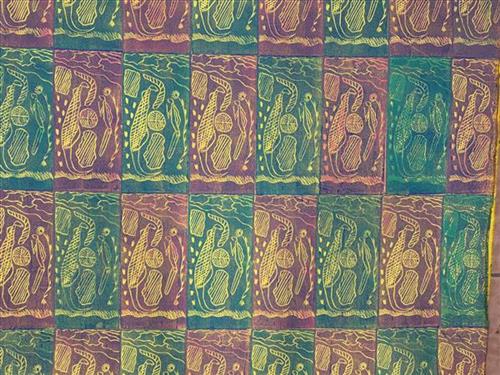
Ngalyod (rainbow serpent) and Mimih
This fabric was created using the linocut fabric printing technique, which has been refined at Bábbarra Women’s Centre since it was introduced in the mid-1990s.
The Lino tile is carved by the artist at Bábbarra Designs. It is printed on fabric by hand using a variety of colours and layers. The linocut technique ensures each textile is a one-off, limited edition piece.
The fabric is colour-safe and can be thrown into a washing machine. Repeated use will soften the fabric, and some fading will occur over time.
Bábbarra Women’s Centre supports the economic independence of Indigenous women in the Arnhem Land community of Maningrida, Northern Territory, Australia. Designs created by the women at Bábbarra reflect strong cultural knowledge, which is passed down to younger generations through their textile design practice.
‘Themes in our artwork almost exclusively come from our Country and cultural connection. Our deep relationship with the land and seas of our customary clan estates strongly defines and governs the social, cultural, spiritual and territorial aspects of our lives.’
Bábbarra Designs Artist Statement