115682400014


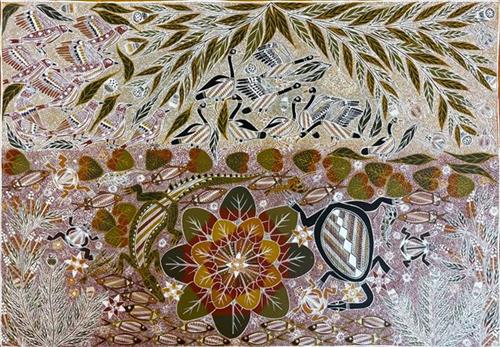
Raypiny Dhawu (Fresh Water Story)

All Aboriginal people originate from a spiritual source, fixed in a particular place in their land or the sea. These ‘spiritual reservoirs’ are often in the form of special waterholes made by Wangarr (creative spirits) that were created long ago close to the beginning of time. These creator beings moved across the countryside, shaping the land and implanting in each tract of country, the spiritual life force for the people who were to own it. These creative spirits took many forms and when they gave the land to each group, they also gave songs, dances, ceremony, the associated laws and language.


The creation story for Ganalbingu people took place near the middle section of the Glyde River where it becomes the Goyder River. Their land, Ngaliyindi, sits astride the Arafura Swamp in Central Arnhem Land. Many Ganalbingu artists paint totemic species significant to their clan. These can include baru (crocodile), banda (long necked turtle), buliya (catfish), yalman (waterlilies), gumang (magpie geese), dakawa (fresh water yabby), ratjuk (barramundi), warrnyu (flying fox) and more.
 

115682407148


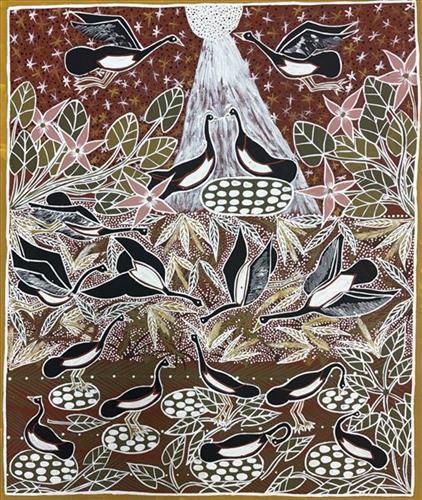
Gumang (Magpie Geese)

The Yolngu people of Arnhem Land originate from a spiritual source, fixed in a particular place in their land or the sea. These ‘Spiritual Reservoirs’ are often in the form of special waterholes made by Wangarr (Creative Beings) long ago close to the beginning of time.

The creator beings moved across the country side, shaping the land and implanting in each tract of country, the spiritual life force for the people who were to own it. These Creative Spirits took many forms. When they gave the land to each group they also gave songs, dances, ceremony, the associated laws and language. The Creation story for Ganalbingu people took place near the middle section of the Glyde River where it becomes the Goyder River. Their land, Ngaliyindi, sits astride the Arafura Swamp in Central Arnhem Land.

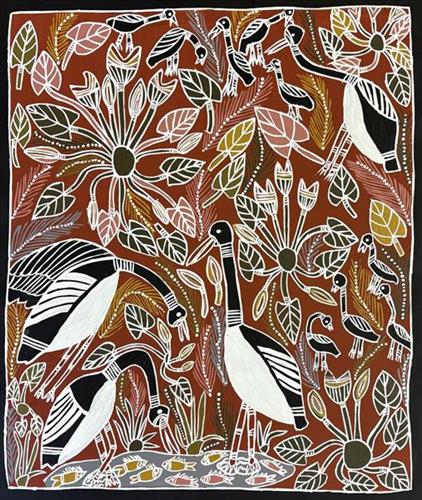
In this painting, the artist has depicted Gumang (magpie geese), which are sacred to the Ganalbingu people. To the east of the Arafura Swamp is a freshwater billabong which is said to have been made by the Goose Spirit and is in the shape of a goose nest. As a result, geese, their eggs and their nests are sacred.

115682408592


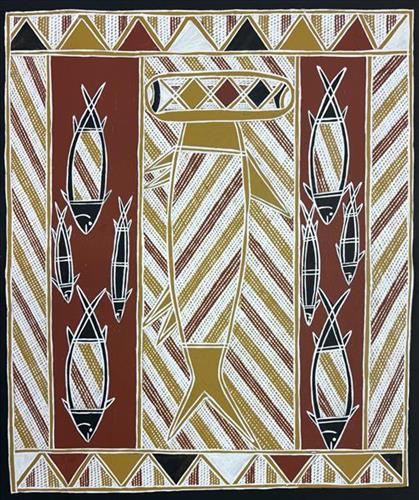
Balgabalga (Hammerhead shark)

This painting depicts Balgabalga (Hammerhead shark) and Bula (Short sucker fish). Balgabalga is a significant totemic species for the Gupapuyngu people from Djiliwirri and is represented through songlines and storylines in which the Bula follows the Balgabalga like a shadow. 

115682409425


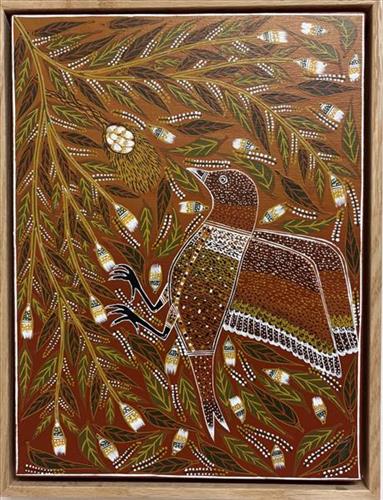
Lidji Lidji (Finch)

This artwork represents totemic finches. These birds herald the beginning of the dry season and are associated with the Ganalbingu clan. Lidji Lidji are also represented in ceremonial song and dance.

115682410133


Woven Mat

Yolŋu weavers of Arnhem Land create utilitarian, ceremonial, and decorative pieces using naturally sourced materials. This mat is made from young Pandanus spiralis leaves, harvested with a wooden hook, stripped of prickles, and dried to create strong, resilient fibres. These fibres are then twisted, coiled, or woven using traditional techniques to produce both functional and decorative mats.

Bula’bula weavers exclusively use natural dyes, derived from locally sourced roots, leaves and grasses. These pigments are extracted and infused into pandanus fibres by boiling over an open fire, producing the rich, vibrant colours characteristic of contemporary Yolŋu weavings.

Traditionally, Nganiyal (conical mats) functioned as insect screens when erected and as seating mats when folded, playing an important role in both daily life and ceremonial practices. Today, Yolŋu artists create a variety of shapes, including flat, round, and oblong mats. These non-traditional styles and the use of bright colours became more common after Missionaries began commissioning pieces in this style.

115682410710


Raki (hand spun bush string)

String is primarily made from the bark of Baḻgurr (Red-flowered Kurrajong – Brachychiton megaphyllus) but sometimes Banyan tree (Ficus virens) and Cocky Apple tree (Planchonia careya). Sections of the tree are cut, and depending on the size, whole portions or part portions from the trunk. The inner bark is beaten or chewed to soften then dyed with natural bush dyes. Once softened and dyed, parts of the fibre are separated into fine strips then rolled on the thigh to create a rope otherwise known as bush string. The bush string is a useful Yolngu item- it can be made into string bags, rope for fishing,  ceremonial items such as headbands, armbands, skirts and many other items.

115682406862


Gumang (Magpie Geese)

The Yolngu people of Arnhem Land originate from a spiritual source, fixed in a particular place in their land or the sea. These ‘Spiritual Reservoirs’ are often in the form of special waterholes made by Wangarr (Creative Beings) long ago close to the beginning of time.

The creator beings moved across the country side, shaping the land and implanting in each tract of country, the spiritual life force for the people who were to own it. These Creative Spirits took many forms. When they gave the land to each group they also gave songs, dances, ceremony, the associated laws and language. The Creation story for Ganalbingu people took place near the middle section of the Glyde River where it becomes the Goyder River. Their land, Ngaliyindi, sits astride the Arafura Swamp in Central Arnhem Land.

In this painting, the artist has depicted Gumang (magpie geese), which are sacred to the Ganalbingu people. To the east of the Arafura Swamp is a freshwater billabong which is said to have been made by the Goose Spirit and is in the shape of a goose nest. As a result, geese, their eggs and their nests are sacred.

115682408138


Wurrutjara (Sand Palm)

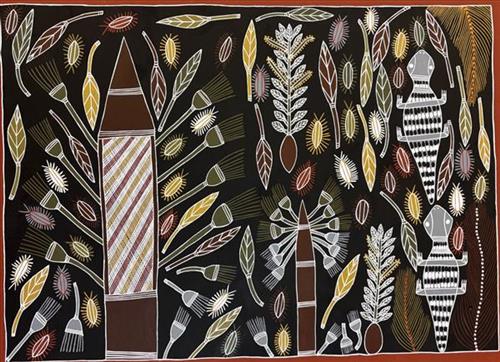
Seen in and around Ramingining, the sand palm is a small, slender palm, growing to about 7 m tall. It is fire tolerant and usually grows in environments where it is exposed to frequent fires. Aboriginal people use this palm as the fruits are edible and the heart  can be eaten, either raw or roasted. The core of the stem is pounded and made into a drink which was used to treat coughs, colds, chest infections, diarrhoea, and tuberculosis.

She has also painted itchy caterpillar and geckos. 

115682408310


Maliya (sailfin dragonet)

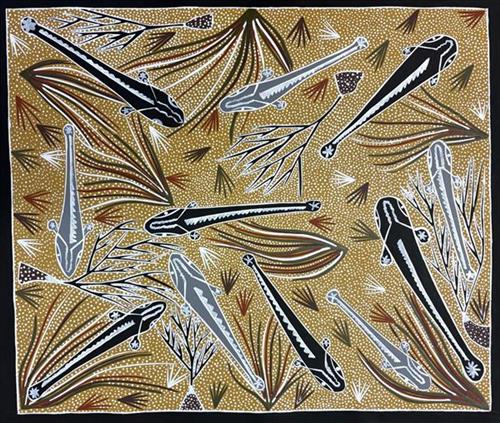
Aboriginal art in Ramingining, Central Arnhem Land is commonly illustrated through designs and images of animals, plants, and landscape. These motifs commonly reflect the artists ancestral inheritance and their dreamings and are referred to as totems.

For this painting, has painted his mother’s totem- Maliya (sailfin dragonet)

115682409564


Woven Barramundi

Yolŋu weavers of Arnhem Land craft both utilitarian and ceremonial objects using naturally sourced materials, with more recent works also including decorative pieces, such as this woven barramundi.

The primary material used in this piece is the young, green leaves of the Pandanus spiralis tree, that are harvested using a long wooden hook. The leaves are stripped of their prickles, with the smaller fibres being dried to produce a strong, resilient material. These fibres are then twisted, coiled, or combined using various techniques to create this motif of a barramundi, a vital and abundant food source for Yolŋu people.

Bula’bula weavers exclusively use natural dyes, derived from locally sourced roots, leaves and grasses. These pigments are extracted and infused into pandanus fibres by boiling over an open fire, producing the rich, vibrant colours characteristic of contemporary Yolŋu weavings.