Hunting Story
Johnny’s painting depicts and old way of life- hunting next to the river. You can see Yolngu are spearing the fish, and have also places a fish trap in the water. He has also paintings two camps- with a shelter and a fire.
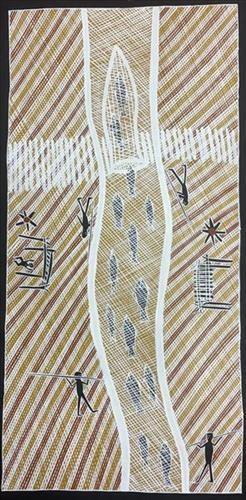
Johnny’s painting depicts and old way of life- hunting next to the river. You can see Yolngu are spearing the fish, and have also places a fish trap in the water. He has also paintings two camps- with a shelter and a fire.
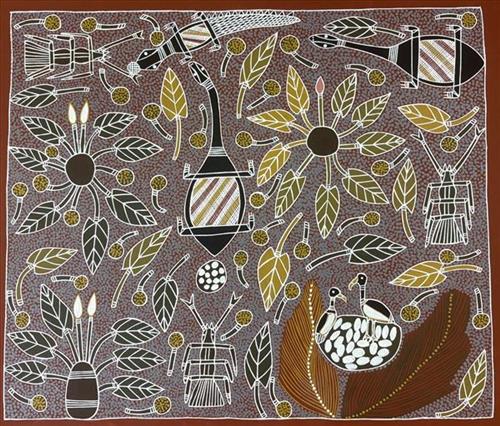
All Aboriginal people originate from a spiritual source, fixed in a particular place in their land or the sea. These ‘spiritual reservoirs’ are often in the form of special waterholes made by Wangarr (creative spirits) that were created long ago close to the beginning of time. These creator beings moved across the countryside, shaping the land and implanting in each tract of country, the spiritual life force for the people who were to own it. These creative spirits took many forms and when they gave the land to each group, they also gave songs, dances, ceremony, the associated laws and language.
The creation story for Ganalbingu people took place near the middle section of the Glyde River where it becomes the Goyder River. Their land, Ngaliyindi, sits astride the Arafura Swamp in Central Arnhem Land. Many Ganalbingu artists paint totemic species significant to their clan. These can include baru (crocodile), banda (long necked turtle), buliya (catfish), yalman (waterlilies), gumang (magpie geese), dakawa (fresh water yabby), ratjuk (barramundi), warrnyu (flying fox) and more.
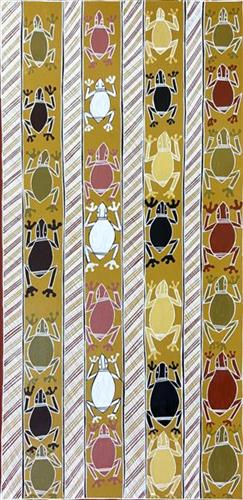
This painting represents Bak’bididi (frogs) sitting around a billabong. The Arafura wetlands across East Arnhem Land are filled with billabongs during the wet season, providing the perfect living conditions for bak’bididi. Their calls you can hear far and wide during the day and night.
Banumbirr – Morning Star Ceremony (Dhuwa moiety)
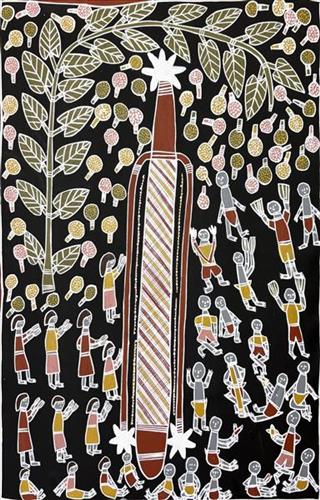
The Morning Star Ceremony is from the Dhuwa moiety. I have painted the ceremony here. It’s got leaves from the banyan tree (ficus virnens) that makes figs for people to eat – they are part of our bush tucker.
The Morning Star is from my great grandfather, my grandfather and my father. I paint it for my family to show my sisters and brothers. My grandfather and my father have both passed away, so I teach the bunggul (dancing) to my children.
We make a little Morning Star (you can see a man holding that on the right side of the painting), so the big Morning Star can came out. It is a long ceremonial pole that we dance around. You can also see the little Morning Star in this painting. There are men with yidaki (didjeridoo) and bilma (clap sticks) singing the Morning Star song cycle part for my people. The women have banyan tree leaves that they are dancing with.
We make a big Morning Star pole as part of the ceremony. You can see that in the middle of this painting.
Banumbirr – Morning Star – is an exchange ceremony with other clans in the Bapurru (clan group).
The Morning Star is the first star you see in the sky in the mornings.
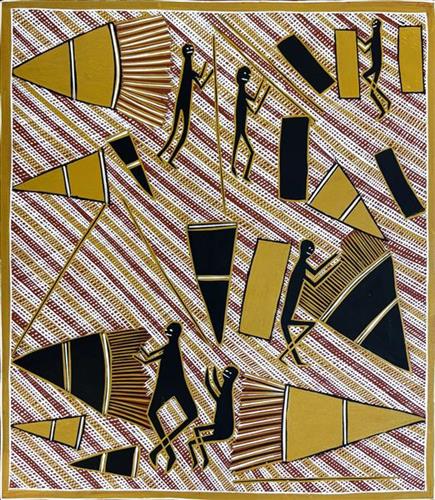
This painting is inspired by a larger artwork by George Milpurrurru (dec.), which in turn was inspired by photographs taken by anthropologist, Donald Thompson.
During the wet season, Aboriginal people lived in a circular paperbark house like a large igloo in which a fire was kept permanently lit to keep the mosquitos out. This painting depicts the men gathering pieces of paperbark and attaching them to the shelter.
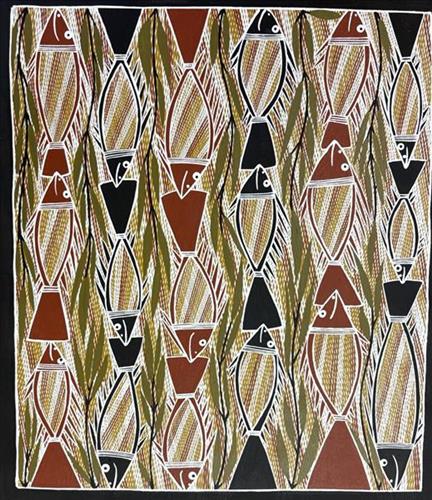
JB paints stories from his Dhuwa homeland in northeast Arnhem Land. Stories are passed on either paternally or maternally, and JB would have learnt these stories from his ancestors. The cross-hatching style is a traditional painting style of this area and can represent elements such as water, air and wind.
JB’s paintings often feature totemic animals of the fresh waters of north east Arnhem Land.
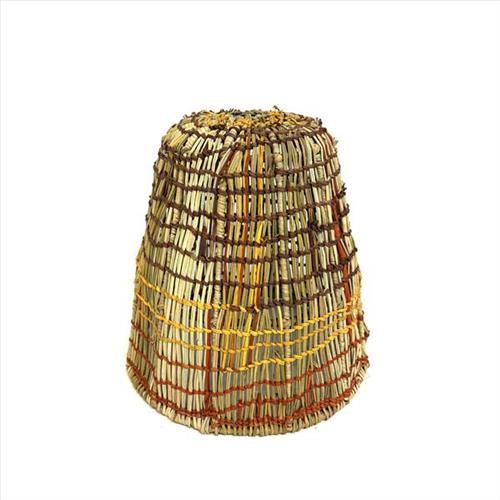
This beautiful lampshade is made with pandanus. Once harvested from the jungle, the fibres are dyed with roots, barks, leaves or fruits making the natural dyes.
The weavers of Ramingining in Northeast Arnhem Land usually create traditional ceremonial and ritual objects working together as a group to harvest materials and develop work yet each with their own contemporary colourful and unique designs. This is one of the first times they have embraced making objects which are not traditional Yolngu objects and the strength of their identity as late career Yolngu Artists is distilled in these lampshades.
Exquisite craftsmanship manually transferred from Grandmothers, Mothers and Aunties is used to create these stunning lampshades which look amazing with lighting projecting the rhythms and patterns or without lighting to appreciate the colour, the intricacies and detail of the design.
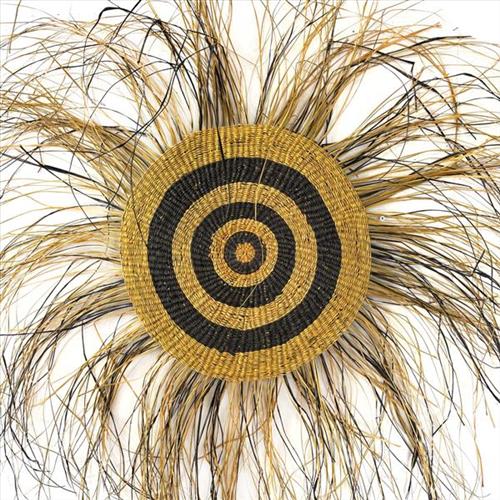
Yolŋu weavers of Arnhem Land create utilitarian, ceremonial, and decorative pieces using naturally sourced materials. This mat is made from young Pandanus spiralis leaves, harvested with a wooden hook, stripped of prickles, and dried to create strong, resilient fibres. These fibres are then twisted, coiled, or woven using traditional techniques to produce both functional and decorative mats.
Bula’bula weavers exclusively use natural dyes, derived from locally sourced roots, leaves and grasses. These pigments are extracted and infused into pandanus fibres by boiling over an open fire, producing the rich, vibrant colours characteristic of contemporary Yolŋu weavings.
Traditionally, Nganiyal (conical mats) functioned as insect screens when erected and as seating mats when folded, playing an important role in both daily life and ceremonial practices. Today, Yolŋu artists create a variety of shapes, including flat, round, and oblong mats. These non-traditional styles and the use of bright colours became more common after Missionaries began commissioning pieces in this style.
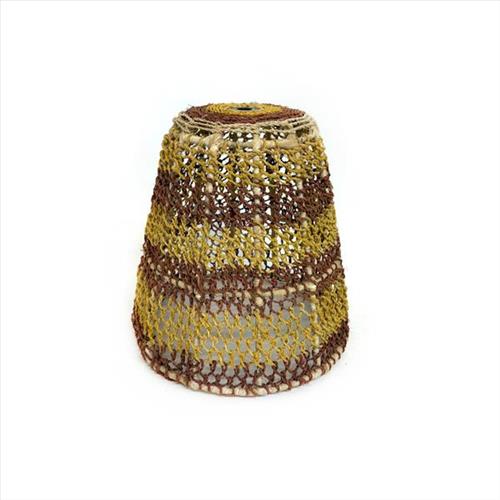
This beautiful lampshade is made with traditional Bush string made from the fibres between the bark and the trunk of the kurrajong tree. Once harvested from the jungle the fibres are dyed with roots, barks, leaves or fruits making the natural dyes. They are then rolled into this strong symmetrical handmade string and woven and knotted using techniques which originally bound together traditional Yolngu objects such as string bags and fishing nets and traps and used to make handles for carrying woven bags or used in ceremonial objects.
The weavers of Ramingining in Northeast Arnhem Land usually create traditional ceremonial and ritual objects working together as a group to harvest materials and develop work yet each with their own contemporary colourful and unique designs. This is one of the first times they have embraced making objects which are not traditional Yolngu objects and the strength of their identity as late career Yolngu Artists is distilled in these lampshades.
Exquisite craftsmanship manually transferred from Grandmothers, Mothers and Aunties is used to create these stunning lampshades which look amazing with lighting projecting the rhythms and patterns or without lighting to appreciate the colour, the intricacies and detail of the design.
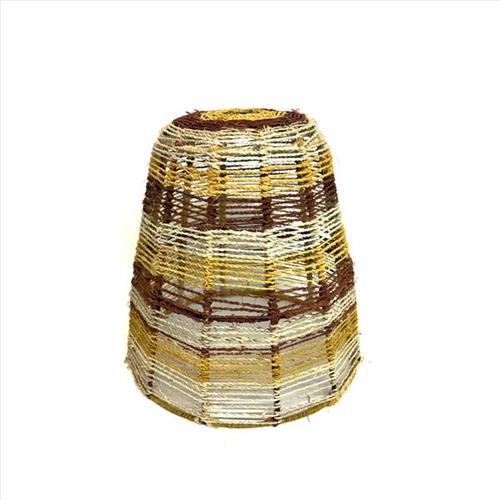
This beautiful lampshade is made with traditional Bush string made from the fibres between the bark and the trunk of the kurrajong tree. Once harvested from the jungle the fibres are dyed with roots, barks, leaves or fruits making the natural dyes. They are then rolled into this strong symmetrical handmade string and woven and knotted using techniques which originally bound together traditional Yolngu objects such as string bags and fishing nets and traps and used to make handles for carrying woven bags or used in ceremonial objects.
The weavers of Ramingining in Northeast Arnhem Land usually create traditional ceremonial and ritual objects working together as a group to harvest materials and develop work yet each with their own contemporary colourful and unique designs. This is one of the first times they have embraced making objects which are not traditional Yolngu objects and the strength of their identity as late career Yolngu Artists is distilled in these lampshades.
Exquisite craftsmanship manually transferred from Grandmothers, Mothers and Aunties is used to create these stunning lampshades which look amazing with lighting projecting the rhythms and patterns or without lighting to appreciate the colour, the intricacies and detail of the design.