115682348701


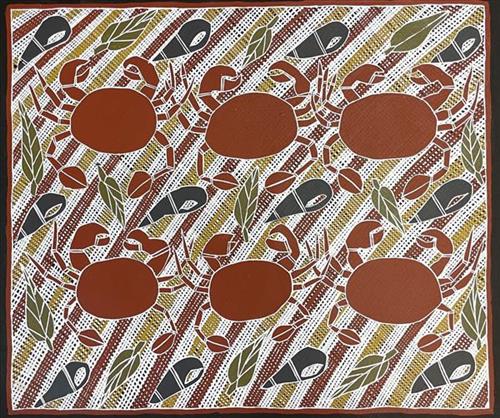
Nyoka (Mud crab)

Here the artist paints shellfish and mud crabs at Gariyak, the county represented in many paintings relating to the Djang’kawu Sisters’ journey. In the coastal mangroves the sisters hunted mud crabs, and baler and conch shells to eat.

115682349802


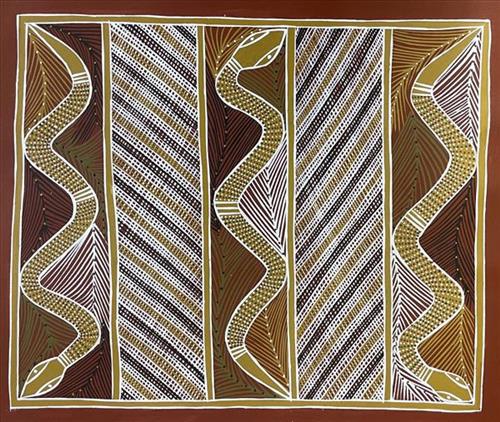
Gununggurr (Lightning Snakes)

The Yolngu people of Arnhem Land originate from a spiritual source, fixed in a particular place in their land or the sea. These ‘Spiritual Reservoirs’ are often in the form of special waterholes made by Wangarr (Creative Beings) long ago close to the beginning of time. These creator beings moved across the country side, shaping the land and implanting in each tract of country, the spiritual life force for the people who were to own it. These Creative Spirits took many forms. When they gave the land to each group they also gave songs, dances, ceremony, the associated laws and language. The Creation story for Ganalbingu people took place near the middle section of the Glyde River where it becomes the Goyder River. Their land, Ngaliyindi, sits astride the Arafura Swamp in Central Arnhem Land.

This painting is of Gunungurr, the black-nose python. Gunungurr is a creator being for the Ganalbingu people and is a bringer of lightning at the commencement of the wet season. Animals and plants are commonly portrayed in Arnhem Land art – often in association with ancestral places and seasonal events. This is because animals and plants were created through the activities of ancestral beings, and can represent them. In art, the animals and plants are usually depicted in a realistic style.
115682350130


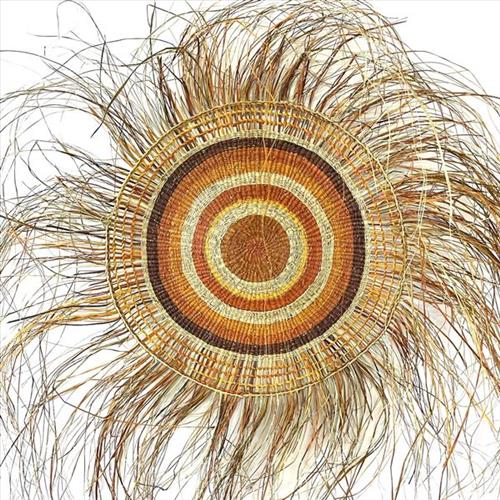
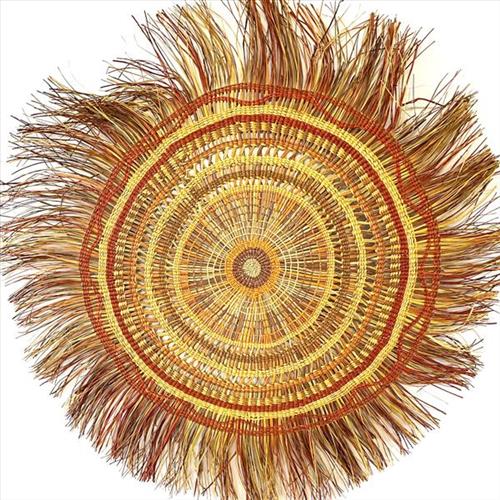
Woven Mat

Traditionally, Nganiyal (conical mats) were used as an insect screen when erected, and as a sitting mat when folded. They are used in Ceremony as well as a functional item. 

Nowadays, artists weave many different shapes including flat, round and oblong. 

115682350129


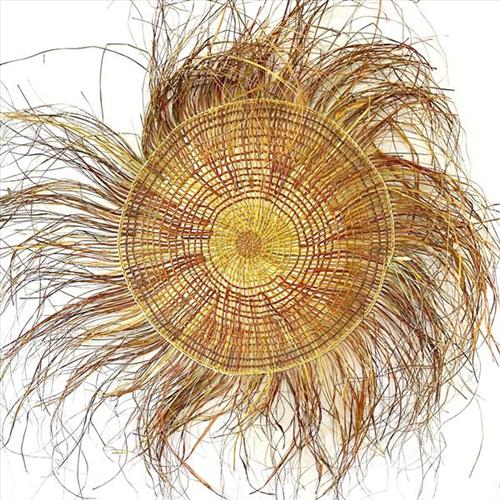
Woven Mat

Traditionally, Nganiyal (conical mats) were used as an insect screen when erected, and as a sitting mat when folded. They are used in Ceremony as well as a functional item. 

Nowadays, artists weave many different shapes including flat, round and oblong. 

115682350128


Woven Mat

Traditionally, Nganiyal (conical mats) were used as an insect screen when erected, and as a sitting mat when folded. They are used in Ceremony as well as a functional item. 

Nowadays, artists weave many different shapes including flat, round and oblong. 

115682350857


Bathi (Pandanus Basket)

Bathi are woven from the split leaves of the Screw Palm (Pandanus Spiralis). Coil weaving was introduced to Arnhem Land in the 1930s. It was adapted from techniques used by Indigenous women throughout South East Australia.

115682350855


Bathi (Pandanus Basket)

Bathi are woven from the split leaves of the Screw Palm (Pandanus Spiralis). Coil weaving was introduced to Arnhem Land in the 1930s. It was adapted from techniques used by Indigenous women throughout South East Australia.

115682350835


Mapu (egg)

Eggs are very important to Yolngu people. They are very common in the bush from both birds and reptiles such as magpie geese, lizards, turtles and crocodiles. They are used in ceremony and a food source.

The artists in Ramingining paint designs and images of animals, plants, and landscape. These motifs commonly reflect the artists ancestral inheritance and their totems and dreamings.