Status: Stock
115682055729
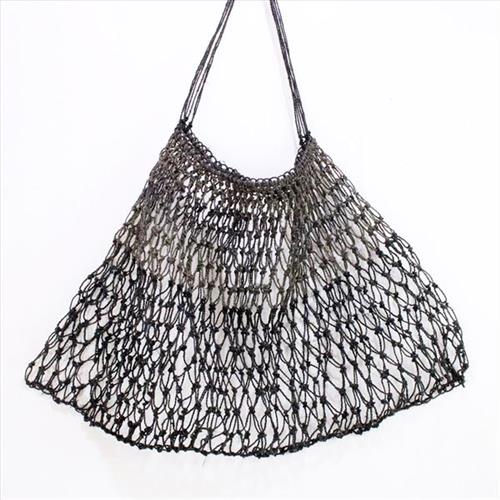
Djerrk / Gay’wu (Bush String Bag)
Hand spun bush string is made from the inner bark of the Banyan tree (ficus viarens), the Kurrajong tree (brachychiton paradoxum) or the Cocky Apple tree (planchonia careya). The bark from the young tree is beaten or chewed whilst still fresh. It is than pounded with a stone to separate the fibres which are then rolled and spun on the thigh. The string is then knitted or knotted to create a bag.
115682321357
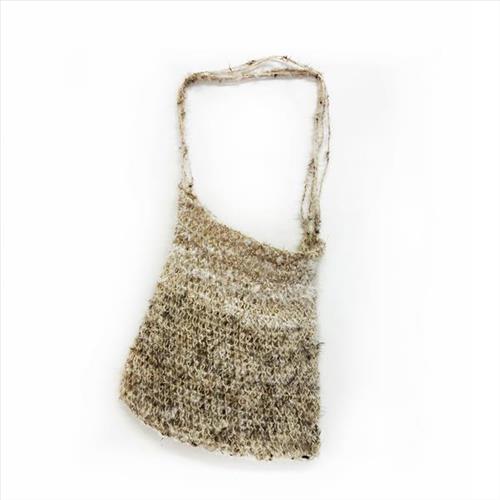
Djerrk (Bush String Bag)
Djerrk are primarily made from the bark of Baḻgurr (Red-flowered Kurrajong – Brachychiton megaphyllus) but sometimes Banyan tree (Ficus virens) and Cocky Apple tree (Planchonia careya). Sections of the tree are cut, and depending on the size, whole portions or part portions from the trunk. The inner bark is beaten or chewed to soften then dyed with natural bush dyes. Once softened and dyed, parts of the fibre are separated into fine strips then rolled on the thigh to create a rope otherwise known as bush string. The bush string is then woven and knotted to create a djerrk (string bag). Djerrk were used for every day utilitarian purposes, particularly collecting bush foods such as bäḻtji (yam).
115682321634
Star
115682321313
Shield
Shields were used as modesty shields for women, normally worn around the shoulders or around the waist.
115682321310
Barramundi
115682321309
Barramundi
115682105427
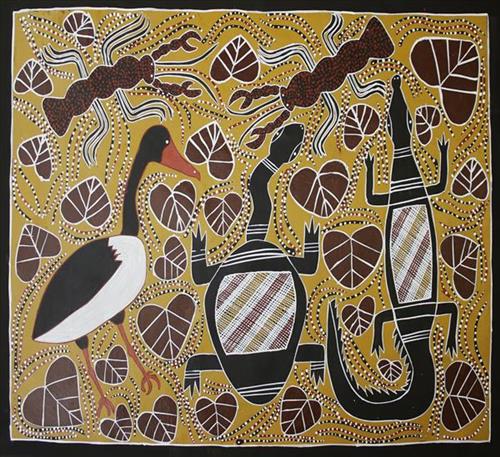
Raypiny Dhawu (Fresh Water Story)
All Aboriginal people originate from a spiritual source, fixed in a particular place in their land or the sea. These ‘Spiritual Reservoirs’ are often in the form of special waterholes made by Wangarr (Creative Beings), long ago close to the beginning of time. These creator beings moved across the country side, shaping the land and implanting in each tract of country, the spiritual life force for the people who were to own it. These Creative Spirits took many forms. When they gave the land to each group they also gave songs, dances, ceremony, the associated laws and language. The Creation story for Ganalbingu people took place near the middle section of the Glyde River where it becomes the Goyder River. Their land, Ngaliyindi, sits astride the Arafura Swamp in Central Arnhem Land. In this painting, the artist has depicted freshwater totems from the Swamp. These include catfish (ginginy), crocodile (baru), file snake (bapi), Darwin prawns (dakawa), Barramundi (ratjuk), water lilies (yalman) and bubbles in the water.
115682311904
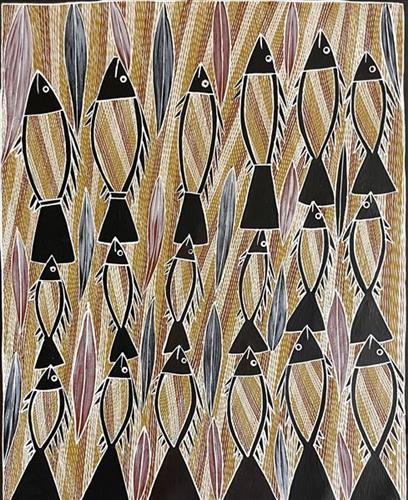
JB Fisher – Wuldulbal/badju (bream)
JB paints stories from his Dhuwa homeland in northeast Arnhem Land. Stories are passed on either paternally or maternally, and JB would have learnt these stories from his ancestors. The cross-hatching style is a traditional painting style of this area and can represent elements such as water, air and wind.
JB’s paintings often feature totemic animals of the fresh waters of north east Arnhem Land.
115682317171
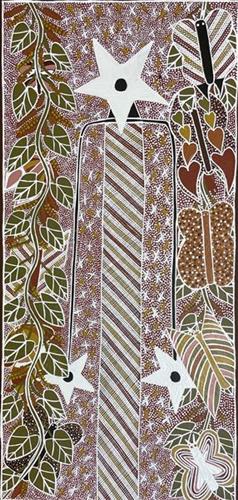
Barnumbirr – Morning Star
Barnumbirr as a Morning Star is a creator spirit in Yolngu culture. Her story is part of the Dhuwa moiety. Barnumbirr flew eastward creating a song-line which includes descriptions of flora, fauna, geographical features and clan borders. Barnumbirr’s songline therefore formed the basis of Madayin Law and the Yolngu understanding of the land.
There is a “Morning Star Ceremony” and due to its scale and importance, the requires a significant level of planning. Part of the ceremony features a Morning Star Pole, which is a decorated and feathers are attached to the top of the pole which represent the Morning Star itself.