221382285146


Goannas

Gapu is a series of limited edition fine prints created in a long standing a collaboration between Basil Hall Editions and Beswick artists. Gapu Series XI uses, for  the first time, the Collograph technique and features 23 prints by 14 senior and emerging artists from Beswick.  Gapu (Water) features life and cultural practice around the water ways of both Beswick and the ancestral homelands of the artists, from hairy yams to woven string bags, sitting ducks on the billabong to fish hiding in the lily roots, ceremonial dilly bags to the mythical Mimis that share country.

Editions are limited to 30 prints, printed on Hahnemuhle paper.

221382317020


Clapsticks

Wood carving has always been part of Aboriginal culture. Men carved wood for many purposes – tools for hunting or gathering food, axes and knives for building shelters, spears and clubs for protection of their lives and territory, objects for ceremony and to mark sacred sites.

Artists source the timber on country, walking from tree to tree to find the right piece for the desired functional outcome. Once found, it is cut and then brought back to camp to be worked, shaped, sanded and finally finished.

Clapsticks are used in traditional ceremony and dance as a percussion instrument to accompany Mago (didjeridu). Denser woods such as Ironwood or Kerosene wood are preferred due to their crisper clap sound. Clapsticks can be left raw or painted and decorated. Straight timber from younger trees is preferred as it requires less work to make functional.

221382317019


Clapsticks

Wood carving has always been part of Aboriginal culture. Men carved wood for many purposes – tools for hunting or gathering food, axes and knives for building shelters, spears and clubs for protection of their lives and territory, objects for ceremony and to mark sacred sites.

Artists source the timber on country, walking from tree to tree to find the right piece for the desired functional outcome. Once found, it is cut and then brought back to camp to be worked, shaped, sanded and finally finished.

Clapsticks are used in traditional ceremony and dance as a percussion instrument to accompany Mago (didjeridu). Denser woods such as Ironwood or Kerosene wood are preferred due to their crisper clap sound. Clapsticks can be left raw or painted and decorated. Straight timber from younger trees is preferred as it requires less work to make functional.

221382317013


Clapsticks

Wood carving has always been part of Aboriginal culture. Men carved wood for many purposes – tools for hunting or gathering food, axes and knives for building shelters, spears and clubs for protection of their lives and territory, objects for ceremony and to mark sacred sites.

Artists source the timber on country, walking from tree to tree to find the right piece for the desired functional outcome. Once found, it is cut and then brought back to camp to be worked, shaped, sanded and finally finished.

Clapsticks are used in traditional ceremony and dance as a percussion instrument to accompany Mago (didjeridu). Denser woods such as Ironwood or Kerosene wood are preferred due to their crisper clap sound. Clapsticks can be left raw or painted and decorated. Straight timber from younger trees is preferred as it requires less work to make functional.

221382317011


Clapsticks

Wood carving has always been part of Aboriginal culture. Men carved wood for many purposes – tools for hunting or gathering food, axes and knives for building shelters, spears and clubs for protection of their lives and territory, objects for ceremony and to mark sacred sites.

Artists source the timber on country, walking from tree to tree to find the right piece for the desired functional outcome. Once found, it is cut and then brought back to camp to be worked, shaped, sanded and finally finished.

Clapsticks are used in traditional ceremony and dance as a percussion instrument to accompany Mago (didjeridu). Denser woods such as Ironwood or Kerosene wood are preferred due to their crisper clap sound. Clapsticks can be left raw or painted and decorated. Straight timber from younger trees is preferred as it requires less work to make functional.

221382317010


Water Buffalo Skull

This commissioned Water Buffalo piece features two Wagilak clan stories along with a young man initiation ceremony body paint style. 

As a central piece on the water buffalo forehead are some gum leaves and gumnuts. This is an important sugarbag story that show when is the right time to harvest GuGu, or native bee honey. When the gumnuts are flowering, the hives are ripe for harvest.

Surrounding the sugarbag story are multiple Laar’da, or stone blades. Stones are harvested on country, and then skilfully shaped and used for hunting purposes. Young men need to learn this skill before they are allowed to hunt on their own.

Yellow and white dots around the eye sockets, as well as the black and red dots around the jaw are similar to the body paint dots placed on young men when they go through initiation ceremony.

Raark or fine line work has been completed using a handmade grass reed brush called Jarlk. Raark is in Yirritja style and consists of mutliple lines before alternating colour.

Modern acrylic paint has been used. Skull was sanded smooth before painting so the Jarlk brush could flow easily.

221382317009


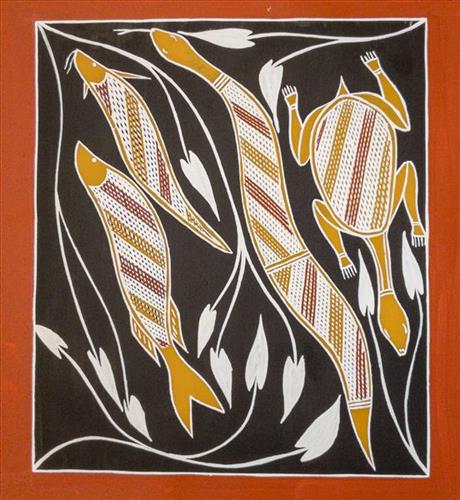
This painting depicts two diving ducks, a long neck turtle, a barramundi and a file snake. All can be found in local billabongs and wet areas, and all are gudwan dagga, or tasty tucker cooked in the coals.

Painting has been completed using a handmade grass reed brush called Jarlk. Raark or fine line work is in a mixture of Yirritja and Dhuwa style. Yirritja consists of multiple lines before alternating colour and can be seen on the diving ducks. Dhuwa features single line before alternating colour and is visible on the turtle and barramundi. 

A stippling effect using a modern paintbrush has been used on the file snake. Modern acrylic paint has been used.

221382317526


Freshwater Feed

This painting depicts four different species found in local billabongs and creeks surrounding Beswick. All are gudwan dagga, or tasty tucker when cooked in the coals. 

At top is a longneck turtle, below which is a file snake. An eel tail catfish can also be seen along with a bonefish.

Painting has been completed using a handmade grass reed brush called Jarlk. Raark or fine line work is in Yirritja style and consists of multiple lines before alternating colour. Modern acrylic paint has been used.

221382318907


Handwoven dilly bag earrings in sterling silver

Wagilak Yapa Watj (Wagilak Sisters) range –
exclusive jewellery from indigenous women of Beswick. Developed in studio workshops with jeweller Kate Sale and weaver Fiona Gavino, traditional fibre artists are translating their skills into a series of fine woven wire earrings and pendants. Hand woven in sliver, gold and copper, traditional forms are transformed as delicate interpretations of string and dilly bags, baskets and mats.

Featuring sterling silver, 9ct gold and copper (all nickel-free work).

221382318906


Handwoven dilly bag earrings in sterling silver

Wagilak Yapa Watj (Wagilak Sisters) range –
exclusive jewellery from indigenous women of Beswick. Developed in studio workshops with jeweller Kate Sale and weaver Fiona Gavino, traditional fibre artists are translating their skills into a series of fine woven wire earrings and pendants. Hand woven in sliver, gold and copper, traditional forms are transformed as delicate interpretations of string and dilly bags, baskets and mats.

Featuring sterling silver, 9ct gold and copper (all nickel-free work).