221382300639


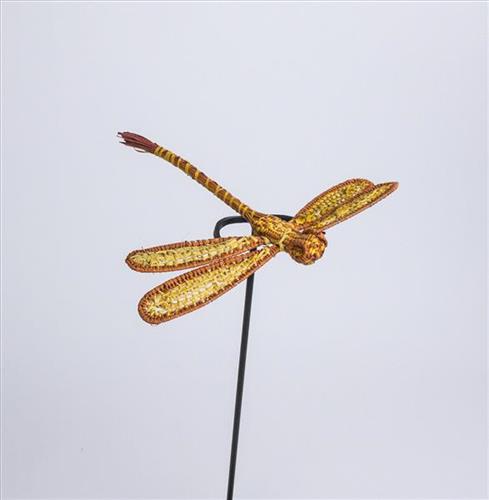
Woven Dragonfly

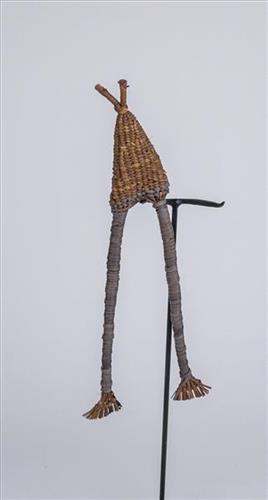
This finely crafted hand woven dragonfly is a cheerful reminder of the real dry season dragonflies.

Signalling in the dry season, dragonflies are ubiquitous with dry winds, cool nights and saying goodbye to the wet season! Our ridiculously talented pandanus artists are continuing to push their skills and techniques with these cute dragonflies a fine example of this. Each are unique, hand woven and coloured using natural bush dyes.

Pandanus fibre art is labour intensive requiring a high level of care and fine needlework. Finished works are both functional and beautiful. Women collect pandanus by pulling from the top of a pandanus tree, stripping then dying the leaves using natural bush colour.
221382300636


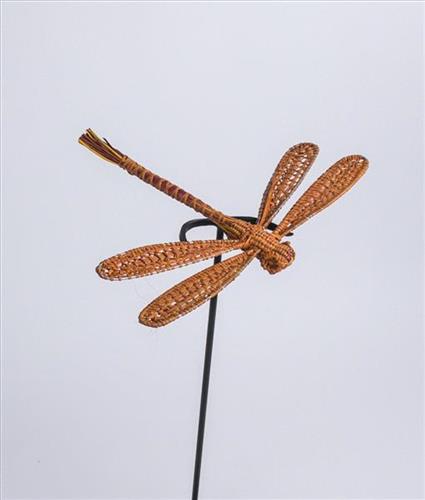
Woven Dragonfly

This finely crafted hand woven dragonfly is a cheerful reminder of the real dry season dragonflies.

Signalling in the dry season, dragonflies are ubiquitous with dry winds, cool nights and saying goodbye to the wet season! Our ridiculously talented pandanus artists are continuing to push their skills and techniques with these cute dragonflies a fine example of this. Each are unique, hand woven and coloured using natural bush dyes.

Pandanus fibre art is labour intensive requiring a high level of care and fine needlework. Finished works are both functional and beautiful. Women collect pandanus by pulling from the top of a pandanus tree, stripping then dying the leaves using natural bush colour.
221382300620


Mukuy Spirit Figures

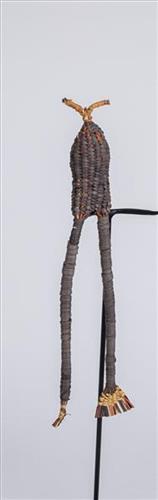
These finely crafted woven figures represent Mukuy Spirit creatures. The Mukuy belong in Yirritja country called Galanbirni. At night you might hear them playing the Didjeridu. The Mukuy travel around a lot and are often found in sacred places. They are mysterious, sometimes playful and sometimes cheeky characters, often referred to as Devil Devil. Mukuy figures tell the stories of country, culture and spiritual beliefs.

221382300616


Mukuy Spirit Figures

These finely crafted woven figures represent Mukuy Spirit creatures. The Mukuy belong in Yirritja country called Galanbirni. At night you might hear them playing the Didjeridu. The Mukuy travel around a lot and are often found in sacred places. They are mysterious, sometimes playful and sometimes cheeky characters, often referred to as Devil Devil. Mukuy figures tell the stories of country, culture and spiritual beliefs.

221382300491


Yams

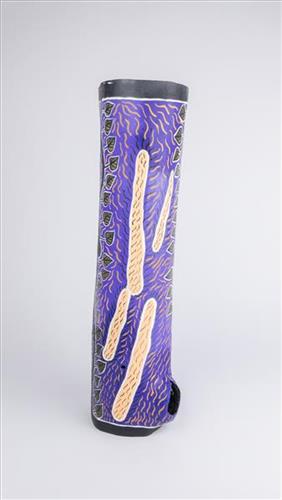
This Lorrkon (hollow coffin log) depicts two different species of yams. Cheeky Yam along with its trailing arm of heart shaped leaves can be seen in two locations. This yam is round and visible in the middle of the vine. This bush tucker can be eaten only after preparation. If the flesh is not properly prepared it is considered poisonous and too cheeky to eat.

Also included is a different yam, known as hairy yams. These are depicted in a lighter colour and are a prized bush tucker. They are one of the tastiest yams available, somewhat similar in taste to a commercial sweet potato.

Painting has been completed using modern paintbrushes as well as a handmade Jarlk brush harvested from local billabongs and wet areas. Fine line work uses this Jarlk brush. Modern acrylic paint has been used.

221382299595


Five File Snakes

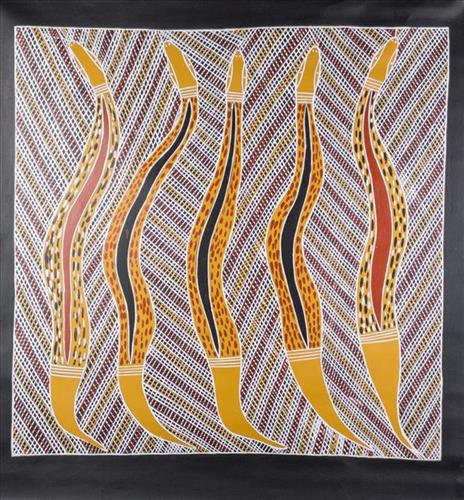
This painting depicts five file snakes found in billabongs. These snakes get their names due to their rough, rasp like skin. They are a prized tasty bush tucker.

Raark or fine line work is in Yirritja style and consists of multiple lines before alternating colour. Painting has been completed using a handmade grass reed brush called Jarlk. Modern acrylic paints have been used.

221382282656


Ibis

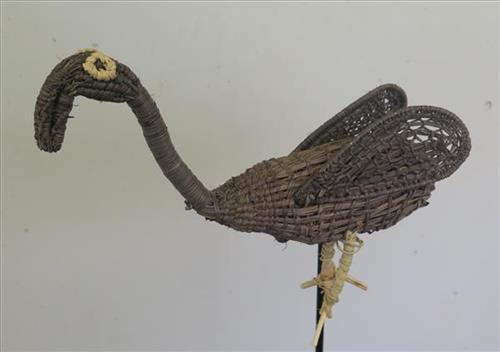
Fibre Art is an ancient Aboriginal women’s craft that is still made today using the same techniques as their ancestors. Making fibre art is labour intensive and much care and fine needlework is required to ensure the finished object is both functional and beautiful. Fibre art from the Ghunmarn Culture Centre includes dilly bags, floor mats, bush fans, woven creatures found in the landscape, plants such as yams (bush potato), baskets, place mats, and spirit figures such as mermaids and Mukuy’s. Natural pandanus fibre (Mukarra), is used to make much of the fibre art produced by the artists of Djilpin Arts. Women collect the pandaus by pulling from the top of the pandanus tree, then stripping and drying the leaves before they are dyed with natural bush colour collected from the Beswick surrounds.

221380831850


Didj (Key: D#, Toot: A)

Key: D#
Toot: A

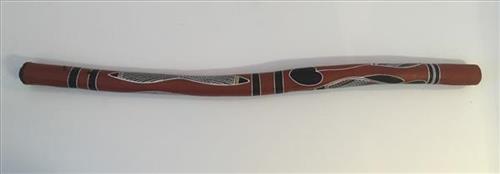
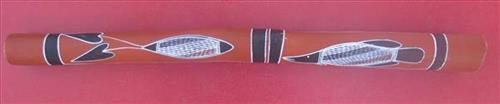
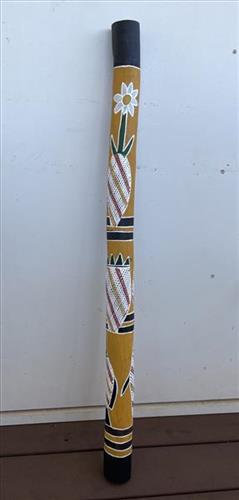
Didjeridus from this region are made in the West Arnhem style. Called Mago, they’re different and special and follow the tradition made famous by Beswick’s Mago Master, elder David Blanasi.Ghunmarn didjeridus are hand cut by Aboriginal people on Aboriginal land. They are drilled out naturally by termites, not by machines. Top quality musical instruments, they are used in ceremony and performance and feature traditional designs handed painted with a grass brush. Supplied with natural sugar-bag wax mouthpieces, these are the genuine article.Didjeridus from Ghunmarn Culture Centre are hand-cut from the woolybutt tree and naturally termite eaten. Some cheaper didjerdius can be drilled out by machine. If you want to be sure yours is termite-eaten look inside, if it is a bit rough the termites have been at work, smooth interiors are a sign of drilling. Ghunmarn artists travel considerable distances on foot to find the just right woolybutt tree. Good instruments are hand-cut and taken back to camp to be worked, shaped, sanded and tuned.Most Ghunamrn didjeridus are high pitch D, low pitch D, F, C or G. The longer the dij the lower the pitch, a shorter didj will give a higher sound.

221380832507


Didjeridu

Didjeridus from this region are made in the West Arnhem style. Called Mago, they’re different and special and follow the tradition made famous by Beswick’s Mago Master, elder David Blanasi.

Ghunmarn didjeridus are sourced on country, and hand cut from Woolybutt trees. Artists travel considerable distances on foot to find the right woolybutt tree naturally hollowed out by termites. Good instruments are hand-cut and taken back to camp to be worked, shaped, sanded, tuned and then finally painted.

These are top quality musical instruments, highly regarded worldwide, and still used in ceremony and performance today. Featuring traditional designs handed painted with a Jarlk grass brush.

Most Ghunamrn didjeridus are high pitch D, low pitch D, F, C or G. The longer the dij the lower the pitch, a shorter didj will give a higher sound.

221382234596


Mako (Key: F#, Toot: A#)

Key: F#
Toot: A#

Didjeridus from this region are made in the West Arnhem style. Called Mago, they’re different and special and follow the tradition made famous by Beswick’s Mago Master, elder David Blanasi.

Ghunmarn didjeridus are sourced on country, and hand cut from Woolybutt trees. Artists travel considerable distances on foot to find the right woolybutt tree naturally hollowed out by termites. Good instruments are hand-cut and taken back to camp to be worked, shaped, sanded, tuned and then finally painted.

These are top quality musical instruments, highly regarded worldwide, and still used in ceremony and performance today. Featuring traditional designs handed painted with a Jarlk grass brush.


Most Ghunamrn didjeridus are high pitch D, low pitch D, F, C or G. The longer the dij the lower the pitch, a shorter didj will give a higher sound.