114082359021


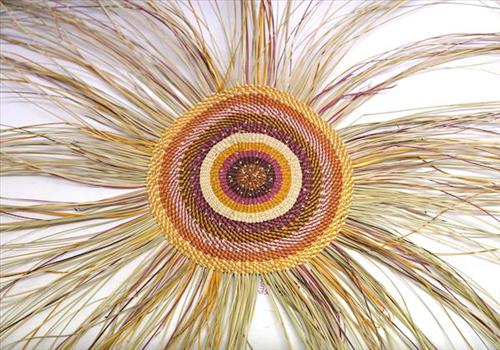
Coiled Pandanus Basket

This basket is made from natural, local materials sourced from the Gunbalanya area. Weavers gather fresh young leaves from the pandanus palm using a hooked stick, then strip and dry them. The pandanus is then boiled up on the campfire with local plant dyes.

Today’s coiled fibre works are the result of rich cultural exchange and artistic innovation. The coiling technique was traditionally used by southern Aboriginal people of the Murray River, and was introduced to Goulburn Island by missionary Greta Matthews in the 1920s. From here it spread amongst Aboriginal people throughout Arnhem Land. These works are living embodiments of Australia’s history. Kunwinjku women have been developing the artform for almost 100 years, experimenting with new forms and adapting it to local materials.

The old plant dyes used in Europe like indigo, saffron, woad and logwood fell out of use with the Industrial Revolution. But here, a natural “paintbox” thrives.

The most common dyes include:
Yellow-orange: Mandjurndum (the bright orange roots of the Pognolobus reticulatus bush)
Brown: Wirdilwirdil (the red bulb of Haemadorum breviculae grass)
Green: The growing shoot of the pandanus itself (Pandanus spiralis), boiled with the ashes of pandanus leaves.
Purple-pink – Windilk (the seeds of the Haemodorum coccineum plant, related to Kangaroo Paw)
Grey-Black – Manbedde (the leaves of the quinine bush, Petalostigma pubescens)

Source: Louise Hamby (ed.) “Twined Together”.

114082338785


Marebu (Woven Mat)

Marebu is the general Kunwinjku term for woven mats. These were traditionally valuable items. Some were used as working surfaces, others were worn and others used during ceremonial occasions.

Traditionally these items would have been woven from plain pandanus, but today they are usually coloured with natural dyes. It is possible that the use of natural dyes was encouraged by missionaries, influenced by what they had seen on Pacific islands. However it would have been local women, with their knowledge of local plants and bush medicines, who would have carried out the experimentation necessary for such a rich dye repertoire.

The most common dyes include:
Yellow-orange: Mandjurndum (the bright orange roots of the Pognolobus reticulatus bush)
Brown: Wirdilwirdil (the red bulb of Haemadorum breviculae grass)
Green: The growing shoot of the pandanus itself (Pandanus spiralis) boiled with the ashes of pandanus leaves
Purple-pink – Windilk (the seeds of the Haemodorum coccineum plant, related to Kangaroo Paw)
Grey-Black – Manbedde (the leaves of the quinine bush, Petalostigma pubescens)

Nawu Marebu nakka nakimuk mat kabirrimarnbun. Daluhdaluk kabirrire kunngobarn (manbelk) kabirrmang dja kundulk manbu mandjangal kabirrikan kabirrikardmang manbu kunngobarn kahdjabdi manekke kabirrimang kabirridurrkmang wanjh kabirrikan kured. Kabirriyirrme rowk kabirrimang drum badjdjukkali nawu nakimuk kabirrikinje mandjurndum dorrengh kabirrikinje yika widilwidil dorrengh. Wanjh kabirridakurrme kore kurrungbang kadato kabukman Wanjh kabirrimarnbun nawu marebu kunbid bedberre. Kabirridejdjingmang nayahwurd kabirrihdjale kabirrikimukwon nakimuk marebu kabirrimarnbun.