111982442818


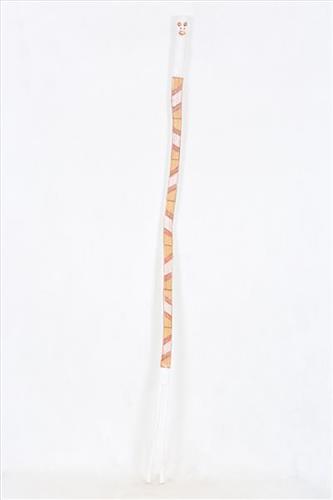
Warraburnburn

In Burarra and Gun-nartpa languages the figure represented in this artwork is generally known as a wangarra ‘ghost spirit’. For the Warrawarra clan ghost spirits have their own particular characteristics and their own name – Warraburnburn.

The Warraburnburn and the closely related Galabarrbarr spirit (owned by the Balkarranga clan) are also manikay song topics.  The spirits are related to each other as maternal grandparent and grandchild, just as the people of Warrawarra and Balkarranga are. The dancing of the two ghost spirit figures forms the finale performance for funerals, and is the final goodbye to a deceased family member.

In many ways the Warraburnburn and Galabarrbarr ghost spirits are like people. They emerge from the patches of jungle on Warrawarra and Balkarranga country in the late afternoon and go hunting in family groups of men, women and children. They stay in contact with each other by calling out as the men hunt for fish and the women walk with their dillybags looking for vegetable food. 

The ghost spirits are associated closely with white ochre and artists commonly paint the bodies of carved figures in white. Different types of ghost spirit wear different patterns. Warraburnburn is decorated with uniform white dots while others are painted white all over. Some ghost spirits are shown with a design painted on their chest infilled with rarrk ‘cross-hatching’, the same designs that are painted onto japi an-guyinda ‘male initiations’. 

They also have supernatural characteristics including superhuman size (jarra anbaykarda ‘super tall’). They know the country intimately – some are malevolent towards humans and will lead people astray, taking them to unfamiliar and dangerous places. These malevolent spirits are likened to an-muburda ‘sorcerers’ and can conduct dangerous rituals that cause harm to people. Others are benign and will lead humans back to familiar paths and their own camps.
 

111982442817


Warraburnburn

In Burarra and Gun-nartpa languages the figure represented in this artwork is generally known as a wangarra ‘ghost spirit’. For the Warrawarra clan ghost spirits have their own particular characteristics and their own name – Warraburnburn.

The Warraburnburn and the closely related Galabarrbarr spirit (owned by the Balkarranga clan) are also manikay song topics.  The spirits are related to each other as maternal grandparent and grandchild, just as the people of Warrawarra and Balkarranga are. The dancing of the two ghost spirit figures forms the finale performance for funerals, and is the final goodbye to a deceased family member.

In many ways the Warraburnburn and Galabarrbarr ghost spirits are like people. They emerge from the patches of jungle on Warrawarra and Balkarranga country in the late afternoon and go hunting in family groups of men, women and children. They stay in contact with each other by calling out as the men hunt for fish and the women walk with their dillybags looking for vegetable food. 

The ghost spirits are associated closely with white ochre and artists commonly paint the bodies of carved figures in white. Different types of ghost spirit wear different patterns. Warraburnburn is decorated with uniform white dots while others are painted white all over. Some ghost spirits are shown with a design painted on their chest infilled with rarrk ‘cross-hatching’, the same designs that are painted onto japi an-guyinda ‘male initiations’. 

They also have supernatural characteristics including superhuman size (jarra anbaykarda ‘super tall’). They know the country intimately – some are malevolent towards humans and will lead people astray, taking them to unfamiliar and dangerous places. These malevolent spirits are likened to an-muburda ‘sorcerers’ and can conduct dangerous rituals that cause harm to people. Others are benign and will lead humans back to familiar paths and their own camps.
 

111982442814


Jarlambu (Eel-tailed Catfish)

Bark paintings have a long cultural tradition, believed to extend back many thousands of years. In northern Australia, the walls of bark shelters in the Kimberley and Arnhem Land may well have been painted to convey and illustrate stories in the same way that rock shelters were. Bark painters in the Maningrida region invoke customary practices and experiment with visual forms. Their paintings merge the natural and spiritual worlds, the secular and sacred, and embody and evoke ancestral presence.The subject matter of some works on bark express or focus on djang, the power of country itself; others the ancestral activities that created it or inhabit it: the powerful Rainbow Serpent Ngalyod, female water spirits including Yawkyawk and jin-Merdewa, and spirit beings such as Namorrorddo and Wangarra. Some paintings feature geometric designs inspired by body painting. Spirit figures such as the long thin Mimih spirits said to live in the rock country are also frequently depicted, as are animals hunted as game, including kangaroo and barramundi. 

The process of making a bark painting begins with the artist choosing a suitable tree (stringybark gum tree, Eucalyptus tetrodonta), in the wet season when the sap is rising and the bark is fairly supple and easy to grip. After finding a section of bark that is free of knots and termite damage, cuts are made top and bottom and, after some encouragement by tugging and prying, a hollow open cylinder of bark is removed. The rough outer bark is stripped off and the bark sheet is trimmed and placed over a fire, inner side downwards, to drive out moisture, including the sap. The bark sheet, pliable from its steaming session, is next placed on the ground and trodden on to flatten it out. Heavy weights are placed on it as it cools to ensure that it doesn’t curl or warp.

Artists use a rich palette of colours derived from natural pigments that can be sourced from their clan estates. The reds, purples, pinks and yellows come from ochres (forms of iron oxide or limonite). Black generally comes from charcoal, and white is from pipeclay. All of these earth pigments are strongly associated with djang. The pipeclay used to create the brilliant white paint, for example, is said to be the faeces of the powerful Rainbow Serpent (Ngalyod in the Kuninjku language) and the spirit essence of the Mardayin ceremony.

Sometimes natural fixatives are mixed in to bind the pigments: wax, yolk of eggs, resins and the sap of orchid plants. Today PVA glue is more commonly used as a binding agent for the pigments. The tool that an artist uses to apply colour to the bark depends on the style of painting and available resources. It may be a feather, or a brush made from a few strands of straight human hair. Cyperus javanicus, a tough sedge grass, may be used to make the slim reed brush required to execute the fine rarrk designs. 

111982442810


Bark Painting

Bark paintings have a long cultural tradition, believed to extend back many thousands of years. In northern Australia, the walls of bark shelters in the Kimberley and Arnhem Land may well have been painted to convey and illustrate stories in the same way that rock shelters were. Bark painters in the Maningrida region invoke customary practices and experiment with visual forms. Their paintings merge the natural and spiritual worlds, the secular and sacred, and embody and evoke ancestral presence.The subject matter of some works on bark express or focus on djang, the power of country itself; others the ancestral activities that created it or inhabit it: the powerful Rainbow Serpent Ngalyod, female water spirits including Yawkyawk and jin-Merdewa, and spirit beings such as Namorrorddo and Wangarra. Some paintings feature geometric designs inspired by body painting. Spirit figures such as the long thin Mimih spirits said to live in the rock country are also frequently depicted, as are animals hunted as game, including kangaroo and barramundi. 

The process of making a bark painting begins with the artist choosing a suitable tree (stringybark gum tree, Eucalyptus tetrodonta), in the wet season when the sap is rising and the bark is fairly supple and easy to grip. After finding a section of bark that is free of knots and termite damage, cuts are made top and bottom and, after some encouragement by tugging and prying, a hollow open cylinder of bark is removed. The rough outer bark is stripped off and the bark sheet is trimmed and placed over a fire, inner side downwards, to drive out moisture, including the sap. The bark sheet, pliable from its steaming session, is next placed on the ground and trodden on to flatten it out. Heavy weights are placed on it as it cools to ensure that it doesn’t curl or warp.

Artists use a rich palette of colours derived from natural pigments that can be sourced from their clan estates. The reds, purples, pinks and yellows come from ochres (forms of iron oxide or limonite). Black generally comes from charcoal, and white is from pipeclay. All of these earth pigments are strongly associated with djang. The pipeclay used to create the brilliant white paint, for example, is said to be the faeces of the powerful Rainbow Serpent (Ngalyod in the Kuninjku language) and the spirit essence of the Mardayin ceremony.

Sometimes natural fixatives are mixed in to bind the pigments: wax, yolk of eggs, resins and the sap of orchid plants. Today PVA glue is more commonly used as a binding agent for the pigments. The tool that an artist uses to apply colour to the bark depends on the style of painting and available resources. It may be a feather, or a brush made from a few strands of straight human hair. Cyperus javanicus, a tough sedge grass, may be used to make the slim reed brush required to execute the fine rarrk designs. 

111982442808


Mimih Spirit

The mimih spirit exists in a realm that runs parallel to and mirrors many facets of human life, demonstrating the deep sense of time and place understood by Aboriginal and Torres Strait Islander people. Such spirits feature importantly in relation to Aboriginal spirituality, cosmology, social and moral tales as well as ritual. As is true with the multiple mediums employed by artists of West Arnhem Land, the development of artistic style and form is in line with an awareness by the artist that the work produced is predominantly made for a broader audience. Whether shown in a national or international context these works communicate and exist in a particular space that is cross-cultural and simultaneously particular to the Arnhem region.

The mimih sits within a complex pedagogical and religious body of knowledge which links Kuninjku people to their distinctive escarpment homelands. Young Kuninjku artists, or apprentices, employ the mimih as an important exercise for the practice of the rarrk technique, as it could be achieved on a smaller surface area before being attempted in larger scale on pieces of bark. The mimih serves a purpose for those young artists first learning to carve in a social space of sharing and innovating. The initial mimih manifestation was a large form that almost mirrored the anatomy of a human and at this stage the sculptures have been likened to mokuy carvings visible in eastern Arnhem Land. Contemporaneously, mimih are depicted in a refined, slender, even emaciated form with a broad range of facial expressions giving both individual character to, and denoting the potential volatility and humour that mimih spirits are notable for in their interaction with bininj (humans). The sculptures are frequently carved from the thin trunks of softwoods such as kapok (bombax ceiba or cottonwood) kurrajong, beach hibiscus or leichardt and are painted with earth pigments for their colouring and design.

A leading figure engaging the spirit in visual storytelling was Crusoe Kuningbal, a Kuninjku man, who while traveling was familiarised with carving styles from the east of Arnhem at the mission in Milingimbi pre-dating World War II. The connection and development of art forms informed by cross cultural dialogues within northern Aboriginal language groups is notable. The mimih became a valued inclusion in performance and public ceremony by Kuninjku people like Kuningbal. At times these ceremonies were performed for extended language groups in the local region. 

Now a familiar and broadly depicted figure of iconography, it is important to acknowledge the development of this quite recent sculptural tradition. The depiction of this particular spirit being, once used as an addition to the sharing of song cycles and ceremony, has since been elevated to a prominent form and subject of contemporary sculpture. Variation in the creation of mimih acts as an indication of the individualism of each artist and their stylistic markers. Additionally significant to note is that in the space of the past thirty years the mimih has begun being produced by multiple language groups residing in the Maningrida area including the traditional owners of Maningrida, the Ndjébbana, speaking Kunibidji as well as Gurrgoni people who have strong ties to Kuninjku. 

________
*Maningrida Arts & Culture acknowledge the work of many academic and non-academic voices when writing on this topic, it is important to note Luke Taylor, who’s broad research has informed this text.

111982442806


Mimih Spirit

The mimih spirit exists in a realm that runs parallel to and mirrors many facets of human life, demonstrating the deep sense of time and place understood by Aboriginal and Torres Strait Islander people. Such spirits feature importantly in relation to Aboriginal spirituality, cosmology, social and moral tales as well as ritual. As is true with the multiple mediums employed by artists of West Arnhem Land, the development of artistic style and form is in line with an awareness by the artist that the work produced is predominantly made for a broader audience. Whether shown in a national or international context these works communicate and exist in a particular space that is cross-cultural and simultaneously particular to the Arnhem region.

The mimih sits within a complex pedagogical and religious body of knowledge which links Kuninjku people to their distinctive escarpment homelands. Young Kuninjku artists, or apprentices, employ the mimih as an important exercise for the practice of the rarrk technique, as it could be achieved on a smaller surface area before being attempted in larger scale on pieces of bark. The mimih serves a purpose for those young artists first learning to carve in a social space of sharing and innovating. The initial mimih manifestation was a large form that almost mirrored the anatomy of a human and at this stage the sculptures have been likened to mokuy carvings visible in eastern Arnhem Land. Contemporaneously, mimih are depicted in a refined, slender, even emaciated form with a broad range of facial expressions giving both individual character to, and denoting the potential volatility and humour that mimih spirits are notable for in their interaction with bininj (humans). The sculptures are frequently carved from the thin trunks of softwoods such as kapok (bombax ceiba or cottonwood) kurrajong, beach hibiscus or leichardt and are painted with earth pigments for their colouring and design.

A leading figure engaging the spirit in visual storytelling was Crusoe Kuningbal, a Kuninjku man, who while traveling was familiarised with carving styles from the east of Arnhem at the mission in Milingimbi pre-dating World War II. The connection and development of art forms informed by cross cultural dialogues within northern Aboriginal language groups is notable. The mimih became a valued inclusion in performance and public ceremony by Kuninjku people like Kuningbal. At times these ceremonies were performed for extended language groups in the local region. 

Now a familiar and broadly depicted figure of iconography, it is important to acknowledge the development of this quite recent sculptural tradition. The depiction of this particular spirit being, once used as an addition to the sharing of song cycles and ceremony, has since been elevated to a prominent form and subject of contemporary sculpture. Variation in the creation of mimih acts as an indication of the individualism of each artist and their stylistic markers. Additionally significant to note is that in the space of the past thirty years the mimih has begun being produced by multiple language groups residing in the Maningrida area including the traditional owners of Maningrida, the Ndjébbana, speaking Kunibidji as well as Gurrgoni people who have strong ties to Kuninjku. 

________
*Maningrida Arts & Culture acknowledge the work of many academic and non-academic voices when writing on this topic, it is important to note Luke Taylor, who’s broad research has informed this text.

111982442805


Gomarla (Egret bird)

The artist has carved the ‘Gomarla’, which in the Burarra word for Egret. This bird is native to the country of Yilan, which is the coastal region North West of Maningrida Community. 

People use feathers from gomarla to make ceremonial regalia for Yirrichinga. Many Yirrichinga groups own manikay ‘song’ for gomarla.

Gomarla mun-baparrurr Gopungorra. Jin-gubatbatcha jin-banga jiny-yorkiya. Gomarla waykin makukuya mu-guyinda.

The egret belongs to the Gopungorra clan. It always eats grasshoppers. The egret is high in a nest (builds its nest in the tree).

111982397002


Mimih Spirit

The mimih spirit exists in a realm that runs parallel to and mirrors many facets of human life, demonstrating the deep sense of time and place understood by Aboriginal and Torres Strait Islander people. Such spirits feature importantly in relation to Aboriginal spirituality, cosmology, social and moral tales as well as ritual. As is true with the multiple mediums employed by artists of West Arnhem Land, the development of artistic style and form is in line with an awareness by the artist that the work produced is predominantly made for a broader audience. Whether shown in a national or international context these works communicate and exist in a particular space that is cross-cultural and simultaneously particular to the Arnhem region.

The mimih sits within a complex pedagogical and religious body of knowledge which links Kuninjku people to their distinctive escarpment homelands. Young Kuninjku artists, or apprentices, employ the mimih as an important exercise for the practice of the rarrk technique, as it could be achieved on a smaller surface area before being attempted in larger scale on pieces of bark. The mimih serves a purpose for those young artists first learning to carve in a social space of sharing and innovating. The initial mimih manifestation was a large form that almost mirrored the anatomy of a human and at this stage the sculptures have been likened to mokuy carvings visible in eastern Arnhem Land. Contemporaneously, mimih are depicted in a refined, slender, even emaciated form with a broad range of facial expressions giving both individual character to, and denoting the potential volatility and humour that mimih spirits are notable for in their interaction with bininj (humans). The sculptures are frequently carved from the thin trunks of softwoods such as kapok (bombax ceiba or cottonwood) kurrajong, beach hibiscus or leichardt and are painted with earth pigments for their colouring and design.

A leading figure engaging the spirit in visual storytelling was Crusoe Kuningbal, a Kuninjku man, who while traveling was familiarised with carving styles from the east of Arnhem at the mission in Milingimbi pre-dating World War II. The connection and development of art forms informed by cross cultural dialogues within northern Aboriginal language groups is notable. The mimih became a valued inclusion in performance and public ceremony by Kuninjku people like Kuningbal. At times these ceremonies were performed for extended language groups in the local region. 

Now a familiar and broadly depicted figure of iconography, it is important to acknowledge the development of this quite recent sculptural tradition. The depiction of this particular spirit being, once used as an addition to the sharing of song cycles and ceremony, has since been elevated to a prominent form and subject of contemporary sculpture. Variation in the creation of mimih acts as an indication of the individualism of each artist and their stylistic markers. Additionally significant to note is that in the space of the past thirty years the mimih has begun being produced by multiple language groups residing in the Maningrida area including the traditional owners of Maningrida, the Ndjébbana, speaking Kunibidji as well as Gurrgoni people who have strong ties to Kuninjku. 

________
*Maningrida Arts & Culture acknowledge the work of many academic and non-academic voices when writing on this topic, it is important to note Luke Taylor, who’s broad research has informed this text.

111982441770


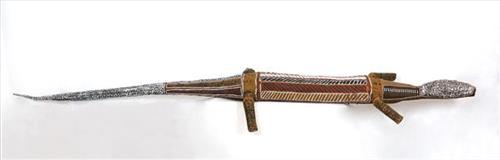
Kalawan (Goanna)

Throughout the 1990s, artists Lena Yarinkura and her mother Lena Djammarrayku (now deceased) diverged from the more conventional fibre work of their contemporaries, extending traditional weaving techniques and materials to make new ambitious and innovative sculptural forms. Yarinkura applied the dilly bag, fish trap and coil basket weaving techniques to make the body of new forms, such as djamo (dog), yok (bandiboot) and yawkyawk (female water spirit), which she then filled with paperbark and painted with ochre. Yarinkura and her husband Bob Burruwal have also become renowned for their distinctive spirit figures, including wurum and wyarra, which are often displayed as part of large installations. In using her weaving skills to make three-dimensional representations, Yarinkura has adapted a traditional weaving technique to explore new narrative possibilities for expressing important cosmological themes or illustrating stories from her homeland. Yarinkura and Burruwal’s children, grandchildren and extended family, including Yolanda Rostron, Philimena Kelly, Vera Cameron and Gloreen Campion, continue this legacy.

111982442015


Lorrkon (Hollow Log)

The Lorrkon or bone pole coffin ceremony is the final ceremony in a sequence of mortuary rituals celebrated by the people of Arnhem Land. This ceremony involves the placing of the deceased’s bones into a hollow log decorated with painted clan designs and ceremonially placed into the ground where it remains until it slowly decays over many years.


The log is made from a termite hollowed Stringybark tree (Eucalyptus tetradonta) and is decorated with totemic emblems. The western Arnhem Land version of the Lorrkon ceremony involves the singing of sacred songs to the accompaniment of karlikarli, a pair of sacred boomerangs used as rhythm instruments. During the final evening of the ceremony, dancers decorate themselves with kapok down, or today, cotton wool and conduct much of the final segments of the ceremony in the secrecy of a restricted men’s camp. The complete ceremony may stretch over a period of two weeks, but on the last night the bones of the deceased, which have been kept in bark or wrapped in cloth, are taken out, painted with red ochre and placed inside the hollow log. This ceremony may take place many years after the person has died.


At first light on the final morning of the Lorrkon ceremony, the men appear, coming out of their secret bush camp carrying the pole towards the women’s camp. The two groups call to each other using distinct ceremonial calls. The women have prepared a hole for the pole to be placed into and when it is stood upright, women in particular kinship relationships to the deceased dance around the pole in a jumping/shuffling motion. The Lorrkon is then often covered with a tarpaulin and left to slowly decay.