111982307754


Nguykal (Golden Trevally)

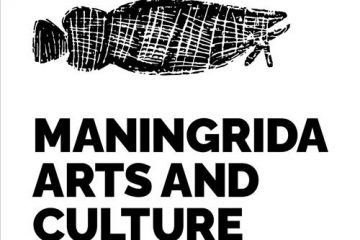
This is a depiction of Nguykal, the Golden Trevally [Gnathanodon speciosus]. In the early times of creation, Nguykal, the Trevally ancestor, travelled as two fish from the east along the coast. As he travelled along the coast he named clans or bapurru. These clans include Gamarl, Mardarrpa, Ritjarrngu, Gumatj, Dhalwangu, Wan.gurri and Warramiri. When Nguykal reached Gu-mugumuk on the east coast of Cape Stewart he leaped from the sea and landed inland at Gamurra Gu-yurra on Warrawarra clan lands. This created the sacred dreaming called Baltha, which is represented in design as a forked shape, reminiscent of the tail of a fish. Baltha stands as a tree at Gamurra Gu-yurra, and the forked shape that the main branches make with the trunk betray its sacred associations.
The Trevally ancestor then returned to the sea and kept travelling around Yinangarnduwa (Cape Stewart). Upon reaching Burnbuwa, a site midway between Yinangarnduwa and Yilan outstation, he became frightened by the appearance of lunggurrma, the clouds and rain associated with the northwest monsoon, which originated from beneath the sea. At this point the two fish separated. One of the Nguykal ancestors went inside at Burnbuwa and remains there as a dreaming, while the other returned back to the east and kept travelling until he reached the Yirrkala area. There he named a site Burnbuwa, which marks the link between these places.
Trevally spend much time swimming in and around the rocky reefs that lie close to shore along the north-central Arnhem Land coast. The formation swimming of the trevally has a religious dimension, and when the Gamarl and their close clansmen dance the Trevally ancestor, they also dance in formation like a school of fish and at one stage two groups of men will dance towards each other.
In painted depictions, cross-hatched stripes of infill surrounding Nguykal may represent rrawa or country at Burnbuwa and other places along the north-eastern Arnhem Land coast where Nguykal swam. Different clan groups each hold tenure over separate sections of country, but together they form a ‘company’ of related clans. These clans form a network linked by a system of reciprocal kinship and ceremonial ties. The Golden Trevally Ancestor is the explanation for the links between the different clan groups, and today the celebration of Nguykal’s creation journey in song, dance and design by the members of these groups continues to strengthen the kinship and ceremonial links between the members of these clans. 
111982307753


Nguykal (Golden Trevally)

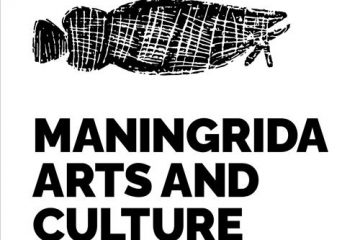
This is a depiction of Nguykal, the Golden Trevally [Gnathanodon speciosus]. In the early times of creation, Nguykal, the Trevally ancestor, travelled as two fish from the east along the coast. As he travelled along the coast he named clans or bapurru. These clans include Gamarl, Mardarrpa, Ritjarrngu, Gumatj, Dhalwangu, Wan.gurri and Warramiri. When Nguykal reached Gu-mugumuk on the east coast of Cape Stewart he leaped from the sea and landed inland at Gamurra Gu-yurra on Warrawarra clan lands. This created the sacred dreaming called Baltha, which is represented in design as a forked shape, reminiscent of the tail of a fish. Baltha stands as a tree at Gamurra Gu-yurra, and the forked shape that the main branches make with the trunk betray its sacred associations.
The Trevally ancestor then returned to the sea and kept travelling around Yinangarnduwa (Cape Stewart). Upon reaching Burnbuwa, a site midway between Yinangarnduwa and Yilan outstation, he became frightened by the appearance of lunggurrma, the clouds and rain associated with the northwest monsoon, which originated from beneath the sea. At this point the two fish separated. One of the Nguykal ancestors went inside at Burnbuwa and remains there as a dreaming, while the other returned back to the east and kept travelling until he reached the Yirrkala area. There he named a site Burnbuwa, which marks the link between these places.
Trevally spend much time swimming in and around the rocky reefs that lie close to shore along the north-central Arnhem Land coast. The formation swimming of the trevally has a religious dimension, and when the Gamarl and their close clansmen dance the Trevally ancestor, they also dance in formation like a school of fish and at one stage two groups of men will dance towards each other.
In painted depictions, cross-hatched stripes of infill surrounding Nguykal may represent rrawa or country at Burnbuwa and other places along the north-eastern Arnhem Land coast where Nguykal swam. Different clan groups each hold tenure over separate sections of country, but together they form a ‘company’ of related clans. These clans form a network linked by a system of reciprocal kinship and ceremonial ties. The Golden Trevally Ancestor is the explanation for the links between the different clan groups, and today the celebration of Nguykal’s creation journey in song, dance and design by the members of these groups continues to strengthen the kinship and ceremonial links between the members of these clans. 
111982307752


Marrchila (Saltwater crocdile)

Marrchila, ana-munya gu-nirra, gu-bugula a-waywunga a-boya, lika guna-gepiya, a-warrchinga a-rracha a-yurra. Nipa a-weya a-workiya, a-yinaga, “Garr-rru.”

The crocodile swims around at night, then after sunrise it climbs up out of the water and lies in the sun getting warm. It always makes a sound, it goes “Garr-rru.”


An-guna mernda a-jirra Gupanga. Ana-mernda a-bawuna, gojilapa Murlulu marrchila a-yurra rrapa gu-gapala.

This is the river at Gupanga. The crocodile came up out of the river and is lying on the island and at Murlulu.


Michpa jal nyi-ni ny-boy barra galang, ny-jarlapiya barra ny-boy, marrchila nula. Galaypa bi-barda.


If you want to go fishing, you should take care of yourself as you go, because of crocodiles. Otherwise, one might bite you.

Rrapa nyina barra ny-boy bugula gochila gu-jirra, o gun-nga gu-waywa barra gu-bamba, gun-gora. Nyi-na barra lorr, waygiji gun-nerranga nipa galaypa a-waywin a-bambun, marrchila.
 

You should always look out to the middle of the water, and at whatever is floating along, it might be harmless. You should look carefully, maybe it’s something else, it might be a crocodile swimming along

111982307751


Ngangiy (Mud-mussels)

This Painting depicts Ngangiy (Mud mussels) a type of shellfish; a mussel, a commonly gathered clam found in the mangrove mud and characteristically coated with coralline growth and stained partly black. Polymesoda coaxans (Corbiculidae). This plentiful shellfish is collected in the dried out floodplains, only a small sliver of the shell is exposed as it buries itself in mud, You need good eyes to find this delicious bush food.

111982307750


Burlupurr – large dillybag

Burlupurr, or dilly bag, is a large woven collecting basket. These large bags are often made from the vine ‘Malasia scandens’, a strong pliable plant which grows along the floor and into the canopy of monsoon vine thickets. The bags are used to collect any kind of large numbers of heavy foods such as fish caught in conical fish traps or large collections of yams.

They can also be made from Pandanus spiralis, a plant which grows in many areas of Arnhem Land. These dilly bags are a tightly woven collecting basket, very finely made. These dilly bags are often used to collect sugarbag, the native honey 

As well as being of practical use, dilly bags are also of religious significance to Arnhem Land people. Dilly bags are said to be totemic objects and associated with particular sites in the landscape.

111982307749


Mimih Spirit

The mimih spirit exists in a realm that runs parallel to and mirrors many facets of human life, also demonstrating the deep sense of time and place understood by Aboriginal and Torres Strait Islander people. Such spirits feature importantly in relation to Aboriginal spirituality, cosmology, social and moral tales as well as ritual. As is true with the multiple mediums employed by artists of West Arnhem Land, the development of artistic style and form is in line with an awareness by the artist that the work produced is predominantly made for a broader audience. Whether shown in a national or international context these works communicate and exist in a particular space that is cross-cultural and simultaneously so particular to the Arnhem region.

The mimih sits within a complex and important pedagogical and religious body of knowledge which links Kuninjku people to their distinctive escarpment homelands. Young Kuninjku artists, or apprentices, employ the mimih as an important exercise for the practice of the rarrk technique, as it could be achieved on a smaller surface area before being attempted in larger scale on pieces of bark. The mimih serves a purpose for those young artists first learning to carve in a social space of sharing and innovating. The initial mimih manifestation was a large form that almost mirrored the anatomy of a human and at this stage the sculptures have been likened to morkuy carvings visible in eastern Arnhem Land. Contemporaneously, mimih are depicted in a refined, slender, even emaciated form with a broad range of facial expressions giving both individual character to, and denoting the potential volatility and humour that mimih spirits are notable for in their interaction with bininj (humans). The sculptures are frequently carved from the thin trunks of softwoods such as kapok (bombax ceiba or cottonwood) kurrajong, beach hibiscus or leichardt and are painted with earth pigments for their colouring and design.

A leading figure engaging the spirit in visual storytelling was Crusoe Kuningbal, a Kuninjku man, who while traveling was familiarised with carving styles from the east of Arnhem at the mission in Milingimbi pre-dating World War II. Thus showing a notable connection and interaction of different language groups across such space. As well as travel and the development of art forms being informed by cross cultural dialogues within northern Aboriginal language groups. The mimih became a valued inclusion in performance and public ceremony by Kuninjku people like Kuningbal. At times these ceremonies were performed for extended language groups in the local region.

Now a familiar and broadly depicted figure of iconography, it is important to acknowledge the development of this quite recent sculptural tradition. The depiction of this particular spirit being, once used as an addition to the sharing of song cycles and ceremony, has since been elevated to a prominent form and subject of contemporary sculpture. Variation in the creation of mimih acts as an indication of the individualism of each artist and their stylistic markers. Additionally significant to note is that in the space of the past thirty years the mimih has begun being produced by multiple language groups residing in the Maningrida area including the traditional owners of Maningrida, the Ndjébbana, speaking Kunibidji as well as Gurrgoni people who have strong ties to Kuninjku. 

________
*Maningrida Arts & Culture acknowledge the work of many academic and non-academic voices when writing on this topic, it is important to note Luke Taylor, who’s broad research has informed this text.

111982307747


Mandjabugudukguduk

 Manjabukudukkurduk refers to a deep black waterhole that has deep spiritual significance as the site where Kuninjku people’s spirit comes into being and returns in death. The artists explains, “When we die our spirit will go back there… so this spirit will live forever, like we are still alive, we’re still living on that country”. It is linked to the Ancestral fish trap, which supports the growth and development of babies. This yirrididja moiety place is a potent site of Djang, Ancestral essence and power, meaning that if it is disturbed Kardbam people become sick and Kunkurra, the destructive cyclonic wind can be activated. Manjabukudukkurduk is also connected to other important songlines of the Kadbam clan estate, including Kalawon (goanna) and Ngalng (yabby).

111982307746


Ngalng (Freshwater yabby);-

This narrative is closely associated with Ngalng (yabby) which are depicted in this work in figurative form, placed alongside the circular holes in which they can be found in creeks and waterholes. Namunjdja explains,

‘Kunkurra is for the Mankorlod area. [It] has songs, so when we sing, kunkurra comes out. Kunkurra is not easy, kunkurra is really hard. It blows everything away, like a cyclone. My father, he painted all these together, kalawan (goanna), ngalng (yabby), narawan (Oenpelli Python), the sacred sites, their ceremonies, they are all linked.’

111982307745


Mandjabugudukguduk

 Manjabukudukkurduk refers to a deep black waterhole that has deep spiritual significance as the site where Kuninjku people’s spirit comes into being and returns in death. The artists explains, “When we die our spirit will go back there… so this spirit will live forever, like we are still alive, we’re still living on that country”. It is linked to the Ancestral fish trap, which supports the growth and development of babies. This yirrididja moiety place is a potent site of Djang, Ancestral essence and power, meaning that if it is disturbed Kardbam people become sick and Kunkurra, the destructive cyclonic wind can be activated. Manjabukudukkurduk is also connected to other important songlines of the Kadbam clan estate, including Kalawon (goanna) and Ngalng (yabby).

111982307744


Djomi

There are two Dreaming ladies at Bábbarra billabong – Djómi and Bábbarra. These two are sisters: one freshwater ‘mermaid’ and one saltwater one. Big long head, big stomach and very skinny legs that Bábbarra.

Their mother is the crocodile who lives in the Bábbarra billabong.

Both sisters will give people babies through the drinking water at Bábbarra. That’s why men stay away and Bábbarra is a sacred women’s site. Too strong our Dreaming – even men can get that baby in their tummies!

When it rains at Bábbarra, or when a cyclone comes, it’s because our Dreaming is too strong. There are lots of women spirits. When the storms come, the spirits go in the underground rivers and hide safely.

If you go fishing in our country, you have to be careful not to catch the Bábbarra and Djómi ‘mermaids’. Some people catch them thinking they are barramundi, but they are actually the ‘mermaid’ spirits. You will know, because they have white hair.

Lena Djabibba, djungkay (mother’s country and ceremonial manager of Bábbarra) and Joy Garlbin (landowner for Bábbarra)

Text courtesy of Bábbarra Women’s Centre copyright 2017