111982291922


Yawkyawk (Ngalkunburriyaymi)

This is a depiction of Ngalkunburriyaymi or Yawkyawk, the fish-women spirit. Sometimes compared to the European notion of mermaids, they exist as spiritual beings living in freshwater streams, particularly those in the stone country. These water spirits are perhaps the most enigmatic, and are usually described and depicted with the tails of fish. Thus the Kuninjku people sometime call them ngalberddjenj which literally means ‘the woman who has a tail like a fish’. They have long hair which is associated with trailing blooms of green algae (man-bak in Kuninjku) found in freshwater streams and rock pools. At times they leave their aquatic homes to walk about on dry land, particularly at night.

Aboriginal people believe that at one time all animals were humans. During the time of the creation of landscapes and plants and animals, these ancestor heroes in human form changed into their animal forms via a series of various significant events now recorded as oral mythologies. Today the Kuninjku believe that ngalkunburriyaymi are alive and well and living in freshwater sites in a number of sacred locations. The Kuninjku also believe that ‘clever’ man (magicians with mystical powers called na-kordang) may take these spirits as wives. The father of Mandarrk, a well known artist who resided in the Central Arnhem area, is said to have had such a spirit as a wife. Unfortunately, it is said, she failed one day to return from being sent to fetch water from the river, and returned to her kin. The ngalkunburriyaymi also have husbands and children of their own kind. Their sites are usually shared with the rainbow serpent ngalyod. Some have ritual importance, for example in some depictions, the yawkyawk spirit holds ceremonial string, just like the lengths of string women hold between both hands today during certain public ceremonies. 

There are at least three major ngalkunburriyaymi sacred sites that are well known in the area south and south-west of Maningrida. One site Bolerrhlerr is on the Mann River at a place near Yikarrakkal Outstation where there are rugged rocky banks and clefts beneath stone overhangs in the water. Another very similar site further west in the Kumadderr River district is surrounded by a number of small but very old rock art sites and has become known in English as ‘Dreaming Lady’. A third site is a major yawkyawk dreaming place which is so significant that the traditional Dangkorlo clan custodians have set up an outstation near the site. The identity of this group is very much related to their yawkyawk dreaming for which they have spiritual and practical responsibility. 

111982291917


Mat

Mats can vary greatly. Artists commonly use a mix of naturally dyed and undyed fibre to create a striking variation of coloured bands. Some artists also incorporate different types of looping to produce different patterns and textured finishes. Each type of mat, fibre bag, basket and dilly bag has its own name in the various languages spoken in the Maningrida region.

111982291913


Burlupurr – large dillybag

Burlupurr, or dilly bag, is a large woven collecting basket. These large bags are often made from the vine ‘Malasia scandens’, a strong pliable plant which grows along the floor and into the canopy of monsoon vine thickets. The bags are used to collect any kind of large numbers of heavy foods such as fish caught in conical fish traps or large collections of yams.

They can also be made from Pandanus spiralis, a plant which grows in many areas of Arnhem Land. These dilly bags are a tightly woven collecting basket, very finely made. These dilly bags are often used to collect sugarbag, the native honey 

As well as being of practical use, dilly bags are also of religious significance to Arnhem Land people. Dilly bags are said to be totemic objects and associated with particular sites in the landscape.

111982291911


Burlupurr – large dillybag

Burlupurr, or dilly bag, is a large woven collecting basket. These large bags are often made from the vine ‘Malasia scandens’, a strong pliable plant which grows along the floor and into the canopy of monsoon vine thickets. The bags are used to collect any kind of large numbers of heavy foods such as fish caught in conical fish traps or large collections of yams.

They can also be made from Pandanus spiralis, a plant which grows in many areas of Arnhem Land. These dilly bags are a tightly woven collecting basket, very finely made. These dilly bags are often used to collect sugarbag, the native honey 

As well as being of practical use, dilly bags are also of religious significance to Arnhem Land people. Dilly bags are said to be totemic objects and associated with particular sites in the landscape.

111982291861


Birlmu or Namarnkorl (Barramundi)

It is well known that Aboriginal art often depicts images of sacred totems or dreamings of Aboriginal culture. However, the world of the non-sacred also provides a rich source of subject matter for Aboriginal art. Much of the rock art of western Arnhem Land for example features secular topics such as common food animals and plants, depicted because of their economic importance but also merely because of their existence in the environment. The artist has painted ‘birlmu’ or ‘namarnkorl’ (Barramundi [Lates calcarifer]). During the dry season the barramundi is an important food source for inland Aboriginal people. These fish are caught throughout the artist’s clan estate, either in fishtraps woven from pandanus or sedge grass, or else hunted with spears and fishing lines in billabongs and streams where they shelter from the sun under fallen logs or amongst the leaves of water plants.

111982291860


Ngalyod (Rainbow Serpent)

The rainbow serpent is a powerful mythological figure for all Aboriginal people throughout Australia. Characteristics of the rainbow serpent vary greatly from group to group and also depending on the site. Often viewed as a female generative figure, the rainbow serpent can sometimes also be male. She has both powers of creation and destruction and is most strongly associated with rain, monsoon seasons and of course the colour seen in rainbows which arc across the sky like a giant serpent. For Aboriginal people in Northern Australia, the rainbow serpent is said to be active during the wet season.

Known as Ngalyod in the Kuninjku language of western central Arnhem Land, the rainbow serpent is mostly associated with bodies of water such as billabongs, creeks, rivers and waterfalls where she resides. Therefore she is responsible for the production of most water plants such as water lilies, water vines, algae and palms, which grow near water. The roar of waterfalls in the escarpment country is said to be her voice. Large holes in stony banks of rivers and cliff faces are said to be her tracks. She is held in awe because of her apparent ability to renew her life by shedding her skin and emerging anew. Aboriginal myths about the rainbow serpent often describe her as a fearful creature that swallows humans only to regurgitate them, transformed by her blood. The white ochre used by artists to create the brilliant white paint for bark paintings, body decoration and in the past, rock art, is said to be the faeces of the rainbow serpent.

Aboriginal people today respect and care take sacred sites where the rainbow serpent is said to reside. Often certain activities are forbidden at these places for fear that the wrath of the great snake will cause sickness, accidents and even tempests. This is not always the case however and there are many rainbow serpent sites today where people may enter to hunt, fish or swim. By painting this figure on bark today, Aboriginal people are carrying on the longest uninterrupted mythological tradition in the world, which has been the subject of art and ceremony for possibly thousands of years.

111982291859


Ngalyod (Rainbow Serpent)

The rainbow serpent is a powerful mythological figure for all Aboriginal people throughout Australia. Characteristics of the rainbow serpent vary greatly from group to group and also depending on the site. Often viewed as a female generative figure, the rainbow serpent can sometimes also be male. She has both powers of creation and destruction and is most strongly associated with rain, monsoon seasons and of course the colour seen in rainbows which arc across the sky like a giant serpent. For Aboriginal people in Northern Australia, the rainbow serpent is said to be active during the wet season.

Known as Ngalyod in the Kuninjku language of western central Arnhem Land, the rainbow serpent is mostly associated with bodies of water such as billabongs, creeks, rivers and waterfalls where she resides. Therefore she is responsible for the production of most water plants such as water lilies, water vines, algae and palms, which grow near water. The roar of waterfalls in the escarpment country is said to be her voice. Large holes in stony banks of rivers and cliff faces are said to be her tracks. She is held in awe because of her apparent ability to renew her life by shedding her skin and emerging anew. Aboriginal myths about the rainbow serpent often describe her as a fearful creature that swallows humans only to regurgitate them, transformed by her blood. The white ochre used by artists to create the brilliant white paint for bark paintings, body decoration and in the past, rock art, is said to be the faeces of the rainbow serpent.

Aboriginal people today respect and care take sacred sites where the rainbow serpent is said to reside. Often certain activities are forbidden at these places for fear that the wrath of the great snake will cause sickness, accidents and even tempests. This is not always the case however and there are many rainbow serpent sites today where people may enter to hunt, fish or swim. By painting this figure on bark today, Aboriginal people are carrying on the longest uninterrupted mythological tradition in the world, which has been the subject of art and ceremony for possibly thousands of years.

111982291858


Ngalyod (Rainbow Serpent)

The rainbow serpent is a powerful mythological figure for all Aboriginal people throughout Australia. Characteristics of the rainbow serpent vary greatly from group to group and also depending on the site. Often viewed as a female generative figure, the rainbow serpent can sometimes also be male. She has both powers of creation and destruction and is most strongly associated with rain, monsoon seasons and of course the colour seen in rainbows which arc across the sky like a giant serpent. For Aboriginal people in Northern Australia, the rainbow serpent is said to be active during the wet season.

Known as Ngalyod in the Kuninjku language of western central Arnhem Land, the rainbow serpent is mostly associated with bodies of water such as billabongs, creeks, rivers and waterfalls where she resides. Therefore she is responsible for the production of most water plants such as water lilies, water vines, algae and palms, which grow near water. The roar of waterfalls in the escarpment country is said to be her voice. Large holes in stony banks of rivers and cliff faces are said to be her tracks. She is held in awe because of her apparent ability to renew her life by shedding her skin and emerging anew. Aboriginal myths about the rainbow serpent often describe her as a fearful creature that swallows humans only to regurgitate them, transformed by her blood. The white ochre used by artists to create the brilliant white paint for bark paintings, body decoration and in the past, rock art, is said to be the faeces of the rainbow serpent.

Aboriginal people today respect and care take sacred sites where the rainbow serpent is said to reside. Often certain activities are forbidden at these places for fear that the wrath of the great snake will cause sickness, accidents and even tempests. This is not always the case however and there are many rainbow serpent sites today where people may enter to hunt, fish or swim. By painting this figure on bark today, Aboriginal people are carrying on the longest uninterrupted mythological tradition in the world, which has been the subject of art and ceremony for possibly thousands of years.

111982292398


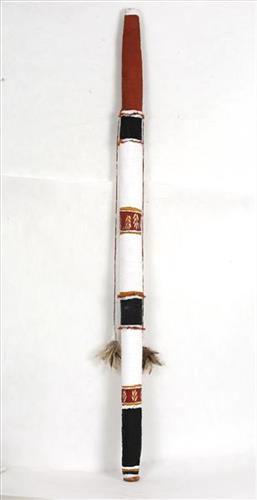
Ngalkodjek Spirit Pole

Transcription of text by Jack Nawilil about two ceremonial objects— Karlanj and Ngalkodjek. Transcribed by Murray Garde and Margaret Carew 2 & 5 December 2017. Notes by Margaret Carew on 5 Dec 2017


Note: The site Jack refers to as Kœnœdjangka is in the Rembarrnga language. The ‘œ’ vowel sounds like the ‘ur’ in English ‘fur’. As this vowel does not exist in neighbouring languages, it is usually converted to an ‘i’ as Kinidjangka by Kuninjku and Burarra speakers. I have used that spelling also in the English translation but retained Kœnœdjangka in the transcription of Jack’s speech. Jack’s speech involves code switching amongst Kriol, Kune, Burarra and English.


[00:00:01] This one here, like ngaye ngakurrmeng, im my draw.


This one here [ceremonial objects], I have drawn my own personal designs on them.


[00:00:09] This one Ngalkodjek.


This one (is called) Ngalkodjek. (MG- note, that this is not the subsection term Ngalkodjok, rather the stem -kodjek is formative in the verb -kodjekmang ‘to abduct’ and may refer to a secret episode in the Nakorrkko story, the father and son cultural heroes for Bininj in western Arnhem Land).


[00:00:13] Daluk, im from Elcho im bin travellng, im from Elcho, gama ngarla, jiny-bona didjan na, and didjan du.


This represents a woman, she travelled (here) from Elcho Island, she is from Elcho, she was a woman indeed, she went/travelled, this one and this one too.


[00:00:27] Didjan najawan, didjan na.


This is another one however, this one.


[00:00:30] Shemaiah: Those two are the same story?


[00:00:33] Same story this mob but I’ll bringim next week. I’ll bring another one.


[00:00:39] This one here, an-nerranga, an-guna balaji, mun-anngiya langa djolworra kantri, im from gun-anngiya, im from like im 


This one here, this is a different one and represents a food plant, what’s its name (that tucker), it is from the saltwater country, from this way, like, it’s from what’s that place


(MC comment: -anngiya is a ‘what’s its name’ word, that inflects for noun class.)


[00:01:05] In my country where that Kœnidjangka way. Didjan na.


In my country there at Kinidjangka. This one here.


[00:01:09] Yo an-guna. Yo Murray, Murray im save, marn.gi.


This one. Murray knows about this.


[00:01:19] Yo, Murray ngudda yibengkan ngayi ngarduk nani Murray. From Kœnidjangka ngamarnbom.


Murray you know this one, it’s my design Murray. I made it, the one from Kinidjangka.


[00:01:28] En nani Kœnidjangka ngamarnbom, en nani kuluban kayo kure Nakorrkko wam. Nani ngamarnbom. Ungke nane ngamarnbom that story ngarduk na. Ngakurrmeng ngaye. Ngudda yibengkan. Kanmarnebengkan Bulanj. Yoh.


This one I made it, the design from Kinidjangka, the place where flying foxes live where the Nakorrkko passed through. I made that. I’ve made that story for you, that one of mine. I have put it there. You know that. You know what I’m talking about Bulanj (to Murray Garde).


[00:01:51] Didjan, nane, dijan gama i bin travelling garra didjei, garra didjei.


This one here, she is a woman who travelled this way, coming this way (to the west from north-east Arnhem Land).


[00:02:03] Im gona garra ebrijing. From Kunidjangka i bin make it. From Kœnidjangka ngamarnbom en nani Kœnidjangka ngamarnbom. En dijan Kœnidjangka ngamarnbom. Nane now.


She has many things. I made it, the one from Kinidjangka. From Kinidjangka I made it. It is from Kinidjangka, this thing i have made. That’s it now.


[00:02:25] Ngarduk my draw nane. Like ngamarnbun, like im nomo marrek ba morning star, im different nani. ngardapa ngardapa ngarla dreaming. Mu-gurrmurra, yo a-gurrmurra a-bona. Wangarr ngarla.


This design belongs to me. Like, I made it, and it should not be confused with a morning star pole, no, it is something different. they are separate indeed, these dreamings. It (an ancestral spirit) put it there. It is my totemic emblem. It is my ancestral design of the ancestral beings, indeed.


MC note: 

mu-gurrmurra

00:02:44.460 – 00:02:45.310

it put it (object belongs to mun- vegetable noun class)

00:02:44.460 – 00:02:45.310

a-gurrmurra a-bona

00:02:45.310 – 00:02:47.928

it put it (object now belongs to an- masculine noun class). a-bona here literally means ‘it (masculine) went’ but functions as an aspectual auxilliary, showing that the action is completed. Tense suffixes construe this in the past.


Shemaiah responds: yo gun-burral

00:02:49.570 – 00:02:51.155

yes that’s true

00:02:49.570 – 00:02:51.155


[00:02:53] Dijan, dijan, im from dijei na, from Elcho. mm dijan.


This one, its origins are from this way (the east), from Elcho, mm, this one.


[00:03:00] gama


a woman


[00:03:02] Shemaiah: Ngay ngay ngay


yeah yeah yeah


[00:03:05] Dijan, im daga ia la Kœnidjangka. Balajiya. But im Mardayin. Bad ai jas putumbat eniwe yuno?


This other one is an edible plant. Food. But it is a sacred thing from the Mardayin ceremony. But I have adapted it to make it a secular version.


MC note: balajiya – note emphasis -ya final syllable.


@Shemaiah: balaji murda

00:03:09.370 – 00:03:10.530

food this one

00:03:09.370 – 00:03:10.530

murda is a contracted demonstrative (from mun-narda), ‘this one in focus’ compare arda, jirda, gurda, other noun class inflected forms. These contracted demonstrative forms are a feature of modern Burarra. 

00:03:09.370 – 00:03:10.530


[00:03:19] Dijan na. Dijan, dijan mun-anngeyo balaji gen


This one. This is also a food.


[00:03:27] Shemaiah: balaji?


Food?


[00:03:28] Yo im my country igen bad awirri-gapajinga ngarla. We digim and karrimang. We eatim na, dijan na. 


Yes, in my country, we dig it, but has a secret element to the story. We dig it and take it out. Then we eat it, this thing.


MC note:

The transitive prefix awirri- (~abirri-) reads to me as ‘you and me plus one more’, ie inclusive unit augmented. If plural/augmented we’d expect mbi-gapajinga ie third person augmented acting on singular object, where there is noun class agreement with the object. If just ‘you and me’ is intended it would be ay-gapajinga. Quite commonly unit augmented prefixes are used in generic statements such as this, where one might expect another prefix going from the speech or discourse context.

00:03:29.960 – 00:03:31.565


[00:03:42] Like ngakurrmeng namekke Murray, Bulanj, nane Ngalkodjek wam from aa kure kamdolkkang from aam, Elcho.


So, Murray, that’s what I’ve put on it (the design). This is Ngalkodjek who travelled, setting out from Elcho Island.


[00:03:58] Ngamarnbom. Nabuyika nane, ngamarnbom manme rerri. Manme ngamarnbom, mane manme kangeydi manbingkanj.


I made it. The other one, I also made that one too. I made the plant food emblem, and the name of that plant is manbingkanj.


[00:04:16] Nane, nane ngamarnbom karlanj ngamarnbom, manme rerrih. Nane na Kœnidjangka ngamarnbom. Ngaleng nani, ngaleng Elcho kamwam daluk. Dijan na.


This thing here, I made it, this object is called karlanj and it represents a plant food. This one I have made is from Kinidjangka. She is a woman who came from Elcho Island. This one now.


[00:04:34] Im from long way dijan i bin travelling, from Elcho, (kala xxx ) like yu nomo save… yuno that, daluk, blanga im business, garra dijan i bin travelling. Yo. Dijan ia im mine dijan. Nane ngarduk rowk Bulanj, namekke draw namekke recordim ngayeman ngangeykurrmehkurrmeng nane.


She was travelling a long way, from Elcho Island (…..) like, you don’t know that story (it’s secret)… you know it related to a woman, it was her ceremonial story, and she was travelling. This thing here is my (clan) design. These are all mine Bulanj (to Garde) and what I have drawn, it’s being recorded now and I’m explaining all the names relating to it.


[00:05:03] Nane Ngalkodjek daluk, nane manme karlanj en nane mak, njamed, um. Karlanj manih manbu. Mak mane manbuyika, djal manbuyika yerri.


This woman, her name is Ngalkodjek, and this is the food, the karlanj, and this whatsit, um. Karlanj, that’s it. And there is another one but it is different again.


[00:05:24] Manbu rerri kayime wanjh mani nawu.


It is similar again, this one here.


[00:05:26] Ngamarnbom.


I made them.


[00:05:28] Ungke Murray. Kaluk yibekkan yingan kumekke mankarre yimarnbun. Yo namekke. Ma, thank you.


This (recording) is for you Murray (to transcribe for the art and cultural centre). You can listen to it and document the cultural story. That’s it. Okay, thank you.
111982290894


Lorrkon (Hollow Log)

The Lorrkon or bone pole coffin ceremony was the final ceremony in a sequence of mortuary rituals celebrated by the people of Arnhem Land. This ceremony involves the placing of the deceased’s bones into a hollow log which was decorated with painted clan designs and ceremonially placed into the ground where it remained until it slowly decayed over many years.

The log is made from a termite hollowed Stringybark tree (Eucalyptus tetradonta) and is decorated with totemic emblems. The western Arnhem Land version of the Lorrkon ceremony involves the singing of sacred songs to the accompaniment of karlikarli, a pair of sacred boomerangs used as rhythm instruments. During the final evening of the ceremony, dancers decorate themselves with kapok down, or today, cotton wool and conduct much of the final segments of the ceremony in the secrecy of a restricted mens’ camp. The complete ceremony may stretch over a period of two weeks, but on the last night the bones of the deceased, which have been kept in a bark container or today wrapped in cloth and kept in a suitcase are taken out, are painted with red ochre and placed inside the hollow log. This ceremony may take place many years after the person has died.

At first light on the final morning of the Lorrkon ceremony, the men appear, coming out of their secret bush camp carrying the pole towards the women’s camp. The two groups call to each other using distinct ceremonial calls. The women have prepared a hole for the pole to be placed into and when it is stood upright, women in particular kinship relationships to the deceased dance around the pole in a jumping/shuffling motion. The Lorrkon is then often covered with a tarpaulin and left to slowly decay.