111982422866


Coil Basket

Coil basketry is a well-established fibre art form in the Maningrida region, especially for women from the Kuninjku, Rembarrnga, Ndjebbana and Nakkara language groups. 

Artists make coiled baskets of many shapes and sizes, ranging from small round baskets to large oval baby baskets, and made mostly from pandanus fibre that is dyed with natural pigments. Bundles of fibre are formed into coils which are covered and stitched together with strands of fibre threaded onto a needle. Artists combine colours and patterns to obtain intricate new graphic patterns.

These techniques are believed to have been introduced to Arnhem Land by Greta Matthews, a missionary on Goulburn Island in the 1920s. She had probably learnt coil basketry from Aboriginal people in the south-east of Australia, possibly the Murray River people such as the Yorta Yorta or the coastal Ngarrindjeri. 

The coiling technique spread quickly from Goulburn Island to people on mainland Arnhem Land. 


111982422865


Coil Basket

Coil basketry is a well-established fibre art form in the Maningrida region, especially for women from the Kuninjku, Rembarrnga, Ndjebbana and Nakkara language groups. 

Artists make coiled baskets of many shapes and sizes, ranging from small round baskets to large oval baby baskets, and made mostly from pandanus fibre that is dyed with natural pigments. Bundles of fibre are formed into coils which are covered and stitched together with strands of fibre threaded onto a needle. Artists combine colours and patterns to obtain intricate new graphic patterns.

These techniques are believed to have been introduced to Arnhem Land by Greta Matthews, a missionary on Goulburn Island in the 1920s. She had probably learnt coil basketry from Aboriginal people in the south-east of Australia, possibly the Murray River people such as the Yorta Yorta or the coastal Ngarrindjeri. 

The coiling technique spread quickly from Goulburn Island to people on mainland Arnhem Land. 


111982422864


Coil Basket

Coil basketry is a well-established fibre art form in the Maningrida region, especially for women from the Kuninjku, Rembarrnga, Ndjebbana and Nakkara language groups. 

Artists make coiled baskets of many shapes and sizes, ranging from small round baskets to large oval baby baskets, and made mostly from pandanus fibre that is dyed with natural pigments. Bundles of fibre are formed into coils which are covered and stitched together with strands of fibre threaded onto a needle. Artists combine colours and patterns to obtain intricate new graphic patterns.

These techniques are believed to have been introduced to Arnhem Land by Greta Matthews, a missionary on Goulburn Island in the 1920s. She had probably learnt coil basketry from Aboriginal people in the south-east of Australia, possibly the Murray River people such as the Yorta Yorta or the coastal Ngarrindjeri. 

The coiling technique spread quickly from Goulburn Island to people on mainland Arnhem Land. 


111982422863


Coil Basket

Coil basketry is a well-established fibre art form in the Maningrida region, especially for women from the Kuninjku, Rembarrnga, Ndjebbana and Nakkara language groups. 

Artists make coiled baskets of many shapes and sizes, ranging from small round baskets to large oval baby baskets, and made mostly from pandanus fibre that is dyed with natural pigments. Bundles of fibre are formed into coils which are covered and stitched together with strands of fibre threaded onto a needle. Artists combine colours and patterns to obtain intricate new graphic patterns.

These techniques are believed to have been introduced to Arnhem Land by Greta Matthews, a missionary on Goulburn Island in the 1920s. She had probably learnt coil basketry from Aboriginal people in the south-east of Australia, possibly the Murray River people such as the Yorta Yorta or the coastal Ngarrindjeri. 

The coiling technique spread quickly from Goulburn Island to people on mainland Arnhem Land. 


111982422861


Stingray

It is well known that Aboriginal art often depicts images of sacred totems or dreamings of Aboriginal culture. However, the world of the non-sacred also provides a rich source of subject matter for Aboriginal art. Much of the rock art of western Arnhem Land for example features secular topics such as common food animals and plants, depicted because of their economic importance but also merely because of their existence in the environment.

111982422860


Kubumi (Anniebell Marrngamarrnga)

Kubumi is a sacred site on the Mann River. Anniebell Marrngamarrnga is the Djungkay (ritual manager) of this place, her mother’s country.

In the creation time, Ngalyod (the Rainbow Serpent) pierced the rock at a place called Bolerrhlerrh and journeyed downstream from there to Ngalmalanj, where the serpent was blocked. She pushed down into the riverbed, pushed into the earth, sinking down forever. Now she lives under the rocky riverbed.

The camping place Kubumi is downstream from Ngalmalanj. During the dry season, the Mann River shrinks to a chain of deep waterholes, exposing the tunnels through the rocky outcrop that interconnect the pools. At Kubumi live the Ngalkunburriyaymi, mermaid-like water spirits. In the distant past, they camped on the sand and were attracted to the freshwater, swimming there. Ngalyod, the Raibow Serpent, pulled them into the ground, through the rock holes.

Today they live within the river; at times they leave their aquatic homes to walk about on dry land, particularly at night. Sometimes they are called ngalberddjenj, which literally means ‘the woman who has a tail like a fish’. Their long hair is associated with trailing blooms of man-bak (green aglae) found in freshwater streams and rock pools.

Known for her intricately woven Yawkyawk and other figurative ancestral forms, Anniebell expands her practice in this work to encompass Kubumi itself — presenting the sacred site as a living, inhabited landscape shaped by Birlmu (barramundi), Nawarlah (brown river stingray), and the Ngalkunburriyaymi.

111982422858


Nawarlah – Brown River Stingray

We hunt the Nawarlah (Brown River Stingray) during the wet season.  There is a plant with a yellow flower that tells us that it is the right time.  We know it will be fat. 

It is well known that Aboriginal art often depicts images of sacred totems or dreamings of Aboriginal culture. However, the world of the non-sacred also provides a rich source of subject matter for Aboriginal art. Much of the rock art of western Arnhem Land for example features secular topics such as common food animals and plants, depicted because of their economic importance but also merely because of their existence in the environment.

111982405385


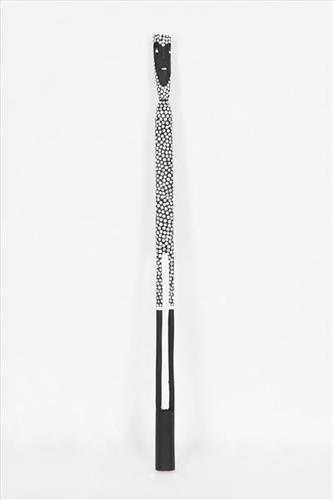
Warraburnburn

In Burarra and Gun-nartpa languages the figure represented in this artwork is generally known as a wangarra ‘ghost spirit’. For the Warrawarra clan ghost spirits have their own particular characteristics and their own name – Warraburnburn.

The Warraburnburn and the closely related Galabarrbarr spirit (owned by the Balkarranga clan) are also manikay song topics.  The spirits are related to each other as maternal grandparent and grandchild, just as the people of Warrawarra and Balkarranga are. The dancing of the two ghost spirit figures forms the finale performance for funerals, and is the final goodbye to a deceased family member.

In many ways the Warraburnburn and Galabarrbarr ghost spirits are like people. They emerge from the patches of jungle on Warrawarra and Balkarranga country in the late afternoon and go hunting in family groups of men, women and children. They stay in contact with each other by calling out as the men hunt for fish and the women walk with their dillybags looking for vegetable food. 

The ghost spirits are associated closely with white ochre and artists commonly paint the bodies of carved figures in white. Different types of ghost spirit wear different patterns. Warraburnburn is decorated with uniform white dots while others are painted white all over. Some ghost spirits are shown with a design painted on their chest infilled with rarrk ‘cross-hatching’, the same designs that are painted onto japi an-guyinda ‘male initiations’. 

They also have supernatural characteristics including superhuman size (jarra anbaykarda ‘super tall’). They know the country intimately – some are malevolent towards humans and will lead people astray, taking them to unfamiliar and dangerous places. These malevolent spirits are likened to an-muburda ‘sorcerers’ and can conduct dangerous rituals that cause harm to people. Others are benign and will lead humans back to familiar paths and their own camps.


111982418932


An-gujechiya (Fish Trap)

To make fish traps and fish net fences artists firstly get vine (mirlarl) from the jungle and they put it in water for one night to make it soft. Next they start weaving it; they make rings for the inside to keep the fish trap’s shape. Artists work for three or four weeks on the fish trap. They also make string from kurrajong (burdaga) to attach the hibiscus (bardainy) rings and to tie the conical end of the fish trap. This fish trap is used in saltwater and freshwater. People also use fish net fences called mun-dirra. A long time ago they would put the mun-dirra across rivers and creeks. In the middle they would place the an-gujechiya. They also used small things like sticks, rocks, mud and grass to block the fish from going through. People would then catch fish like saltwater barramundi rajarra, freshwater barramundi (janambal), small black freshwater catfish (buliya), bonefish (an-guwirrpiya), and sand bass (dalakan) in these fish traps.