111982128670


Ngaldadmurrng

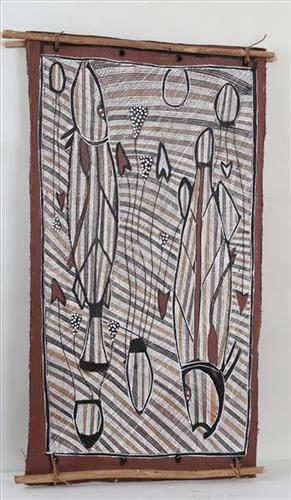
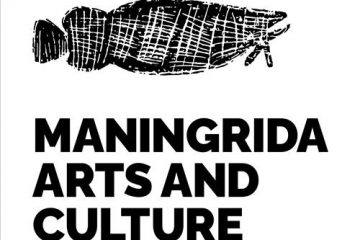
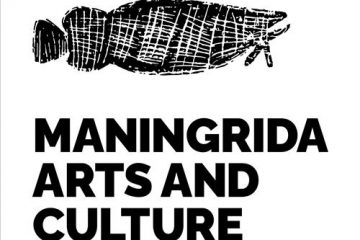
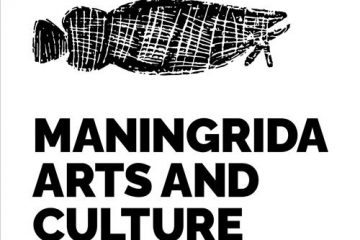
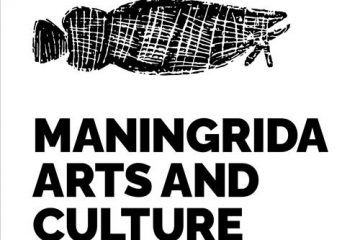
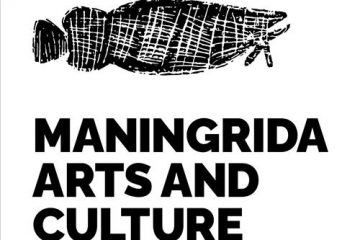
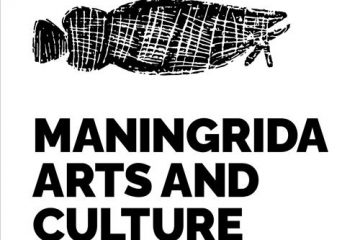
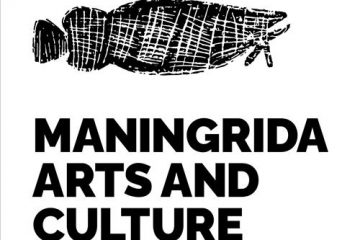
This is a painting of ngaldadmurrng ‘Saratoga fish’ (Scleropages jardini) sometimes also called the Northern Spotted Barramundi.

Saratoga are commonly found in creeks, rivers and billabongs around the artist’s clan estate. The animal depicted is on one level easy to recognise and it’s meaning is easily accessible. On a deeper level the animal is depicted with intense rarrk ‘cross hatched’ infill, which creates a reference to Mardayin ceremonial mysticism. 

Saratoga makes their nests on the bottom of riverbeds in the sand by digging with their tails and fins and lay eggs into these depressions. During mortuary rituals the Kuninjku imitate these nests in sand sculpture. At the end of funerals all those who have attended the funeral are required to stand in the ‘saratoga’s nests’ and they are doused with water to be cleansed from the polluting effects of the deceased. A large meteorite crater near Mumeka in the Liverpool River district is said to be the nest of the saratoga which now stands in the landscape as djang ‘a sacred site’. 

In painting this image Marawarr is continuing a long tradition of figurative artistic practice carried out by Arnhem Land.


111982128668


Kun-madj – large dillybag vine

Kun-madj, or dilly bag, is a large woven collecting basket. These large bags are often made from the vine ‘Malasia scandens’, a strong pliable plant which grows along the floor and into the canopy of monsoon vine thickets. The bags are used to collect any kind of large numbers of heavy foods such as fish caught in conical fish traps or large collections of yams.

They can also be made from Pandanus spiralis, a plant which grows in many areas of Arnhem Land. These dilly bags are a tightly woven collecting basket, very finely made. These dilly bags are often used to collect sugarbag, the native honey

As well as being of practical use, dilly bags are also of religious significance to Arnhem Land people. Dilly bags are said to be totemic objects and associated with particular sites in the landscape.

111982128655


Ngaldadmurrng

This is a painting of ngaldadmurrng ‘Saratoga fish’ (Scleropages jardini) sometimes also called the Northern Spotted Barramundi.

Saratoga are commonly found in creeks, rivers and billabongs around the artist’s clan estate. The animal depicted is on one level easy to recognise and it’s meaning is easily accessible. On a deeper level the animal is depicted with intense rarrk ‘cross hatched’ infill, which creates a reference to Mardayin ceremonial mysticism. 

Saratoga makes their nests on the bottom of riverbeds in the sand by digging with their tails and fins and lay eggs into these depressions. During mortuary rituals the Kuninjku imitate these nests in sand sculpture. At the end of funerals all those who have attended the funeral are required to stand in the ‘saratoga’s nests’ and they are doused with water to be cleansed from the polluting effects of the deceased. A large meteorite crater near Mumeka in the Liverpool River district is said to be the nest of the saratoga which now stands in the landscape as djang ‘a sacred site’. 

In painting this image Marawarr is continuing a long tradition of figurative artistic practice carried out by Arnhem Land.


111982128635


Barnda – long neck turtle

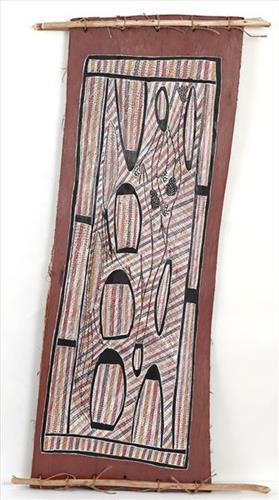
In the mythology or dreaming history of the Ganalbingu and Gurrgurrdjunggu peoples, two sisters who were the human forms of barnda ‘the Long-neck Turtle’ (Chelodina rugosa) came travelling a long distance from the east towards Ganalbingu country in Central Arnhem Land. They travelled through Martay country arriving at a place called Ji-malawa, the site today of a homeland/outstation community in the Blyth River district. At this place they turned their speech to the Burarra language and named sites as they travelled. The two Barnda sisters continued their journey to Gamardi, a site in Djinang country and they again changed their language to a dialect of Djinang called Wulagi.

Barnda is also Bulunbulun’s personal ‘Dreaming’ given to him by his father who was walking in the swamp at the time of the artist’s birth. 

While discussing the painting’s imagery, Bulunbulun explained that some components were the domain of ‘inside’ or secret ceremonial meaning and therefore he could only describe the ‘outside’ or public aspects of them.

In the painting Bulunbulun depicts the passage of the barnda through the country and the locations where the long neck turtle stopped to create features in the landscape in the Dreamtime. The two black circular forms are ngambul ‘a waterhole’ formed by barnda. The two horizontal bands of rarrk ‘crosshatching’ in the midlle and upper section of the painting are marwurru ‘a paperbark log’ over which barnda walked along the journey. The large areas of rarrk represent gurrwiling ‘the swamp’ created by barnda. The vertical swaying lines are gunbuluru and wuye different types of reeds that are so sharp that they can cut one legs when walking through the swamp. At the top of the painting above the head of the image of the turtle is a band of rarrk, which represents the view of the plain country and swamp from a hill.


111982128634


Waterholes (Kubumi)

Kubumi is a sacred site on the Mann River. This is its story, as told by a ritual manager of the site, Lulu Laradjbi, with the authority of her husband Mick Kubarkku, a land owner of that country.

Ngalyod the Rainbow Serpent pierced the rock at a place called Bolerrhlerrh and journeyed downstream from there to Ngalmalanj. The camping place Kubumi is downstream from there but at Ngalmalanj the serpent was blocked. It pushed down into the riverbed, pushed into the earth, sinking down forever. Now it lives under the rocky riverbed. That site continues downstream. Upstream is the site Molerrhlerrh, which has a waterfall and a big waterhole. There the serpent moved inside, downstream, to the lower region.

During the dry season at Kubumi, the Mann River shrinks to a series of deep waterholes, exposing the tunnels through the rocky outcrop that interconnect the pools.

111982128633


Kunkurra (The Spiralling Wind)

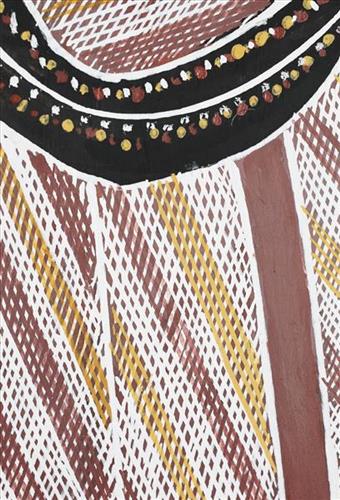
‘Kunkurra’, the spiralling wind is associated with several sites in the Kardbam clan estate. On one level, this painting can be interpreted as a depiction of the kinds of mini-cyclones common during the wet season in Arnhem Land, where the artist lives. In this painting, Kunkurra also relates specifically to a site called Bilwoyinj, near Mankorlod.

At this site, two of the most important Kuninjku creation beings, a father and son known as na-korrkko, are believed to have hunted and eaten a goanna. They left some of the goanna fat behind at the site, which turned into the rock that still stands there today. The word Bilwoyinj, which is the name of this site, also refers to the fat of the goanna. Bilwoyinj site is also a ceremonial ground for a ceremony called Yabbaduruwa, a major ceremony owned by the Yirridja patrimoiety. The Yabbaduruwa ceremony is primarily concerned with initiation, land ownership and promoting the cyclical regeneration of the human and natural worlds.

111982128632


Kun-madj – large dillybag vine

Kun-madj, or dilly bag, is a large woven collecting basket. These large bags are often made from the vine ‘Malasia scandens’, a strong pliable plant which grows along the floor and into the canopy of monsoon vine thickets. The bags are used to collect any kind of large numbers of heavy foods such as fish caught in conical fish traps or large collections of yams.

They can also be made from Pandanus spiralis, a plant which grows in many areas of Arnhem Land. These dilly bags are a tightly woven collecting basket, very finely made. These dilly bags are often used to collect sugarbag, the native honey

As well as being of practical use, dilly bags are also of religious significance to Arnhem Land people. Dilly bags are said to be totemic objects and associated with particular sites in the landscape.

111982128631


Ngalyod (Rainbow Serpent)

The rainbow serpent is a powerful mythological figure for all Aboriginal people throughout Australia. Characteristics of the rainbow serpent vary greatly from group to group and also depending on the site. Often viewed as a female generative figure, the rainbow serpent can sometimes also be male. She has both powers of creation and destruction and is most strongly associated with rain, monsoon seasons and of course the colour seen in rainbows which arc across the sky like a giant serpent. For Aboriginal people in Northern Australia, the rainbow serpent is said to be active during the wet season.

Known as Ngalyod in the Kuninjku language of western central Arnhem Land, the rainbow serpent is mostly associated with bodies of water such as billabongs, creeks, rivers and waterfalls where she resides. Therefore she is responsible for the production of most water plants such as water lilies, water vines, algae and palms, which grow near water. The roar of waterfalls in the escarpment country is said to be her voice. Large holes in stony banks of rivers and cliff faces are said to be her tracks. She is held in awe because of her apparent ability to renew her life by shedding her skin and emerging anew. Aboriginal myths about the rainbow serpent often describe her as a fearful creature that swallows humans only to regurgitate them, transformed by her blood. The white ochre used by artists to create the brilliant white paint for bark paintings, body decoration and in the past, rock art, is said to be the faeces of the rainbow serpent.

Aboriginal people today respect and care take sacred sites where the rainbow serpent is said to reside. Often certain activities are forbidden at these places for fear that the wrath of the great snake will cause sickness, accidents and even tempests. This is not always the case however and there are many rainbow serpent sites today where people may enter to hunt, fish or swim. By painting this figure on bark today, Aboriginal people are carrying on the longest uninterrupted mythological tradition in the world, which has been the subject of art and ceremony for possibly thousands of years.

111982128159


Wak Wak

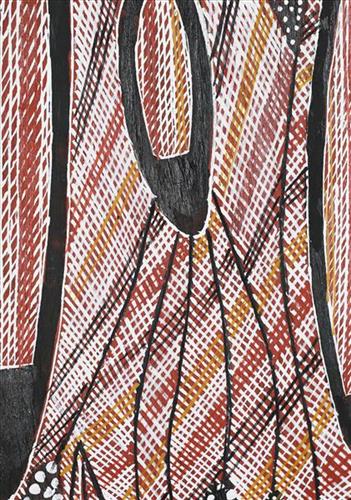
This painting depicts a sacred site at ‘Kurrurldul’, an outstation south of Maningrida.

The ‘rarrk’, or abstract crosshatching, on this work represents the design for the crow totem ancestor called ‘Djimarr’. Today this being exists in the form of a rock, which is permanently submerged at the bottom of Kurrurldul Creek. The ‘Djimarr’ rock in the stream at Kurrurldul is said to move around and call out in a soft hooting tone at night. Both the stone itself and the area around it are considered sacred.

The imagery represents the rock mentioned above at the bottom of Kurrurldul creek, which is the final transmutation of the dreaming ancestor ‘Djimarr’. Finally, the pattern used here is also the crow design used in the sacred ‘Mardayin’ ceremony, which is a large regional patri-moiety ceremony now rarely conducted in central and eastern Arnhem Land.

111982128158


Ngalkunburriyaymi fish-women spirit #1

the water spirits Yawkyawk or Ngalkunburriyaymi are perhaps the most enigmatic of themes. sometimes compared to the European notion of mermaids, they exist as spiritual beings living in freshwater streams, particularly those in the stone country. the spirit yawkyawk are usually described and depicted with the tails of fish, as in the painting. thus the kuninjku people sometimes call them Ngalberddjenj which literally means the women who has a tail like a fish.’ they have long hair which is associated with trailing blooms of green algae (called man-bak in kuninjku ) found in freshwater streams and rock pools. at times they leave their aquatic homes to walk about dry land, particularly at night.

Today the kuninjku believe that ngalkunburriyaymi are alive and well living in freshwater sites in a number of sacred locations. the kuninjku also believe that ‘ clever’ men ( magicians with mystical powers called in Kuninjku na-kordang ) may take these spirits as wives. the Ngalkunburriyaymi also have husbands and children of their own kind. their sites are usually shared with the rainbow serpent ngalyod. some have ritual importance; for example in some depictions the yawkyawk spirit holds ceremonial string, just like the lengths of string women hold between both hands today during certain public ceremonies.

There are at least three major Ngalkunburriyaymi sacred sites that are well known in the area south and  south-west of Maningrida. one site is on the Mann River at a place near Yikarrakal Outstation where the Mann River has rugged rocky banks and clefts beneath stone overhangs in the water. Another very similar site further west in the Kumadderr River district is surrounded by a number of small but very old rock art sites and has become known in English as Dreaming Lady . A third site is a major yawkyawk dreaming place which is so significant that the traditional clas custodians have set up an outstation community near the site, and the identity of this group is very much related  to their yawkyawk dreaming for which they have spiritual and practical responsibility. This group, known as dangkorlo clan, are well known for their bark paintings and sculptures of yawkyawk.

The techniques of bark painting are usually handed down from one generation to the next, as are the rights of each artist to a particular site or dreaming. The artists mother is a member of the Dangkorlo clan. This theme has often been painted by Flora’s father Mick Kubarkku.