114182418274


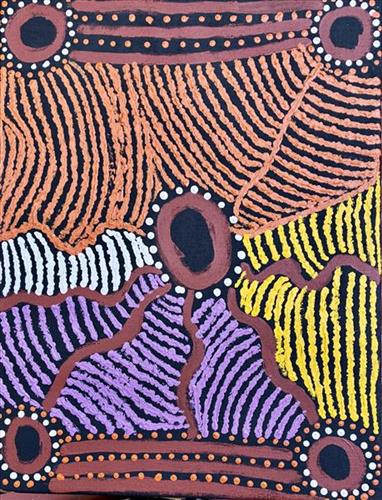
Wati kutjara – The goanna men

This is the story of two powerful magicians who came to the Ngaanyatjarra Lands from far away to the west;

‘These two men are always together, always camping together. They do all sorts of tricks when they travel across the lands as they stop from place to place. When they reached ‘Wirtapi Wara’ (Long Black or Blackstone Range) they argued about which way to go around. One went around the south side and the other the north side.

At a distance it seemed they didn’t recognise each other or perhaps they were just pretending not to recognise each other! It is also said that at Papulankutja they tricked each other by changing their appearance at the same time so they had no chance to recognise each other. The name Papulankutja comes from the Ngaanyatjarra word meaning, ‘to stare without recognising each other’.


Dimensions: 122 x 156cm

114182425892


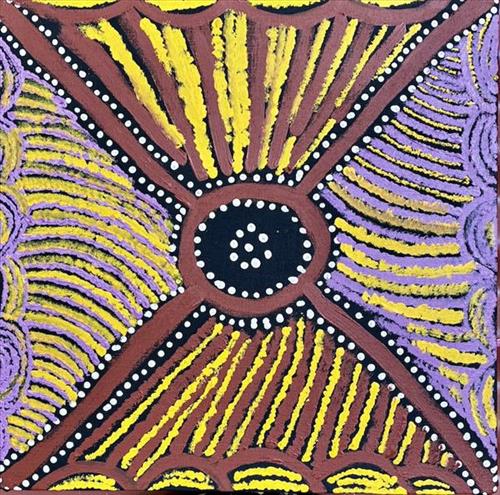
Kungkarrangkalpa (Seven Sisters)

‘Kungkarrangkalpa’ (The Seven Sisters or Pleaides) is significant Tjukurrpa (dreamtime). Its origins you may be familiar with in astronomy and its connection to ‘Wati Nyiru’ (Magic Man or Orion).  The roots of this dreaming stems across indigenous groups around the world. The Australian Aboriginal songline is one part to the whole dreaming which can be traced all around the world. The ladies of the Ngaanyatjarra Lands depict their significant chapter and understanding of the journey of the sisters. The different versions of this story depend on where you live and the significance’s of local Tjukurrpa places.

Nyiru fell in love with the sisters but he was of the wrong skin group to marry, but he still pursued them on their journey. The sisters travel across the land to escape Nyiru’s unwanted attentions, but he is persistent and always finds them. There are significant land forms which can be sited today that evidence this dreaming. As Nyiru is chasing the sisters he tries to catch them by using magic to turn into the most tempting kampurarrpa (bush tomato) and the most beautiful Yirli (wild fig tree), for them to eat and camp under. However, the sisters are knowledgeable of his magic and too clever for Nyiru who they outwit again and again. They go hungry and run through the night rather than be caught by him. As the journey continues, Nyiru gets so frustrated at the wit of the sisters that he uses his magic to make the oldest sister sick to try and get closer to her. The other sisters rescue the big sister and nurse her back to health. It is said he also captures the youngest sister, but with the help of the oldest sister, she escapes back to her sisters who are waiting for her. Eventually, the sisters fly into the sky to escape Nyiru, forming the constellation. Nyiru felt lonely, longing for the sisters who were so far away. Nyiru used his magic to go to the sky, forever in pursuit.

114182412947


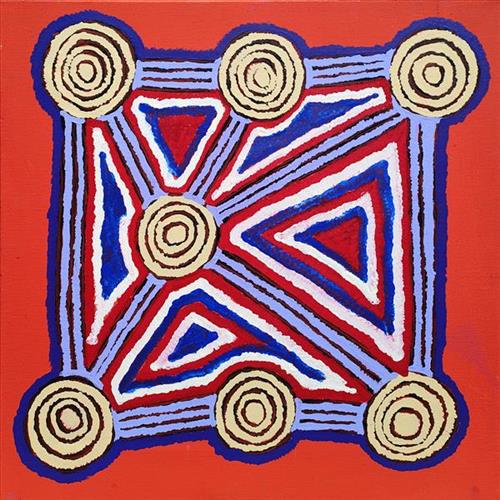
Rosie – Winboll Rockhole


Rosie paints the land that birthed her: the sacred Winboll Rockhole, a place cradled on the far western side of Mantamaru (Jameson) a place where ancient waters sleep beneath the earth and stories from time immemorial breathe through the stones.

Rosie brings to life the rhythm of her birthplace, a land where sunlight dances upon the rocks and whispers of ancestors float on the wind. Her work is a glimpse into the heart of Winboll Rockhole, a land woven with mystery.


Dimensions: 38 x 38cm

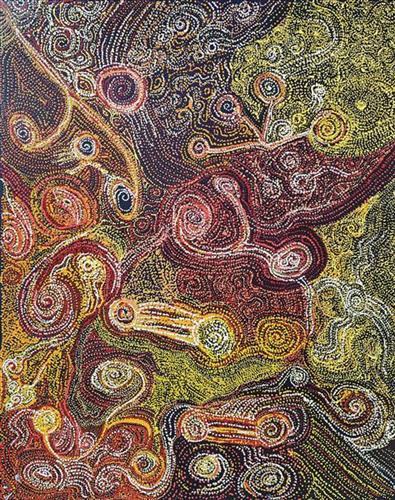
114182412943


Rosie – Winboll Rockhole

Rosie paints the land that birthed her: the sacred Winboll Rockhole, a place cradled on the far western side of Mantamaru (Jameson) a place where ancient waters sleep beneath the earth and stories from time immemorial breathe through the stones.

Rosie brings to life the rhythm of her birthplace, a land where sunlight dances upon the rocks and whispers of ancestors float on the wind. Her work is a glimpse into the heart of Winboll Rockhole, a land woven with mystery.


Dimensions: 38 x 38cm

114182413392


Kungkarrangkalpa (Seven Sisters)

‘Kungkarrangkalpa’ (The Seven Sisters or Pleaides) is significant Tjukurrpa (dreamtime). Its origins you may be familiar with in astronomy and its connection to ‘Wati Nyiru’ (Magic Man or Orion).  The roots of this dreaming stems across indigenous groups around the world. The Australian Aboriginal songline is one part to the whole dreaming which can be traced all around the world. The ladies of the Ngaanyatjarra Lands depict their significant chapter and understanding of the journey of the sisters. The different versions of this story depend on where you live and the significance’s of local Tjukurrpa places.

Nyiru fell in love with the sisters but he was of the wrong skin group to marry, but he still pursued them on their journey. The sisters travel across the land to escape Nyiru’s unwanted attentions, but he is persistent and always finds them. There are significant land forms which can be sited today that evidence this dreaming. As Nyiru is chasing the sisters he tries to catch them by using magic to turn into the most tempting kampurarrpa (bush tomato) and the most beautiful Yirli (wild fig tree), for them to eat and camp under. However, the sisters are knowledgeable of his magic and too clever for Nyiru who they outwit again and again. They go hungry and run through the night rather than be caught by him. As the journey continues, Nyiru gets so frustrated at the wit of the sisters that he uses his magic to make the oldest sister sick to try and get closer to her. The other sisters rescue the big sister and nurse her back to health. It is said he also captures the youngest sister, but with the help of the oldest sister, she escapes back to her sisters who are waiting for her. Eventually, the sisters fly into the sky to escape Nyiru, forming the constellation. Nyiru felt lonely, longing for the sisters who were so far away. Nyiru used his magic to go to the sky, forever in pursuit.

Kakalyalya (white cockatoo)


Dimensions: 61 x 61cm

114182418271


Kungkarrangkalpa (Seven Sisters)

‘Kungkarrangkalpa’ (The Seven Sisters or Pleaides) is significant Tjukurrpa (dreamtime). Its origins you may be familiar with in astronomy and its connection to ‘Wati Nyiru’ (Magic Man or Orion).  The roots of this dreaming stems across indigenous groups around the world. The Australian Aboriginal songline is one part to the whole dreaming which can be traced all around the world. The ladies of the Ngaanyatjarra Lands depict their significant chapter and understanding of the journey of the sisters. The different versions of this story depend on where you live and the significance’s of local Tjukurrpa places.

Nyiru fell in love with the sisters but he was of the wrong skin group to marry, but he still pursued them on their journey. The sisters travel across the land to escape Nyiru’s unwanted attentions, but he is persistent and always finds them. There are significant land forms which can be sited today that evidence this dreaming. As Nyiru is chasing the sisters he tries to catch them by using magic to turn into the most tempting kampurarrpa (bush tomato) and the most beautiful Yirli (wild fig tree), for them to eat and camp under. However, the sisters are knowledgeable of his magic and too clever for Nyiru who they outwit again and again. They go hungry and run through the night rather than be caught by him. As the journey continues, Nyiru gets so frustrated at the wit of the sisters that he uses his magic to make the oldest sister sick to try and get closer to her. The other sisters rescue the big sister and nurse her back to health. It is said he also captures the youngest sister, but with the help of the oldest sister, she escapes back to her sisters who are waiting for her. Eventually, the sisters fly into the sky to escape Nyiru, forming the constellation. Nyiru felt lonely, longing for the sisters who were so far away. Nyiru used his magic to go to the sky, forever in pursuit.


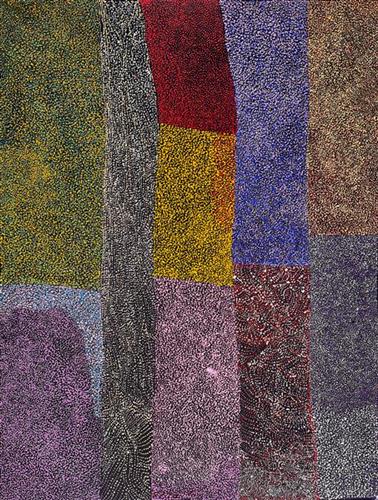
Dimensions: 61 x 61cm

114182418668


Tjitji kutjarra – Two boys

This is the story of the two boys, though some say it was two brothers or a brother and sister, living around Mantamaru (Jameson). One day they saw the track of a big snake, they followed and eventually caught and ate. Unbeknownst, the brothers they had eaten a spirit or magical snake.

The next day the brothers felt unwell. Any task became hard and their walking slowed down. Gradually they became slower and slower until they reach the top of a hill where no longer able to move they turned to stone.  

Driving east from Jameson (on your left) you can see two lonely up-right rocks, one smaller than the other on the top of a hill which are called Tjitji (child) Kutjarra (two).


Dimensions: 56 x 76cm

114182421463


The Ngaanyatjarra Lands

‘The Ngaanyatjarra Lands’, Craig Morrison is predominantly a landscape artist depicting vibrant scenes from across the Ngaanyatjarra Lands. Craig is a self taught landscape painter taking inspiration from the Hermannsburg movement. Craig’s paintings are a celebration of the seasonal changes which bring vast site of sandhills and hills in the summer and lush foliage coming into spring. Craig enjoys exploring the lands, studying the elements of his environment with close detail. He is a great role model for younger male artists in the community.


Dimensions: 40 x 61cm

114182421729


Wati kutjara – The goanna men

This is the story of two powerful magicians who came to the Ngaanyatjarra Lands from far away to the west;

‘These two men are always together, always camping together. They do all sorts of tricks when they travel across the lands as they stop from place to place. When they reached ‘Wirtapi Wara’ (Long Black or Blackstone Range) they argued about which way to go around. One went around the south side and the other the north side.

At a distance it seemed they didn’t recognise each other or perhaps they were just pretending not to recognise each other! It is also said that at Papulankutja they tricked each other by changing their appearance at the same time so they had no chance to recognise each other. The name Papulankutja comes from the Ngaanyatjarra word meaning, ‘to stare without recognising each other’.


Dimensions: 40 x 40cm

114182421727


Minyma Kutjarra – (Two Sisters)

‘Minyma Kutjara’ (Two Ladies), is a popularly depicted story by women from the Ngaanyatjarra Lands. The painting has different chapters depending on where the artist is from and the inherited story of their ancestors.  we see the ladies sitting together at their camp situated among the sand hills. They are surrounded by an abundance of desert flowers and fruits. The painting is a reflection on the lush nature of the land that was so many years ago. When there is rain coming to the lands it makes everyone so pleased as it indicates good foraging and hunting.


Dimensions: 61 x 61cm