111582270949


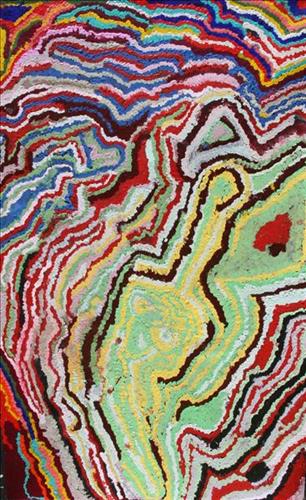
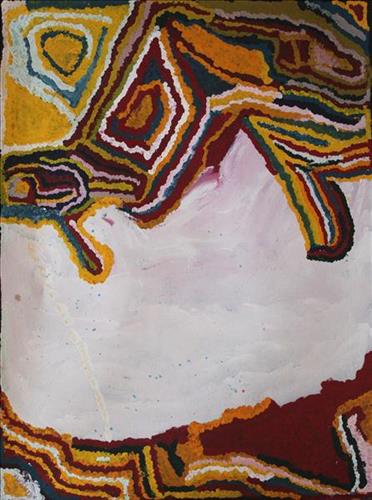
Kaalpa (Kalypa, Canning Stock Route Well 23)

“Kaalpa (Kalypa, Canning Stock Route Well 23) is my grandfather’s Country. There’s a waterhole there, Kaalpa waterhole. It’s my two pops’ Country. They been walking around, hunting around Kaalpa. You can see a yapu (rock), warla (lake), claypans, karru (creek) and tuwa (sandhills) there. It’s on the [Canning] Stock Route, it’s Well 23.  

In pujiman (traditional, desert dwelling) days, pujimanpa (desert born people) walking around all this Country. My pops told me about that place, a big flat area, parlkarra (flat country) good for hunting parnajarrpa (goanna), lunki (witchetty grub), lungkurta (blue tongue lizard), wamurla (bush tomato), jinyjiwirrilyi (wild gooseberry). Kaalpa is a busy place for emus getting a drink. 

I went [to Kaalpa] for the first time [in 2018] on a Martumili KJ [Kanyirninpa Jukurrpa] trip. I went hunting there, got a parnajarrpa. When I went there, I was pukurlpa (happy). It made you open up your spirit, it feels like home.”

 – Corban Clause Williams

Kaalpa is a permanent water source located northeast of Kumpupirntily (Kumpupintily, Lake Disappointment). This site is a place of great cultural significance, and is also known for good hunting. Adjacent to the waterhole is a hill of the same name. The landscape around Kaalpa is parlkarra (flat country), bordered by tali (sandhills) stretching as far as Windy Corner, northeast and towards the border of Western Australia and the Northern Territory. The large and dangerous Jukurrpa (Dreamtime) mosquito and fly beings partially created the landforms in this area and continue to live underground here.

Kaalpa also features in the Minyipuru (Jakulyukulyu, Seven Sisters) Jukurrpa, a central creation narrative for Martu, Ngaanyatjarra, Pitjantjatjara and Yankunytjatjara people that is associated with the seasonal Pleiades star constellation. At Kaalpa the Minyipuru met a group of men; it was the first time either group had seen members of the opposite sex. The men tried to grab the women, but the Minyipuru chased them, hitting them with their digging sticks and leaving them lying there as they continued travelling east.

Relayed in song, dance, stories and paintings, Minyipuru serves as a creation narrative, a source of information relating to the physical properties of the land, and an embodiment of Aboriginal cultural laws. Beginning in Roebourne on the west coast of Western Australia, the story morphs in its movement eastward across the land, following the women as they walk, dance, and even fly from waterhole to waterhole. As they travel the women camp, sing, wash, dance and gather food, leaving markers in the landscape and creating landforms that remain to this day, such as groupings of rocks and trees, grinding stones and seeds. During the entirety of their journey the women are pursued by a lustful old man, Yurla, although interactions with other animals, groups of men, and spirit beings are also chronicled in the narrative.

The intersection of the Canning Stock Route with Kaalpa also made this a site of early contact with Europeans for many Martu then living a pujiman life in the desert. Following the route’s construction, Martu encountered Europeans and other Martu working as cattle drovers as they would travel up and down the Stock Route from water source to water source. Increasingly, pujimanpa followed the route to newly established ration depots, mission and pastoral stations. They were drawn to the route in search of food, by a sense of curiosity, or by loneliness. By the late 1950s and early 1960s, most of the desert family groups had left the desert. Eventually, these factors combined with an extreme and prolonged drought in the 1960s to prompt the few remaining pujimanpa to move in from the desert.
111582270976


Untitled

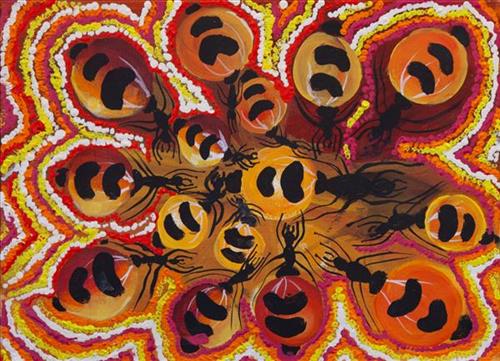
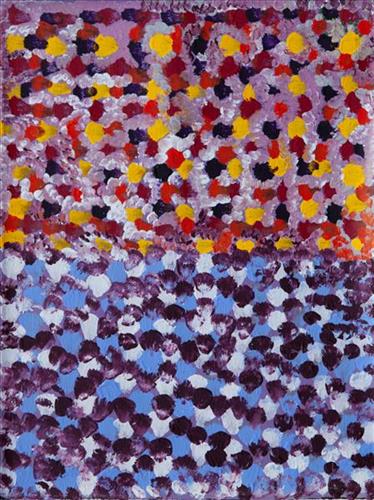
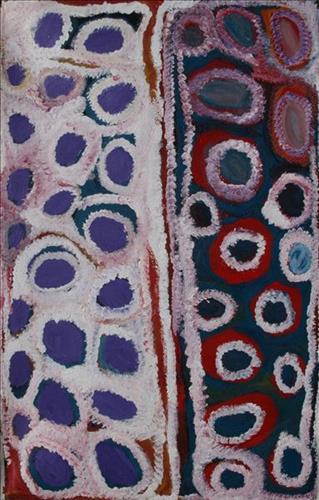
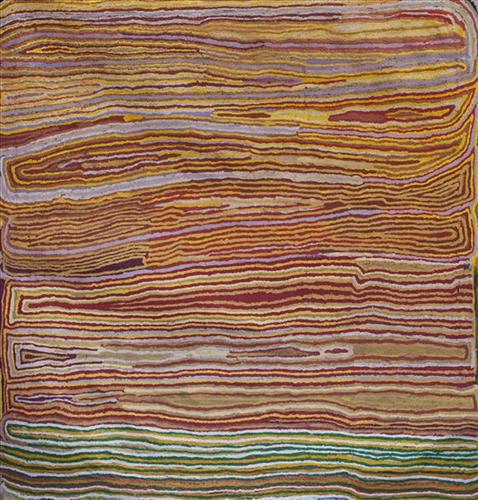
As in this work, husband and wife Leon Cutter and Ivy Bidu regularly collaborate on their paintings. Most often they work together in the Newman Martumili studio.

Ivy was taught to paint by her older sister and well renowned Martumili Artist, Ngamaru Bidu, and her aunt, Jakayu Biljabu (dec.). Leon also learned to paint through observation with his family in Wiluna, and in particular with his older sister Georgina Brown.

Leon and Ivy’s paintings are thematically based around their Country, east of Nyayartakujarra (Ngayarta Kujarra, Lake Dora) and north in the area surrounding Wantili (Warntili, Canning Stock Route Well 25), Parnngurr, Georgina Bore and Kaalpa (Kalypa, Canning Stock Route Well 23). Regularly depicted in their work are the varieties of bush tucker found in these areas; animals including kirti-kirti (hill kangaroo), parngarra (goanna), kipara (bush turkey) and wuukarta (honey ants), and plant based foods such as jinyjiwirrily (wild gooseberry), jawirli (quandong), wamurla (bush tomato), kakula (bush cucumber) and minyarra (bush onion).

In addition to representing these physical aspects of their Country, Ivy and Leon’s works also often depict metaphysical information; Jukurrpa (Dreaming) narratives chronicling the creation of specific physical landmarks, referenced through depictions of ceremonial sites, songlines, and markers left in the land. These Jukurrpa narratives have been passed to Leon and Ivy by family as they sat down together around waru (fire).

Marlpa is the Martu concept of companionship, and Martumili Artists are famous for working together and alongside each other in their art-making. Collaboration takes form in intergenerational partnerships, cross-cultural dialogues and community wide projects. Through working and painting together, Martumili Artists celebrate the strength of Martu culture, and the joy of community.

Younger Martu artists typically begin painting with their parents, grandparents and extended family, thus fostering an organic process of learning, not only about painting techniques, but also specific locations, family histories, traditional ways of life, bush tucker and Jukurrpa. 

111582270974


Untitled

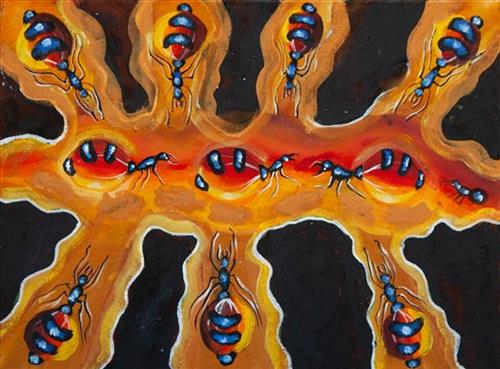
As in this work, husband and wife Leon Cutter and Ivy Bidu regularly collaborate on their paintings. Most often they work together in the Newman Martumili studio.

Ivy was taught to paint by her older sister and well renowned Martumili Artist, Ngamaru Bidu, and her aunt, Jakayu Biljabu (dec.). Leon also learned to paint through observation with his family in Wiluna, and in particular with his older sister Georgina Brown.

Leon and Ivy’s paintings are thematically based around their Country, east of Nyayartakujarra (Ngayarta Kujarra, Lake Dora) and north in the area surrounding Wantili (Warntili, Canning Stock Route Well 25), Parnngurr, Georgina Bore and Kaalpa (Kalypa, Canning Stock Route Well 23). Regularly depicted in their work are the varieties of bush tucker found in these areas; animals including kirti-kirti (hill kangaroo), parngarra (goanna), kipara (bush turkey) and wuukarta (honey ants), and plant based foods such as jinyjiwirrily (wild gooseberry), jawirli (quandong), wamurla (bush tomato), kakula (bush cucumber) and minyarra (bush onion).

In addition to representing these physical aspects of their Country, Ivy and Leon’s works also often depict metaphysical information; Jukurrpa (Dreaming) narratives chronicling the creation of specific physical landmarks, referenced through depictions of ceremonial sites, songlines, and markers left in the land. These Jukurrpa narratives have been passed to Leon and Ivy by family as they sat down together around waru (fire).

Marlpa is the Martu concept of companionship, and Martumili Artists are famous for working together and alongside each other in their art-making. Collaboration takes form in intergenerational partnerships, cross-cultural dialogues and community wide projects. Through working and painting together, Martumili Artists celebrate the strength of Martu culture, and the joy of community.

Younger Martu artists typically begin painting with their parents, grandparents and extended family, thus fostering an organic process of learning, not only about painting techniques, but also specific locations, family histories, traditional ways of life, bush tucker and Jukurrpa. 

111582270966


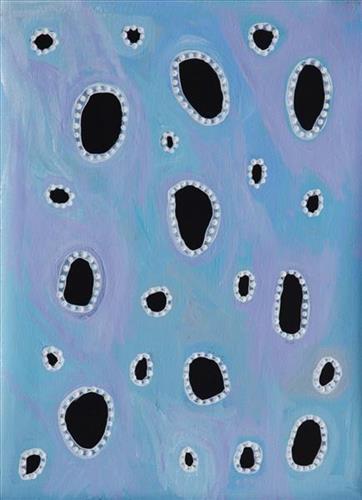
Mungili Waterholes and Rock Holes

“I was swimming there. Yeah, we go visit them a long time [ago]. We drink it, rain water from the rain. Big waterhole. It’s a fresh water, when the rain comes, fills it up. One for swimming and another rock hole for drinking.”

– Marlene Anderson

In this work Marlene depicts a waterhole and rock hole located in Mungili, the small outstation community located just off the Eagle Highway in Western Australia, approximately 430 kilometres northeast of Wiluna and 250 kilometres north of Warburton. Marlene grew up in Mungili, and as such it forms a significant part of her ‘ngurra’ (home Country, camp). Typically Marlene depicts this site with a central large circular form that represents the main waterhole, surrounded by smaller circular forms representing satellite water bodies.

During the pujiman (traditional, desert dwelling) period, knowledge of water sources was critical for survival, and today Martu Country is still defined in terms of the location and type of water. Each of the hundreds of claypans, rockholes, waterholes, soaks and springs found in the Martu desert homelands is known through real life experience and the recounting of Jukurrpa (Dreaming) narratives by name, location, quality and seasonal availability. This encyclopedic knowledge extends even to the nature and movement of arterial waterways, and sustained Martu as they travelled across their Country, hunting and gathering, visiting family, and fulfilling ceremonial obligations. They would traverse very large distances annually, visiting specific areas in the dry and wet season depending on the availability of water and the corresponding cycles of plant and animal life on which hunting and gathering bush tucker was reliant.

111582270965


Jigalong

“This one here. Yeah. That’s Jigalong. I’ve been there. I was working there. That’s good, this one here. Stories, yeah? This one here. I was painting in Jigalong. This one’s the cars. The cars. And the houses in Jigalong. And then the sandhills, lakes. That’s the lake [points to top right-hand corner]. The lake here and the green trees, and the sandhills. We going out working, you know? We going out working to Jigalong. All the ladies, we go out. All the ladies. Yeah that’s the one, all the ladies. We work choppers. Yeah I’ve been there in Jigalong with my mum and dad long time. And the cars. We go out in that. We go out working. We just work around Jigalong, the ladies.”

– Helen Dale Samson

Jigalong Aboriginal Community, the largest of the Martu communities, is located on the western edge of the Little Sandy Desert, not far from the town of Newman. Jigalong was established in 1907 as the site for a maintenance and rations store for workmen constructing the Rabbit Proof Fence, and converted to a camel breeding site in the 1930’s before finally becoming a Christian mission under the Apostolic Church in 1947. The land was returned to the Martu in 1974. 

For many Martu, Jigalong Mission was the site where their pujiman (traditional, desert dwelling) lifestyle came to an end from the late 1940s as they transitioned to a life as stockmen and women working in cattle stations in the Pilbara region and beyond. In the wake of the extreme and prolonged drought of the 1960s, the last of the remaining pujimanpa (desert dwellers) were forced to move to missions like Jigalong, where a supply of food and water was assured. There, many Martu were reunited with family members that had already moved in from the desert. 

Old Jigalong is where the camp on Jigalong Station was situated before the present Community was built. Dale grew up here, but would frequently camp with her family on Country during weekends. Helen Dale continues to live in Jigalong today.

11151034136


Yirrajarra

“Yirrajarra, it’s a yinta (permanent spring) in Warman Country. That’s my camp, that’s my place, that’s my Country. Home there,”

–  Mitutu Mabel Wakarta (dec.)

Yirrajarra comprises of two soaks situated near Lake Auld, and north of Tiwa (Canning Stock Route Well 26). As the site of a continuous source of good fresh water, surrounded by plentiful puri (shade), Yirrajarra was an important semi-permanent camping ground during the pujiman (traditional, desert dwelling) era. 

Yirrajarra is Mabel Mitutu’s birthplace, and as such an integral part of her ngurra (home Country, camp). Having walked all of this country with her family in her youth, Mabel Mitutu here depicts her knowledge of the region and its features in detail. Physical characteristics of the land and the location of its resources are portrayed alongside the Jukurrpa (Dreaming) narratives associated with this area.

During the pujiman period, Martu would traverse very large distances annually in small family groups, moving seasonally from water source to water source, and hunting and gathering bush tucker as they went. At this time knowledge of water sources was critical for survival, and today Martu Country is still defined in terms of the location and type of water. Each of the hundreds of claypans, rockholes, waterholes, soaks and springs found in the Martu desert homelands is known by name, location, quality and seasonal availability through real life experience and the recounting of Jukurrpa (dreaming) narratives.

11151027067


Parnngurr Community

Parnngurr is an Aboriginal community located 370km east of Newman, at the Southern end of the Karlamilyi (Rudall River) area, and in the Pilbara region of Western Australia. Created during the return to Country movement of the 1980s, with the recognition of Aboriginal land rights and native title, the community was named after its’ original primary water source, a nearby rockhole and yinta (permanent spring). Until recently the community was widely known as Cotton Creek, after the European name for the ephemeral creek running alongside the community. Parnngurr and its surrounds are physically dominated by distinctively red tali (sandhills), covered sparingly with spinifex and low lying shrub.

Historically Parnngurr Rockhole was an important site for Aboriginal people during the pujiman (traditional, desert born) era. During this nomadic period families stopped and camped here depending on the seasonal availability of water and the corresponding cycles of plant and animal life on which hunting and gathering bush tucker was reliant. At Parnngurr and other similarly important camp sites, families would meet for a time before moving to their next destination. 

Parnngurr is also a site chronicled in the epic Jukurrpa (Dreaming) story of the Minyipuru (Jakulyukulyu, Seven Sisters), as they flee from the lustful old man, Yurla. The sisters stopped to rest on Parnngurr Hill before continuing on their long journey east. Minyipuru is a central Jukurrpa narrative for Martu, Ngaanyatjarra, Pitjantjatjara and Yankunytjatjara people that is associated with the seasonal Pleiades star constellation. Relayed in song, dance, stories and paintings, Minyipuru serves as a creation narrative, a source of information relating to the physical properties of the land, and an embodiment of Aboriginal cultural laws. Beginning in Roebourne on the west coast of Western Australia, the story morphs in its movement eastward across the land, following the women as they walk, dance, and even fly from waterhole to waterhole. As they travel the women camp, sing, wash, dance and gather food, leaving markers in the landscape and creating landforms that remain to this day, such as groupings of rocks and trees, grinding stones and seeds. During the entirety of their journey the women are pursued by a lustful old man, Yurla, although interactions with other animals, groups of men, and spirit beings are also chronicled in the narrative.

11151032426


Punmu Lake

This is Mitutu’s Country- her ‘ngurra’ (home Country, camp). People identify with their ngurra in terms of specific rights and responsibilities, and the possession of intimate knowledge of the physical and cultural properties of one’s Country. Painting ngurra, and in so doing sharing the Jukurrpa (Dreaming) stories and physical characteristics of that place, has today become an important means of cultural maintenance. Mitutu’s ngurra encompasses her birthplace, Yirajarra soak, located close to Lake Auld and just north of Tiwa (Canning Stock Route Well 26), and the Country that her family walked in the pujiman (traditional, desert-dwelling) era, around the Karlamilyi (Rudall River) region.

Portrayed in this work are features of Mitutu’s family’s ngurra, such as the gorges and rivers, dominant permanent red tali (sandhills), warta (trees, vegetation), and the individually named water sources they camped at. Rock holes, waterholes, soaks and springs were all extremely important sites for Martu people during the pujiman period, and are generally depicted with circular forms. 

The encyclopaedic knowledge of the location, quality and seasonal availability of the hundreds of water bodies found in one’s Country sustained Martu as they travelled across their Country, hunting and gathering, visiting family, and fulfilling ceremonial obligations. They would traverse very large distances annually, visiting specific areas in the dry and wet season depending on the availability of water and the corresponding cycles of plant and animal life on which hunting and gathering bush tucker was reliant. As they travelled and hunted they would also burn areas of Country, generating a greater diversity of plant and animal life.

11151029508


Nyilangkur Claypan – Grandfather’s country

This painting depicts Nyilangkur lyinji Claypan this is the artist’s Grandfater’s country where her family lived traditionally during the pujiman (bush) days. The Martu lived very nomadically moving from water source to water source hunting and gathering bush tucker as they went. They would traverse very large distances visiting some areas in the dry and some in the wet season depending on the availability of water. As they travelled and hunted they would also burn areas of country creating a larger diversity of plant and animal life.

11152117537


Untitled

Mabel was born in the 1920s at Yirajara, which is near Jurntu Jurntu. Her parents were both Warnman people whose country encompassed Tarl and Nayijara. Mabel grew up in the pujiman (bush) way through her teens and as an adult, she walked into Jigalong Mission. She paints her ngurra (home) and her warrarn (country) to teach the young so that they can learn to paint, too.