111582439361


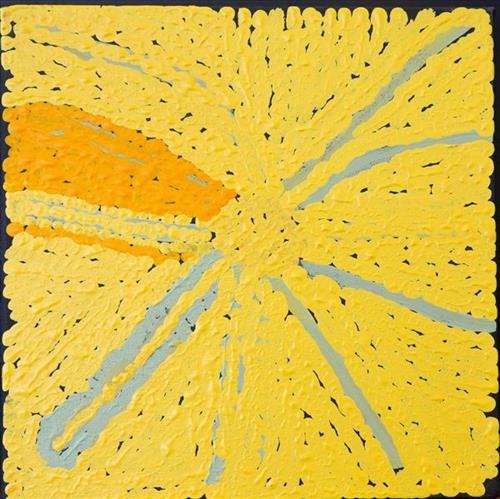
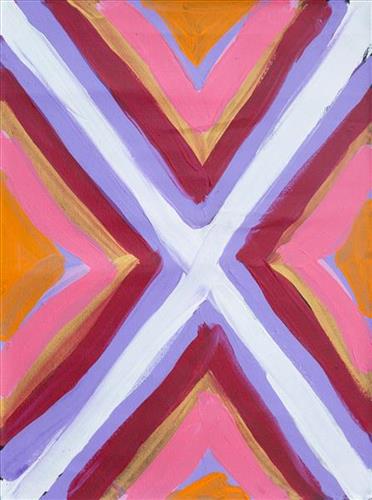
Kumpupirntily (Kumpupintily, Lake Disappointment)

“That’s Kumpupirntily- Lake Disappointment. The cannibals live underneath the lake there. It’s a salt lake. That’s all the ladies sitting around the lake, sitting around the claypans in the lake. That’s our Country; mine and Yunkurra’s [Billy Atkins’] Country.”

– Judith Anya Samson

Kumpupirntily lies within Anya’s ngurra (home Country, camp) through her family. This a stark, flat and unforgiving expanse of blinding salt lake is surrounded by sand hills, and located in the Little Sandy and Gibson Desert of Western Australia. Kumpupirntily translates to ‘bladder burst’; the lake was formed when the bladder of the Jila Kujarra (Two Snakes) burst here. Jila Kujarra is one of the key Jukurrpa (Dreaming) narratives for the Martu. Though the story belongs to Warnman people, it is shared across the Western Desert with several other language groups. The narrative centres on the travels of two snakes as they are pursued by the Niminjarra, spiritual ancestors of the Warnman people. 

Later in the Jukurrpa period the Ngayurnangalku (ancestral cannibal beings) made Kumpupirntily their home, where they continue to remain today. For this reason Kumpupirntily is considered one of the most sacred and dangerous sites of the Western Desert. The Ngayurnangalku are fearsome ancestral cannibal beings said to resemble people in their appearance, except for their fangs and long curved knife like fingernails they use to catch and hold their human victims. 

At Kumpupirntily, the Ngayurnangalku had a meeting to debate whether or not they would continue to live as cannibals, and eventually came to the decision to stop eating people. That night, a female baby cannibal was born. Following protocol, the baby also had to be consulted by the group. She determined that the Ngayurnangalku should continue to eat people. Her decision divided the group, and from this point the group from the east continued to live as ‘bad’ cannibals at Kumpupirntily, while the group from the west became ‘good’, thereafter consuming only animals. 

The cannibal Ngayurnangalku still live beneath the crust of Kumpupirntily lake in an underground world lit by their own sun. They surface only to feed on human flesh, coming in and out of the world we see through a small hill that acts as a gateway between worlds; Yapu Maparnpa (magical hill). Stored with the Ngayurnangalku in their underground world is an arsenal of maparnpa (holding power for sorcery) weapons, as well as deposits of pujurrpa (red ochre) that the Ngayurnangalku use to paint themselves with when they dance.

Several phenomena at Kumpupirntily act as a warning of the imminent appearance of the Ngayurnangalku; still skies, wilany (boomerang-shaped clouds), and the emergence of the parla-parla (type of lizard), smacking their mouths. The vigilance of the Martu as they travel in the Country around Kumpupirntily is so great that several other precautions are followed; fires are not lit, planes and helicopters are not flown directly over the area, and digging in the lake is strongly discouraged. All of these activities are believed to disturb the Ngayurnangalku, causing them to rise from their underground world.
111582439360


Wanti Yuu (Women, Yeah!)

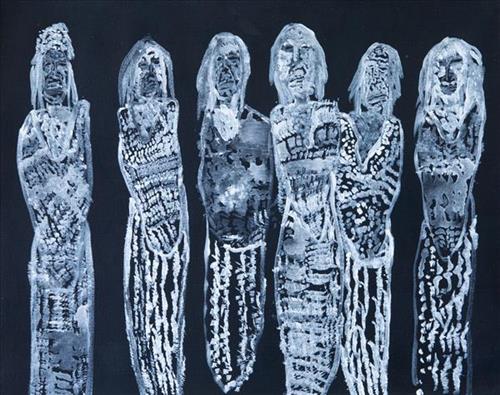
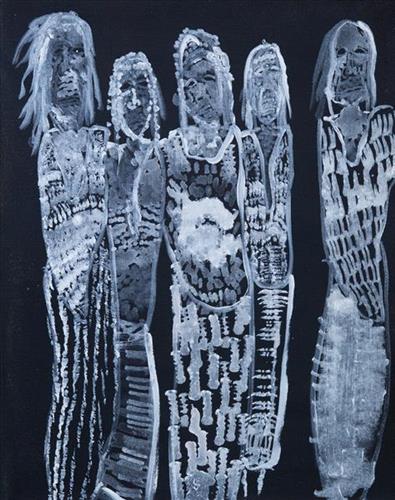
“Wanti Yuu (Woman Yeah!) is a story of resilience and of women coming together. It is about the strength of the women in our community who put themselves last and take on a lot. She [Wanti Yuu] is someone who looks after her family, putting the grand kids and everyone around her first. The word Matriarch comes to mind. They are the matriarch of the family. The Boss Lady. Always helping everyone else out and leaving herself to the end. She paints, she teaches us her knowledge, like basket weaving and honey ant collecting. She is the top lore woman and her story of Pujiman (traditional, desert dwelling) is so important. She is a leader of the Martu women and a senior artist. That’s all I can say about these women. These women; you give her the bread if you know what I mean. It’s a true story. Anything in my pockets. Because when you look at her, her stance, her energy and her vibe, you can feel it. You don’t muck around with Wanti Yuu.”

-Silvia Wilson

Wanti Yuu celebrates women’s resilience, matriarchal relationships, and Sylvia’s place in this story.

As Sylvia explains, the work is both a depiction of, and attribute to, the women in her life. “I follow my great grandmother’s guidance and direction in life. These women in my life carry so much on their shoulders, as well as the responsibility and future of our culture.”


111582439357


Untitled

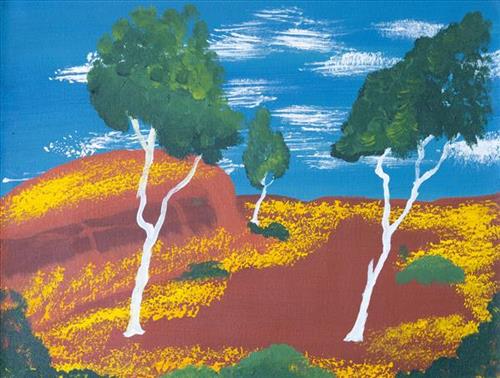
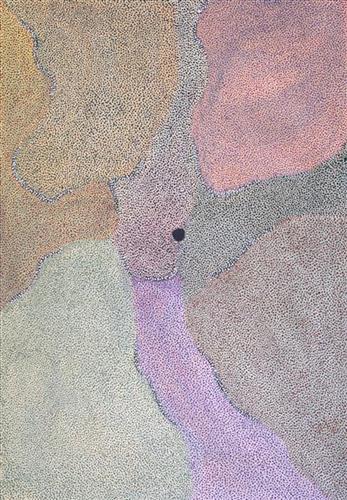
This work portrays an area known to the artist, painted here from memory. During the pujiman (traditional, desert dwelling) era one’s survival depended on their intimate knowledge of the location of resources; thus physical elements of Country, such as sources of kapi (water), tali (sandhills), and different varieties of warta (trees, vegetation) were carefully observed and remembered. Today, this relationship with Country remains equally strong, despite the movement of Martu out of the desert and into remote Aboriginal communities, towns and cities.

Also visible may be traces of life cycles based around kalyu (rain, water) and waru (fire). A thousands of year old practice, fire burning continues to be carried out as both an aid for hunting and a means of land management today. As the Martu travelled and hunted they would burn tracts of land, ensuring plant and animal biodiversity and reducing the risk of unmanageable, spontaneous bush fires. The patchwork nature of regrowth is visible in many landscape works, with each of the five distinctive phases of fire burning visually described with respect to the cycle of burning and regrowth.  

Finally, metaphysical information relating to a location may also be recorded; Jukurrpa (Dreaming) narratives chronicle the creation of physical landmarks, and can be referenced through depictions of ceremonial sites, songlines, and markers left in the land. 

111582439356


Dreamtime

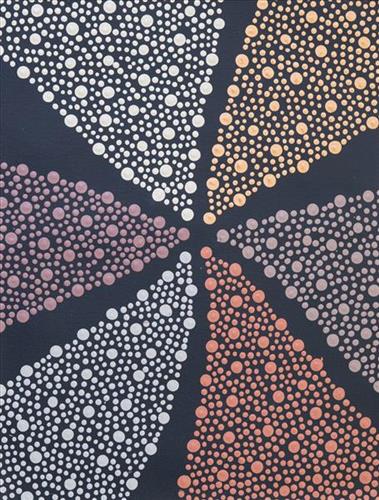
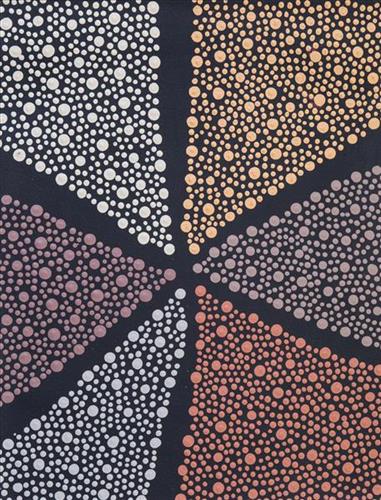
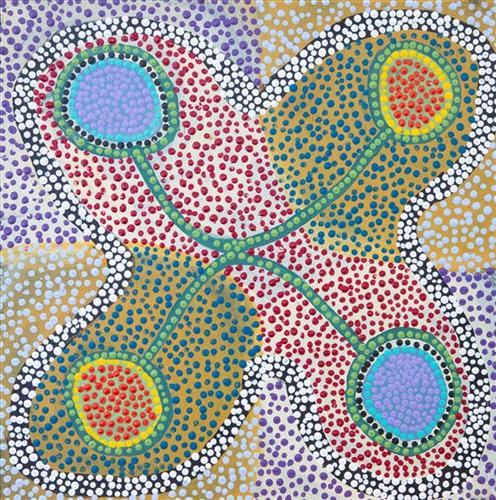
“The shapes represent the family groups from different regions. It’s been really good, reconnecting with family and getting to know which family member is who. Getting to know my uncles, telling me about my mum that has passed away. Hearing about the stories and about my grandmother as well. Her stories, yeah, uncle Matthew tells us stories about my family. It’s nice to know where you come from, especially coming back home and connecting back to family.” – Kerri- Anne Wilson In the heart of central Western Australia, the Martu people are the traditional owners of a vast landscape stretching from the Great Sandy Desert in the north to Wiluna in the south. Across this Country, their lives are bound by a common ancestral heritage, law, and culture. To one another, they are walytja (family). Walytja The Martu term for family, walytja, encapsulates a broader idea of relatedness that permeates every aspect of life. The Martu four-section kinship system determines a person as belonging to either the Purungu, Milangka, Panaka or Karrimarra skin group, and was created by the Jukurrpa (Dreaming) ancestors. This system not only defines relationships, it also establishes a framework for expectations and obligations, and extends the importance of family far beyond mere blood or marriage ties. Family is not limited to blood connections; it encompasses all relationships within the entire community, forming a network of relationships that was crucial to survival during the pujiman (traditional, desert dwelling) era, and that remains fundamental to Martu life today. The kinship system allows everyone to know what expectations one person can have in relation to another, and means that familial terms and relationships are present between any two individuals, whether or not they are related by blood.

111582439355


Dreamtime

“The shapes represent the family groups from different regions. It’s been really good, reconnecting with family and getting to know which family member is who. Getting to know my uncles, telling me about my mum that has passed away. Hearing about the stories and about my grandmother as well. Her stories, yeah, uncle Matthew tells us stories about my family. It’s nice to know where you come from, especially coming back home and connecting back to family.” – Kerri- Anne Wilson In the heart of central Western Australia, the Martu people are the traditional owners of a vast landscape stretching from the Great Sandy Desert in the north to Wiluna in the south. Across this Country, their lives are bound by a common ancestral heritage, law, and culture. To one another, they are walytja (family). Walytja The Martu term for family, walytja, encapsulates a broader idea of relatedness that permeates every aspect of life. The Martu four-section kinship system determines a person as belonging to either the Purungu, Milangka, Panaka or Karrimarra skin group, and was created by the Jukurrpa (Dreaming) ancestors. This system not only defines relationships, it also establishes a framework for expectations and obligations, and extends the importance of family far beyond mere blood or marriage ties. Family is not limited to blood connections; it encompasses all relationships within the entire community, forming a network of relationships that was crucial to survival during the pujiman (traditional, desert dwelling) era, and that remains fundamental to Martu life today. The kinship system allows everyone to know what expectations one person can have in relation to another, and means that familial terms and relationships are present between any two individuals, whether or not they are related by blood.

111582439353


Wanti Yuu (Women, Yeah!)

“Wanti Yuu (Woman Yeah!) is a story of resilience and of women coming together. It is about the strength of the women in our community who put themselves last and take on a lot. She [Wanti Yuu] is someone who looks after her family, putting the grand kids and everyone around her first. The word Matriarch comes to mind. They are the matriarch of the family. The Boss Lady. Always helping everyone else out and leaving herself to the end. She paints, she teaches us her knowledge, like basket weaving and honey ant collecting. She is the top lore woman and her story of Pujiman (traditional, desert dwelling) is so important. She is a leader of the Martu women and a senior artist. That’s all I can say about these women. These women; you give her the bread if you know what I mean. It’s a true story. Anything in my pockets. Because when you look at her, her stance, her energy and her vibe, you can feel it. You don’t muck around with Wanti Yuu.”

-Silvia Wilson

Wanti Yuu celebrates women’s resilience, matriarchal relationships, and Sylvia’s place in this story.

As Sylvia explains, the work is both a depiction of, and attribute to, the women in her life. “I follow my great grandmother’s guidance and direction in life. These women in my life carry so much on their shoulders, as well as the responsibility and future of our culture.”


111582439352


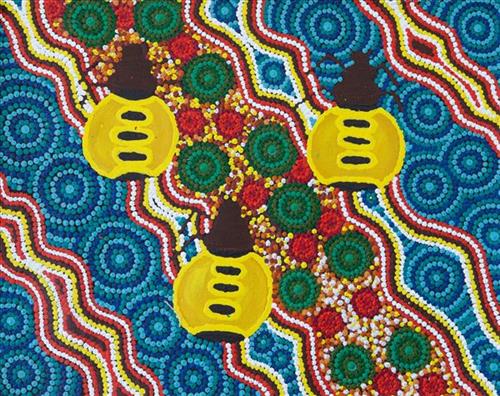
Wuukurta (Honey Ants)

Wuukurta (honey ants) are found in a variety of arid or semiarid environments, with nests of up to two metres deep and more than two metres across. Wuukurta are a highly sought after bush tucker, known otherwise as ‘bush lollies’ due to their sweet, honey like taste. They are eaten whilst still alive by holding the head and legs between two fingers and biting off the thorax. Martu dig for wuukurta nests through the seasons, but they are known to be especially abundant following the rains.

During the pujiman (traditional, desert dwelling) period, Martu would traverse very large distances annually in small family groups, moving seasonally from water source to water source, and hunting and gathering bush tucker as they went. Whilst desert life has moved away from mobile hunter-gatherer subsistence throughout the course of the twentieth century, bush tucker continues to be a significant component of the modern Martu diet. Hunting and gathering bush tucker remains equally valuable as an important cultural practice that is passed on intergenerationally. Though hunting and gathering implements have been modernised, methods of harvesting, tracking and the use of fire burning to drive animals from their retreats are still commonly practiced today.

111582439129


Yalta

“This is my grandmother’s and mother’s Country, Yalta. It’s very close to Kunawarritji side. I’ve never been there. That was where my mother was born during the pujiman (traditional, desert dwelling) times. All the tali (sandhills) around. I want to go there one day, to see that Country, I might go there one day” 

 – Marianne Burton

Yalta is a waterhole located between the Great Sandy Desert’s Percival Lakes region and Kunawarritji Aboriginal community. This site was visited by the Ngayurnangalku (cannibals) during the Jukurrpa (Dreaming). These fearsome ancestral cannibal beings are said to resemble people in their appearance, except for their fangs and long curved knife like fingernails they use to catch and hold their human victims. The Ngayurnangalku continue to live beneath the crust of Kumpupirntily (Kumpupintily, Lake Disappointment), south east of Yalta.  

Yalta lies within Marianne’s ngurra (home Country, camp) through her grandmother and mother. As stated by Marianne here, the site is especially significant to her as it was here that her mother was born. The Western Desert term ‘ngurra’ is hugely versatile in application. Broadly denoting birthplace and belonging, ngurra can refer to a body of water, a camp site, a large area of Country, or even a modern house. People identify with their ngurra in terms of specific rights and responsibilities, and the possession of intimate knowledge of the physical and cultural properties of one’s Country. This knowledge is traditionally passed intergenerationally through family connections. Painting ngurra, and in so doing sharing the Jukurrpa stories and physical characteristics of that place, has today become an important means of cultural maintenance. Physical maintenance of one’s ngurra, like cultural maintenance, ensures a site’s wellbeing, and is a responsibility of the people belonging to that area.

111582439128


Untitled

This is Ngamaru’s Country- her ‘ngurra’ (home Country, camp). People identify with their ngurra in terms of specific rights and responsibilities, and the possession of intimate knowledge of the physical and cultural properties of one’s Country. Painting ngurra, and in so doing sharing the Jukurrpa (Dreaming) stories and physical characteristics of that place, has today become an important means of cultural maintenance. 

Ngamaru’s ngurra encompasses the Country that she and her family walked in the pujiman (traditional, desert dwelling) era. At this time Ngamaru travelled nomadically with her own and other family groups, most notably the Biljabu and Whyoulter families. 

Ngamaru was born at Martilirri (Canning Stock Route Well 22). She grew up, walked and hunted primarily around Wikiri, Rarrki (Canning Stock Route Well 27), Wantili (Warntili, Canning Stock Route Well 25), Pitu, Nyilangkurr and Nyinyari. She continued to live nomadically before eventually deciding to move to Jigalong Mission along with many other relatives following an extreme and prolonged drought in the 1960s. 

Portrayed in this work are features of Ngamaru’s ngurra, such as the striking salt lakes, dominant permanent red tali (sandhills), warta (trees, vegetation), and the individually named water sources Ngamaru and her family camped at. These include Julyjarru, Juntiwa, Jaturti, Karanyal (Canning Stock Route Well 20), Martilirri (Canning Stock Route Well 22), Kaalpa (Canning Stock Route Well 23), Kartarru (Blue Hills Station, Canning Stock Route Well 24), Wantili (Canning Stock Route Well 25, Tiwa (Canning Stock Route Well 26), Rarrki (Canning Stock Route Well 27), Warla-warla (Canning Stock Route Well 31), Kulilu, Kunapila, Nyilangkurr, Parnngurr, Pitu, Purn, Wangkakalu, Wikiri, Yiranang, and Yulpu. Rock holes, waterholes, soaks and springs were all extremely important sites for Martu people during the pujiman period, and are generally depicted with circular forms. 

The encyclopaedic knowledge of the location, quality and seasonal availability of the hundreds of water bodies found in one’s Country sustained Martu as they travelled across their Country, hunting and gathering, visiting family, and fulfilling ceremonial obligations. They would traverse very large distances annually, visiting specific areas in the dry and wet season depending on the availability of water and the corresponding cycles of plant and animal life on which hunting and gathering bush tucker was reliant. As they travelled and hunted they would also burn areas of Country, generating a greater diversity of plant and animal life.

111582439127


Punmu

“This area here is our Country. It’s our Country right here. We returned to our Country with a Toyota and a grader that made the road. A grader right up to here. Punmu is a good place. It’s a happy place to live. My spirit feels good living here. In pujiman (traditional, desert dwelling) time we lived in this area now. I’m happy with this life now, happy because I feel grounded by my Country. It’s important to hold onto the legacy of the ancestors. It’s up to the young people to carry it on now. For the ancestors past and present.”

– Minyawe Miller as translated by Kanyirninpa Jukurrpa


Punmu refers to a region and an Aboriginal community within its vicinity, located 670km North-East of Newman. Created during the return to Country movement of the 1980s, with the recognition of Martu land rights and native title, the community was named after a nearby Jukurrpa (Dreaming) story.

Punmu Aboriginal community sits on the edge of a large salt lake known as Nyayartakujarra, or Lake Dora. The lake runs south into Karlamilyi River (Rudall River). Surrounding Punmu are numerous fresh water soaks and the red tali (sandhills) typical of the area. The most frequently visited yinta (permanent springs) around Punmu include Wirlarra, Rawa, Yilyara, Jila-jila and Tuu-tuu.

The Country around Punmu features in several Jukurrpa stories. Of particular importance is the story of the Jila Kujarra (Two Snakes), one of the key Jukurrpa narratives for the Martu. Though the story belongs to Warnman people, it is shared across the Western Desert with several other language groups. The narrative centres on the travels of two snakes as they are pursued by the Niminjarra, spiritual ancestors of the Warnman people. 

Before transforming themselves into snakes, the Jila Kujarra were young brothers. As snakes, they began travelling home to their mother, but were intercepted by the Niminjarra, who tracked the Jila Kujarra to Paji, east of Nyayartakujarra (Lake Dora). Though the Jila Kujarra eluded their pursuers here by escaping under the lake at Paji, they were soon after speared and injured by two Pukurti (initiates with bundled hair) at Nyayartakujarra, who returned with the Niminjarra to cook the snakes at the site of Kumpupirntily (Kumpupintily, Lake Disappointment). As the Niminjarra cut down the length of the Jila Kujarra, the snake’s bladders were pierced, causing an explosion of scalding hot urine in which the Niminjarra all perished and became black rocks at the site. The spirits of the Jila Kujarra returned to their mother at Nyayartakujarra, where the mother and her sons entered the ground below Nyayartakujarra and remain to this day.