111582215926


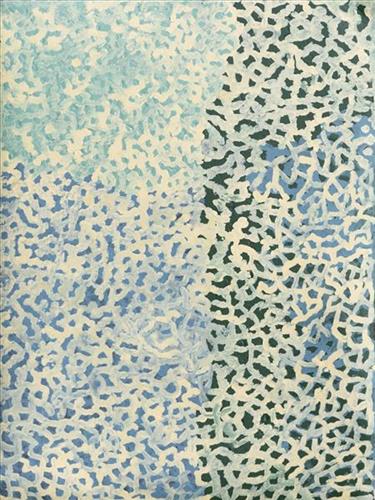
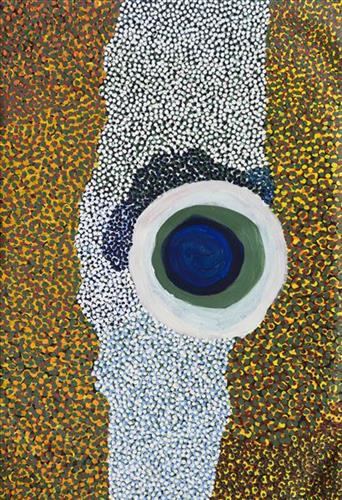
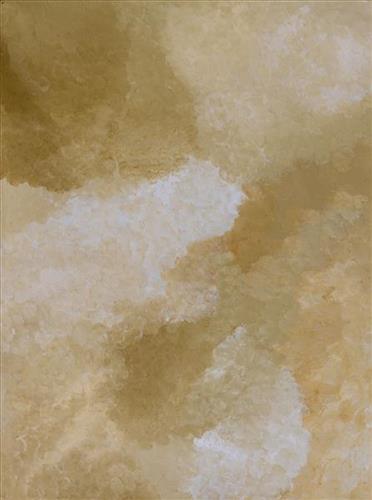
Kulyakartu

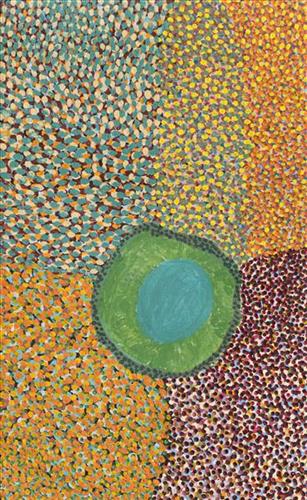
“Long time ago I been there. It is my grandmother’s, grandfather’s, father’s, [and] mother’s country, Kulyakartu.  I am painting this particular place. It keeps me connected, [gives me a] sense of belonging [to] tell my grandmother’s story through my art.  Where she was born, I’m a part of that. 

It makes me feel proud painting.  Most important is telling the story behind the painting so people can understand where I am coming from.  Kulyakartu is our ngurra (home Country, camp).  I will continue telling the story through my art.”

– Derrick Butt

This painting depicts Kulyakartu, Derrick’s ancestral ngurra (home Country, camp). Kulyakartu is a large area in the far north of the Martu homelands, near the Percival Lakes region of Western Australia’s Great Sandy Desert. Kulyakartu is mostly flat grass Country, and is known as a good hunting area. In particular, parnajarrpa (goanna), wild cats, and lunki (witchetty grub) are found in abundance here. In the wantajarra (wet season) the dry lakes in the region fill with water.

111582215925


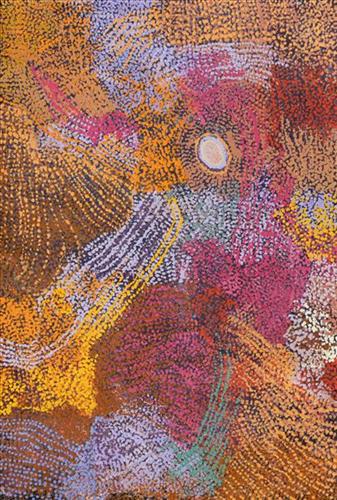
Kulyakartu

“My Country, Kulyakartu. I grew up there, from little boy to big boy grew up there.”

 – Muuki Taylor

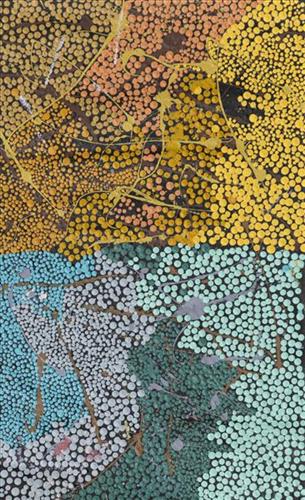
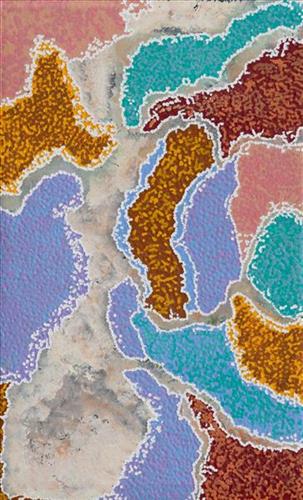
This painting depicts Kulyakartu, Muuki’s ngurra (home Country, camp). Kulyakartu is located in the far north of the Martu homelands, near the Percival Lakes region of Western Australia’s Great Sandy Desert. Muuki has extensive knowledge of the Country in this region, where he grew up living traditionally during the pujiman (traditional, desert dwelling) days with his family. Kulyakartu is mostly grass Country where there is very good hunting. In particular parnajarrpa (goanna), wild cats, and lunki (witchetty grub) are found in abundance here. There is no permanent water source in Kulyakartu, so Muuki’s family would walk here annually following the wantajarra (wet season). During the yalijarra (hot, dry season) they would head south again to more permanent water.

Muuki paints Kulyakartu in all its different seasonal stages. Often visible in his work is the patchwork nature of regrowth subsequent to the practice of waru (fire) burning that assists with hunting, regenerates growth, and encourages greater diversity in plant and animal life. This mosaic patterning is aligned with the five distinct Martu cyclical phases of burning and regrowth. First is nyurnma (freshly burnt Country) when Muuki is “making waru”. Following nyurnma are the rains and subsequent waru-waru, when young, bright green plants start to grow. Nyukura occurs between one and three years after burning, when plants have matured and are fruiting and seeding. Manguu is “when him finished”, four to six years post burning, and when spinifex has matured to the point that it can be burned once again. Finally, kunarka signifies the time when spinifex and other plant species have become old growth, and pose a risk of destructive bushfires.

111582215924


Nyayartakujarra (Ngayarta Kujarra, Lake Dora)

“This painting shows Nyayartakujarra (Lake Dora) and the waterholes. In pujiman (traditional, desert dwelling) days we all walked from waterhole to waterhole. We were travelling around for a long time; we were all naked! We grew up walking all around these waterholes. This painting is a map from that time. All of these waterholes are still here, with all of the songs and all of the dances. We are still singing and dancing for this Country.”

 – Mantararr (Muntararr) Rosie Williams (dec.), Jakayu Biljabu, Yikartu Bumba, Nyanjilpayi (Ngarnjapayi) Nancy Chapman, Mulyatingki Marney, Mayiwalku May Chapman, and Reena Rogers

Nyayartakujarra is a vast and culturally significant salt lake located in the north east section of the Karlamilyi River region. Surrounding Nyayartakujarra are numerous fresh water soaks and the red tali (sandhills) typical of the area. Punmu Aboriginal Community, where Nyanjilpayi lives today, lies on the eastern edge of the lake. Nyayartakujarra lies within Nyanjilpayi’s ngurra (home Country, camp), the area which she knew intimately and travelled extensively with her family in her youth. 

Nyayartakujarra is an important site in the Jila Kujarra (Two Snakes) Jukurrpa (Dreaming) narrative. Though the story belongs to Warnman people, it is shared across the Western Desert with several other language groups. The narrative centres on the travels of two snakes as they are pursued by the Niminjarra, spiritual ancestors of the Warnman people.

Before transforming themselves into snakes, the Jila Kujarra were young brothers. As snakes, they began travelling home to their mother, but were intercepted by the Niminjarra, who tracked the Jila Kujarra to Paji, east of Nyayartakujarra. Here they eluded the Niminjarra, but the Jila Kujarra were soon after speared and injured at Nyayartakujarra by two Pukurti (initiates with bundled hair), who returned with the Niminjarra to cook the snakes at the site of Kumpupirntily (Kumpupintily, Lake Disappointment). As the Niminjarra cut down the length of the Jila Kujarra, the snake’s bladders were pierced, causing an explosion of scalding hot urine in which the Niminjarra all perished and became black rocks at the site. At the same time, the urine of the Jila Kujarra formed the lake at Kumpupirntily, which translates to ‘bladder burst’. The spirits of the Jila Kujarra returned to their mother at Nyayartakujarra, where the mother and her sons entered the ground below the lake and remain to this day.

111582215923


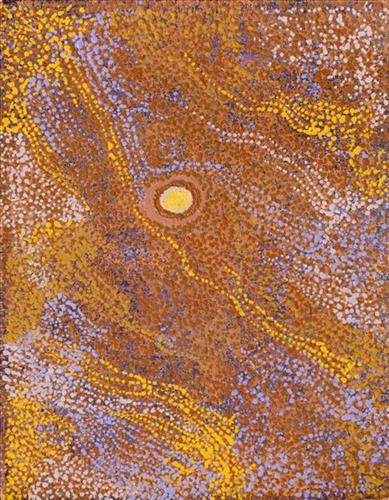
Wild flower

“I make a painting and it’s a wild bush flower, desert flower! And bush tucker. I do painting for bush tucker and wild flower.”

– Danita Wise

Depicted in this work are traditional types of bush tucker, their floral habitats, and their related hunting and gathering methods. During the pujiman (traditional, desert dwelling) period, Martu would traverse very large distances annually in small family groups, moving seasonally from water source to water source, and hunting and gathering bush tucker as they went. Whilst desert life has moved away from mobile hunter-gatherer subsistence throughout the course of the twentieth century, bush tucker continues to be a significant component of the modern Martu diet. Hunting and gathering bush tucker remains equally valuable as an important cultural practice that is passed on intergenerationally. Though hunting and gathering implements have been modernised, methods of harvesting, tracking and the use of fire burning to drive animals from their retreats are still commonly practiced today. 

Typically, animals hunted for their kuwiyi (meat) include kirti-kirti (euro kangaroo) and marlu (plains kangaroo), parnajarrpa (sand goanna), kipara (Australian bustard, bush turkey) and karlaya (emu). Lunki (witchetty grub) and wuukurta (honey ants) are dug from tree and bush trunks, or from underground nests. Popular mayi (plant food) includes minyarra (bush onion), collected from small, grass like plants; root vegetables dug from underground such as kulyu and mata (types of bush potato); and seeds such as kalaru (samphire, salt bush), yuwinyji, and marnkalpa (spinifex species). Jawirli (quondong), wamurla (bush tomatoes), jinyjiwirrily (wild gooseberry), ngaputa (melon), and karlkula (bush banana) are some of the most popular bush fruits. These are often collected in the wantajarra (cool season) and tuulpara (spring) months, along with juri (sweet) botanical gums and wama (nectar), obtained from various plant species. 

Traditional tools used for hunting and gathering bush tucker were carved from wanari (mulga), mulunturu (desert oak), yurungkura (river red gum) and mijarrpa (bloodwoods), and included kurlata (spears), jurna (hitting stick), karli (boomerangs), wana (digging-sticks), piti (timber bowls used for carrying food and water), and jiwa (grinding stones for grinding seeds into flour). While carved objects retain enormous social and ceremonial importance in Martu life, they are no longer used for hunting and gathering.

Over half a million square kilometres of mangroves, off shore islands, deep gorges, mountain ranges, desert sand dunes and river pools ensure the Pilbara’s flora is as diverse as the landscape. Plants and flowers in the Pilbara have evolved unique adaptations to survive in an arid climate that receives most of its rainfall during summer by way of tropical cyclones. Watercourses are lined with river red gums, coolibah, silver cadjeput and desert bloodwood trees. Gorges contain permanent water supplies to support moisture loving plants like the common rock fig and rock kurrajong. From July to September wildflowers of all colours, sizes and shapes, like the unmistakeable Sturt’s desert pea, fluffy mulla mulla, the tall majestic Ashburton pea or any number of the 65 species of Acacia (wattle) can be seen throughout the region.
111582215922


Yulpu

Yulpu is a large soak located within the McKay Ranges, and just south of Parnngurr Aboriginal community. Yulpu is still a popular camping ground and hunting area for Martu today.

During the pujiman (traditional, desert dwelling) period, Martu would traverse very large distances annually in small family groups, moving seasonally from water source to water source, and hunting and gathering bush tucker as they went. At this time knowledge of water sources was critical for survival, and today Martu Country is still defined in terms of the location and type of water. Each of the hundreds of claypans, rockholes, waterholes, soaks and springs found in the Martu desert homelands is known by name, location, quality and seasonal availability through real life experience and the recounting of Jukurrpa (Dreaming) narratives.

111582215921


Kaalpa (Kalypa, Canning Stock Route Well 23)

Kaalpa (Kalypa, Canning Stock Route Well 23) is a permanent water source located northeast of Kumpupirntily (Kumpupintily, Lake Disappointment). This site is a place of great cultural significance, and is also known for good hunting. Adjacent to the waterhole is a hill of the same name. The landscape around Kaalpa is parlkarra (flat country), bordered by tali (sandhills) stretching as far as Windy Corner, toward the border of Western Australia and the Northern Territory. The large and dangerous Jukurrpa (Dreamtime) mosquito and fly beings partially created the landforms in this area and continue to live underground here.

At Kaalpa the Minyipuru (Jakulyukulyu, Seven Sisters) met a group of men; it was the first time either group had seen members of the opposite sex. The men were sitting down at Kaalpa doing law business when the Minyipuru arrived. They tried to grab the women, but the Minyipuru chased them, hitting them with their digging sticks and whipping them, then leaving them lying there. From Kaalpa the Minyipuru continued dancing as they travelled to Kartarru (Canning Stock Route Well 24).

Minyipuru is a central Jukurrpa narrative for Martu, Ngaanyatjarra, Pitjantjatjara and Yankunytjatjara people that is associated with the seasonal Pleiades star constellation. Relayed in song, dance, stories and paintings, Minyipuru serves as a creation narrative, a source of information relating to the physical properties of the land, and an embodiment of Aboriginal cultural laws. Beginning in Roebourne on the west coast of Western Australia, the story morphs in its movement eastward across the land, following a group of women as they walk, dance, and even fly from waterhole to waterhole. As they travel the women camp, sing, wash, dance and gather food, leaving markers in the landscape and creating landforms that remain to this day, such as groupings of rocks and trees, grinding stones and seeds. During the entirety of their journey the women are pursued by a lustful old man, Yurla, although interactions with other animals, groups of men, and spirit beings are also chronicled in the narrative.

The intersection of the Canning Stock Route with Kaalpa also made this a site of early contact with Europeans for many Martu then living a pujiman (traditional, desert dwelling) life in the desert. Following the route’s construction, Martu encountered Europeans and other Martu working as cattle drovers as they would travel up and down the Stock Route from water source to water source. Increasingly, pujimanpa (desert dwellers) followed the route to newly established ration depots, mission and pastoral stations. They were drawn to the route in search of food, by a sense of curiosity, or by loneliness. By the late 1950s and early 1960s, most of the desert family groups had left the desert. Eventually, these factors combined with an extreme and prolonged drought in the 1960s to prompt the few remaining pujimanpa to move in from the desert.

111582215919


Milkarra

Milkarra is a soak located just north of the eastern end of the Percival Lakes region in Western Australia’s Great Sandy Desert.  This site lies within Ngarga’s ngurra (home Country, camp) through her father, and was part of the area which she knew intimately and travelled extensively with her family in her youth. Ngarga recalls walking around this Country when she was a little girl. Sometimes she would wait here while her parents went out hunting. It’s a good area to hunt for little goannas, blue tongue lizards, wild cats and foxes.

Milkarra is also known for its abundance of minyarra (bush onions). Minyarra (bush onion) are a favoured bush tucker amongst the Martu, popular for their sweet, nutty taste and for the relative ease with which they are foraged. Typically, minyarra is collected in large quantities close to springs, and then shared and eaten over the following days. The minyarra plant is small and grass like, with edible tubers at the root. They can be eaten raw or cooked, and are harvested by first loosening the soil at their base with a pounding stone, and then pulling out the plant. 

During the pujiman (traditional, desert dwelling) period, Martu would traverse very large distances annually in small family groups, moving seasonally from water source to water source, and hunting and gathering bush tucker as they went. At this time knowledge of water sources was critical for survival, and today Martu Country is still defined in terms of the location and type of water. Each of the hundreds of claypans, rockholes, waterholes, soaks and springs found in the Martu desert homelands is known by name, location, quality and seasonal availability through real life experience and the recounting of Jukurrpa (Dreaming) narratives.

111582215918


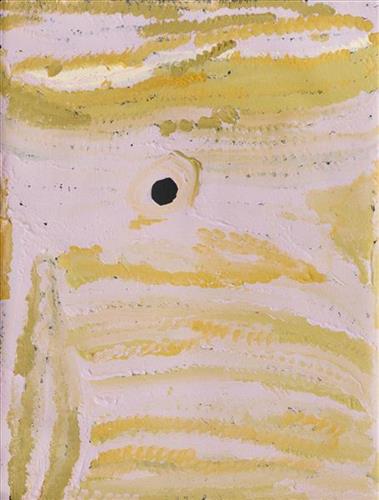
Yimiri

“Yimiri is [at] a salt lake. There’s two water in the middle, drinking water. That’s a drinking water for us. You can walk right up to lake in the middle of the salt. It’s fresh and beautiful. You gotta sing out for Yimiri, that’s a snake Country. That’s a special water place. We sing out for water; “Yimiri, I’m coming to visit you, I’m coming for fresh water.”

I grew up around these salt lakes [Percival Lakes] with all the families; Yuwali mob, all together. Too salty to drink, so get fresh water from Yimiri, a yinta (permanent spring) in the lake. When they got sick or sores, mothers would wash them in the salt on hot days to make the kids better.”

 -Ngarga Thelma Judson

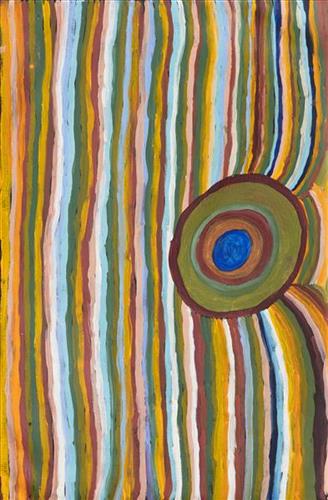
Yimiri comprises two soaks situated in the middle of a salt lake in the Percival Lakes area, within Western Australia’s Great Sandy Desert. Around the waterhole the Country is dominated by tuwa (sand hills), depicted here with lines and sections of colour. This painting depicts Yimiri, a very important site for yinta. Yimiri is the larger of two soaks in the middle of a big salt warla (lake). When visiting this site to drink water, the plants and warta (trees, vegetation) growing in the kapi (water) are cleaned out as a way of maintaining the site.

During the pujiman (traditional, desert dwelling) days, Ngarga and her family travelled extensively through this county, their ngurra (home Country, camp). Her family moved up and down through this Country between water sources. When it was raining, they would build a wuungku (shelter) where they could sleep and stay warm beside a waru (fire). When they camped in a particular location for a period the elders would go hunting, leaving the children behind. Ngarga fondly recalls playing around in the tuwa (sandhills) in this region, catching parla-parla (type of lizard).

Yimiri is home to an ancestral jila (snake). The Western Desert term jila is used interchangeably to describe springs considered to be ‘living’ waters and snakes, both of which play a central role in Martu culture and Jukurrpa (Dreaming). During the pujiman period, knowledge of water sources was critical for survival, and today Martu Country is still defined in terms of the location of water sources. Of the many permanent springs in Martu Country, very few are ‘living waters’; waters inhabited by jila. Before they became snakes, these beings were men who made rain, formed the land and introduced cultural practices like ceremonies and ritual songs. Some of the men travelled the desert together, visiting one another, but they all ended their journeys at their chosen spring alone, transformed into a snake. These important springs are named after their jila inhabitant, guarding their waters.

The region surrounding Yimiri was formed by Wirnpa, one of the most powerful of the ancestral jila (snake) men and the last to travel the desert during the Jukurrpa. Wirnpa is a rainmaking jila who lived and hunted in the Percival Lakes area. His travels are described in the songs and stories of many language groups across the Western Desert, even those far removed from his home site. In his epic travels, Wirnpa met and feasted with many other ancestral beings, exchanged ceremonial objects, and created a series of different laws and ceremonies. When he finally returned home, he searched for his many children only to discover that they had already died. They had laid down and become the salt springs of the Percival Lakes. Wirnpa wept for his children before himself transforming into a snake and entering the soak where he still resides.

111582215917


Kulyakartu

“Long time ago I been there. It is my grandmother’s, grandfather’s, father’s, [and] mother’s country, Kulyakartu.  I am painting this particular place. It keeps me connected, [gives me a] sense of belonging [to] tell my grandmother’s story through my art.  Where she was born, I’m a part of that. 

It makes me feel proud painting.  Most important is telling the story behind the painting so people can understand where I am coming from.  Kulyakartu is our ngurra (home Country, camp).  I will continue telling the story through my art.”

– Derrick Butt

This painting depicts Kulyakartu, Derrick’s ancestral ngurra (home Country, camp). Kulyakartu is a large area in the far north of the Martu homelands, near the Percival Lakes region of Western Australia’s Great Sandy Desert. Kulyakartu is mostly flat grass Country, and is known as a good hunting area. In particular, parnajarrpa (goanna), wild cats, and lunki (witchetty grub) are found in abundance here. In the wantajarra (wet season) the dry lakes in the region fill with water.

111582215443


Parnngurr

“We were climbing Parnngurr hill; we were frightened. Kartiya (Europeans) would walk around, trying to catch Martu people. We would run up the hill and hide. We watched them catch people. We were eating flour that white people gave us. It was horrible. From [Parnngurr rockhole], we got in the truck and went with the white people to Jigalong. Kumpaya [Girgirba], Jakayu [Biljabu] and Ngamaru [Bidu], we were all on top of the hill looking at the white people.”

– Bugai Whyoulter


Parnngurr rockhole is located 370km east of Newman. This site lies within Bugai’s ngurra (home Country, camp), the area which she knew intimately and travelled extensively with her family in her youth. For many Martu, including Bugai, Parnngurr also signifies the location at which their nomadic bush life came to an end. Poignantly described here by Bugai, it was here that a group of 29 Martu were picked up by the Native Welfare Department to be taken to Jigalong Mission in 1963. Collectively the group had come to the decision to move to the mission as a result of an extended drought, which had caused a scarcity in food and water resources. The group also wanted to join their families, who had already moved to Jigalong.

At the junction of three linguistic groups; Manyjilyjarra, Kartujarra, and Warnman, Parnngurr rockhole was a critical and permanent source of water during the pujiman (traditional, desert born) era, supporting many ritual large gatherings. During this nomadic period families stopped and camped here depending on the seasonal availability of water and the corresponding cycles of plant and animal life on which hunting and gathering bush tucker was reliant. At Parnngurr and other similarly important camp sites families would meet for a time before moving to their next destination. Parnngurr rockhole and its surrounds are physically dominated by distinctively red tali (sandhills), covered sparingly with spinifex and low lying shrub. 

Parnngurr community, just north of Parnngurr rockhole, was created during the Return to Country movement of the 1980s, coinciding with the recognition of Aboriginal land rights and native title. The community was named after its’ original primary water source. Until recently the community was widely known as Cotton Creek, after the European name for the ephemeral creek running alongside the community.