111582165120


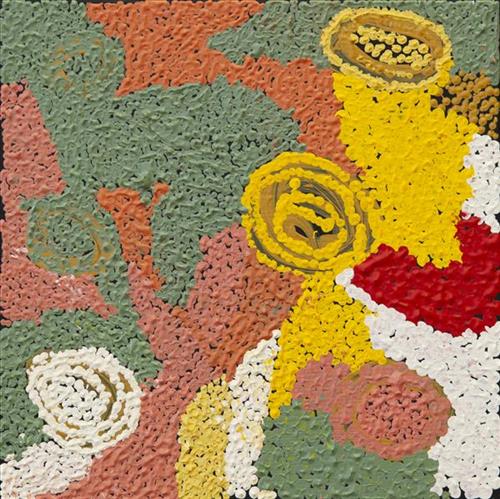
Parnngurr Rockhole (Cotton Creek)

“Bugai [Whyoulter] told us to go back towards Parnngurr [with the intention of going into Jigalong mission], and we all went together along the track towards Parnngurr. In the afternoon we were going along, getting water for ourselves and walked over a sandhill. On the other side of the sandhill were a lot of vehicles: there was a bulldozer in front, then a grader and then several Land Rovers. We dropped everything and started to run. Old Man Biljabu [Jakayu’s husband] stopped and got ready to kill the whitefellas with his maparn [invisible power]. The whitefellas were waving in a friendly way and we all called out to Old Man Biljabu, “Stop! Stop! Don’t do it!” Jakayu and her husband started to walk towards the whitefellas. Everyone else followed behind them, starting to walk slowly.

We went and met the whitefellas and started talking to them, but they couldn’t understand us… The whitefella told us to go back to our camp and he would come and bring us food. After a time, he came and gave us a whole sheep, and some flour, sugar, bread and fruit. We threw the sheep away [for fear it might be poisoned] and left all the other food except for the sugar. We didn’t boil the sugar in the water with the tea, we just stirred it into warm water and drank it, like we did with bush tucker [edible botanical gum]. We used some of the flour to make a wet dough and drizzle it onto the ashes, the way we cooked seed damper. We didn’t finish eating the food – we just got up and went to Wiirnukurrujunu for pencil yams. We saw other Martu family groups pass by on the far side.

[Later, ] the whitefella followed us and found us where we were asleep… He went back to the mission to get Martu people who could translate. He went back to Jigalong and told Bob Ward, an old man, Sam Kelly’s father. He and Mr. Ward tracked us all the way to Yulpu and got there in the afternoon.

That day, everyone had gone hunting, and when we came back to our camp, there were four or five Land Rovers there. Mum had gone hunting early in the morning, carrying water with her. All us kids had gone west from Yulpu, and we had got one big goanna between all of us. When we came back in the afternoon, we saw that the whitefellas were in our camp, waiting for us. Us kids walked over slowly… When we came closer, Mr Ward opened a box and gave us blankets, clothes and food. He asked us where the others were, and we told him that they had gone over the hill. He told us to follow them and to call them back, and to come back all together and to wait at the road building camp. We agreed to do this. He told all us kids, “This is one blanket for all of you, you have to share it.” But we didn’t take the blanket. We kept walking with no clothes on, we left it there, no clothes, no blanket, didn’t even take the dresses.

We followed our parents over the hill… We spent the night with them and then went back to the place where we had been spotted [originally, at Parnngurr rockhole]. We waited there for the whitefellas to come back. When they arrived, they said that they had left their truck in between Parnngurr and Jigalong because it couldn’t go over the sandhills. The whitefellas were coming to get us in the Land Rover, taking three of us at a time, over to where the truck was waiting. From there they were carting all the people back to the truck. We all got in the truck and went right up to Old Jigalong, got there in the night time. That’s all.”

– Ngamaru Bidu, as translated by Ngalangka Nola Taylor

Parnngurr rockhole is located just south of Parnngurr Aboriginal community. This site lies within Ngamaru’s ngurra (home Country, camp), the area which she knew intimately and travelled extensively with her family in her youth. For many Martu, including Ngamaru, Parnngurr also signifies the location at which their nomadic bush life came to an end. Poignantly described here by Ngamaru, it was here that a group of 29 Martu were picked up by the Native Welfare Department to be taken to Jigalong Mission in 1963. Collectively the group had come to the decision to move to the mission as a result of an extended drought, which had caused a scarcity in food and water resources. The group also wanted to join their families, who had already moved to Jigalong.

At the junction of three linguistic groups; Manyjilyjarra, Kartujarra, and Warnman, Parnngurr rockhole was a critical and permanent source of water during the pujiman (traditional, desert born) era that supported many ritual large gatherings. During this nomadic period families stopped and camped here depending on the seasonal availability of water and the corresponding cycles of plant and animal life on which hunting and gathering bush tucker was reliant. At Parnngurr and other similarly important camp sites families would meet for a time before moving to their next destination. Parnngurr and its surrounds are physically dominated by distinctively red tali (sandhills), covered sparingly with spinifex and low lying shrub.

Parnngurr is also an important site chronicled in the epic Jukurrpa (Dreaming) story of the Jakulyukulyu, or Minyipuru (Seven Sisters). The sisters stopped to rest on Parnngurr Hill before continuing on their long journey east. Minyipuru is a central Jukurrpa narrative for Martu, Ngaanyatjarra, Pitjantjatjara and Yankunytjatjara people that is associated with the seasonal Pleiades star constellation. Relayed in song, dance, stories and paintings, Minyipuru serves as a creation narrative, a source of information relating to the physical properties of the land, and an embodiment of Aboriginal cultural laws. Beginning in Roebourne on the west coast of Western Australia, the story morphs in its movement eastward across the land, following the women as they walk, dance, and even fly from waterhole to waterhole. As they travel the women camp, sing, wash, dance and gather food, leaving markers in the landscape and creating landforms that remain to this day, such as groupings of rocks and trees, grinding stones and seeds. During the entirety of their journey the women are pursued by a lustful old man, Yurla, although interactions with other animals, groups of men, and spirit beings are also chronicled in the narrative.
111582164771


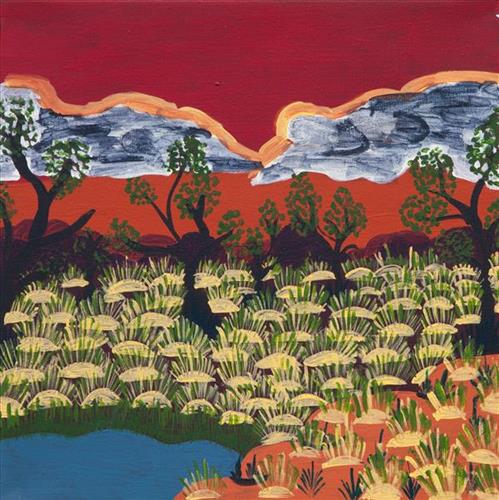
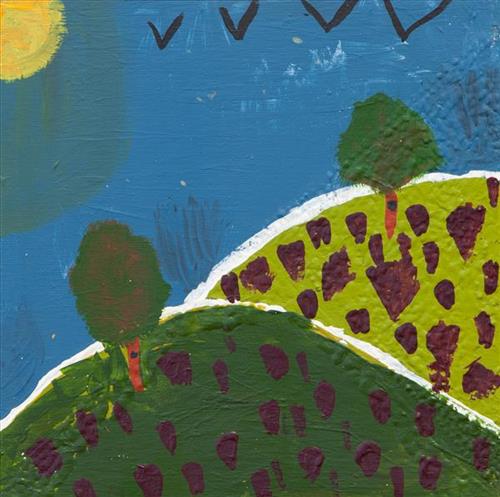
Untitled

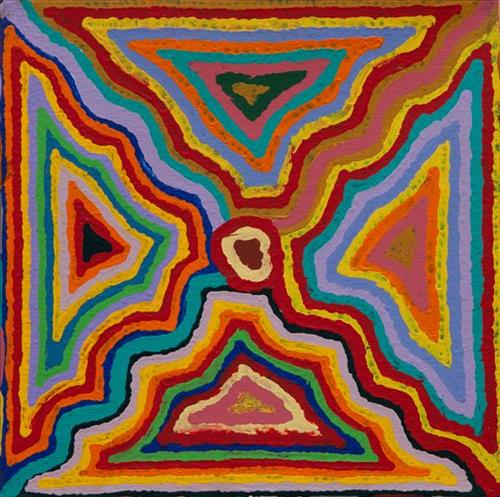
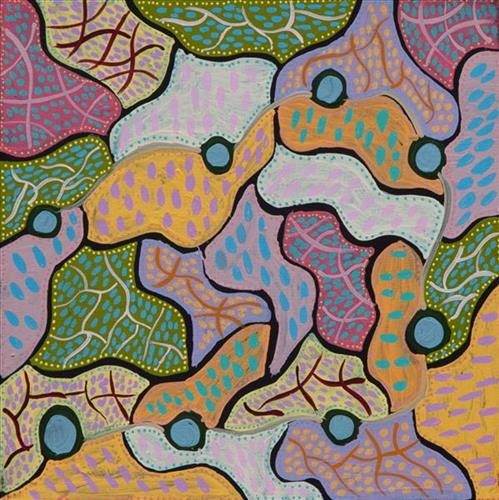
This work portrays an area known intimately to the artist, painted here from memory. During the pujiman (traditional, desert dwelling) era one’s survival depended on their intimate knowledge of the location of resources; thus physical elements of Country, such as sources of kapi (water), tali (sandhills), and different varieties of warta (trees, vegetation) were carefully observed and remembered. Today, this relationship with Country remains equally strong, despite the movement of Martu out of the desert and into remote Aboriginal communities, towns and cities.

Also visible may be traces of life cycles based around kalyu (rain, water) and waru (fire). A thousands of year old practice, fire burning continues to be carried out as both an aid for hunting and a means of land management today. As the Martu travelled and hunted they would burn tracts of land, ensuring plant and animal biodiversity and reducing the risk of unmanageable, spontaneous bush fires. The patchwork nature of regrowth is visible in many landscape works, with each of the five distinctive phases of fire burning visually described with respect to the cycle of burning and regrowth.  

Finally, metaphysical information relating to a location may also be recorded; Jukurrpa (Dreaming) narratives chronicle the creation of physical landmarks, and can be referenced through depictions of ceremonial sites, songlines, and markers left in the land. 

111582164765


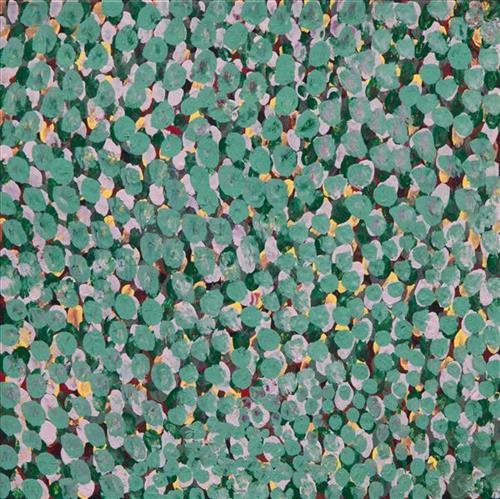
Bush Tucker

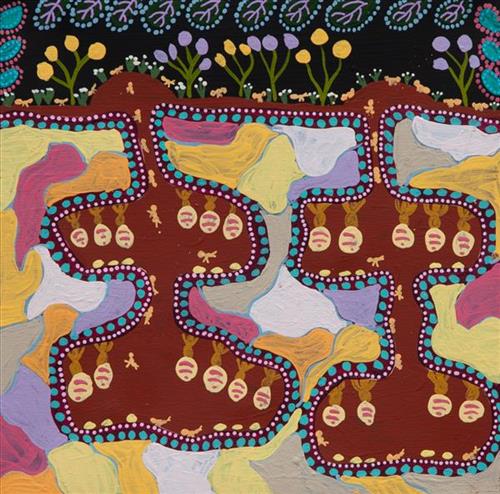
Depicted in this work are traditional types of bush tucker, their habitats, and their related hunting and gathering methods. During the pujiman (traditional, desert dwelling) period, Martu would traverse very large distances annually in small family groups, moving seasonally from water source to water source, and hunting and gathering bush tucker as they went. Whilst desert life has moved away from mobile hunter-gatherer subsistence throughout the course of the twentieth century, bush tucker continues to be a significant component of the modern Martu diet. Hunting and gathering bush tucker remains equally valuable as an important cultural practice that is passed on intergenerationally. Though hunting and gathering implements have been modernised, methods of harvesting, tracking and the use of fire burning to drive animals from their retreats are still commonly practiced today. 

Typically, animals hunted for their kuwiyi (meat) include kirti-kirti (euro kangaroo) and marlu (plains kangaroo), parnajarrpa (sand goanna), kipara (Australian bustard, bush turkey) and karlaya (emu). Lunki (witchetty grub) and wuukurta (honey ants) are dug from tree and bush trunks, or from underground nests. Popular mayi (plant food) includes minyarra (bush onion), collected from small, grass like plants; root vegetables dug from underground such as kulyu and mata (types of bush potato); and seeds such as kalaru (samphire, salt bush), yuwinyji, and marnkalpa (spinifex species). Jawirli (quondong), wamurla (bush tomatoes), jinyjiwirrily (wild gooseberry), ngaputa (melon), and karlkula (bush banana) are some of the most popular bush fruits. These are often collected in the wantajarra (cool season) and tuulpara (spring) months, along with juri (sweet) botanical gums and wama (nectar), obtained from various plant species. 

Traditional tools used for hunting and gathering bush tucker were carved from wanari (mulga), mulunturu (desert oak), yurungkura (river red gum) and mijarrpa (bloodwoods), and included kurlata (spears), jurna (hitting stick), karli (boomerangs), wana (digging-sticks), piti (timber bowls used for carrying food and water), and jiwa (grinding stones for grinding seeds into flour). While carved objects retain enormous social and ceremonial importance in Martu life, they are no longer used for hunting and gathering.

111582164795


Yulpu

Yulpu is a large soak located within the McKay Ranges, and just south of Parnngurr Aboriginal community. Yulpu is still a popular camping ground and hunting area for Martu today.

During the pujiman (traditional, desert dwelling) period, Martu would traverse very large distances annually in small family groups, moving seasonally from water source to water source, and hunting and gathering bush tucker as they went. At this time knowledge of water sources was critical for survival, and today Martu Country is still defined in terms of the location and type of water. Each of the hundreds of claypans, rockholes, waterholes, soaks and springs found in the Martu desert homelands is known by name, location, quality and seasonal availability through real life experience and the recounting of Jukurrpa (Dreaming) narratives.

111582164791


Kurturarra

“Kurturarra is my Grandmother’s Country. Warla (lake) with a spring. Tali (sandhills) all around.”

 – Beverley Rogers

This site lies within Beverley’s ngurra (home Country, camp) through her grandmother. Kurturarra is a yinta (permanent spring) located within the largest of the salt lakes in the Percival Lakes region, and surrounded by acacia trees. The Percival Lakes form a string of ephemeral salt lakes in the north of Western Australia, extending across a distance of 350km. They lie at the southern region of the Great Sandy Desert and east of the Karlamilyi (Rudall River) region.

The region surrounding Kurturarra was formed by Wirnpa, one of the most powerful of the ancestral jila (snake) men and the last to travel the desert during the Jukurrpa (Dreaming). Wirnpa is a rainmaking jila who lived and hunted in the Percival Lakes area. His travels are described in the songs and stories of many language groups across the Western Desert, even those far removed from his home site. In his epic travels, Wirnpa met and feasted with many other ancestral beings, exchanged ceremonial objects, and created a series of different laws and ceremonies. When he finally returned home, he searched for his many children only to discover that they had already died. They had laid down and become the salt springs of the Percival Lakes. Wirnpa wept for his children before himself transforming into a snake and entering the soak where he still resides.

111582164785


Punmu – Nyanjilpayi

Punmu refers to a region and an Aboriginal community within its vicinity, located 670km North-East of Newman. Created during the return to Country movement of the 1980s, with the recognition of Martu land rights and native title, the community was named after a nearby Jukurrpa (Dreaming) story. Punmu community sits on the edge of a large salt lake known as Nyayartakujarra, or Lake Dora. The lake runs south into Karlamilyi River (Rudall River). Surrounding Punmu are numerous fresh water soaks and the red tali (sandhills) typical of the area. The most frequently visited yinta (permanent springs) around Punmu include Wirlarra, Rawa, Yilyara, Jila-jila and Tuu-tuu.

Nyanjilpayi grew up in and travelled through this Country as a young girl with her family. This is her grandfather’s ngurra (home Country, camp). Following the passing of their parents, sisters Mayiwalku, Mulyatingki and Nyanjilpayi continued to travel through this region for several years, occasionally meeting with other family groups. 

The Country around Punmu features in several Jukurrpa narratives. Of particular importance is the story of the Jila Kujarra (Two Snakes), one of the key Jukurrpa narratives for the Martu. Though the story belongs to Warnman people, it is shared across the Western Desert with several other language groups. The narrative centres on the travels of two snakes as they are pursued by the Niminjarra, spiritual ancestors of the Warnman people. 

Before transforming themselves into snakes, the Jila Kujarra were young brothers. As snakes, they began travelling home to their mother, but were intercepted by the Niminjarra, who tracked the Jila Kujarra to Paji, east of Nyayartakujarra (Lake Dora). Though the Jila Kujarra eluded their pursuers here by escaping under the lake at Paji, they were soon after speared and injured by two Pukurti (initiates with bundled hair) at Nyayartakujarra, who returned with the Niminjarra to cook the snakes at the site of Kumpupirntily (Kumpupintily, Lake Disappointment). As the Niminjarra cut down the length of the Jila Kujarra, the snake’s bladders were pierced, causing an explosion of scalding hot urine in which the Niminjarra all perished and became black rocks at the site. The spirits of the Jila Kujarra returned to their mother at Nyayartakujarra, where the mother and her sons entered the ground below Nyayartakujarra and remain to this day.

111582164783


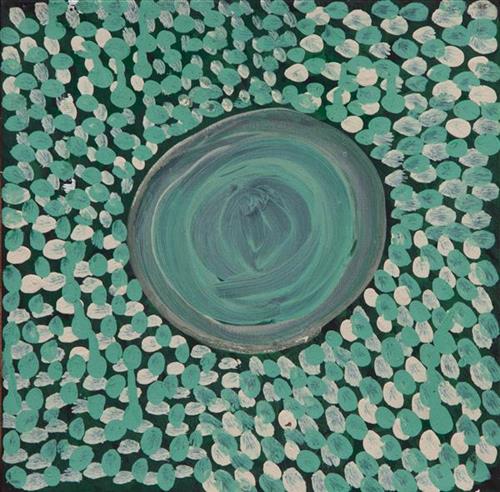
Jamparri

Jamparri is a yinta (permanent spring) located yapurra (west) of Karlamilyi River (Rudall River) and ngaparti (south) of Yaralalu waterhole. Both areas are known as good hunting sites. The Karlamilyi River and its surrounds were created by the Jila Kujarra (Two Snakes) as they journeyed north east to Nyayartakujarra (Lake Dora).

Jila Kujarra is one of the key Jukurrpa (Dreaming) narratives for the Martu. Though the story belongs to Warnman people, it is shared across the Western Desert with several other language groups. The narrative centres on the travels of two snakes as they are pursued by the Niminjarra, spiritual ancestors of the Warnman people.

111582164781


Untitled

This is Ngarga’s Country- her ‘ngurra’ (home Country, camp). People identify with their ngurra in terms of specific rights and responsibilities, and the possession of intimate knowledge of the physical and cultural properties of one’s Country. Painting ngurra, and in so doing sharing the Jukurrpa (Dreaming) stories and physical characteristics of that place, has today become an important means of cultural maintenance. 

Ngarga’s ngurra encompasses the Country that she and her family walked in the pujiman (traditional, desert-dwelling) era. She grew up, walked and hunted primarily around the Percival Lakes region as a young girl, travelling with her mother, siblings, and extended family. She lived nomadically before her family was persuaded to move to Jigalong Mission in 1963 by staff from the Native Welfare Department in 1963. Hers was one of the last families to leave the desert.

Portrayed in this work are features of Ngarga’s ngurra, such as the striking salt lakes, dominant permanent red tali (sandhills), warta (trees, vegetation), and the individually named water sources she and her family camped at. These include Wirnpa, Yimiri, Jaramarra, Kurturarra, Karily-karily, Kiriwirri, Kupankurlu, Linyjalangu, Ngurtukurangu, and Milkarra. Rock holes, waterholes, soaks and springs were all extremely important sites for Martu people during the pujiman period, and are generally depicted with circular forms. 

The encyclopaedic knowledge of the location, quality and seasonal availability of the hundreds of water bodies found in one’s Country sustained Martu as they travelled across their Country, hunting and gathering, visiting family, and fulfilling ceremonial obligations. They would traverse very large distances annually, visiting specific areas in the dry and wet season depending on the availability of water and the corresponding cycles of plant and animal life on which hunting and gathering bush tucker was reliant. As they travelled and hunted they would also burn areas of Country, generating a greater diversity of plant and animal life

111582164778


Well 33 to Well 40

Juntu-juntu (Canning Stock Route Well 30) is a waterhole located between the Karlamilyi (Rudall River) region and Kunawarritji Aboriginal Community, on the northern section of the Canning Stock Route. Kakarra (east) of Juntu-juntu are Warla-warla and Yaturti waterholes. 

Prevalent in the area surrounding Juntu-juntu are jawirli (quondong) trees, providing one of the few bush fruits that comprised part of the pujiman (traditional, desert dwelling) diet. High in vitamin C, the fruit can be eaten raw or cooked, and was also prepared as a treatment for skin ailments due to its antibacterial properties. 

The intersection of the Canning Stock Route with Juntu-juntu also made this a site of early contact with Europeans for many Martu then living a pujiman life in the desert. Following the route’s construction, Martu encountered Europeans and other Martu working as cattle drovers as they would travel up and down the Stock Route from water source to water source. Increasingly, pujimanpa (desert dwellers) followed the route to newly established ration depots, mission and pastoral stations. They were drawn to the route in search of food, by a sense of curiosity, or by loneliness. By the late 1950s and early 1960s, most of the desert family groups had left the desert. Eventually, these factors combined with an extreme and prolonged drought in the 1960s to prompt the few remaining pujimanpa to move in from the desert.

111582164775


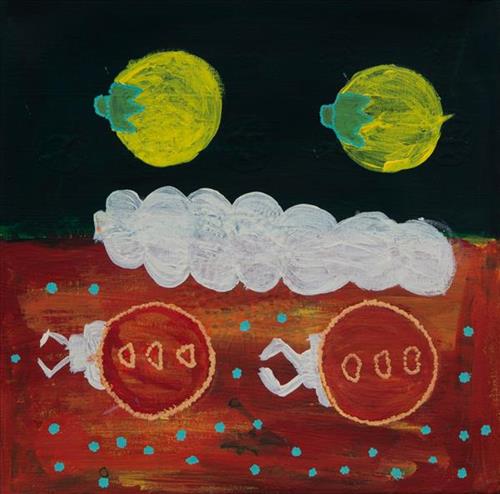
Wuukurta (honey ants) Dancing

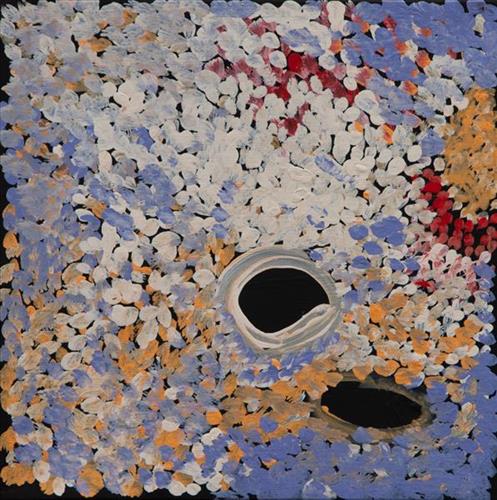
Wuukurta (honey ants) are found in a variety of arid or semiarid environments, with nests of up to two metres deep and more than two metres across. Wuukurta are a highly sought after bush tucker, known otherwise as ‘bush lollies’ due to their sweet, honey like taste. They are eaten whilst still alive by holding the head and legs between two fingers and biting off the thorax. Martu dig for wuukurta nests through the seasons, but they are known to be especially abundant following the rains.

During the pujiman (traditional, desert dwelling) period, Martu would traverse very large distances annually in small family groups, moving seasonally from water source to water source, and hunting and gathering bush tucker as they went. Whilst desert life has moved away from mobile hunter-gatherer subsistence throughout the course of the twentieth century, bush tucker continues to be a significant component of the modern Martu diet. Hunting and gathering bush tucker remains equally valuable as an important cultural practice that is passed on intergenerationally. Though hunting and gathering implements have been modernised, methods of harvesting, tracking and the use of fire burning to drive animals from their retreats are still commonly practiced today.