110682148654
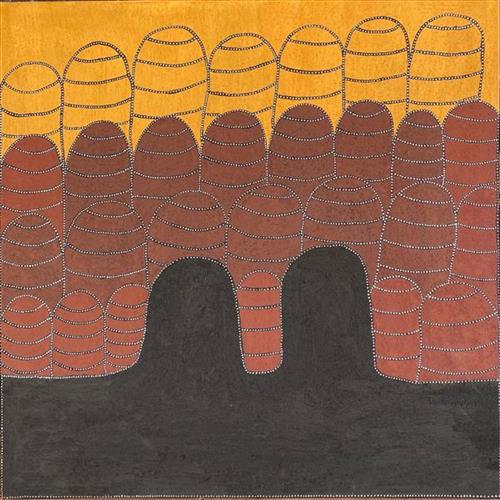
Kangaroo Rock Dreaming (Norton Bore)
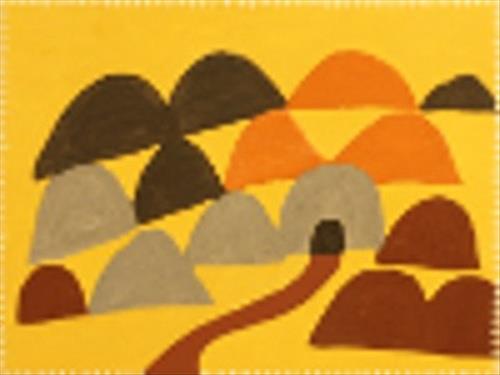
This is the kangaroo rock at Norton Bore. Old people would rub this rock when they wanted to go hunting and kangaroos would come out at Violet Valley and Norton Bore. If you go there now, you’ll see all of the kangaroos still around these places, all kinds of kangaroos, red kangaroos, ones with white chests.
These are two shelters made out of trees and leaves, when the old people were hunting they would hide in these shelters with their spears and when the kangaroos came they would spear them for feed.
1106929269
WINUBA SPRING
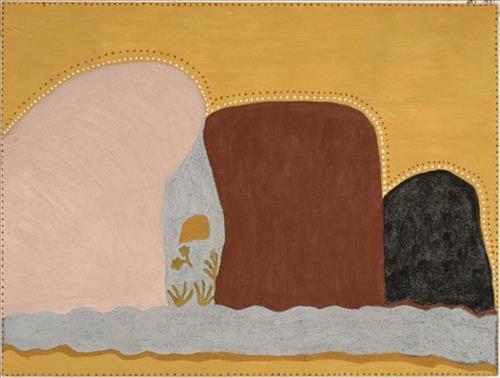
‘That’s Winuba Spring again,’ Evelyn Malgil says. ‘I just do him different shapes you know, different ways.’ ‘This is my father country. Hot water spring and cold water spring. Those big hills are my family place. That water live all year ’round.’ The waterhole at Winuba holds water all through the dry season, when other creeks and waterholes dry up. This is Malgil’s traditional country. Winuba Spring is the Ngarrangkarni (Dreaming) place for the sandfrog.
1106923513
LALANGGARRANY DU DARNDAL -CROCODILE & TURTLE
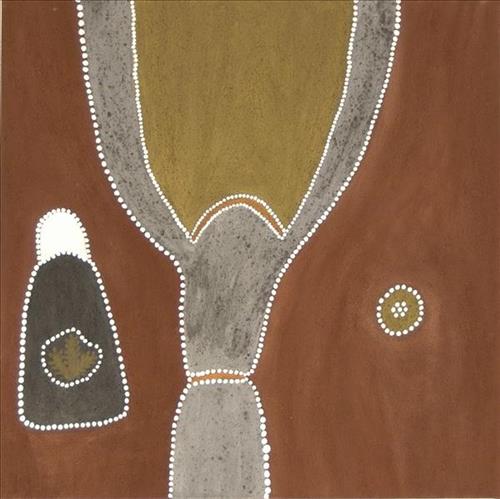
‘That’s that darndal and lalangkarrany. And that big mangkerrekerreny this side, big lizard. That his thamanyji –grandpa for lalangkarrany. And his grandma again old darndal, he Nangala. Yeah. Juwurruny, lalangkarrany and mangkerrgerreny [is] Jungurrany. Jida wananyandeburru gurlum biya manamiyanda. He bin look round, digging all the way you know? Got ‘im that crocodile, julij [carry] him all the way la coolamon, look around, he bin jidajida all the way, [stabbing the ground] jida all the way ‘til he bin come to Murruwuny. Rurd now, rurd nyiniyanya [she sat down] lalangkarrany, got a lalangkarrany got a coolamon, landurrbaya [with a coolamon]. La nyarnde[gum] he bin put ‘im down, la gum, you know gum tree, big one? La shady tree and he bin go got a ganany [digging stick] now yilag. He bin jida, jida, jida right down; water bin shoot out. Nerraj nginini now gurlun yilang balawabiny jidangarriny nyanini. [the water shot out when the turtle stabbed the ground] Jida nyanini daburr nyinamanya gurlun gulurrugu neraj nginini balawabiny. Well the water bin shoot up now he bin fill up now, go back wiji nyanini [she ran] . He bin get all the nyarnde for him, all the nyarnde. He bin put ‘im right round la derla la tail all around la head everywhere. He bin tell ‘im “wiji buma now, yilag,[run now” he bin tell ‘im to run la that water now. Lalangkarrany bin run, he bin go down la water yilag, nothing. He bin shoot out you know? He wasn’t what’s-a-name, he wasn’t too happy to go down right down. That lalangkarrany he bin put ‘im la him more nyarnde, he never go down you know? He bin put ‘im la him more nyarnde he bin run fast, he never come out. Turtle now he bin put ‘im bat a more nyarnde again he bin try him. Nothing, he bin come out again. He bin go back put ‘im more nyarnde, finish. He bin nyirregnyirreg for good, stop there. And that mangkerre bin run, he bin go stand up la campground. You can see that rock la standing up. Murruwuny now that one. Fish Hole, top way la Springvale way, well that dunbin [gap] down this way. And he livin’ there. You can see big mob crocodile everywhere la bank when you light ‘im bat night-time you know? You can see murl there murl everywhere. Eye, murlu deg ngerne lirringbe nginji murlu he lookin’ out you know? He bin looking out, shiny.’
This Ngarrangkarni involves Darndal the turtle and Lalangkarrany the crocodile. According to Gija kinship system, the turtle is Nangala skin, making her the crocodile’s grandmother, he is Juwurru. Waving Lizard, Mangkerrekerreny is Jungurra, the crocodile’s grandfather. Crocodile was mortally wounded in a fight with Binjirrminy the bat. The turtle placed her dying grandson in a coolamon (landurr) and carried him to this place. As she walked she stabbed the ground with her digging stick trying to find water. At Murruwuny, she put Crocodile down under a shady nyarndeny tree. She stabbed her stick into the sand again and a jet of water came shooting out, creating a deep pool. She covered crocodile in sap and told him to jump into the water, he did but floated to the top. She continued to cover him in more gum, all over his body until at last he jumped in and sank to the bottom. Turtle then covered herself in gum and tried to follow Crocodile. She too floated to the top. Covering herself with more gum, she again jumped in the water and like her grandson sank to the bottom and stayed there. Mangkerrekerreny ran away and turned to stone at a place close to Murruwun. This is Juli’s traditional country on Springvale Station. She says when you go to this spot on the river at night and shine a torch, you can see the glinting eyes of many crocodiles.
1106929347
Warndiwal
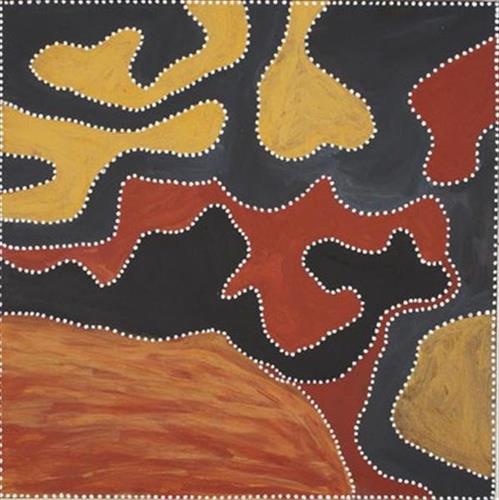
This painting is of the Country on Springvale station, Barlinyin.
Recently, in the wet season, Rusty travelled to this place with his grandchildren. There they were shown how to catch and kill a goanna, they learnt new Gija words, they learnt about Rusty’s life on this Country – it is where he was born and where he worked as a young man. They learnt about the historical, complicated politics of the land and Rusty’s expereince of it and relation to it.
In the left hand corner, Rusty has painted red soil plains. The black area is black soil. The yellow ochre parts are flat country. The grey part of this painting is Warndiwal creek. It is a tributary of Bullock Hole, a popular rest spot for Rusty and others in his family when they lived and worked on Springvale Station.

1106920444

JUMULUNY NGARRANGGARNI
This is a painting of Dougie’s traditional country, where he was born,where he was raised and where he worked as a young man.
The country is called Ngarrgooroon and it lies east from Warmun.
Jumuluny means boab in the Gija language.
This is an important place for Gija people. The Ngarranggarni (Dreamtime) story behind this place is that these boabs were once children, whose parents did not follow the kinship laws and marry the ‘right way’. Their children grew up deformed, and turned into these boabs, which grow along the ground, instead up straight up. Today, pregnant women are warned not to visit this place, as they may give birth to deformed children.

11061037561

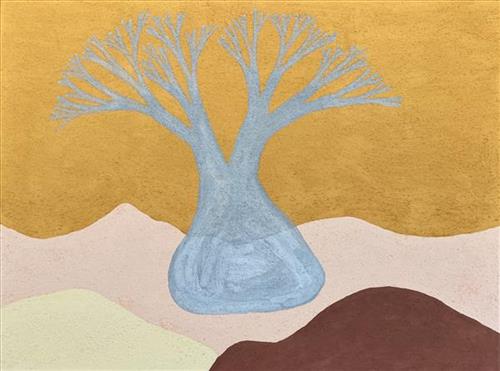
Jumulunj (Boab Tree)
This is the Jumulunj (boab tree) Peggy says, that’s for women – Ngalim ngalim-boorroo.
When women gave birth out in the bush, they would often put their placentas in the boab tree, to make the babies strong. Then that boab tree belongs to that child.
Boab trees are also an importnt food source – the roots of young trees can be eaten along with the boab nut. Peggy speaks of this often and people still eat it widely today.


