Summer Leaves
The Pilbara bush is surprisingly resilient and the plants can survive many months without rain. We use many of the leaves as medicine like our ancestors taught us.
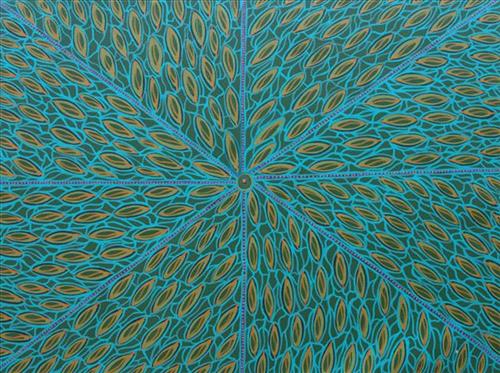
The Pilbara bush is surprisingly resilient and the plants can survive many months without rain. We use many of the leaves as medicine like our ancestors taught us.
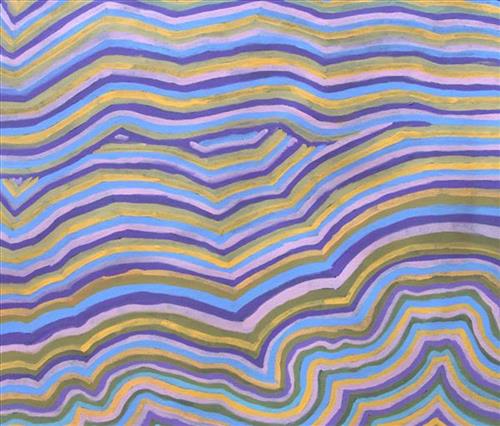
In our land when you come to our country you will see lots of colours in the rocks. This painting is about these colours – ochres, reds and oranges, which stream across the rock face as the sun gets lower in the sky.
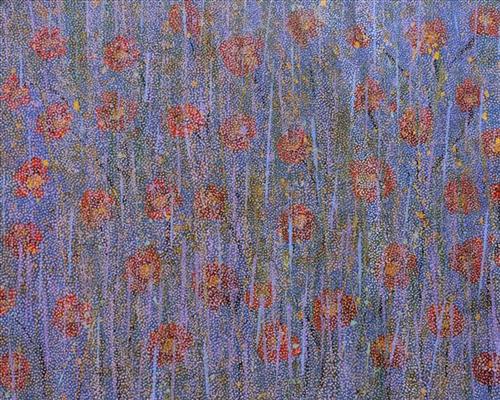
This is my interpretation of the Sturt Pea. It has a vibrant red flower and a succulent sweet juice that can be eaten.
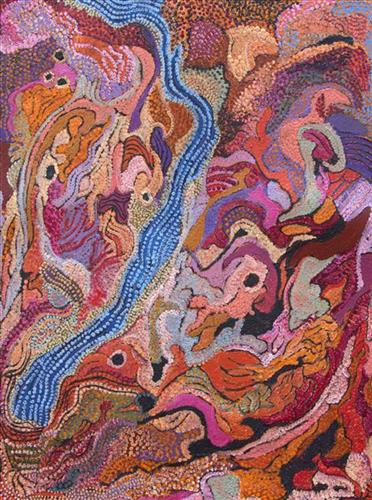
We have many of these hidden creeks running through our country. Some are dry, but you know there is water beneath the surface because of the birds flying into the thick growth of grass alongside. This is where we will find a soak for water.
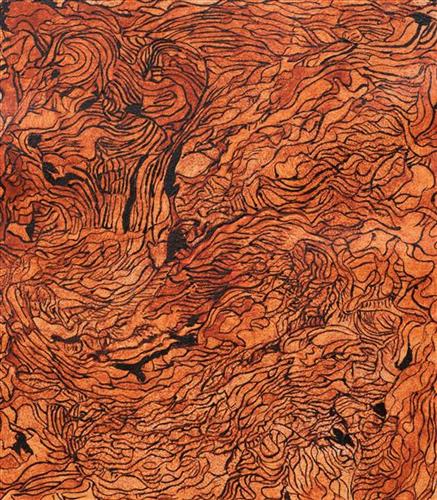
During dry summer months our country looks so dry, but the beauty of the red earth, the spinifex and dry grass make it beautiful.
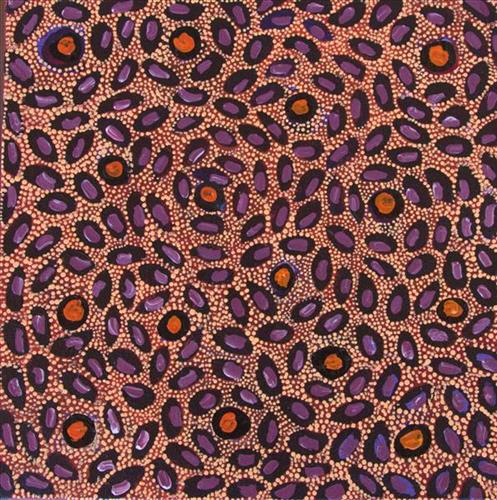
This is the Fortescue Mulla Mulla or ‘Gumbarli’ in Yindjibarndi language. The flower is a purplish colour. It’s not a bush medicine, just a flower that grows in the country, in lines along the roads and everywhere. In this painting, the seeds of the Mulla Mulla are all blowing out. Once the leaves and petals have fallen off, the seeds are blown all through the land to bring flowers again the next year.
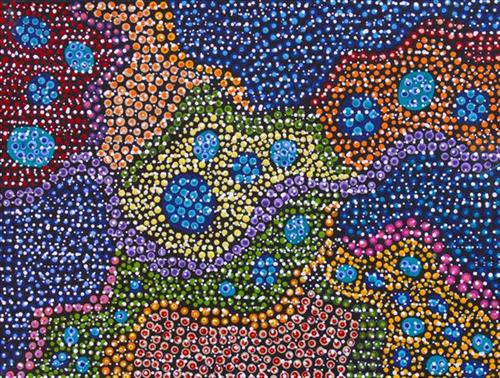
In Yindjibarndi country there are many different shaped rock formations. It looks like a truck has tipped a huge pile of rocks. At different times of the day, especially in the evening sunset, you will see the beautiful colours changing across the face of the rocks which compliments the soft spinifex growing through the country.
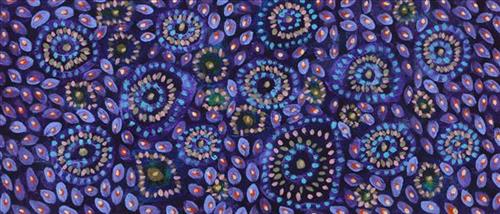
This painting shows the many waterholes you find in the Pilbara region. Some are well known, others are hidden amongst the hills.
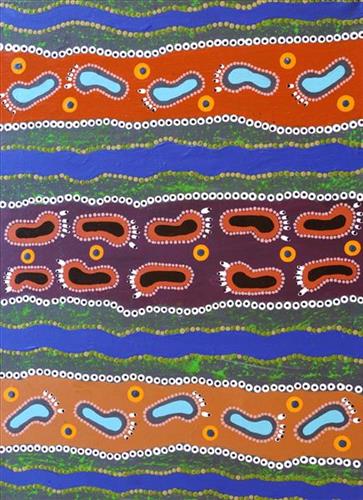
These are the tracks of my ancestors who walked the land long before us. We now walk where they walked.
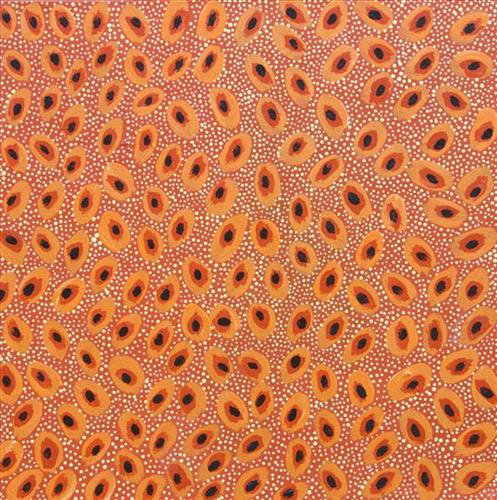
In this painting I have depicted the pods of a shrub which is common in the Pilbara area. It is a smallish bush which comes into seed in September, when the Emu is visible in the Milky Way. This is the time the emu chicks hatch and it is one of their main sources of food. When the pod opens the parent emus feed the little black seeds to their chicks. The seed pod, which is about the size and the shape of a cockroach, turns from orange to yellow, so when all the bushes are in pod at different stages, there is a brilliant display of orange and yellow colours throughout the country. The official name of this annual shrub is Senna notabilis, but, due to the oblong, flat shape and the glossy golden brown colour of its pods, it is known commonly as Cockroach Bush. It has a little round fruit, a berry, that starts of green and turns red when it is ripe, but it’s poisonous. The shrub starts off as a light green colour and then, as it matures, it gets darker. The flowers are a yellowy orange and they, too, get darker with a bit of black as they are fading away.