111981994004
Bush Jewellery – Earrings
The women of Maningrida and surrounding homelands use a combination of locally found seeds, bone and shells to make a variety of jewellery including necklaces. earrings and bracelets. Many of the artists use complex patterns and designs to make their beautiful creations.
111981994007
Bush Jewellery – Earrings
The women of Maningrida and surrounding homelands use a combination of locally found seeds, bone and shells to make a variety of jewellery including necklaces. earrings and bracelets. Many of the artists use complex patterns and designs to make their beautiful creations.
111981994005
Bush Jewellery – Earrings
The women of Maningrida and surrounding homelands use a combination of locally found seeds, bone and shells to make a variety of jewellery including necklaces. earrings and bracelets. Many of the artists use complex patterns and designs to make their beautiful creations.
111981994003
Bush Jewellery – Earrings
The women of Maningrida and surrounding homelands use a combination of locally found seeds, bone and shells to make a variety of jewellery including necklaces. earrings and bracelets. Many of the artists use complex patterns and designs to make their beautiful creations.
111981993955
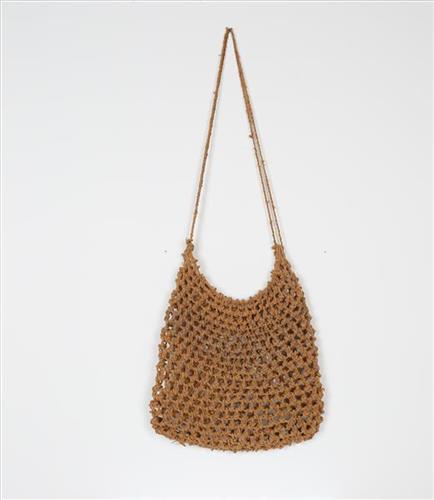
Knotted string bag made from banyan tree
111981993880

Wak Wak
This painting depicts a sacred site at ‘Kurrurldul’, an outstation south of Maningrida.
The ‘rarrk’, or abstract crosshatching, on this work represents the design for the crow totem ancestor called ‘Djimarr’. Today this being exists in the form of a rock, which is permanently submerged at the bottom of Kurrurldul Creek. The ‘Djimarr’ rock in the stream at Kurrurldul is said to move around and call out in a soft hooting tone at night. Both the stone itself and the area around it are considered sacred.
The imagery represents the rock mentioned above at the bottom of Kurrurldul creek, which is the final transmutation of the dreaming ancestor ‘Djimarr’. Finally, the pattern used here is also the crow design used in the sacred ‘Mardayin’ ceremony, which is a large regional patri-moiety ceremony now rarely conducted in central and eastern Arnhem Land.
111581994255
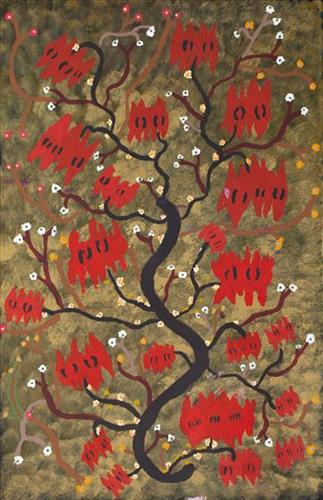
Untitled
“Martu people know how to find water in the desert, they know the Country looks different where there is water under the ground.”
– Corban Clause Williams
Depicted in this work are sources of kapi (water) within the artists’ ngurra (home Country, camp), typically represented with circular forms. During the pujiman (traditional, desert dwelling) period, knowledge of water sources was critical for survival, and today Martu Country is still defined in terms of the location and type of water. Each of the hundreds of claypans, rockholes, waterholes, soaks and springs found in the Martu desert homelands is known through real life experience and the recounting of Jukurrpa (Dreaming) narratives by name, location, quality and seasonal availability. This encyclopedic knowledge extends even to the nature and movement of arterial waterways, and sustained Martu as they travelled across their Country, hunting and gathering, visiting family, and fulfilling ceremonial obligations. They would traverse very large distances annually, visiting specific areas in the dry and wet season depending on the availability of water and the corresponding cycles of plant and animal life on which hunting and gathering bush tucker was reliant.
111581994252
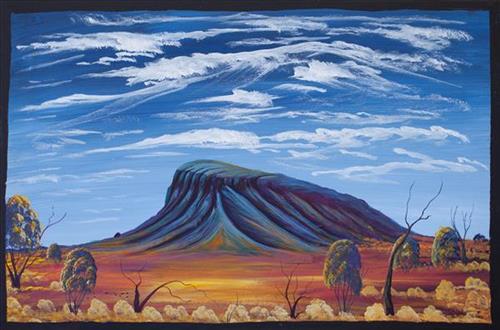
Mirtikanya (Mujupunkanu, Watchpoint Hill)
Mirtikanya is a hill and claypan close to Balfour Downs Station and north of Jigalong Aboriginal community, where Dale continues to live today. During the pujiman (traditional, desert dwelling) era, Mintikanya was primarily used as a camping site in the wantajarra (wet season), when the claypan filled with kapi (water).
Mirtikanya’s location close to Jigalong Mission made it a popular camping site for mission residents on the weekend. For many Martu Jigalong Mission was where their pujiman (traditional, desert dwelling) lifestyle came to an end from the late 1940s as they transitioned to a life as stockmen and women working in cattle stations in the Pilbara region and beyond. In the wake of the extreme and prolonged drought of the 1960s, the last of the remaining pujimanpa (desert dwellers) were forced to move to missions like Jigalong, where a supply of food and water was assured. There, many were reunited with family members that had already moved in from the desert.
111581994250
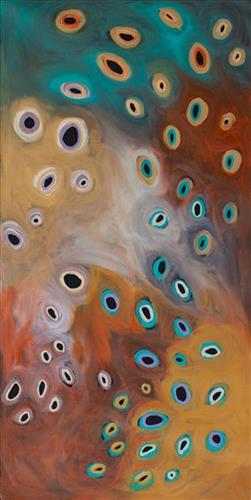
Waterholes
This work depicts waterholes within the artists’ ngurra (home Country, camp), typically represented with circular forms. Waterholes are sites that require maintenance, including digging to increase flow, clearing out surrounding growth, and cleaning up after sullying by camels or cattle.
During the pujiman (traditional, desert dwelling) period, knowledge of water sources was critical for survival, and today Martu Country is still defined in terms of the location and type of water. Each of the hundreds of claypans, rockholes, waterholes, soaks and springs found in the Martu desert homelands is known through real life experience and the recounting of Jukurrpa (Dreaming) narratives by name, location, quality and seasonal availability. This encyclopedic knowledge extends even to the nature and movement of arterial waterways, and sustained Martu as they travelled across their Country, hunting and gathering, visiting family, and fulfilling ceremonial obligations. They would traverse very large distances annually, visiting specific areas in the dry and wet season depending on the availability of water and the corresponding cycles of plant and animal life on which hunting and gathering bush tucker was reliant.