221776314106


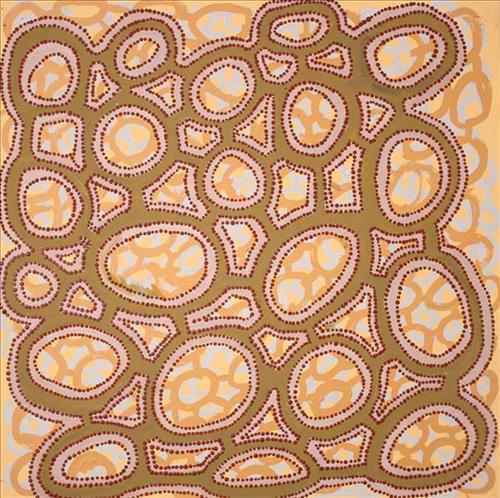
Luga – Cracked mud

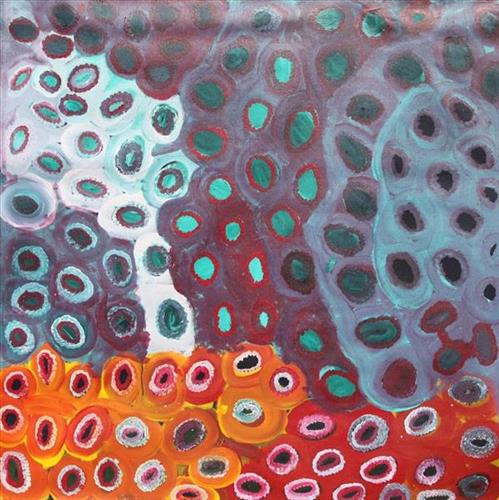
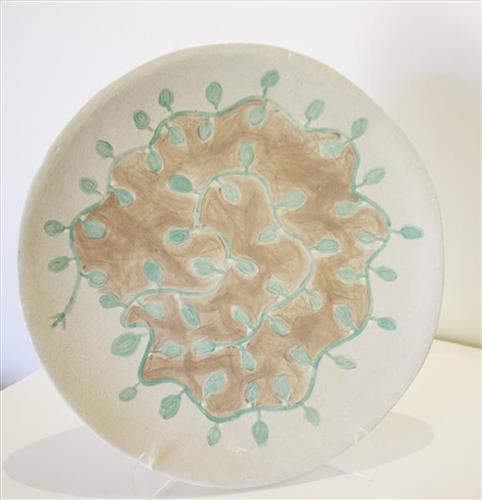
Kittey has depicted the drying and cracked mud of her mother’s country along the Sturt River. She describes the area where she visited as a child along the banks and waterholes by the river as black soil country.“When we were young, my sisters and cousins would play with dried and cracked mud flats. The “Looka” is the name we had for the dried mud flats. In the wet seasons and after a big tide on the Sturt River the water would rise up on the black mud flats, as it dried it would turn crystal like salt. We would play making cakes from the dried shapes and sometimes play like stepping stones. Sometimes the old people would eat these cracked mud cakes as bush medicine for the salt. I like making paintings from my memories from when we were young and all together.”

11151035677


Minyipuru (Jakulyukulyu, Seven Sisters)

The term Jukurrpa is often translated in English as the ‘dreaming’, or ‘dreamtime’. It refers generally to the period in which the world was created by ancestral beings, who assumed both human and nonhuman forms. These beings shaped what had been a formless landscape; creating waters, plants, animals, and people. At the same time they provided cultural protocols for the people they created, as well as rules for interacting with the natural environment. At their journey’s end, the ancestral beings transformed themselves into important waters, hills, rocks, and even constellations. 

Minyipuru, or Jakulyukulyu (Seven Sisters) is a central Jukurrpa narrative for Martu, Ngaanyatjarra, Pitjantjatjara and Yankunytjatjara people that is associated with the seasonal Pleiades star constellation. Relayed in song, dance, stories and paintings, Minyipuru serves as a creation narrative, a source of information relating to the physical properties of the land, and an embodiment of Aboriginal cultural laws. When Martumili Artists was established in 2005, this was the first Jukurrpa story the artists agreed to paint for a broader public. 

Beginning in Roebourne on the west coast of Western Australia, the story morphs in its movement eastward across the land, following a group of women as they walk, dance, and even fly from waterhole to waterhole. As they travel the women camp, sing, wash, dance and gather food, leaving markers in the landscape and creating landforms that remain to this day, such as groupings of rocks and trees, grinding stones and seeds. During the entirety of their journey the women are pursued by a lustful old man, Yurla, although interactions with other animals, groups of men, and spirit beings are also chronicled.

11153039450


Untitled

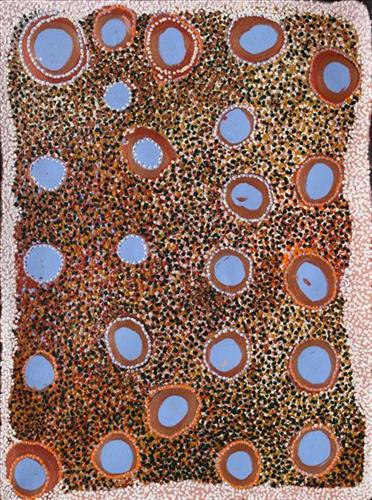
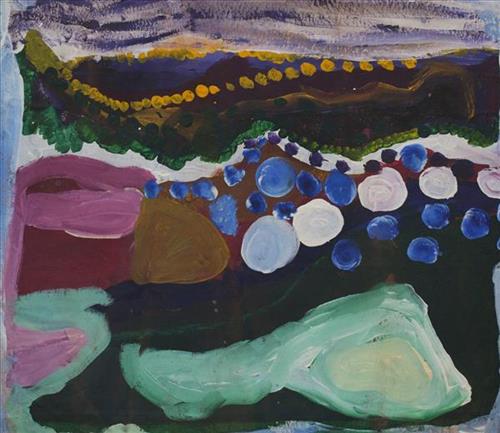
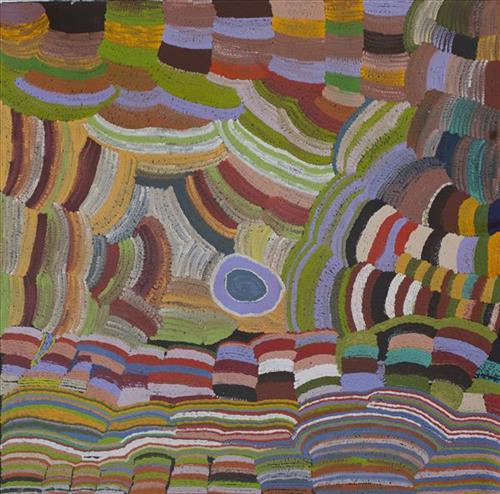
This is Bugai’s Country- her ‘ngurra’ (home Country). The Western Desert term ‘ngurra’ is hugely versatile in application. Broadly denoting birthplace and belonging, ngurra can refer to a body of water, a camp site, a large area of Country, or even a modern house. People identify with their ngurra in terms of specific rights and responsibilities, and the possession of intimate knowledge of the physical and cultural properties of one’s Country. Painting ngurra, and in so doing sharing the jukurrpa (dreamtime) stories and physical characteristics of that place, has today become an important means of cultural maintenance.   

This painting represents the Country Bugai lived in and walked through with her family in her youth. She traversed the area from Pukayiyirna, where she was born near to what is now Balfour Downs Station, all around the Parnngurr area and up and down the Canning Stock Route as far as Kunawarritji (Well 33 on the Canning Stock Route). 

Portrayed are features of Martu Country, such as the dominant tali (sandhills), warta (trees, vegetation), and water sources. Rock holes, waterholes, soaks and springs were all extremely important sites for Martu people during the pujiman (traditional, desert-dwelling) period. The encyclopaedic knowledge of the location, quality and seasonal availability of the hundreds of water bodies found in one’s Country sustained Martu as they travelled across their Country, hunting and gathering, visiting family, and fulfilling ceremonial obligations. They would traverse very large distances annually, visiting specific areas in the dry and wet season depending on the availability of water and the corresponding cycles of plant and animal life on which hunting and gathering bush tucker was reliant. As they travelled and hunted they would also burn areas of country, generating a greater diversity of plant and animal life.

111580587219


Untitled

This is Wurta Amy French’s Country- her ‘ngurra’ (home Country, camp). People identify with their ngurra in terms of specific rights and responsibilities, and the possession of intimate knowledge of the physical and cultural properties of one’s Country. Painting ngurra, and in so doing sharing the Jukurrpa (Dreaming) stories and physical characteristics of that place, has today become an important means of cultural maintenance. 

Wurta’s ngurra encompasses the Country that she and her family walked in the pujiman (traditional, desert-dwelling) era. At this time Wurta travelled nomadically with her own and other family groups. The Country they traversed encompassed an enormous tract of land, all around the Karlamily (Rudall River) region and through to Tiwa (Canning Stock Route Well 26) .

Wurta was born at Wantili (Warntili, Canning Stock Route Well 25). She grew up, walked and hunted primarily around water sources Pangkartal, Yalpalpa, Walirrlirri, Yanytikuji, Wartararra, Tintinmarran, Pimurlu, Raarki (Canning Stock Route Well 27), and Tiwa. Her family continued to live nomadically before eventually deciding to move to Jigalong Mission along with many other relatives following an extreme and prolonged drought in the 1960s. 

Portrayed in this work are features of Wurta’s ngurra, such as the hills, gorges and valleys, warta (trees, vegetation), and the individually named water sources she and her family camped at. Rock holes, waterholes, soaks and springs were all extremely important sites for Martu people during the pujiman period, and are generally depicted with circular forms. 

The encyclopaedic knowledge of the location, quality and seasonal availability of the hundreds of water bodies found in one’s Country sustained Martu as they travelled across their Country, hunting and gathering, visiting family, and fulfilling ceremonial obligations. They would traverse very large distances annually, visiting specific areas in the dry and wet season depending on the availability of water and the corresponding cycles of plant and animal life on which hunting and gathering bush tucker was reliant. As they travelled and hunted they would also burn areas of Country, generating a greater diversity of plant and animal life.
221776385675


Jillynbeng

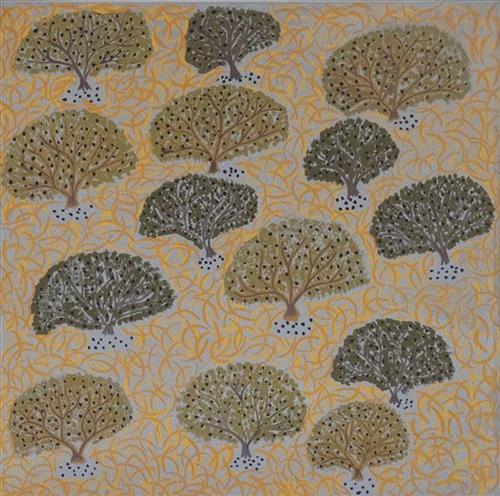
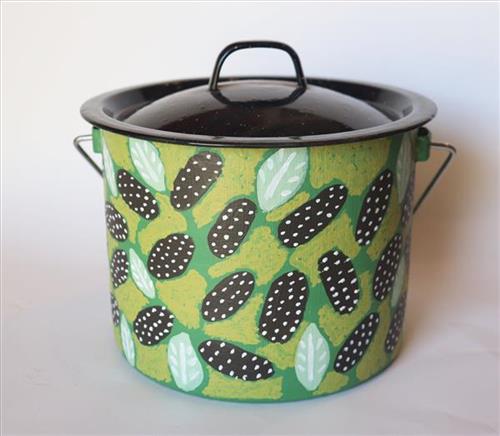
In this artwork Peggy has depicted a bush tucker known as Jilinybeng or “bush cucumber”. This plant grows as a vine and you have to search for it amongst the grasses. Typical of the artist’s recent work the background is flecked with strokes of paint representing the spinifex and grasses being blown by the wind. For the artist this movement of the grasses as the wind blows across the country is evidence that the spirit of culture is alive because “you can see it.” The bush lemon fruit is a grey/green colour that ripens in the wet season and is collected either from the vine directly or on the ground where the fruit has dropped. “This fruit can be eaten when raw but if you eat too much it makes your tongue bright red and hurts your lips. You can also boil the fruit and drink the liquid.  Jilibnybeng is very good for you because it is high in Vitamin C.”

111581637506


Untitled

“This is my Country. My little brother was born here in pujiman (traditional, desert-dwelling) times. I was a big girl, no man yet. We were walking a long way. In the painting you can see the tali (sand hills) and the burning Country.”

– Nyanjilpayi (Ngarnjapayi) Nancy Chapman

This is Nyanjilpayi’s Country- her ‘ngurra’ (home Country, camp). People identify with their ngurra in terms of specific rights and responsibilities, and the possession of intimate knowledge of the physical and cultural properties of one’s Country. Painting ngurra, and in so doing sharing the Jukurrpa (Dreaming) stories and physical characteristics of that place, has today become an important means of cultural maintenance. 

Nyanjilpayi’s ngurra encompasses the Country that she and her family walked in the pujiman  era. Nyanjilpayi was born at Jarntinti, a large claypan at the southern end of Nyayartakujarra (Lake Dora) and within the Karlamilyi (Rudall River) region. She grew up, walked and hunted primarily around the Country extending across the Punmu, Kunawarritji (Canning Stock Route Well 33) and Karlamilyi (Rudall River) regions. Following the death of both their parents, Nyanjilpayi and her sisters travelled alone between Punmu and Kunawarritji, occasionally meeting with other family groups. They continued to live nomadically before eventually deciding to move to Jigalong Mission along with many other relatives following an extreme and prolonged drought in the 1960s. 

Portrayed in this work are features of Nyanjilpayi’s ngurra, such as the dominant permanent red tali (sandhills), warta (trees, vegetation), and the individually named water sources she and her family camped at. These include Jarntinti, Yaralalu, Januwa, Jilankujarra, Karlajarntu, Kartungu, Kularti, Kumpupajanu, Kunalimpi, Kunarra, Marnakarti, Pangkapirni, Wilunganinya, Wurur-wururna, Yilyara, and Yirrajarra Rock holes, waterholes, soaks and springs were all extremely important sites for Martu people during the pujiman period, and are generally depicted with circular forms. 

The encyclopaedic knowledge of the location, quality and seasonal availability of the hundreds of water bodies found in one’s Country sustained Martu as they travelled across their Country, hunting and gathering, visiting family, and fulfilling ceremonial obligations. They would traverse very large distances annually, visiting specific areas in the dry and wet season depending on the availability of water and the corresponding cycles of plant and animal life on which hunting and gathering bush tucker was reliant. As they travelled and hunted they would also burn areas of Country, generating a greater diversity of plant and animal life.
222281950398


Well on Number 6

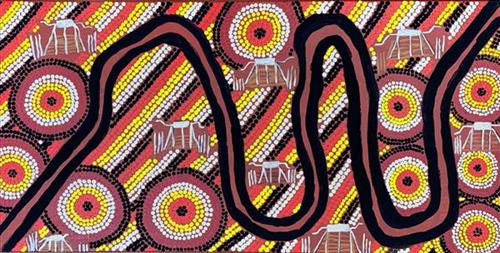
This painting depicts the story of the Well number 6 where cattles and bullocks were rested for their riders to pump out water. The journey was to bring the bullocks from Halls Creek.