111982119222


Mat

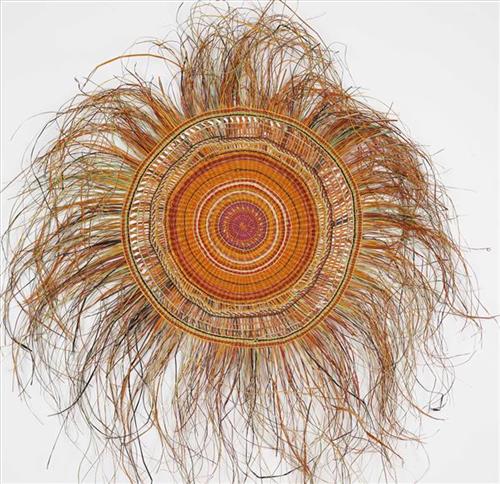
Mats can vary greatly. Artists commonly use a mix of naturally dyed and undyed fibre to create a striking variation of coloured bands. Some artists also incorporate different types of looping to produce different patterns and textured finishes. Each type of mat, fibre bag, basket and dilly bag has its own name in the various languages spoken in the Maningrida region.
111982119221


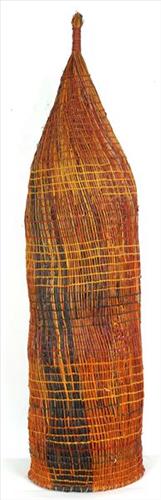
An-gujechiya (Fish Trap)

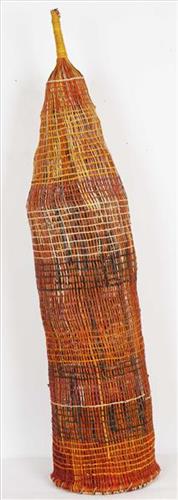
To make fish traps and fish net fences artists firstly get vine (mirlarl) from the jungle and they put it in water for one night to make it soft. Next they start weaving it; they make rings for the inside to keep the fish trap’s shape. Artists work for three or four weeks on the fish trap. They also make string from kurrajong (burdaga) to attach the hibiscus (bardainy) rings and to tie the conical end of the fish trap. This fish trap is used in saltwater and freshwater. People also use fish net fences called mun-dirra. A long time ago they would put the mun-dirra across rivers and creeks. In the middle they would place the an-gujechiya. They also used small things like sticks, rocks, mud and grass to block the fish from going through. People would then catch fish like saltwater barramundi rajarra, freshwater barramundi (janambal), small black freshwater catfish (buliya), bonefish (an-guwirrpiya), and sand bass (dalakan) in these fish traps.

111982119219


An-gujechiya (Fish Trap)

To make fish traps and fish net fences artists firstly get vine (mirlarl) from the jungle and they put it in water for one night to make it soft. Next they start weaving it; they make rings for the inside to keep the fish trap’s shape. Artists work for three or four weeks on the fish trap. They also make string from kurrajong (burdaga) to attach the hibiscus (bardainy) rings and to tie the conical end of the fish trap. This fish trap is used in saltwater and freshwater. People also use fish net fences called mun-dirra. A long time ago they would put the mun-dirra across rivers and creeks. In the middle they would place the an-gujechiya. They also used small things like sticks, rocks, mud and grass to block the fish from going through. People would then catch fish like saltwater barramundi rajarra, freshwater barramundi (janambal), small black freshwater catfish (buliya), bonefish (an-guwirrpiya), and sand bass (dalakan) in these fish traps.

111982119208


Man-ngalinj (bush potato)

Man-ngalinj is a root vegetable often described as ‘bush potato’. It’s duwa, the artist’s moiety. It has a bulbous root and a long thin vine with small flowers that grows across the ground or up the trunks of nearby trees. Large crops can be found near the artist’s outstation, Bolkdjam. Man-ngalinj are harvested after the Wet season in the early Dry

111982119199


Miwal

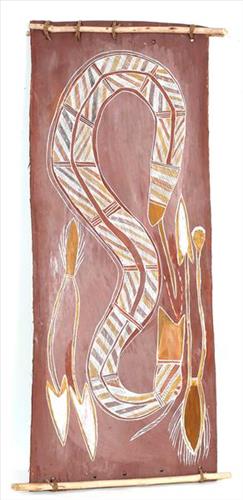
Stanley is part of the Marrangu people, who share a songline that stretches from Ritjarrngu country on the Gulf of Carpentaria right up towrads the East to Raymanggirr, a place close to Gapuwiyak owned by Balkarranydji, who are another Marrangu clan. This songline celebrates the travels of Djarwarri, the Honey spirit and the spirit women who is call Miwal by the Djinang Marrangu. Different Marrangu clans have different names for this spirit woman.

This Miwal story is scared to the Marrangu Djinang people. Standley is one of the ceremonial leards of the Wurrkiganydirr clan group and performs the songs that are part of this story in ceremonies throughout the Maningrida region.