111582120122


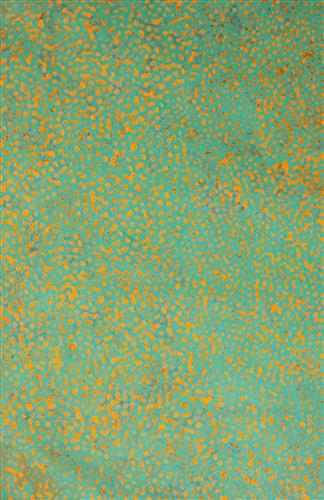
Untitled

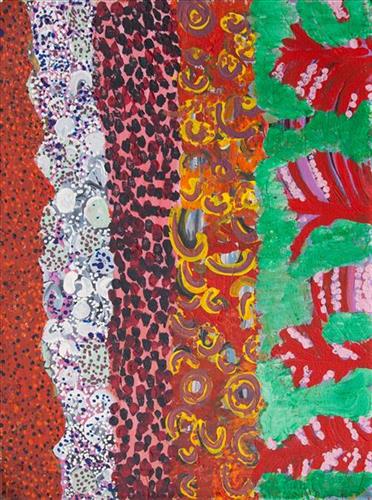
“When Martu paint, it’s like a map. Martu draw story on the ground and on the canvas, and all the circle and line there are the hunting areas and different waters and tracks where people used to walk, and [some you] can’t cross, like boundaries. So nowadays you see a colourful painting and wonder what it is, but that’s how Martu tell story long ago. It’s not just a lovely painting, it’s a story and a songline and a history and everything that goes with it.” 

– Ngalangka Nola Taylor and Joshua Booth

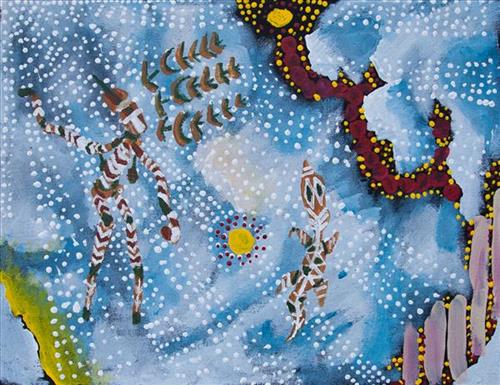
This work portrays an area of Country that can be interpreted in multiple ways. Firstly, the image may be read as an aerial representation of a particular location known to the artist- either land that they or their family travelled, from the pujiman (traditional, desert dwelling) era to now. During the pujiman period, Martu would traverse very large distances annually in small family groups, moving seasonally from water source to water source, and hunting and gathering bush tucker as they went. At this time, one’s survival depended on their intimate knowledge of the location of resources; thus physical elements of Country, such as sources of kapi (water), tali (sandhills), different varieties of warta (trees, vegetation), ngarrini (camps), and jina (tracks) are typically recorded with the use of a use of a system of iconographic forms universally shared across the desert. 

An additional layer of meaning in the work relates to more intangible concepts; life cycles based around kalyu (rain, water) and waru (fire) are also often evident. A thousands of year old practice, fire burning continues to be carried out as both an aid for hunting and a means of land management today. As the Martu travelled and hunted they would burn tracts of land, ensuring plant and animal biodiversity and reducing the risk of unmanageable, spontaneous bush fires. The patchwork nature of regrowth is evident in many landscape works, with each of the five distinctive phases of fire burning visually described with respect to the cycle of burning and regrowth.  

Finally, metaphysical information relating to a location may also be recorded; Jukurrpa (Dreaming) narratives chronicle the creation of physical landmarks, and can be referenced through depictions of ceremonial sites, songlines, and markers left in the land. Very often, however, information relating to Jukurrpa is censored by omission, or alternatively painted over with dotted patterns.
111582120119


Untitled

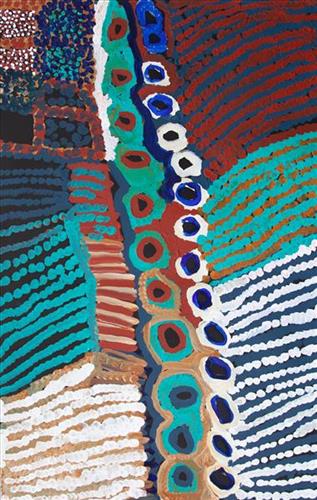
“When Martu paint, it’s like a map. Martu draw story on the ground and on the canvas, and all the circle and line there are the hunting areas and different waters and tracks where people used to walk, and [some you] can’t cross, like boundaries. So nowadays you see a colourful painting and wonder what it is, but that’s how Martu tell story long ago. It’s not just a lovely painting, it’s a story and a songline and a history and everything that goes with it.” 

– Ngalangka Nola Taylor and Joshua Booth

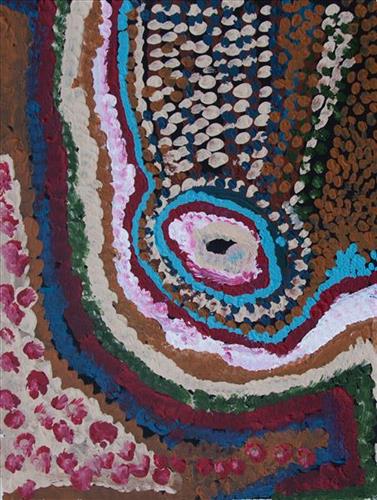
This work portrays an area of Country that can be interpreted in multiple ways. Firstly, the image may be read as an aerial representation of a particular location known to the artist- either land that they or their family travelled, from the pujiman (traditional, desert dwelling) era to now. During the pujiman period, Martu would traverse very large distances annually in small family groups, moving seasonally from water source to water source, and hunting and gathering bush tucker as they went. At this time, one’s survival depended on their intimate knowledge of the location of resources; thus physical elements of Country, such as sources of kapi (water), tali (sandhills), different varieties of warta (trees, vegetation), ngarrini (camps), and jina (tracks) are typically recorded with the use of a use of a system of iconographic forms universally shared across the desert. 

An additional layer of meaning in the work relates to more intangible concepts; life cycles based around kalyu (rain, water) and waru (fire) are also often evident. A thousands of year old practice, fire burning continues to be carried out as both an aid for hunting and a means of land management today. As the Martu travelled and hunted they would burn tracts of land, ensuring plant and animal biodiversity and reducing the risk of unmanageable, spontaneous bush fires. The patchwork nature of regrowth is evident in many landscape works, with each of the five distinctive phases of fire burning visually described with respect to the cycle of burning and regrowth.  

Finally, metaphysical information relating to a location may also be recorded; Jukurrpa (Dreaming) narratives chronicle the creation of physical landmarks, and can be referenced through depictions of ceremonial sites, songlines, and markers left in the land. Very often, however, information relating to Jukurrpa is censored by omission, or alternatively painted over with dotted patterns.
111582120110


Untitled

This is Dale’s Country- her ‘ngurra’ (home Country, camp). People identify with their ngurra in terms of specific rights and responsibilities, and the possession of intimate knowledge of the physical and cultural properties of one’s Country. Painting ngurra, and in so doing sharing the Jukurrpa (Dreaming) stories and physical characteristics of that place, has today become an important means of cultural maintenance. Dale’s ngurra encompasses her birthplace, Jigalong, and the Country that her family walked in the pujiman (traditional, desert-dwelling) era, including Puntawarri, Raarki (Canning Stock Route Well 27), Kularti, Kumpupirntily , Mirtikanya, (Kumpupintily, Lake Disappointment), and Mukurtu.

Portrayed in this work are features of Dale’s family’s ngurra, such as the striking salt lakes, dominant permanent red tali (sandhills), warta (trees, vegetation), and the individually named water sources they camped at. Rock holes, waterholes, soaks and springs were all extremely important sites for Martu people during the pujiman period, and are generally depicted with circular forms. 

The encyclopaedic knowledge of the location, quality and seasonal availability of the hundreds of water bodies found in one’s Country sustained Martu as they travelled across their Country, hunting and gathering, visiting family, and fulfilling ceremonial obligations. They would traverse very large distances annually, visiting specific areas in the dry and wet season depending on the availability of water and the corresponding cycles of plant and animal life on which hunting and gathering bush tucker was reliant. As they travelled and hunted they would also burn areas of Country, generating a greater diversity of plant and animal life.

111582120109


Untitled

This is Biddy’s Country- her ‘ngurra’ (home Country, camp). People identify with their ngurra in terms of specific rights and responsibilities, and the possession of intimate knowledge of the physical and cultural properties of one’s Country. Painting ngurra, and in so doing sharing the Jukurrpa (Dreaming) stories and physical characteristics of that place, has today become an important means of cultural maintenance. 

Biddy’s ngurra encompasses the Country that she and her family walked in the pujiman (traditional, desert-dwelling) era, as well as the stations and communities in which she has resided in later life. Biddy was born in the bush on Anna Plains cattle station, located on the remote Kimberley coast of northern Western Australia, stretching from the shores of Eight Mile Beach to the Great Sandy Desert. She came to work on stations as a ‘grown kid,’ and recalls living in and walking across vast distances over the ‘plains’ (Nyamal Country around Marble Bar) for most of her young life. In the 1970’s she moved to Strelley Station, established by Aboriginal rights activist Don McLeod. In later life Biddy moved to Warralong Community, located between Port Hedland and Marble Bar, where she continues to live today.   

Portrayed in this work are features of Biddy’s ngurra, such as the nimarinya (salt) clay pans and the individually named water sources she and her family camped at.

111582120107


Kulyakartu

“My Country, Kulyakartu. I grew up there, from little boy to big boy grew up there.”

 – Muuki Taylor

This painting depicts Kulyakartu, Muuki’s ngurra (home Country, camp). Kulyakartu is located in the far north of the Martu homelands, near the Percival Lakes region of Western Australia’s Great Sandy Desert. Muuki has extensive knowledge of the Country in this region, where he grew up living traditionally during the pujiman (traditional, desert dwelling) days with his family. Kulyakartu is mostly grass Country where there is very good hunting. In particular parnajarrpa (goanna), wild cats, and lunki (witchetty grub) are found in abundance here. There is no permanent water source in Kulyakartu, so Muuki’s family would walk here annually following the wantajarra (wet season). During the yalijarra (hot, dry season) they would head south again to more permanent water.

Muuki paints Kulyakartu in all its different seasonal stages. Often visible in his work is the patchwork nature of regrowth subsequent to the practice of waru (fire) burning that assists with hunting, regenerates growth, and encourages greater diversity in plant and animal life. This mosaic patterning is aligned with the five distinct Martu cyclical phases of burning and regrowth. First is nyurnma (freshly burnt Country) when Muuki is “making waru”. Following nyurnma are the rains and subsequent waru-waru, when young, bright green plants start to grow. Nyukura occurs between one and three years after burning, when plants have matured and are fruiting and seeding. Manguu is “when him finished”, four to six years post burning, and when spinifex has matured to the point that it can be burned once again. Finally, kunarka signifies the time when spinifex and other plant species have become old growth, and pose a risk of destructive bushfires.

111982120638


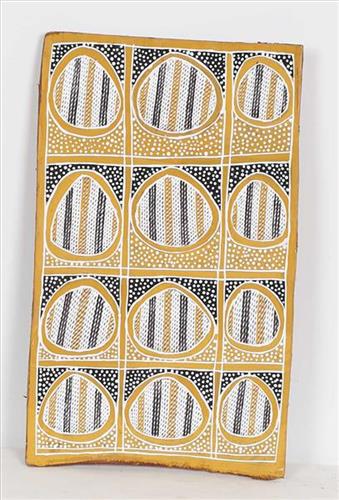
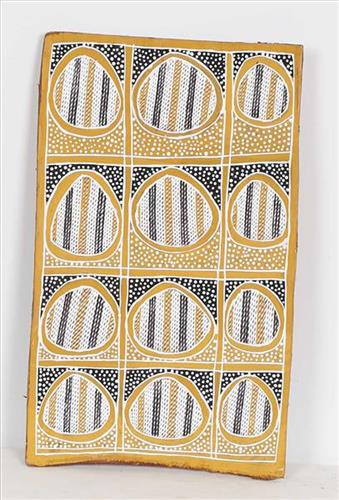
Ngangiy (Mud-mussels)

This Painting depicts Ngangiy (Mud mussels) a type of shellfish; a mussel, a commonly gathered clam found in the mangrove mud and characteristically coated with coralline growth and stained partly black. Polymesoda coaxans (Corbiculidae). This plentiful shellfish is collected in the dried out floodplains, only a small sliver of the shell is exposed as it buries itself in mud, You need good eyes to find this delicious bush food.

111982120627


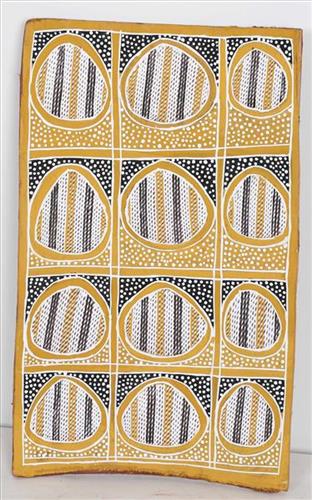
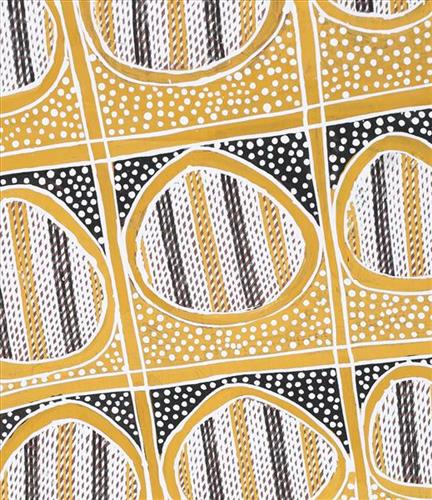
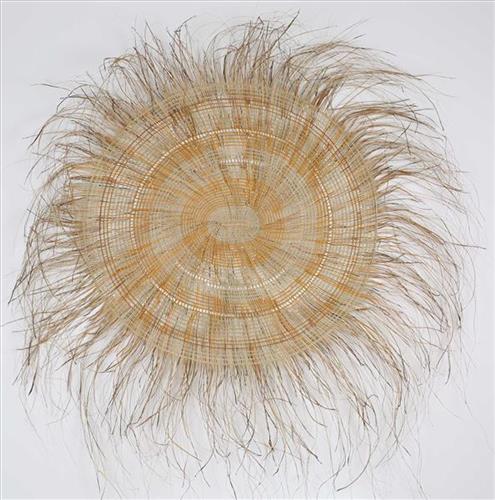
Mat

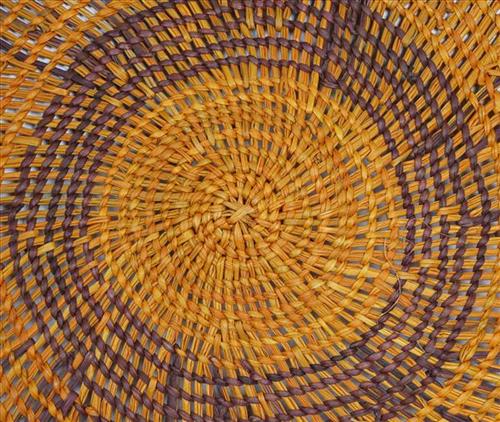
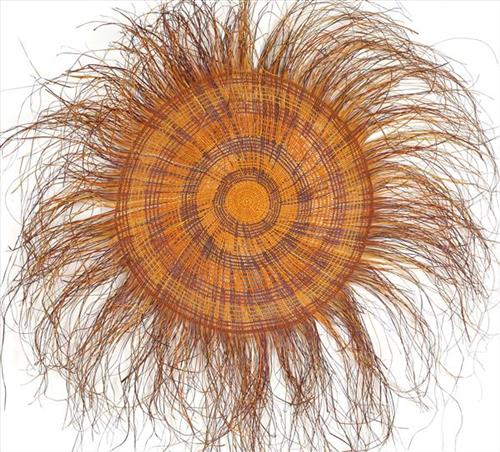
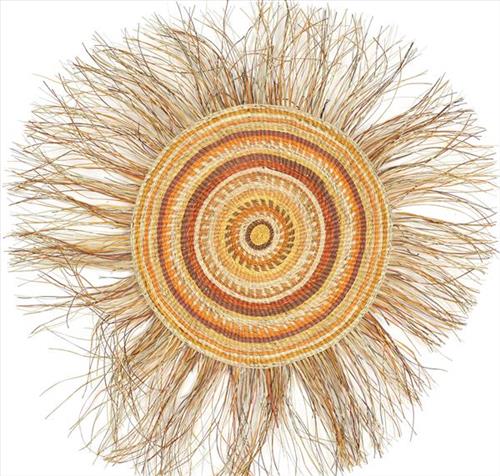
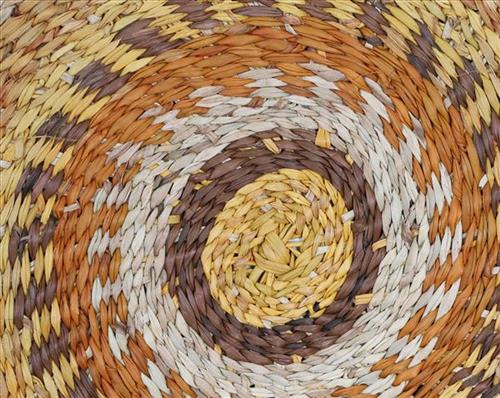
Mats can vary greatly. Artists commonly use a mix of naturally dyed and undyed fibre to create a striking variation of coloured bands. Some artists also incorporate different types of looping to produce different patterns and textured finishes. Each type of mat, fibre bag, basket and dilly bag has its own name in the various languages spoken in the Maningrida region.

111982120625


Mat

Mats can vary greatly. Artists commonly use a mix of naturally dyed and undyed fibre to create a striking variation of coloured bands. Some artists also incorporate different types of looping to produce different patterns and textured finishes. Each type of mat, fibre bag, basket and dilly bag has its own name in the various languages spoken in the Maningrida region.

111982120610


Mat

Mats can vary greatly. Artists commonly use a mix of naturally dyed and undyed fibre to create a striking variation of coloured bands. Some artists also incorporate different types of looping to produce different patterns and textured finishes. Each type of mat, fibre bag, basket and dilly bag has its own name in the various languages spoken in the Maningrida region.

111582120622


Home, Kaalpa

DESART PHOTOGRAPHY PRIZE

RETURNING UNSOLD WORKS (EDITION NUMBERS) TO ART CENTRES AND FUTURE SALES/PRINTING PROCEDURES

For each successful entry for the photography prize, Desart will print one photograph, to be catalogued as an AP (Artist’s Proof). This image will be framed and shown in the exhibition and then retained by Desart (catalogued on SAM for our ‘Collection’).

Desart manages sales for the first month of the exhibition. During this time, Desart will retain 30% of the public sale price to recoup framing, printing, freight and general exhibition costs. The artist will be paid 70% of the public price. Art Centres must invoice Desart for this.

Desart will create catalogue numbers on SAM for an edition of 10 works, but these 10 works will only be printed on demand if the image sells.

The works are priced so that they are part of a finite edition – that is, no more than 10 will ever be produced. It is essential that everyone honours even this after the exhibition to retain the integrity and value of the work as a limited edition. If the artist wishes to alter the image, they could potentially create a ‘second state’ to sell, but the original photograph is capped at an edition of 10 only.

After the first month, any unsold ‘works’ (which are actually catalogue numbers rather than physical works) are returned to the art centre for any future sales.

For this Desart will provide each art centre with a report of sales. The art centre will the need to catalogue these in their own system (SAM) using the remaining edition numbers.

Below is our contact (Richard at Darkstar) and all prints should be printed there, to the same specifications, in order to retain the integrity and identical nature of the edition of photographs.

darkstardigital.com.au

Richard Crampton: 0408 849 276

rcrampton@darkstardigital.com.au

Shop 3, 138 Botany Rd, Alexandria, NSW 2015

Images are sent by drop box including thumbnails and print size should be specified as A2, A3 or A4. For consistency the works need to be printed on white cotton rag paper. Printing costs can be found on the website:

http://darkstardigital.com.au/pricing/

Richard is prepared to send the works straight to the purchaser or back to the art centre but you will need to factor in packing and shipping costs (he will let you know how much). Sydney clients are often happy to go and pick the work up.