111982144907


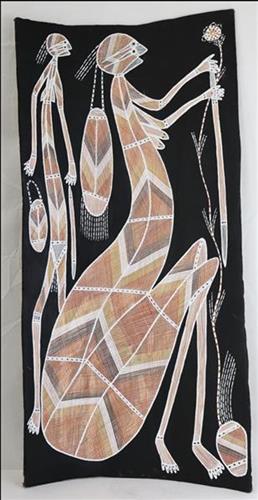
Mimih Spirit

The mimih spirit exists in a realm that runs parallel to and mirrors many facets of human life, also demonstrating the deep sense of time and place understood by Aboriginal and Torres Strait Islander people. Such spirits feature importantly in relation to Aboriginal spirituality, cosmology, social and moral tales as well as ritual. As is true with the multiple mediums employed by artists of West Arnhem Land, the development of artistic style and form is in line with an awareness by the artist that the work produced is predominantly made for a broader audience. Whether show in a national or international context these works communicate and exist in a particular space that is cross-cultural and simultaneously so particular to the Arnhem region.


The mimih sits within a complex and important pedagogical and religious body of knowledge which links Kuninjku people to their distinctive escarpment homelands. Young Kuninjku artists, or apprentices, employ the mimih as an important exercise for the practice of the rarrk technique, as it could be achieved on a smaller surface area before, being attempted in larger scale, on pieces of bark. The mimih serves a purpose for those young artists first learning to carve in a social space of sharing and innovating. The initial mimih manifestation was a large form that almost mirrored the anatomy of a human and at this stage the sculptures have been likened to morkuy carvings visible in eastern Arnhem Land. Contemporaneously, mimih are depicted in a refined, slender, even emaciated form with a broad range of facial expressions giving both individual character to, and denoting the potential volatility and humour that mimih spirits are notable for in their interaction with bininj (humans). The sculptures are frequently carved from the thin trunks of softwoods such as kapok (bombax ceiba or cottonwood) kurrajong, beach hibiscus or leichardt and are painted with earth pigments for their colouring and design.

A leading figure engaging the spirit in visual storytelling was Crusoe Kuningbal, a Kuninjku man, who while traveling was familiarised with carving styles from the east of Arnhem at the mission in Milingimbi pre-dating World War II. This showing a notable connection and interaction of different language groups across such space. As well as travel and the development of art forms being informed by cross cultural dialogues within northern Aboriginal language groups. The mimih became a valued inclusion in performance and public ceremony by Kuninjku people like Kuningbal. At times these ceremonies were performed for extended language groups in the local region.


Now a familiar and broadly depicted figure of iconography, it is important to acknowledge the development of this quite recent sculptural tradition. The depiction of this particular spirit being, once used as an addition to the sharing of song cycles and ceremony, has since been elevated to a prominent form and subject of contemporary sculpture. Variation in the creation of
mimih acts as an indication of the individualism of each artist and their stylistic markers. Additionally significant to note is that in the space of the past thirty years the mimih has begun being produced by multiple language groups residing in the Maningrida area including the traditional owners of Maningrida, the Ndjébbana, speaking Kunibidji as well as Gurrgoni people who have strong ties to Kuninjku.

________
*Maningrida Arts & Culture acknowledge the work of many academic and non-academic voices when writing on this topic, it is important to note Luke Taylor, who’s broad research has informed this text.

111582144921


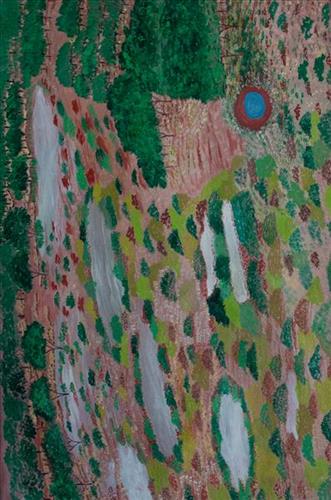
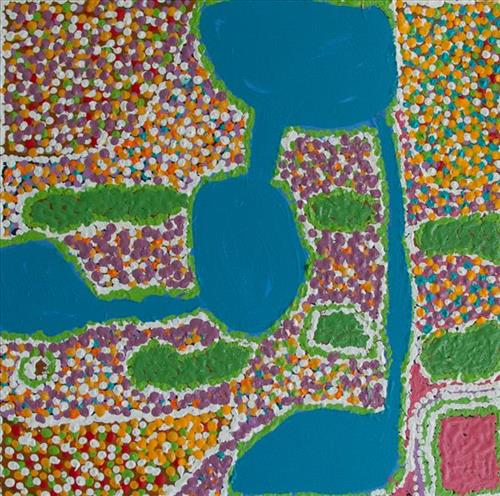
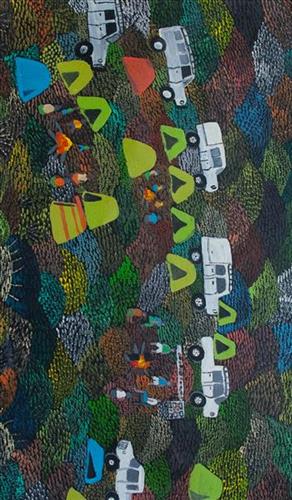
Ranger trip

“On the ranger trip we took all the kid and camped halfway. The kids and all of us enjoyed camped out in the bush”

-Noreen Kadibil, 2022.


This work portrays an area known intimately to the artist, painted here in exquisite detail from memory. During the pujiman (traditional, desert dwelling) era one’s survival depended on their intimate knowledge of the location of resources; thus physical elements of Country, such as sources of kapi (water), tali (sandhills), and different varieties of warta (trees, vegetation) were carefully observed and remembered. Today, this relationship with Country remains equally strong, despite the movement of Martu out of the desert and into remote Aboriginal Communities, towns and cities.

Also visible may be traces of life cycles based around kalyu (rain, water) and waru (fire). A thousands of year old practice, fire burning continues to be carried out as both an aid for hunting and a means of land management today. As the Martu travelled and hunted they would burn tracts of land, ensuring plant and animal biodiversity and reducing the risk of unmanageable, spontaneous bush fires. The patchwork nature of regrowth is visible in many landscape works, with each of the five distinctive phases of fire burning visually described with respect to the cycle of burning and regrowth.  

Finally, metaphysical information relating to a location may also be recorded; Jukurrpa (Dreaming) narratives chronicle the creation of physical landmarks, and can be referenced through depictions of ceremonial sites, songlines, and markers left in the land. 

111582144919


Ranger trip

“We took all of the school kids on the Ranger trip to Jural-Jural rockhole, and made camp halfway down the track. The principle came as well [a] couple teachers. Then next morning [we] took the kids to Kurnajirrpi. Murphy, Sonia and the principle dug the soak out, the the water came out”

-Noreena Kadibil, 2022.


This work portrays an area known intimately to the artist, painted here in exquisite detail from memory. During the pujiman (traditional, desert dwelling) era one’s survival depended on their intimate knowledge of the location of resources; thus physical elements of Country, such as sources of kapi (water), tali (sandhills), and different varieties of warta (trees, vegetation) were carefully observed and remembered. Today, this relationship with Country remains equally strong, despite the movement of Martu out of the desert and into remote Aboriginal Communities, towns and cities.

Also visible may be traces of life cycles based around kalyu (rain, water) and waru (fire). A thousands of year old practice, fire burning continues to be carried out as both an aid for hunting and a means of land management today. As the Martu travelled and hunted they would burn tracts of land, ensuring plant and animal biodiversity and reducing the risk of unmanageable, spontaneous bush fires. The patchwork nature of regrowth is visible in many landscape works, with each of the five distinctive phases of fire burning visually described with respect to the cycle of burning and regrowth.  

Finally, metaphysical information relating to a location may also be recorded; Jukurrpa (Dreaming) narratives chronicle the creation of physical landmarks, and can be referenced through depictions of ceremonial sites, songlines, and markers left in the land. 

377810582145005


Kunmadj

Kunmadj is the Kuninjku term for large woven collecting baskets, known as dillybags.

They are often made from the burney vine (Malaisia scandens), a strong, pliable plant that grows along the ground and into the canopy of monsoon vine thickets. The baskets are used to collect a variety of heavy foods, such as fish caught in conical fish traps or a good harvest of yams. As well as being of practical use, dillybags are of cultural significance to Arnhem Land people. Dillybags are totemic objects and they are associated with particular sites in the landscape.

377810582145001


Gurrpurdu (Diving Bird)

A design by emerging textile designer, Charmaine Pascoe.

‘My Gurrpurdu (diving bird) was white. She flew from Gan Gan to Gapuwiyak and then to Yathalamarra. And then she flew to Gartji.

At Gartji two fresh water seaweed shoots, one long and one short were trying to keep diving bird down. They were saying, “Don’t go away you belong to this country”.  Diving bird said “No! I’m going to travel around to other country”.  She was flapping her wings and then those two seaweed shoots let her go.

Then diving bird flew to make water hole at Gamurra Gu-yurra. She tasted the water but it was salty not fresh water. Then she put her poo like white clay on the ground at Gamurra Gu-yurra. The while clay was used for painting, funerals and ceremonies.

Then she continued to fly to Ji-balbal where she put the white clay again and then from Ji-balbal she dived underwater to Gochan Jiny-jirra. When she got there she got out of the water and was flapping her wings. At the same time she was singing. She was using her wings to dry out so that she could fly to Nangak.’ Charmaine Pascoe 2020

111982144992


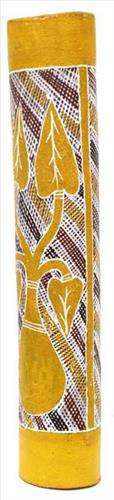
Lorrkon (Hollow Log)

The Lorrkon or bone pole coffin ceremony was the final ceremony in a sequence of mortuary rituals celebrated by the people of Arnhem Land. This ceremony involves the placing of the deceased’s bones into a hollow log which was decorated with painted clan designs and ceremonially placed into the ground where it remained until it slowly decayed over many years.

The log is made from a termite hollowed Stringybark tree (Eucalyptus tetradonta) and is decorated with totemic emblems. The western Arnhem Land version of the Lorrkon ceremony involves the singing of sacred songs to the accompaniment of karlikarli, a pair of sacred boomerangs used as rhythm instruments. During the final evening of the ceremony, dancers decorate themselves with kapok down, or today, cotton wool and conduct much of the final segments of the ceremony in the secrecy of a restricted mens’ camp. The complete ceremony may stretch over a period of two weeks, but on the last night the bones of the deceased, which have been kept in a bark container or today wrapped in cloth and kept in a suitcase are taken out, are painted with red ochre and placed inside the hollow log. This ceremony may take place many years after the person has died.

At first light on the final morning of the Lorrkon ceremony, the men appear, coming out of their secret bush camp carrying the pole towards the women’s camp. The two groups call to each other using distinct ceremonial calls. The women have prepared a hole for the pole to be placed into and when it is stood upright, women in particular kinship relationships to the deceased dance around the pole in a jumping/shuffling motion. The Lorrkon is then often covered with a tarpaulin and left to slowly decay.

111982144976


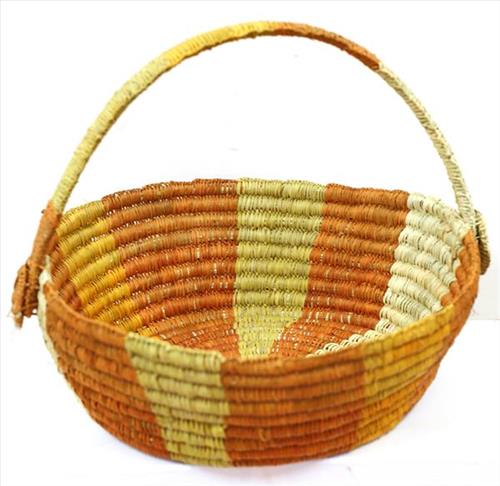
Coil Basket

Coiling technique was introduced in the 1920s at Goulburn Island to the Maung people by missionaries and quickly spread to the mainland. Many artists produce coiled baskets of varied shapes, ranging from small round baskets to large oval baby baskets made from dyed pandanus. Artists combine colours and patterns to obtain intricate new graphic patterns.

111582144922


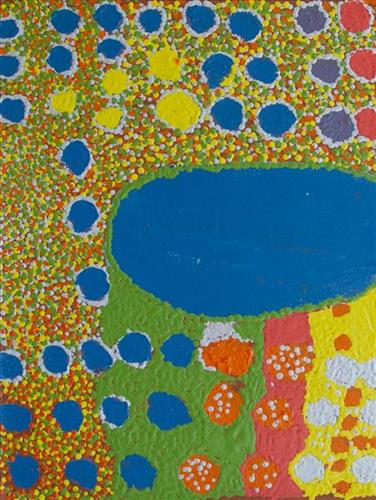
Wantili (Warntili, Canning Stock Route Well 25)

“That’s my jamu (grandfather) and nanna’s Country. I always go on a ranger trip there with my mum, Thelma Judson and my little baby brothers, Junior and Jamie Rowlands.”

– Lynette Rowlands

Wantili (Warntili, Canning Stock Route Well 25) is a large round jurnu (soak) and linyji (claypan) near Well 25 on the Canning Stock Route. The area is dominated by claypans surrounded by tuwa (sandhills), and Nyilangkurr, a prominent yapu (hill) is located on the edge of the claypan. Following rain the typically dry claypans are filled with water, with the overflow from nearby waterholes flowing to Wantili. At that time, Wantili becomes an important place for obtaining fresh water for drinking and bathing. Wantili is significant for the fact that at this site Kartujarra, Manyjilyjarra, Putijarra and Warnman people would all come together for ceremonies during the pujiman (traditional, desert dwelling) era. Many jiwa (stones used by women for grinding seeds) from these times can still be found there today. 

Wantili is an incredibly important cultural site, ‘where the creation started.’ (Cyril Whyoulter). In this creation story, the world was initially dark, and people were like rocks, with no arms or legs. Following the sun’s first rising, life-forms become increasingly complex while particular features in the land were created. Beyond these details much of the Jukurrpa (Dreaming) narrative relating to Wantili is ngurlu (sacred, taboo), and only for Martu, but the site is open, and anyone can go there. 

Wantili is also one of the many sites featured in the epic Minyipuru (Jakulyukulyu, Seven Sisters) Jukurrpa story. Minyipuru is a central Jukurrpa narrative for Martu, Ngaanyatjarra, Pitjantjatjara and Yankunytjatjara people that is associated with the seasonal Pleiades star constellation. Relayed in song, dance, stories and paintings, Minyipuru serves as a creation narrative, a source of information relating to the physical properties of the land, and an embodiment of Aboriginal cultural laws. The story follows the movement of a group of women travelling all the way across the desert, beginning at Roebourne on the coast of Western Australia, as they are pursued by Yurla, a lustful old man. As the women travelled, they stopped to rest at many sites to eat, dance, rest and sing, on the way leaving behind an assortment of articles that became formations in the land, such as groupings of rocks and trees, grinding stones and seeds. The sisters rested at Wantili before throwing seeds, then continued their journey far to the east and beyond Martu Country, stopping at various sites through central and South Australia.

The intersection of the Canning Stock Route with Wantili also made this a site of early contact with Europeans for many Martu then living a pujiman life in the desert. Following the route’s construction, Martu encountered Europeans and other Martu working as cattle drovers as they would travel up and down the Stock Route from water source to water source. Increasingly, pujimanpa (desert dwellers) followed the route to newly established ration depots, mission and pastoral stations. They were drawn to the route in search of food, by a sense of curiosity, or by loneliness. By the late 1950s and early 1960s, most of the desert family groups had left the desert. Eventually, these factors combined with an extreme and prolonged drought in the 1960s to prompt the few remaining pujimanpa to move in from the desert.

111582144918


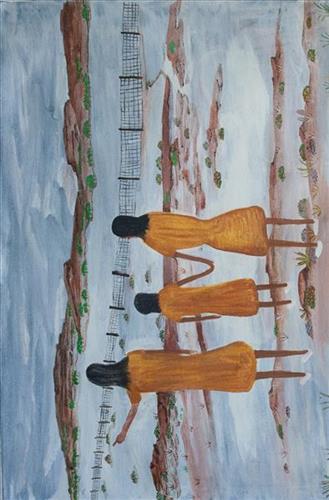
Rabbit Proof Fence

“My mother is Daisy Kadibil. She was one of the sisters who walked along the Rabbit Proof Fence. At Jigalong one day, the old people, the mothers were getting their rations. The kids were playing around and Daisy saw a car come, and it took off with the kids. A man in the car was chasing them and took them to the mission at Moore River. They were taken to the mission by the government.

The girls were placed with other mutta mutta children (children of mixed descent) who had all been taken away from their families. [At the mission there was] a girls’ dormitory, church and staff houses. The gum trees around the mission were really big trees. They are different to the rest of the country.

Their mum and dad used to say if they take you away you know what to do- follow the Rabbit Proof Fence back. So that’s what they did. My Mum and Aunty walked from Moore River settlement, following the Rabbit Proof Fence. They were heading back to Jigalong. My other Aunty Gracie got picked up in Magnet and taken back to Moore River Settlement, so it was only two of them going back home. Back in Old Jigalong the three mothers were running to meet the two daughters who made it all the way back. 

After she came home to Jigalong my mother got married. She had my two sisters, brother and me. It’s important for me and for my younger generation to know about it. How mum walked back from where she was taken away to, so my grandkids from generation to generation can know how she survived and found her way back.”

– Noreena Kadibil 

In 1931 sisters Molly Craig, Daisy Kadibil and Gracie Fields were taken from their families, like many other Aboriginal children at that time, and transported to Moore River Native Settlement, north of Perth. They were taken away in the belief that part-Aboriginal children should be trained as domestic servants. 

The three girls escaped the next day and, incredibly, walked 1600 kilometres home to Jigalong using the Rabbit-Proof Fence to navigate. The Rabbit Proof Fence remains the world’s longest fence, and was built in the early 1900s to separate rabbits from pasture. For nine weeks, the girls followed its length in order to be reunited with their family. They crossed a flooded river, sand dunes, heathlands, wheatbelts and plains, claypans and salt lakes. They slept in dug-out rabbit burrows, and caught and cooked rabbits, along with other plant based bush tucker. For the duration of their journey they were pursued by policeman and an Aboriginal police tracker.

The girls’ story has been immortalised in the novel “Follow the Rabbit-Proof Fence” by Doris Pilkington (Nugi Garimara, 1996), and was adapted into the film “Rabbit Proof Fence” (2002). This story retains special significance for the Martu, and in particular those inhabitants of Jigalong Aboriginal community. The three girls were Martu, and their children and grandchildren, including Noreena and her family, continue to live in the Martu homelands today.

111582144916


Wantili (Warntili, Canning Stock Route Well 25)

“That’s my jamu (grandfather) and nanna’s Country. I always go on a ranger trip there with my mum, Thelma Judson and my little baby brothers, Junior and Jamie Rowlands.”

– Lynette Rowlands

Wantili (Warntili, Canning Stock Route Well 25) is a large round jurnu (soak) and linyji (claypan) near Well 25 on the Canning Stock Route. The area is dominated by claypans surrounded by tuwa (sandhills), and Nyilangkurr, a prominent yapu (hill) is located on the edge of the claypan. Following rain the typically dry claypans are filled with water, with the overflow from nearby waterholes flowing to Wantili. At that time, Wantili becomes an important place for obtaining fresh water for drinking and bathing. Wantili is significant for the fact that at this site Kartujarra, Manyjilyjarra, Putijarra and Warnman people would all come together for ceremonies during the pujiman (traditional, desert dwelling) era. Many jiwa (stones used by women for grinding seeds) from these times can still be found there today. 

Wantili is an incredibly important cultural site, ‘where the creation started.’ (Cyril Whyoulter). In this creation story, the world was initially dark, and people were like rocks, with no arms or legs. Following the sun’s first rising, life-forms become increasingly complex while particular features in the land were created. Beyond these details much of the Jukurrpa (Dreaming) narrative relating to Wantili is ngurlu (sacred, taboo), and only for Martu, but the site is open, and anyone can go there. 

Wantili is also one of the many sites featured in the epic Minyipuru (Jakulyukulyu, Seven Sisters) Jukurrpa story. Minyipuru is a central Jukurrpa narrative for Martu, Ngaanyatjarra, Pitjantjatjara and Yankunytjatjara people that is associated with the seasonal Pleiades star constellation. Relayed in song, dance, stories and paintings, Minyipuru serves as a creation narrative, a source of information relating to the physical properties of the land, and an embodiment of Aboriginal cultural laws. The story follows the movement of a group of women travelling all the way across the desert, beginning at Roebourne on the coast of Western Australia, as they are pursued by Yurla, a lustful old man. As the women travelled, they stopped to rest at many sites to eat, dance, rest and sing, on the way leaving behind an assortment of articles that became formations in the land, such as groupings of rocks and trees, grinding stones and seeds. The sisters rested at Wantili before throwing seeds, then continued their journey far to the east and beyond Martu Country, stopping at various sites through central and South Australia.

The intersection of the Canning Stock Route with Wantili also made this a site of early contact with Europeans for many Martu then living a pujiman life in the desert. Following the route’s construction, Martu encountered Europeans and other Martu working as cattle drovers as they would travel up and down the Stock Route from water source to water source. Increasingly, pujimanpa (desert dwellers) followed the route to newly established ration depots, mission and pastoral stations. They were drawn to the route in search of food, by a sense of curiosity, or by loneliness. By the late 1950s and early 1960s, most of the desert family groups had left the desert. Eventually, these factors combined with an extreme and prolonged drought in the 1960s to prompt the few remaining pujimanpa to move in from the desert.