377810582137314


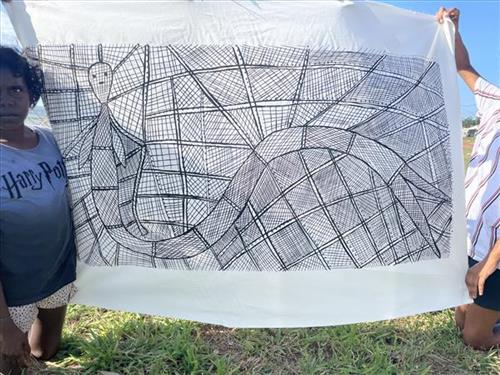
Yawkyawk in Stone Country

Yawkyawk is a word from the Aboriginal Kunwinjku/Kunwok language, meaning ‘young woman’ and ‘young woman spirit being’.

Sometimes compared to the European notion of mermaids, yawkyawks are usually depicted with the tails of fish. They have long hair, associated with trailing blooms of algae, typically found in Arnhem Land streams and rock pools. There can be wet season yawkyawk and dry season yawkyawk. It is said that when men go out hunting, they sometimes hear the song of the yawkyawk and become confused, loosing their way back to country.


111982137295


Burlupurr – large dillybag

Burlupurr, or dilly bag, is a large woven collecting basket. These large bags are often made from the vine ‘Malasia scandens’, a strong pliable plant which grows along the floor and into the canopy of monsoon vine thickets. The bags are used to collect any kind of large numbers of heavy foods such as fish caught in conical fish traps or large collections of yams.

They can also be made from Pandanus spiralis, a plant which grows in many areas of Arnhem Land. These dilly bags are a tightly woven collecting basket, very finely made. These dilly bags are often used to collect sugarbag, the native honey 

As well as being of practical use, dilly bags are also of religious significance to Arnhem Land people. Dilly bags are said to be totemic objects and associated with particular sites in the landscape.

111982137291


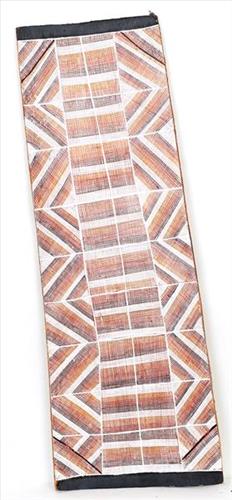
Wak Wak

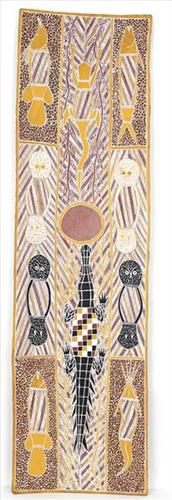
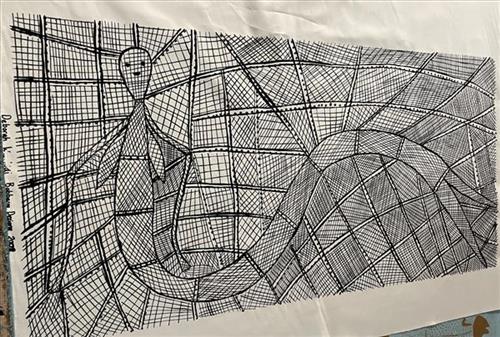
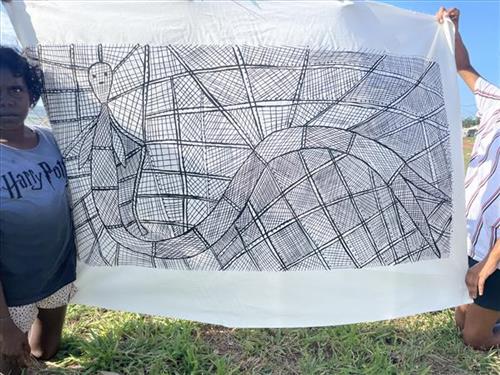
This painting depicts a sacred site at ‘Kurrurldul’, an outstation south of Maningrida.

The ‘rarrk’, or abstract crosshatching, on this work represents the design for the crow totem ancestor called ‘Djimarr’. Today this being exists in the form of a rock, which is permanently submerged at the bottom of Kurrurldul Creek. The ‘Djimarr’ rock in the stream at Kurrurldul is said to move around and call out in a soft hooting tone at night. Both the stone itself and the area around it are considered sacred.

The imagery represents the rock mentioned above at the bottom of Kurrurldul creek, which is the final transmutation of the dreaming ancestor ‘Djimarr’. Finally, the pattern used here is also the crow design used in the sacred ‘Mardayin’ ceremony, which is a large regional patri-moiety ceremony now rarely conducted in central and eastern Arnhem Land.

377810582137270


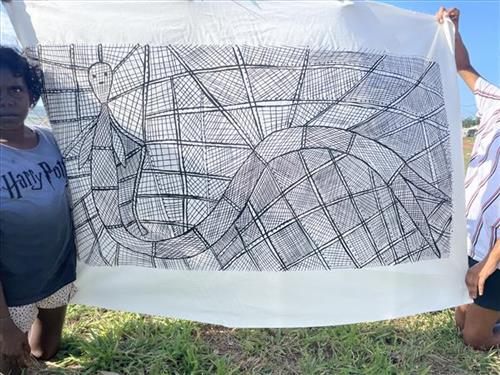
Yawkyawk in Stone Country

Yawkyawk is a word from the Aboriginal Kunwinjku/Kunwok language, meaning ‘young woman’ and ‘young woman spirit being’.

Sometimes compared to the European notion of mermaids, yawkyawks are usually depicted with the tails of fish. They have long hair, associated with trailing blooms of algae, typically found in Arnhem Land streams and rock pools. There can be wet season yawkyawk and dry season yawkyawk. It is said that when men go out hunting, they sometimes hear the song of the yawkyawk and become confused, loosing their way back to country.


377810582137266


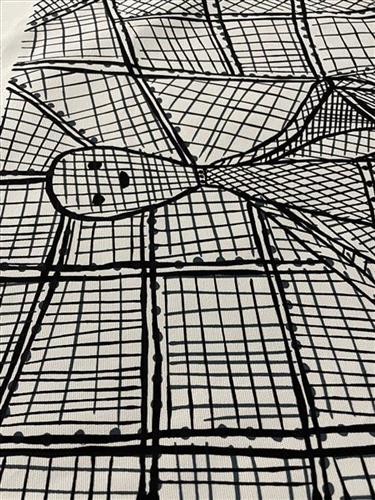
Yawkyawk in Stone Country

Yawkyawk is a word from the Aboriginal Kunwinjku/Kunwok language, meaning ‘young woman’ and ‘young woman spirit being’.

Sometimes compared to the European notion of mermaids, yawkyawks are usually depicted with the tails of fish. They have long hair, associated with trailing blooms of algae, typically found in Arnhem Land streams and rock pools. There can be wet season yawkyawk and dry season yawkyawk. It is said that when men go out hunting, they sometimes hear the song of the yawkyawk and become confused, loosing their way back to country.


377810582137277


Mandjabu

Kuninjku people traditionally make two sorts of conical fish traps. One is called mandjabu and is made from a strong, durable vine called milil, and a smaller one is called manylik mandjabu, and made from the grass manylik. The mandjabuconical fish trap is bigger and stronger and used in tidal reaches of creeks to catch large fish. The smaller, lighter manyliktrap is used in freshwater flowing creeks to catch smaller fish and freshwater prawns. In earlier times, only men were involved in the construction of the large fish traps, but children would often crawl inside and assist.

To make mandjabu, weavers firstly harvest milil (burney vine, Malaisia scandens) and put it in water overnight to make it soft. Then they start weaving it; they make rings for the inside to keep the fish trap’s shape. People also make string from the bark of burdaga (kurrajong) to attach the bardainy (hibiscus) rings and to tie the conical end of the fish trap. It’s hard work and it can take three or four weeks to make a fish trap. People also use fish-net fences called kunkarlewabe. They would put the kunkarlewabe  across rivers and creeks. In the middle they would place the mandjabu. They also used small things like sticks, rocks, mud and grass to block the fish from going through. This way we would catch fish such as saltwater barramundi rajarra, ngaldadmurrng (freshwater barramundi), small black freshwater catfish (buliya), bonefish (an-guwirrpiya), and sand bass (dalakan) in the mandjabu.

377810582137271


Rrugurrgurda (Mud Crab)

This design tells the story of Elizabeth’s homeland – a dreaming place, a good dreaming place with plentiful mud crabs. Elizabeth’s homeland lies east of Maningrida, at the mouth of Blyth river. This country is known for a large spiritual mud crab, which lives in the area.

Many families go and collect crabs to eat there with long sticks, or collect directly from the shores. Mud crabs hide in the muddy bottoms of estuaries and mangrove forests in areas surrounding Maningrida. After a king tide, a large cyclical tide that bring the crabs out from the mangroves, it is a good time to find crabs.

Rrugurrgurda (mud crabs) is pronounced Ahh-rewg-gurd-gurda in the Burarra language. Rrugurrgurda are good baladji (bush food in Burarra) and can be caught all year round. They are put on the fire to cook and they are ready when they turn a bright orange colour.

377810582137250


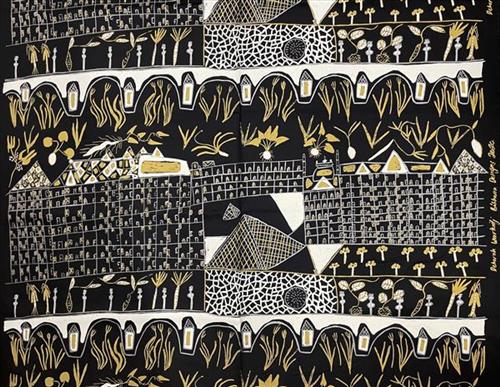
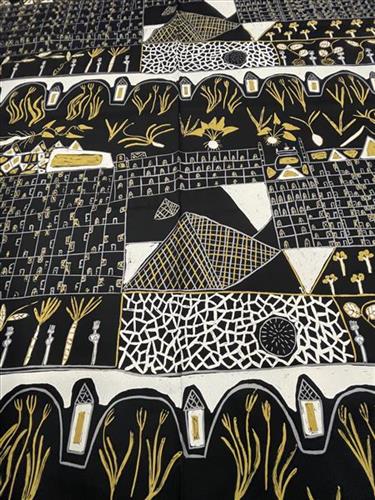
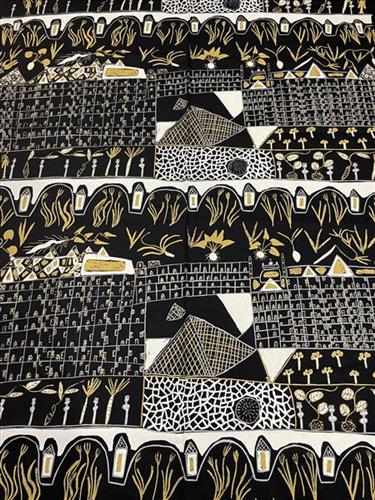
Kunred Kodbarre (The Louvre)

“This design is new and tells a different story of when I went to Paris. This building in the middle of my design is the Louvre. We went and saw that big building made of glass, and there were lots of people walking around. In Paris, there is a big creek made from bricks, with water flowing through the city. I have painted it here too, with the light poles next to it. There are so many tall buildings in Paris. When I see this design, I remember everything about my trip to Paris. For this design I had the idea of putting our Aboriginal bush tucker around the Louvre, so the plants here are kundayarr (pandanus), wayuk (water lily) and karrbarda (long yam). I painted some French trees too’.

In 2019 five artists from Babbarra Women’s Centre travelled to France for the opening of their exhibition Jarracharra: Dry Season Wind. Deborah Wurrkidj, Jennifer Wurrkidj, Janet Marawarr, Jacinta Lami Lami and Elizabeth Kala Kala danced at the opening of the exhibition to a packed embassy gallery, and hosted various public panels including at the Musee du Quai Branly. The artists featured in Vogue magazine, wearing garments featuring their own printed designs on the balcony of the Ambassador to France, with a panoramic view of the Eiffel Tower in the background.

Inspired by the same voyage, on return to Maningrida Deborah Wurrkidj wove a sculpture of the Eiffel Tower out of naturally dyed pandanus, titled Ngaye ngawam nganang kunred  kukimukken, kubba nakornamkuyeng karri (I travelled a long way away, to that place with the tall tower). The work was a finalist in the prestigious 2020 Telstra National Aboriginal & Torres Strait Islander Art Awards (NATSIAA).

377810582136991


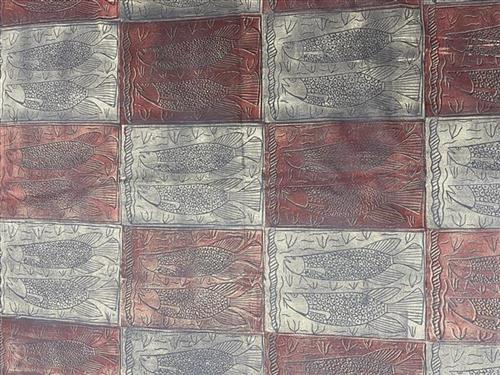
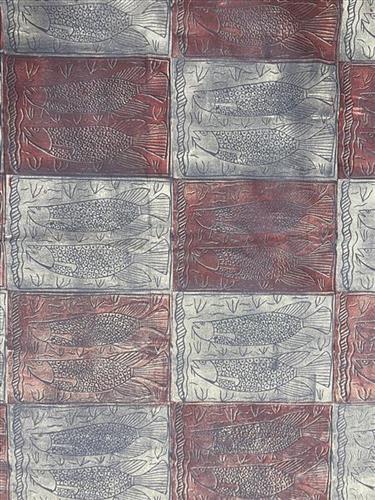
Ngaldadmurrng (Saratoga)

This design tells the story of Saratoga dreaming,  a freshwater fish that swims on the edge of creeks and rivers. This design is the Saratoga dreaming from the Mularra songline. Where the Saratoga we call Murdulngu, Danguny travelled from Malmyangarnak billabong to Mirrigatja.

This Billabong was owned by Murdulngu (Saratoga) before the water was taken over by shark Barlangu he came all the way from east to north then to west. He was travelling when that water level was high he went up the stream but he couldn’t make it. This Barlangu came from Murruggun clan but really this shark came from long way all the way south. This story is connected through Mularra songline it represents many clans.

With permission from clan elders, Carol is able to pass on this family knowledge through her passion in textile and art.


‘I am proud of my first design, I want to keep this design for future, for my children and grandchildren so they remember this story, this story is a big part of the mularra songline’ Carol Liyawanga Campion