Marrngunj
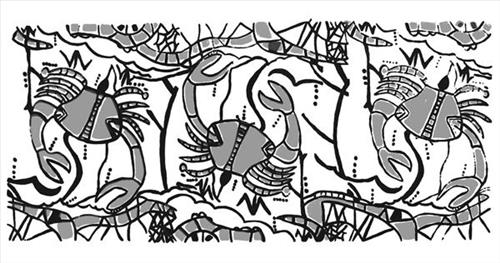
Marrngunj is the Kuninjku name for catfish. Catfish get their name from sensory barbels around the mouth which resemble a cat’s whiskers. Marrngunj specifically refers to the ‘eel-tailed’ catfish, a reference to its long tapering tail.

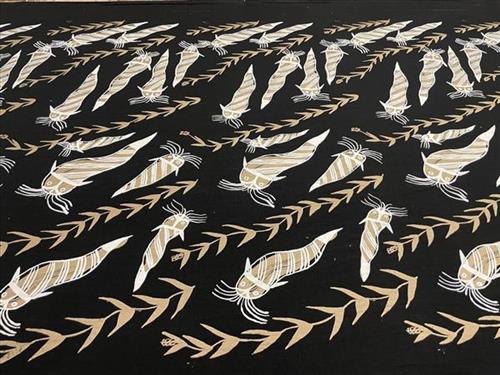
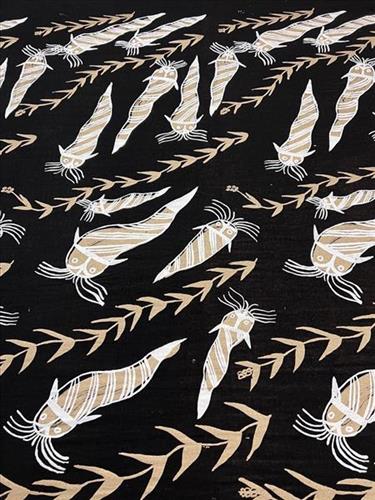
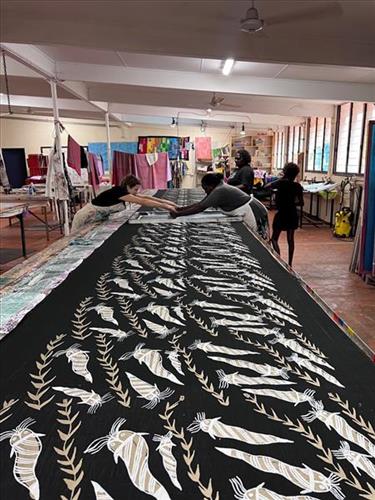
Marrngunj is the Kuninjku name for catfish. Catfish get their name from sensory barbels around the mouth which resemble a cat’s whiskers. Marrngunj specifically refers to the ‘eel-tailed’ catfish, a reference to its long tapering tail.

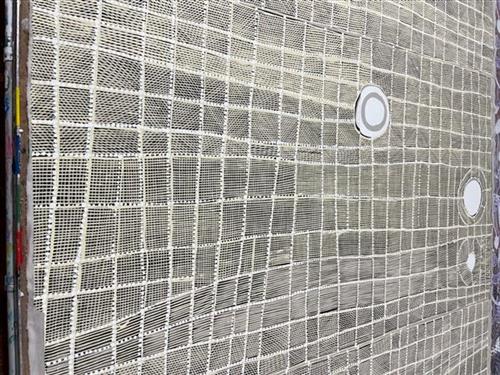
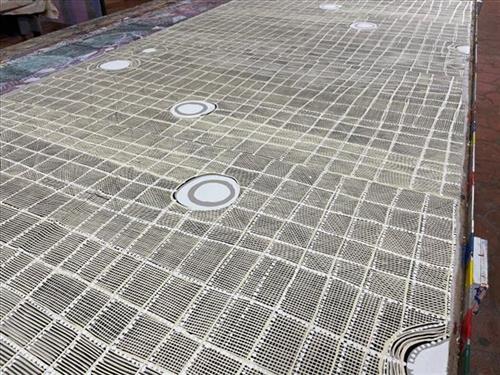
Before, a long time ago, when old people would die they would put their bones inside the lorrkkon and leave it outside. It is part of ceremony. The old people remembering and thinking about that person who passed away, there is lots of talking about where that lorrkkon needs to go.
My father, James Iyuna, taught me how to paint, to paint that rarrk. That memory is from him, he taught my sister Deborah and me. This story is from him, this design. When he was painting and drawing we would watch and we would learn.
Jennifer Wurrkidj
Jennifer is a Kuninjku artist from the Kurulk clan whose country lies around the outstation of Mumeka in central Arnhem Land. She has depicted lorrkkon (hollow-log coffin), kun-karninj (digging stick) and mandjabu (fishtrap) in this design.
The Lorrkkon or hollow-log coffin ceremony is the final ceremony in a sequence of mortuary rituals celebrated by the people of Arnhem Land. This ceremony might take place many years after the person has died, and involves the placing of the deceased’s bones into a hollow log that is decorated with painted clan designs and ceremonially placed into the ground where it slowly decays over many years.
The lorrkkon (hollow-log coffin) is made from the trunk of a termite-hollowed manbuluduk (stringybark tree, Eucalyptus tetradonta) and is decorated with totemic emblems. The western Arnhem Land version of the Lorrkkon ceremony involves the singing of sacred songs to the accompaniment of karlikarli, a pair of sacred boomerangs used as rhythm instruments. During the final evening of the ceremony, dancers decorate themselves with kapok down or, today, cotton wool, and conduct much of the final segments of the ceremony in the secrecy of a restricted men’s camp. The complete ceremony may stretch over a period of two weeks, but on the last night the bones of the deceased, which have been kept in a bark container, or today wrapped in cloth and kept in a suitcase, are taken out, and are painted with red ochre and placed inside the hollow-log coffin.
At first light on the final morning of the Lorrkkon ceremony, the men appear, coming out of their secret bush camp carrying the lorrkkon towards the women’s camp. The two groups call to each other using distinct ceremonial calls. The women have prepared a hole for the lorrkkon to be placed into, and when it is stood upright, women in particular kinship relationships to the deceased dance around the lorrkkon in a jumping/shuffling motion. It is then often covered with a tarpaulin and left to slowly decay.

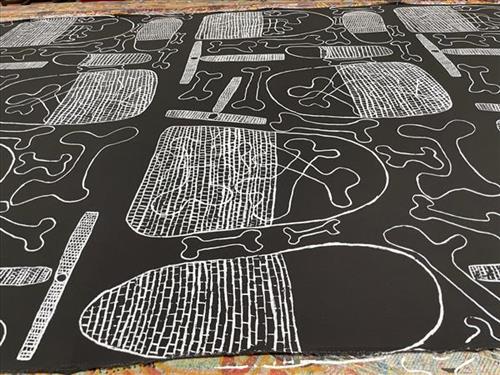
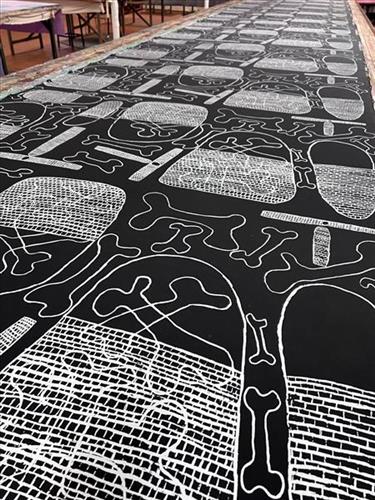
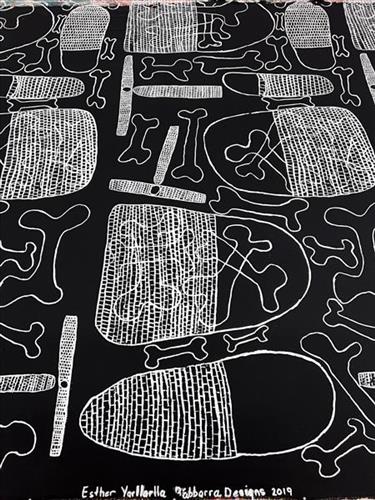
In Esther’s first screen design, she depicts the story of Mardarda (bones) and Njarlarla (fire sticks) carried in a dilly bag, reminiscent of traditional ways of the Ndjebenna people.
‘Back in the old days, our people would use a ‘bush lighter’ for lighting fires, which was two pieces of special wood which would make fire easily. The old people carried a dilly bag containing the fire stick all times, when they moved camps.
Old people would always carry dilly bags, sometimes with water, honey, food or bones of our deceased people.
When someone passed away their body would be put on a high platform built from eucalyptus and paperbark. They would use a firestick to light a fire under the platform, and people would sing and dance around that platform to send the deceased’s spirit back to his or her country.
The body would then be left here for many months. When ready, the clan would return to collect the bones to take them back to the deceased’s homeland for burial.
To travel to the homeland, people would paint the bones with brown ochre and place them in a dillybag. When they reached the deceased’s homeland, people would sing together, place the bones in the lorrkkon and to leave them rest forever.”

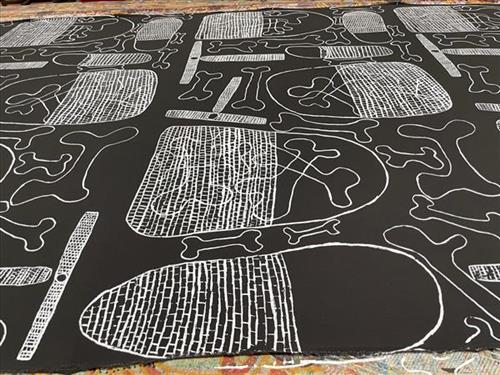
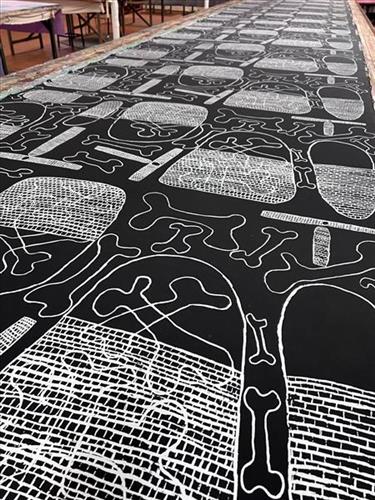
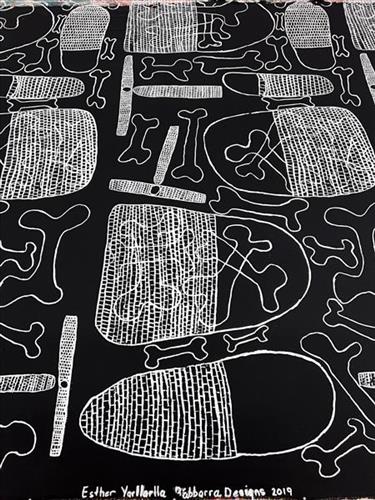
In Esther’s first screen design, she depicts the story of Mardarda (bones) and Njarlarla (fire sticks) carried in a dilly bag, reminiscent of traditional ways of the Ndjebenna people.
‘Back in the old days, our people would use a ‘bush lighter’ for lighting fires, which was two pieces of special wood which would make fire easily. The old people carried a dilly bag containing the fire stick all times, when they moved camps.
Old people would always carry dilly bags, sometimes with water, honey, food or bones of our deceased people.
When someone passed away their body would be put on a high platform built from eucalyptus and paperbark. They would use a firestick to light a fire under the platform, and people would sing and dance around that platform to send the deceased’s spirit back to his or her country.
The body would then be left here for many months. When ready, the clan would return to collect the bones to take them back to the deceased’s homeland for burial.
To travel to the homeland, people would paint the bones with brown ochre and place them in a dillybag. When they reached the deceased’s homeland, people would sing together, place the bones in the lorrkkon and to leave them rest forever.”

In Esther’s first screen design, she depicts the story of Mardarda (bones) and Njarlarla (fire sticks) carried in a dilly bag, reminiscent of traditional ways of the Ndjebenna people.
‘Back in the old days, our people would use a ‘bush lighter’ for lighting fires, which was two pieces of special wood which would make fire easily. The old people carried a dilly bag containing the fire stick all times, when they moved camps.
Old people would always carry dilly bags, sometimes with water, honey, food or bones of our deceased people.
When someone passed away their body would be put on a high platform built from eucalyptus and paperbark. They would use a firestick to light a fire under the platform, and people would sing and dance around that platform to send the deceased’s spirit back to his or her country.
The body would then be left here for many months. When ready, the clan would return to collect the bones to take them back to the deceased’s homeland for burial.
To travel to the homeland, people would paint the bones with brown ochre and place them in a dillybag. When they reached the deceased’s homeland, people would sing together, place the bones in the lorrkkon and to leave them rest forever.”