111582175479


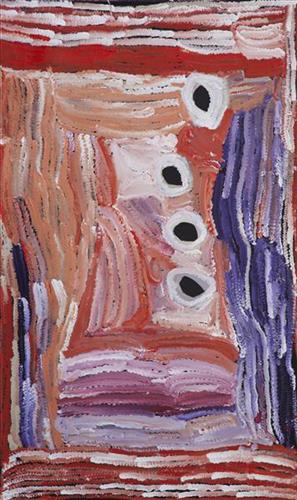
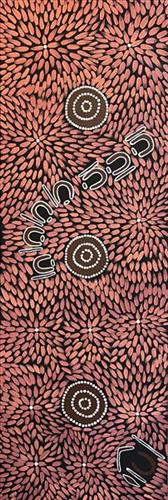
Bush Foods Camp

Depicted in this work are traditional types of bush tucker, their habitats, and their related hunting and gathering methods. During the pujiman (traditional, desert dwelling) period, Martu would traverse very large distances annually in small family groups, moving seasonally from water source to water source, and hunting and gathering bush tucker as they went. Whilst desert life has moved away from mobile hunter-gatherer subsistence throughout the course of the twentieth century, bush tucker continues to be a significant component of the modern Martu diet. Hunting and gathering bush tucker remains equally valuable as an important cultural practice that is passed on intergenerationally. Though hunting and gathering implements have been modernised, methods of harvesting, tracking and the use of fire burning to drive animals from their retreats are still commonly practiced today. 

Typically, animals hunted for their kuwiyi (meat) include kirti-kirti (euro kangaroo) and marlu (plains kangaroo), parnajarrpa (sand goanna), kipara (Australian bustard, bush turkey) and karlaya (emu). Lunki (witchetty grub) and wuukurta (honey ants) are dug from tree and bush trunks, or from underground nests. Popular mayi (plant food) includes minyarra (bush onion), collected from small, grass like plants; root vegetables dug from underground such as kulyu and mata (types of bush potato); and seeds such as kalaru (samphire, salt bush), yuwinyji, and marnkalpa (spinifex species). Jawirli (quondong), wamurla (bush tomatoes), jinyjiwirrily (wild gooseberry), ngaputa (melon), and karlkula (bush banana) are some of the most popular bush fruits. These are often collected in the wantajarra (cool season) and tuulpara (spring) months, along with juri (sweet) botanical gums and wama (nectar), obtained from various plant species. 

Traditional tools used for hunting and gathering bush tucker were carved from wanari (mulga), mulunturu (desert oak), yurungkura (river red gum) and mijarrpa (bloodwoods), and included kurlata (spears), jurna (hitting stick), karli (boomerangs), wana (digging-sticks), piti (timber bowls used for carrying food and water), and jiwa (grinding stones for grinding seeds into flour). While carved objects retain enormous social and ceremonial importance in Martu life, they are no longer used for hunting and gathering.

111582175473


Jarntinti- Nyanjilpayi Nancy Chapman

“I, me, Nyanjilpayi paint this one, Jarntinti Lake. I been born there, mine. I been little girl born there, Jarntinti area.  

Jarntinti big claypan near Punmu. Tarlpa, Jutupa, Wawulpa, all waterhole and yinta (permanent spring) in Jarntinti area. Long time [ago] plenty bush tucker there, yukuri (green grass, vegetation) everywhere, plenty kalaru (Samphire, salt bush). You can find him biggest mob there. You got to get that kalaru, grind it and make a damper. Get him up and wash him, wash him, wash him then grind him into flour for a damper. 

No kalaru today, no bush tucker, nothing. I don’t know [why]. Bush tucker nothing now, he never grow there anymore. Jarntinti everywhere clean water today, big rain there. I don’t know why no bush tucker now. I don’t know what’s wrong”.  

– Nyanjilpayi (Ngarnjapayi) Nancy Chapman


“When I was born, my spirit appeared at Jarntinti. I was born at the waterhole called Jarntinti. That’s my Country, Jarntinti. I know all about it, about that water over there, about my home, our grandparent’s Country. We travelled all around as pujiman (traditional, desert dwelling), camping and then setting off again by foot. My family’s water, my grandmother’s, my grandfathers and my ancestors. I was taught from them. Our knowledge is ancient and has been passed on by our grandparents.”

– Nyanjilpayi Nancy Chapman, as translated by Kanyirninpa Jukurrpa


Jarntinti is a large claypan at the Southern end of Nyayartakujarra (Lake Dora), a large salt lake surrounded by tali (sand hills) within the Karlamilyi (Rudall River) region. This area is Nyanjilpayi’s birthplace; her ngurra (home Country, camp). Jarntinti formed part of the region which Nyanjilpayi traversed extensively as a young girl. During the pujiman era, Jarntinti was primarily used as a camping site in the wantajarra (wet season), when the claypan filled with kapi (water).

As related by Nyanjilpayi, an abundance of bush tucker could be found at Jarntinti. During the pujiman period, Martu would traverse very large distances annually in small family groups, moving seasonally from water source to water source, and hunting and gathering bush tucker as they went. Whilst desert life has moved away from mobile hunter-gatherer subsistence throughout the course of the twentieth century, bush tucker continues to be a significant component of the modern Martu diet. Hunting and gathering bush tucker remains equally valuable as an important cultural practice that is passed on intergenerationally.

111582175471


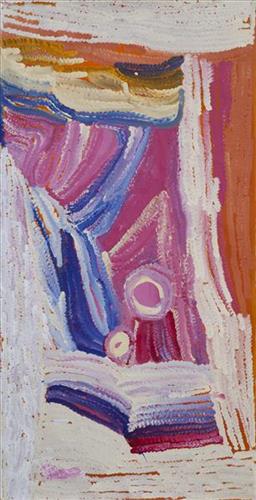
Matakurlu

Matakurlu is a soak located between Punmu Aboriginal community and the Percival Lakes region of Western Australia’s Great Sandy Desert. Matakurlu features as a site in both the Minyipuru (Jakulyukulyu, Seven Sisters) and Wati Kujarra (Two Goanna Men) Jukurrpa (Dreaming) narratives.

Minyipuru is a central Jukurrpa narrative for Martu, Ngaanyatjarra, Pitjantjatjara and Yankunytjatjara people that is associated with the seasonal Pleiades star constellation. Beginning in Roebourne on the west coast of Western Australia, the story morphs in its movement eastward across the land, following a group of women as they walk, dance, and even fly from waterhole to waterhole. As they travel the women camp, sing, wash, dance and gather food, leaving markers in the landscape and creating landforms that remain to this day, such as groupings of rocks and trees, grinding stones and seeds. During the entirety of their journey the women are pursued by a lustful old man, Yurla, although interactions with other animals, groups of men, and spirit beings are also chronicled in the narrative.

Wati Kujarra is an equally important Martu Jukurrpa narrative. The Wati Kujarra existed as half men, half goanna. They were responsible for the creation of many land features in Martu Country and beyond as they travelled, hunted and burned Country together. Wati Kujarra is a ngurlu (sacred, taboo) men’s story, and for this reason much of the content is only shared with initiated men.

During the pujiman (traditional, desert dwelling) period, Martu would traverse very large distances annually in small family groups, moving seasonally from water source to water source, and hunting and gathering bush tucker as they went. At this time knowledge of water sources was critical for survival, and today Martu Country is still defined in terms of the location and type of water. Each of the hundreds of claypans, rockholes, waterholes, soaks and springs found in the Martu desert homelands is known by name, location, quality and seasonal availability through real life experience and the recounting of Jukurrpa narratives.

111582175456


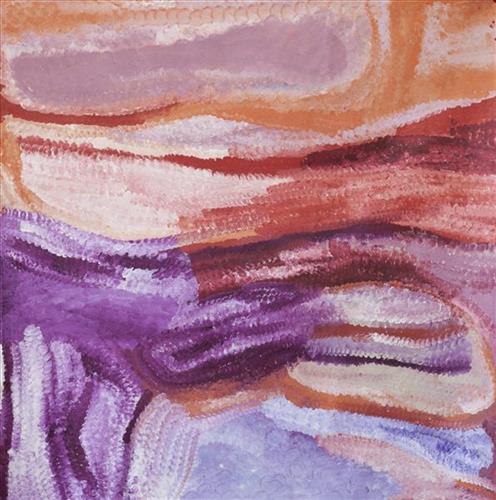
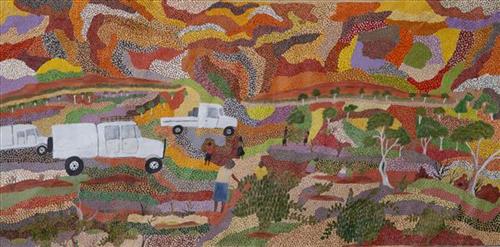
Wantili (Warntili, Canning Stock Route Well 25)

“Bugai always tells about Wantili (Warntili, Canning Stock Route Well 25) because she grew up around Wantili. Her family would travel between Wantili, Kaalpa, Juntu-juntu, Raarki, and Wuranu Wells along the Canning Stock Route. She paints around Wantili. She saw whitefellas there for the first time, Canning mob when they were travelling up and down the stock route with the bullock. She was a young girl walking around at Wantili. Big mob of people they been walking around there. Canning and his drovers were travelling, making the road. They were running away from those whitefellas, watching them from a long distance. She was a teenager when she was travelling around there with her four mothers and one daddy. They used to travel around in family groups, Bugai and Jakayu [Biljabu], and Jakayu’s nyupa (partner) Phillip Biljabu.” 

– Bugai Whyoulter, as translated by her grandson, Cyril Whyoulter


“I was just becoming a teenager, still travelling around with my mother and father. We were at Juntu-juntu, Wuranu, Raarki, Tiwa and Wantili. At Wantili we killed a cow, they were bringing cattle through from Kunawarritji … Wantili was a good place to make yakapiri (woven bark sandals).”

– Bugai Whyoulter as translated by Ngalangka Nola Taylor


Wantili, which forms the focus of much of Bugai’s work, is a large round jurnu (soak) and linyji (claypan) near Well 25 on the Canning Stock Route. The Wantili region is dominated by claypans surrounded by tuwa (sandhills), and Nyilangkurr, a prominent yapu (hill) is located close to the eastern edge of the claypan. Following rain the typically dry claypans are filled with water, with the overflow from nearby waterholes flowing to Wantili. At that time, Wantili becomes an important place for obtaining fresh water for drinking and bathing. Wantili is significant for the fact that at this site Kartujarra, Manyjilyjarra, Putijarra and Warnman people would all come together for ceremonies during the pujiman (traditional, desert dwelling) era. Many jiwa (stones used by women for grinding seeds) from these times can still be found there today.

Wantili lies within Bugai’s ngurra (home Country, camp). As described in her account, Wantili was one of the sites she knew intimately and travelled extensively with her family and other family groups during the pujiman period. At this time, Martu would traverse very large distances annually, moving seasonally from water source to water source, and hunting and gathering bush tucker as they went. Knowledge of water sources was critical for survival, and today Martu Country is still defined in terms of the location and type of water. Each of the hundreds of claypans, rockholes, waterholes, soaks and springs found in the Martu desert homelands is known by name, location, quality and seasonal availability through real life experience and the recounting of Jukurrpa (Dreaming) narratives. 

Wantili is also especially significant to Bugai as it was here that she saw whitefellas for the first time; drovers with their cattle travelling along the Canning Stock Route. The establishment of the route by Alfred Canning and his team in 1910 resulted in first contact with Europeans for many Martu, including Bugai and her family, then living a pujiman life in the desert. Encounters occurred between Martu, Europeans, and other Martu working as cattle drovers as they travelled and down the Stock Route from water source to water source. Increasingly, Martu followed the route to newly established ration depots, mission and pastoral stations. They were drawn to the route in search of food, by a sense of curiosity, or by loneliness. By the late 1950s and early 1960s, most of the desert family groups had left the desert. Eventually, these factors combined with an extreme and prolonged drought in the 1960s to prompt the few remaining pujiman to move in from the desert. Bugai returned to the Wantili area as a young woman, when she herself drove cattle along the Stock Route.

Culturally, Wantili is an incredibly important site, ‘where the creation started.’ (Cyril Whyoulter). In this creation story, the world was initially dark, and people were like rocks, with no arms or legs. Following the sun’s first rising, life-forms become increasingly complex while particular features in the land are created. Beyond these details much of the Jukurrpa narrative relating to Wantili is ngurlu (sacred, taboo), and only for Martu, but the site is open, and anyone can go there. 

Wantili is also one of the many sites featured in the epic Minyipuru (Jakulyukulyu, Seven Sisters) Jukurrpa story. Minyipuru is a central Jukurrpa narrative for Martu, Ngaanyatjarra, Pitjantjatjara and Yankunytjatjara people that is associated with the seasonal Pleiades star constellation. Relayed in song, dance, stories and paintings, Minyipuru serves as a creation narrative, a source of information relating to the physical properties of the land, and an embodiment of Aboriginal cultural laws. The story follows the movement of a group of women travelling all the way across the desert, beginning at Roebourne on the coast of Western Australia, as they are pursued by Yurla, a lustful old man. As the women travelled, they stopped to rest at many sites to eat, dance, rest and sing, on the way leaving behind an assortment of articles that became formations in the land, such as groupings of rocks and trees, grinding stones and seeds. The sisters rested at Wantili before throwing seeds, then continued their journey far to the east and beyond Martu Country, stopping at various sites through central and South Australia.

377810582175391


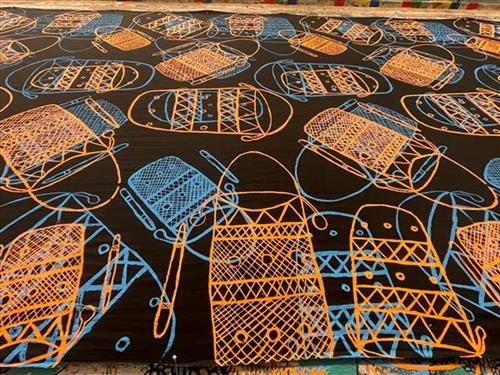
Dedded Wongkorr

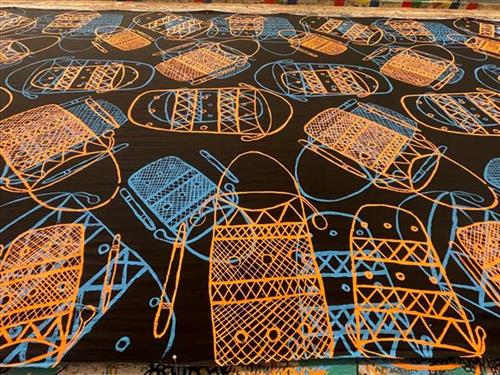
This design depicts a ‘wongkorr’ sacred dilly bag woven with brightly coloured orange parrot feathers called ‘dedded’. It is depicted alongside a digging stick. Wongkorr are used in a number of public ceremonial contexts, and are sacred objects for the Bininj Kunwok speaking people of Western Arnhem Land.

‘This is a really special kind of dillybag for us, not like a normal dillybag.

This story was from a long time ago, when my great great grandfather was alive. He’s the one that was a medicine man for our people.
We are not supposed to see that sacred spirit dillybag that lives below the saltwater. If we ever see that site, it might drag us under and drown us. When the tide goes out he floats and when the tide comes in he goes under to hide.

This story is about fresh water and salt water mixing and our ancient law. There are strings of the Wongkorr hold it under the water. The Wongkorr is made with lorikeet parrot feathers and Kurrajong bark string.

I remember having a ceremony at that outstation Bolkjam when I was only 16 years old, near Ji Bal-bal homeland, and my father would tell me the story of the Wongkorr sacred site. My two sisters taught me to paint, and my Dad was a famous painter. Some balanda (non-Indigneous) know my father’s painting, it is about digging sticks, sharks and wongkorr.

This story links to mixed water, plant life and animals living at the artist’s country, and following the lessons and knowledge of the ancestors.’ Elizabeth Kala Kala

377810582175390


Dedded Wongkorr

This design depicts a ‘wongkorr’ sacred dilly bag woven with brightly coloured orange parrot feathers called ‘dedded’. It is depicted alongside a digging stick. Wongkorr are used in a number of public ceremonial contexts, and are sacred objects for the Bininj Kunwok speaking people of Western Arnhem Land.

‘This is a really special kind of dillybag for us, not like a normal dillybag.

This story was from a long time ago, when my great great grandfather was alive. He’s the one that was a medicine man for our people.
We are not supposed to see that sacred spirit dillybag that lives below the saltwater. If we ever see that site, it might drag us under and drown us. When the tide goes out he floats and when the tide comes in he goes under to hide.

This story is about fresh water and salt water mixing and our ancient law. There are strings of the Wongkorr hold it under the water. The Wongkorr is made with lorikeet parrot feathers and Kurrajong bark string.

I remember having a ceremony at that outstation Bolkjam when I was only 16 years old, near Ji Bal-bal homeland, and my father would tell me the story of the Wongkorr sacred site. My two sisters taught me to paint, and my Dad was a famous painter. Some balanda (non-Indigneous) know my father’s painting, it is about digging sticks, sharks and wongkorr.

This story links to mixed water, plant life and animals living at the artist’s country, and following the lessons and knowledge of the ancestors.’ Elizabeth Kala Kala

377810582174928


Ngaldadmurrng (Saratoga)

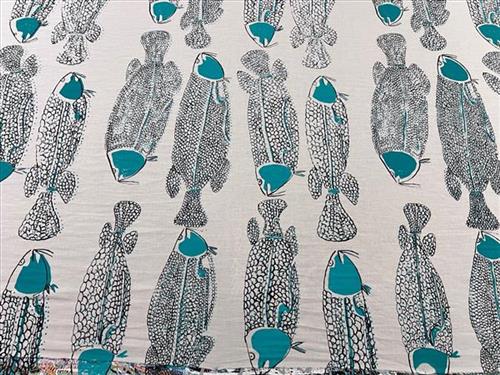
This design tells the story of Saratoga dreaming,  a freshwater fish that swims on the edge of creeks and rivers. This design is the Saratoga dreaming from the Mularra songline. Where the Saratoga we call Murdulngu, Danguny travelled from Malmyangarnak billabong to Mirrigatja.

This Billabong was owned by Murdulngu (Saratoga) before the water was taken over by shark Barlangu he came all the way from east to north then to west. He was travelling when that water level was high he went up the stream but he couldn’t make it. This Barlangu came from Murruggun clan but really this shark came from long way all the way south. This story is connected through Mularra songline it represents many clans.

With permission from clan elders, Carol is able to pass on this family knowledge through her passion in textile and art.


‘I am proud of my first design, I want to keep this design for future, for my children and grandchildren so they remember this story, this story is a big part of the mularra songline’ Carol Liyawanga Campion

377810582174920


Ngaldadmurrng (Saratoga)

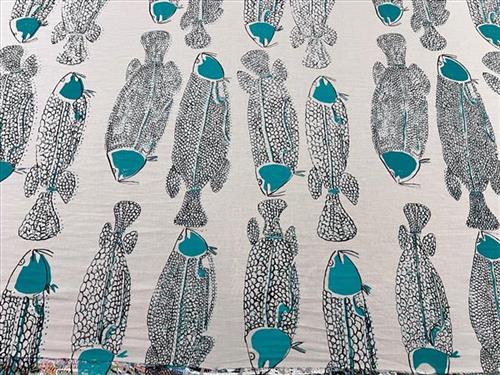
This design tells the story of Saratoga dreaming,  a freshwater fish that swims on the edge of creeks and rivers. This design is the Saratoga dreaming from the Mularra songline. Where the Saratoga we call Murdulngu, Danguny travelled from Malmyangarnak billabong to Mirrigatja.

This Billabong was owned by Murdulngu (Saratoga) before the water was taken over by shark Barlangu he came all the way from east to north then to west. He was travelling when that water level was high he went up the stream but he couldn’t make it. This Barlangu came from Murruggun clan but really this shark came from long way all the way south. This story is connected through Mularra songline it represents many clans.

With permission from clan elders, Carol is able to pass on this family knowledge through her passion in textile and art.


‘I am proud of my first design, I want to keep this design for future, for my children and grandchildren so they remember this story, this story is a big part of the mularra songline’ Carol Liyawanga Campion

377810282174362


Kungkarangkalpa (Seven Sisters)

The Seven Sisters Creation Story is of great significance to the Pitjantjatjara and Yankunytjatjara people. The sisters travelled a long time ago through the artist’s traditional country in South Australia’s North West and the south west corner of the Northern Territory. 

A man called Wati Nyiru was chasing the sisters trying to court one of them. He used all kinds of trickery in pursuit of them but through the skill of the eldest, they always managed to keep one step ahead of him. The sisters finally escaped to a far away place so they could stay together safe from the clutches of Wati Nyiru. 

To this day the seven stars of the sisters followed by the bright star of Wati Nyiru following can be seen in the night sky in the constellations known as the Pleiades and Orion. 

Within the traditions of Tjukurpa or Creation Law are coded life survival skills. There is inma or ceremony for the Kungkarangkalpa in order to teach and celebrate; for people to learn where they fit within both the environment and social systems. 

Anangu feel strongly about continuing to teach and learn Tjukurpa and their art is important and vital work. It sustains them economically, physically and culturally. It keeps the stories and traditions alive. 

Walkatjara Art is the Aboriginal owned and governed art centre belonging to Mutitjulu community, located in the Uluru-Kata Tjuta National Park, NT.

www.facebook.com/walkatjaraart        www.walkatjara.com

377810282174359


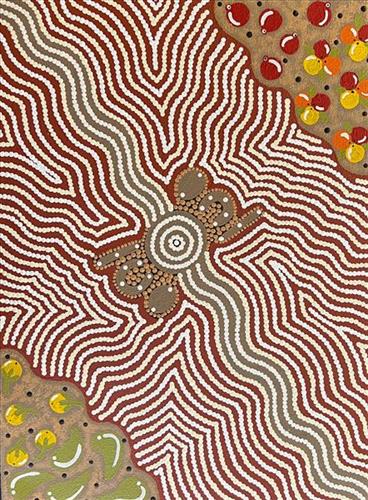
Mai Wiru (Bush Foods)

Minyma tjuta ankupai putikutu piti wanatjara. Paluru tjana mai kutjupa kutjupa tjuta mantjilpai tjitji tjutaku. Waltjangku wirura palyara nyinantjaku.’

The women go out into the bush with their bowls and digging sticks. They collect all sorts of bush foods for the children.

Some of the delicious fruits found out bush include:

Unturngu –  The bush banana. It is a slender creeper whose fruits are eaten raw when young, or baked when older.

Kaliny-Kalinypa – The honey grevillea is a hardy yellow desert flower that grows in sandy spinifex plains. The tasty honey-like nectar of the flower is often collected towards the end of the hot summer, and can be either mixed with water for a sweet cordial-like drink, or sucked straight off the plant!

Kampurarpa – The bush tomato plant, fruits after good rains and have a piquant spicy taste. They and can be eaten fresh from the bush or after they have dried and dropped to the ground. The dried fruits can also be ground and mixed with a little water to form a ‘fruit patty’. 

Mangata – The fruit of the Quandong tree (Santalum acuminatum). It is sometimes called bush peaches are sweet and deep red in colour when they are ready for picking in spring. The fruits have a hard seed inside which Anangu women paint beautiful designs on.  These are then used to make bracelet and necklaces. Traditionally the kernel inside this seed could be used both medicinally and as a hair conditioner.

Ili – The ili is a delicious, sweet fruit, very high in vitamin C. It can be found growing naturally around Uluru and in rocky gullies throughout the central desert. It can be easily spotted when the fruit turns yellow, but is ripe and ready to eat when it turns a deep purplish red. 

Arnguli – The flowers of the arnguli are small, creamy-white with four petals.The fruit which follow are olive-like, start off green, then change to purple then black as they ripen. They are flourish after rain and are an important bush food plant for Anangu. The fruit are eaten fresh or reconstituted in water if dry. Sometimes the kernels were roasted then ground to make an edible paste. The paste from the ground kernels was also used as a medical liniment.  Another use for the fruit is as a dye.

Tjanmata – Bush Onions-The small bulbs of the bush onion are baked in hot sand and ashes then eaten, once the papery covering (nyiri) is removed.

Anangu say that by painting and talking about bush foods it guarantees that supplies will be plentiful all year round!