Past, Presant, Future no.1
Large basket – Hand woven and coated with White Ochre
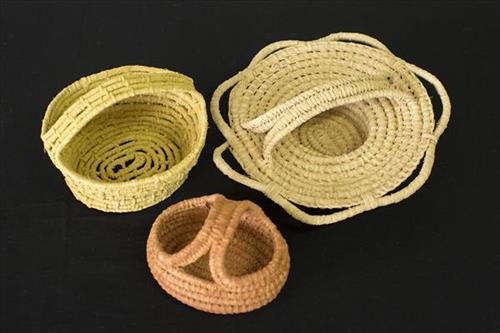
Large basket – Hand woven and coated with White Ochre
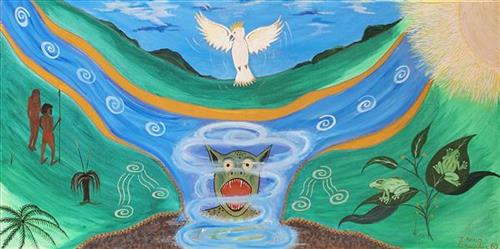
Collaborative painting by Gavin Saunders and Jack Anselmi. This work was commissioned for a childrens’ publication.
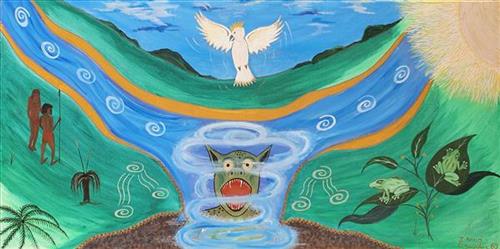
Collaborative painting by Gavin Saunders and Jack Anselmi. This work was commissioned for a childrens’ publication.
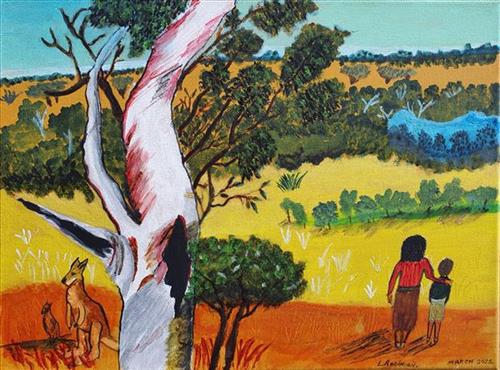
Mother and son out on country
The Wagilag Sisters are central to the four important ceremonies of the Dhuwa moiety; the Djungguwan, the Gunabibi, the Ngulmarrk, and the Mandaialla.
The story is primarily an account of how, in the distant past, the two Wagilag Sisters came out of the southern interior and across the countryside to the Liyagalawumirr waterhole at Mirarrmina.
This painting is where the two sisters came along and get all the tools for hunting. They got ritjano and Damilipa (Blue Tongue Lizard). Ritjano is similar to a carrot, and grows abundantly in North East Arnhem Land. The vegetable is a staple food in traditional Yolngu culture, and has been a reliable food source when other foods are scarce. The ladies will collect and roast the ritjano, which has a very sweet flavour.
The sisters put all the bush food into their dilly bags.
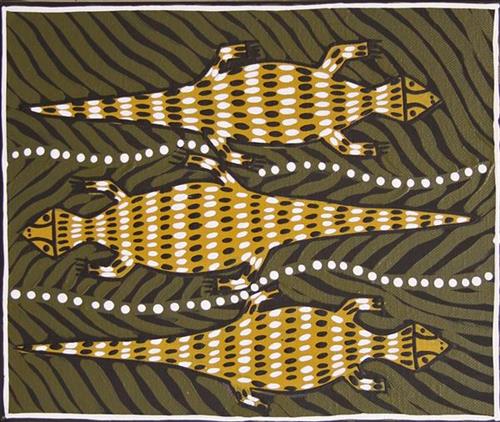
This painting depicts Damilipa (Blue Tongue Lizard) scouring the vast landscapes of Gurrwiliny, NE Arnhem Land. Damilipa can be seen across Arnhem Land all year around. Damilipa is the dreaming for Evonne’s Waku (great-grandfather from mothers side).
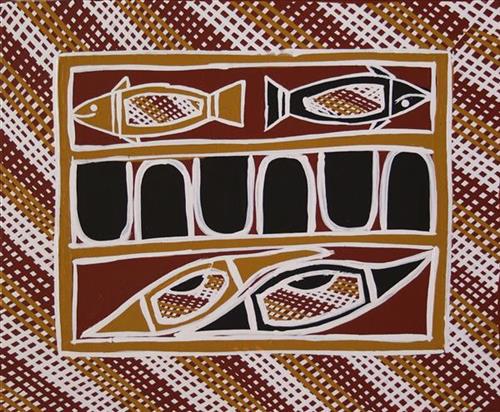
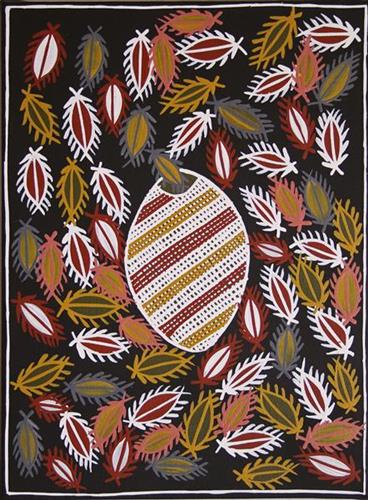
This painting is of a conch shell and the “U” shapes are oysters. The rrark (cross hatching) is representing water.
As part of Evonne’s family tradition To make these intricate table mats, artists collect the young leaves from the Pandanus Spiralis palm tree. They then strip the leaves of thorns and into thin strips before they are boiled with tree roots or leaves that are used to make natural dye. is lit over the conch shell and the smoke from this fire is used in a smoking ceremony. This ceremony has cleansing properties.
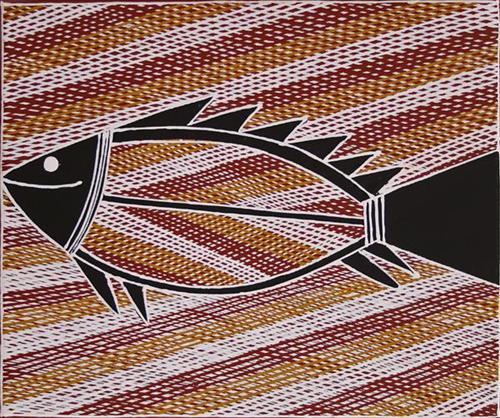
JB paints stories from his Dhuwa homeland in northeast Arnhem Land. Stories are passed on either paternally or maternally, and JB would have learnt these stories from his ancestors. The cross-hatching style is a traditional painting style of this area and can represent elements such as water, air and wind.
JB’s paintings often feature totemic animals of the fresh waters of north east Arnhem Land.
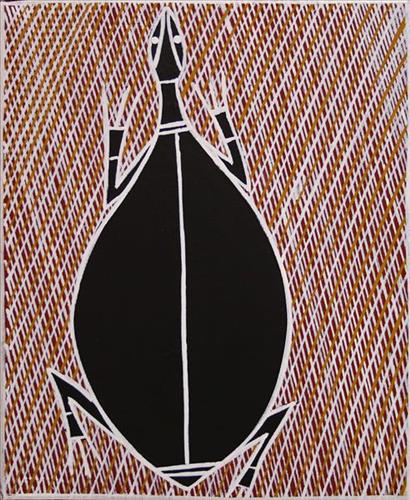
The long necked turtle is a dreaming totem for the freshwater people, the Ganalbingu, whose country includes the World Heritage listed, Arafura Wetlands in Central Arnhem Land, Northern Territory
The Yolngu (people) of Arnhem Land originate from a spiritual source, fixed in a particular place in their land or the sea. These ‘Spiritual Reservoirs’ are often in the form of special waterholes made by Wangga (Creator Beings), long ago close to the beginning of time. These creator beings moved across the country side, shaping the land and implanting in each tract of country, the spiritual life force for the people who were to own it.
These creator spirits took many forms. When they gave the land to each group they also gave songs, dances, ceremony, the associated laws and language. The Creation story for Ganalbingu people took place near the middle section of the Glyde River where it becomes the Goyder River. Their land, Ngaliyindi, sits astride the Arafura Swamp in Central Arnhem Land. Some of their major Creative Beings include Banda (freshwater long neck turtle) and Yalman (water lilies).
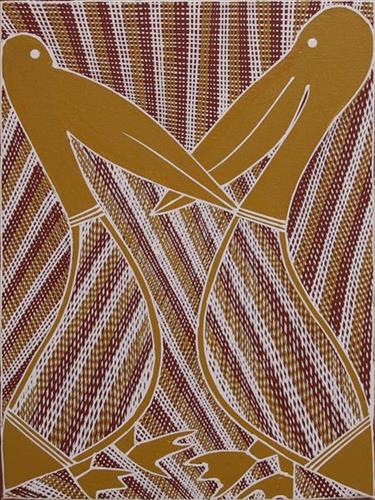
JB paints stories from his Dhuwa homeland in northeast Arnhem Land. Stories are passed on either paternally or maternally, and JB would have learnt these stories from his ancestors. The cross-hatching style is a traditional painting style of this area and can represent elements such as water, air and wind.
His paintings often feature totemic animals of the fresh waters of north east Arnhem Land.