222082214582


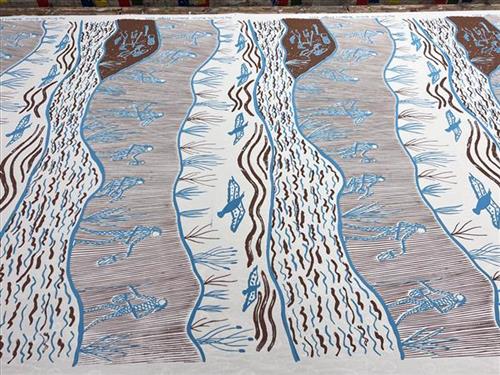
Many Gulpaga

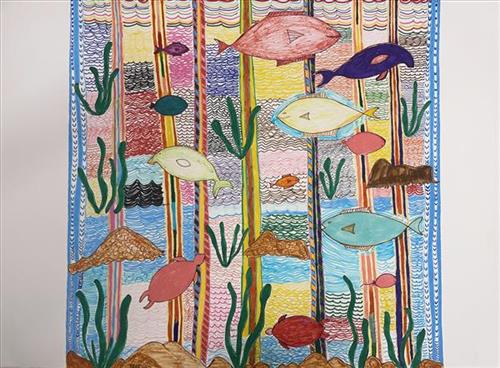
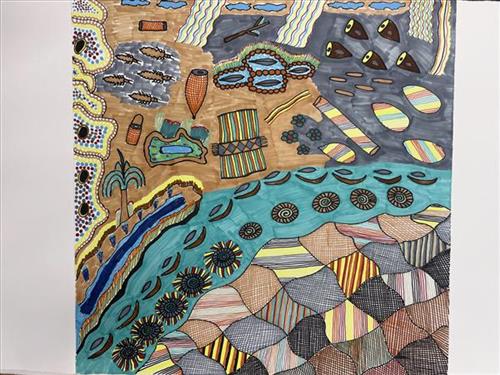
Many Gulpaga is inspired by the waterholes near my home Country,Yorta Yorta. I would often visit these waterholes with my family. I have always felt a deep pull towards water as I find this element to be very peaceful yet powerful. I believe this may be a result of my totems being water animals. The long neck turtle, my tribal totem and the Murray Cod, my personal totem.

377810582214549


Kunred Kodbarre (The Louvre)

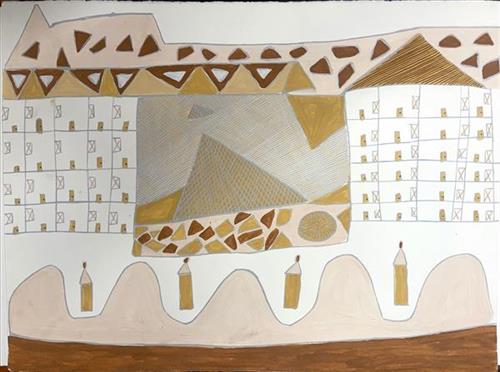
“This design is new and tells a different story of when I went to Paris. This building in the middle of my design is the Louvre. We went and saw that big building made of glass, and there were lots of people walking around. In Paris, there is a big creek made from bricks, with water flowing through the city. I have painted it here too, with the light poles next to it. There are so many tall buildings in Paris. When I see this design, I remember everything about my trip to Paris. For this design I had the idea of putting our Aboriginal bush tucker around the Louvre, so the plants here are kundayarr (pandanus), wayuk (water lily) and karrbarda (long yam). I painted some French trees too’.

In 2019 five artists from Babbarra Women’s Centre travelled to France for the opening of their exhibition Jarracharra: Dry Season Wind. Deborah Wurrkidj, Jennifer Wurrkidj, Janet Marawarr, Jacinta Lami Lami and Elizabeth Kala Kala danced at the opening of the exhibition to a packed embassy gallery, and hosted various public panels including at the Musee du Quai Branly. The artists featured in Vogue magazine, wearing garments featuring their own printed designs on the balcony of the Ambassador to France, with a panoramic view of the Eiffel Tower in the background.

Inspired by the same voyage, on return to Maningrida Deborah Wurrkidj wove a sculpture of the Eiffel Tower out of naturally dyed pandanus, titled Ngaye ngawam nganang kunred  kukimukken, kubba nakornamkuyeng karri (I travelled a long way away, to that place with the tall tower). The work was a finalist in the prestigious 2020 Telstra National Aboriginal & Torres Strait Islander Art Awards (NATSIAA).
377810582214545


Ngalng

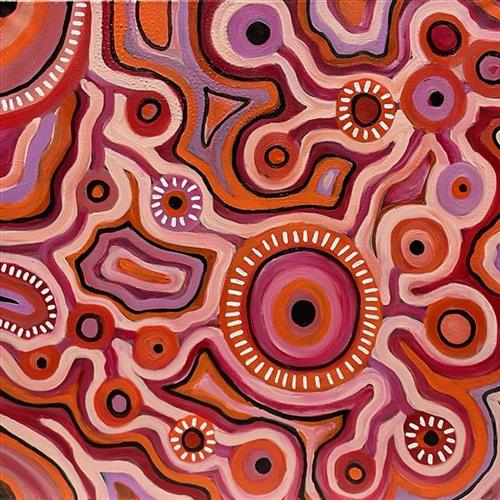
Ngalng (fresh water yabby)

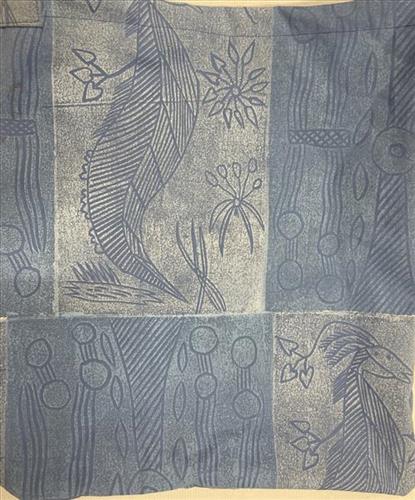
‘This is a story from Mankorlod. This is a djang story. This is the creation story about the fresh water yabby. Starting with the stone, that’s the raw one and the cooked one. The stone rock suddenly turned to ngalng, in a flash. Ngalng started growing and turned into a body. It’s a magic one and it can change from rock to ngalng to human and back to ngalng. Now it’s a ngalng. 

The country is near Mankorlod and Korlobididah. The ngalng is stuck there forever on the rock at Korlobididah,’ 

‘There is also duruk (camp dog) called ‘Djanbokkon’. This is a duruk that comes from water and no one has seen it. This is a true duruk, he goes everywhere in the country. His body is striped. He is a secret dog and he has a secret story.’ 

Janet Marawarr 2022

377810582214518


Yokkarra (fish)

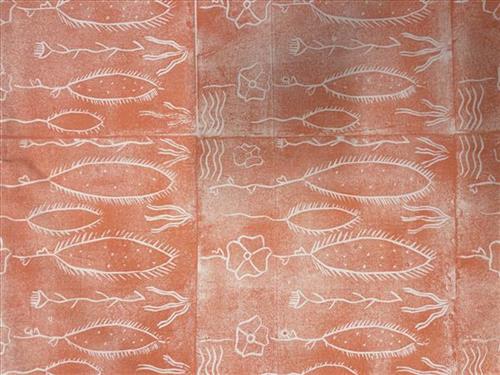
‘Hi it’s me Marilyn! I’m the age of 52. I like working at the women centre and doing lino printing but I prefer screen printing. I have one design, that’s lorrkkon (hollow log). My great grandfather used to make lorrkkon and do bark paining. I never met him but I heard a lot of stories about him. My mother used to tell me history stories. When I was 16 my parents passed away. I’m was on my own but now I’ve got my own family and my partner who helps me. I’ve got 6 grandchildren.

My homeland is Entrance island, Haulround island and Juda point. I really like Haulround island and that’s where we collect barruar (seagull egg). Entrance island is my favourite camping area, I go across with boat. Balanda (non-Aboriginal or European people) can’t go into those islands or Juda point without permission from me.

Come and chat to me if you want to go to any of those places. We have a sacred totem ngaduma (palm tree) at those places and if people destroy it, we will have a strong wind and maybe a cyclone.’

Marilyn James 2021

377810582214511


Namorrorddo Part 3

Mythical creatures of a malevolent nature, namorrorddo are shooting star spirits. They have long claws and trails of white light coming from their heads. They also carry a long club called miyarrurl which they use to beat victims.Yiman kabenerohrok nakidjkidj ya nakka wanjh kabenerohrok namorrorddo. Namorrorddo kabirlikan, bidngalnjkuyeng yoh.

Namorrorddo is similar to the spirit called ‘Nakidjkidj’, the same as Nakidjkidj. Namorrorddo however carries light (ie. the shooting star) and has really long claws, yes.

Source: https://www.njamed.com/

377810582214505


Namorrorddo Part 2

Mythical creatures of a malevolent nature, namorrorddo are shooting star spirits. They have long claws and trails of white light coming from their heads. They also carry a long club called miyarrurl which they use to beat victims.Yiman kabenerohrok nakidjkidj ya nakka wanjh kabenerohrok namorrorddo. Namorrorddo kabirlikan, bidngalnjkuyeng yoh.

Namorrorddo is similar to the spirit called ‘Nakidjkidj’, the same as Nakidjkidj. Namorrorddo however carries light (ie. the shooting star) and has really long claws, yes.

Source: https://www.njamed.com/

377810582214494


Bawáliba (Stone Country Mimih)

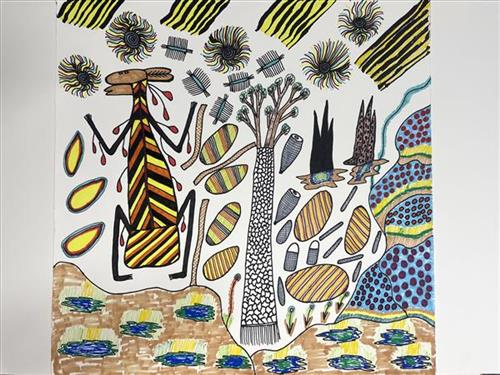
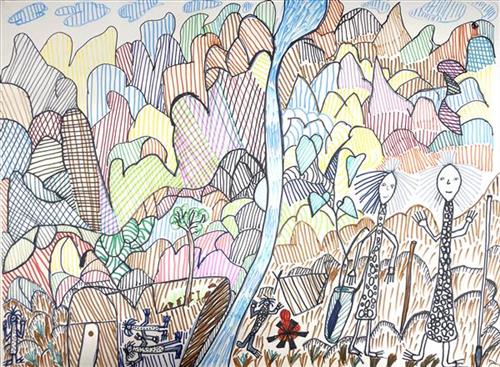
‘Bawáliba is the djang (Dreaming) of my mother and my uncles. They are good spirits, they protect us and they recognise families. They are really tall- just like human beings, like us. They dance late at night and have a lot of hair.

In olden times, long long long time ago Bawáliba were here, before people were on the land. Bawáliba used to go out hunting and care for country. They hunt carrying fish traps and digging sticks, near the homeland Djinkarr. They go out hunting on the floodplains with dilly bags and digging sticks. They collect a lot of bush foods, and sleep together with one bark shelter.
Sometimes now they still come alive when we sleep, they might come to our houses and peep through the window. At night, they cover themselves with white clay and red cloth tied around their waist. If we hear them, we jump out of bed and get up to look -but they have disappeared, they’re just too quick. Bawáliba might knock on the window to remind us they are there looking out for us.If you listen deeply you can hear them whisper, sometimes they talk about us and might say, ‘why are those people making camp here?’ then they realise ‘Oh they are family from here, it’s ok, they are just sleeping here for the night’.

During the day they always turn into stone and they sleep. We still know that green rock covered in moss near Djinkarr, that’s Bawáliba sleeping.
Some of my ancestors used to speak the same language as the Bawaliba, but all those old people are passed away now. It’s a little bit sad for us, because no one now can speak that Bawaliba language anymore.’ Lucy Yarawanga 2019

377810582214489


Bawaliba and Ngalyod (Rainbow Serpent)

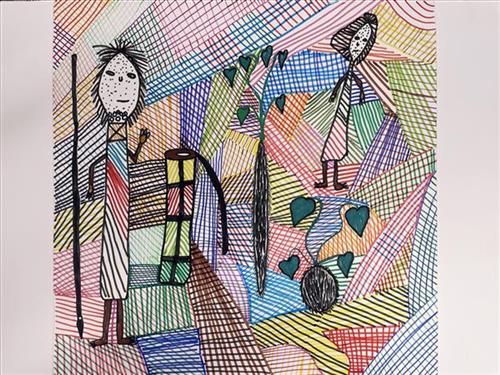
‘My Kikka (mother), when she was alive, she would tell me these stories. I was just a  little girl and she would tell us the stories in her language Gurrgoni.

In the camps there were boy and girl Bawaliba, and old Bawaliba too. They loved to  dance by the firelight, keeping rhythm with a stick. They had lots of hair, they were  really tall and skinny, with spots on their bodies. The Bawaliba lived a long time in  peace. They were the only spirits on their country and so they were never disturbed.

One day, a long time ago, the Bawaliba were out hunting and they saw a large  snake- they didn’t know then but she was the Rainbow Serpent. They were really  scared, they had never seen that. creature before. She was really beautiful- like a  normal king brown snake but with a rainbow from the sky on her back. The rainbow  serpent was really hungry, and she could smell the Bawaliba from a long way away.  She was out looking for food.  The Bawaliba tried to stop Ngalyod coming for them but she was just too quick. She  snuck up behind the Bawaliba and before they could get away she ate them up.  When she was really full and couldn’t eat anymore Bawaliba she changed the rest of  them into stone. Still til this day, the Bawaliba stay on that same country as stones.’ Lucy Yarawanga

377810582214395


Namurre Boko

A two colour screen print design from 2022. Jay’s first large format design to join the Bábbarra Designs Collection.

‘Bini-murreko means two brothers – big brother and little brother.

Two brothers were really strong leaders and good hunters, sharing animals with different tribes.
With those different tribe there were jealousy going on.
Little brother went walkabout and heard the different tribe was talking about his tribe.
They said ngarribin manre djed-djedme bokko
Meaning: will make spear for them
Ngarrbin danj-bun, ngarrbinbun
Meaning: will spear them kill them
little brother turn around went back tell his brother
Namurre bokko kadi marne djed-djedme Karre wonens, kardi-djal danjbun
Meaning: they making spear for us, they gonna spear us
Couple of months they saw different tribe
They changed their attitude
They been bringing lots of animals to them and start asking for women
And that tribe realise that’s how those brothers died.
They kill them
This Why? They got jealous because two brothers was a good hunter.

This story written on the rock art and it stays forever.’