115682231872


Generic

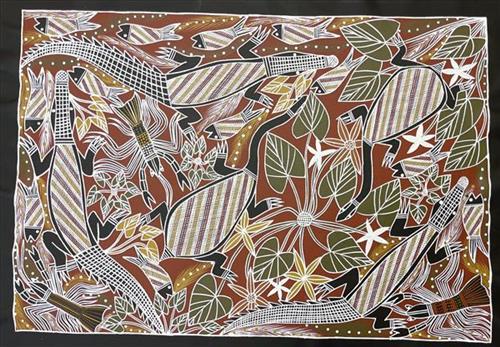
Aboriginal art in Ramingining, Central Arnhem Land is commonly illustrated through designs and images of animals, plants, and landscape. These motifs commonly reflect the artists ancestral inheritance and their dreamings and are referred to as totems.

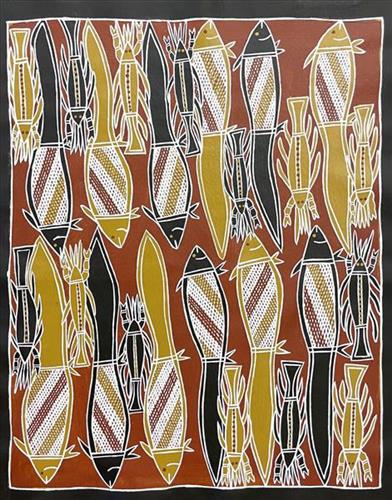
For this painting, Evonne has painted catfish in a billabong.

115682231870


Giny’kiny (Catfish)

Giny’kiny (cat fish) are a totemic species significant to the Gupapuyngu clan. They are represented through storylines and songlines through art and bunggul (dance). The lines in the painting depict the ripples in which the Giny’kiny created when swimming through the shallow waters. During bunggul (dance) the ripples are depicted through the use of string and the barbs of the Giny’kiny are represented by holding out spears. Peter Gambung says “when we dance we imagine we are catfish, our mind leaves our human body and goes to our spirit”. The songline is performed at different bungguls such as dhapi (boys initiation ceremony) and bapurru (funeral) in which is performed to assist the deceased persons spirit to go home.

115682231762


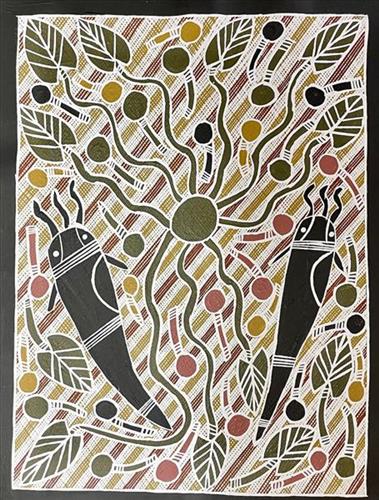
Fresh water Yabby and fish

Aboriginal art in Ramingining, Central Arnhem Land is commonly illustrated through designs and images of animals, plants, and landscape. These motifs commonly reflect the artists ancestral inheritance and their dreamings and are referred to as totems.

For this painting,  Peter has painted Fresh water Yabby and fish.

115682231728


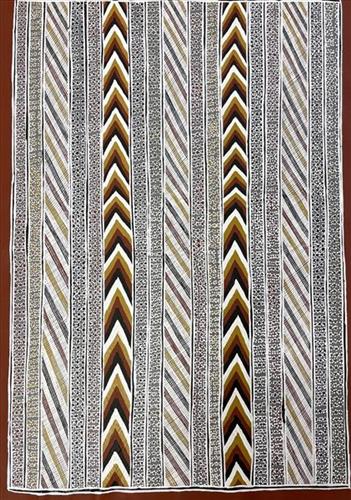
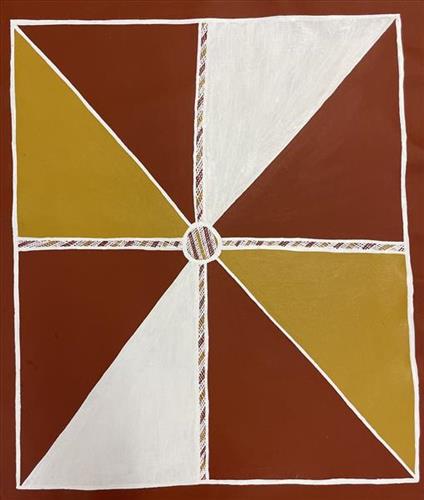
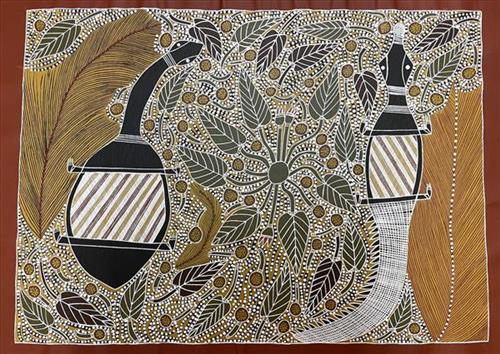
Garrawura Minyt’j

Each Yolngu clan was created by their ancestors as they moved along the country whilst they were singing, dancing and talking. Each time they arrived at a new land, they created distinct rom (culture, law). A part of this rom is miny’tji (art, totemic designs, colours). Each clan has a distinct miny’tji, and Yolngu can tell where someone is from by their miny’tji. The ancestors passed down sacred designs, some of which are secret or have secret meanings. These designs were traditionally painted on people’s bodies, or carved into sacred objects. More recently, they have been painted on canvases and barks. This painting is of Dhunbaḻmirriwuy’s miny’tji. It uses the colours which were passed down to her from her ancestors. The circles represent waterholes, while the lines represent the land. This design is a sort of coat of arms for the Garrawura clan.

115682231719


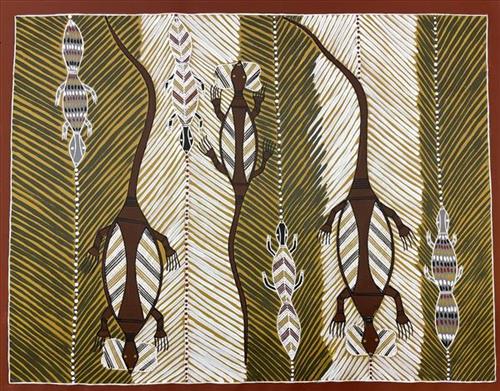
Shannon’s frilled necked lizards

The Wagilag Sisters are central to the four important ceremonies of the Dhuwa moiety; the Djungguwan, the Gunabibi, the Ngulmarrk, and the Mandaialla.

The story is primarily an account of how, in the distant past, the two Wagilag Sisters came out of the southern interior and across the countryside to the Liyagalawumirr waterhole at Mirarrmina. There the younger sister profaned the pool of Wititj (the great Olive Python) by accidently allowing her blood to fall into the waterhole. Because of this, the women (and their children) were swallowed by Wititj.

Shannon is painting a part of the story that features frilled necked lizards and lizards.

115682231711


Raypiny Dhawu (Fresh Water Story)

All Aboriginal people originate from a spiritual source, fixed in a particular place in their land or the sea. These ‘spiritual reservoirs’ are often in the form of special waterholes made by Wangarr (creative spirits) that were created long ago close to the beginning of time. These creator beings moved across the countryside, shaping the land and implanting in each tract of country, the spiritual life force for the people who were to own it. These creative spirits took many forms and when they gave the land to each group, they also gave songs, dances, ceremony, the associated laws and language.


The creation story for Ganalbingu people took place near the middle section of the Glyde River where it becomes the Goyder River. Their land, Ngaliyindi, sits astride the Arafura Swamp in Central Arnhem Land. Many Ganalbingu artists paint totemic species significant to their clan. These can include baru (crocodile), banda (long necked turtle), buliya (catfish), yalman (waterlilies), gumang (magpie geese), dakawa (fresh water yabby), ratjuk (barramundi), warrnyu (flying fox) and more.


111982231436


Djamo (dog)

The djamo (dog) holds special mythological as well as practical significance for people of Central Arnhem land, particularly women. The men used to go hunting with a spear and the women with a dog. If the men didn’t catch a kangaroo, the women would catch a goanna. If neither caught anything, then they could catch fish. If there was neither kangaroo nor goanna, then they would eat sugarbag. This is how it was long ago – sugarbag, lily root, yam, goanna, sand goanna, fish and more were part of the regular diet. “Don’t forget that long ago we didn’t know European food, we knew bush food. We used to grow from bush food.” Rembarrnga women have literally and metaphorically brought together strands from their country and the mythology of their heritage to produce three dimensional fibre creatures filled with mystical significance. Dog, mermaid, rainbow serpent, blue tongue and fish multiplication spirits: each creature plays an important role in the clan’s cultural landscape. Materials for this camp dog comes from the clan estate. Dayarr (pandanus) and rulk (grass) are the twines used for the creature’s bodies. Warlppurrunggu (bush turkey) and nganarrngh (black cockatoo) feathers provide bulkkan-na (hair). Marnarr (red), gamununggu (white), garlba (yellow) ochres and roerroe (black) ashes are then carefully mixed and applied for colour. The use of local materials provides an integral link between the mythological nature of the creatures, which inhabit the country and their physical form.

115682231354


Raypiny Dhawu (Fresh Water Story)

All Aboriginal people originate from a spiritual source, fixed in a particular place in their land or the sea. These ‘spiritual reservoirs’ are often in the form of special waterholes made by Wangarr (creative spirits) that were created long ago close to the beginning of time. These creator beings moved across the countryside, shaping the land and implanting in each tract of country, the spiritual life force for the people who were to own it. These creative spirits took many forms and when they gave the land to each group, they also gave songs, dances, ceremony, the associated laws and language.


The creation story for Ganalbingu people took place near the middle section of the Glyde River where it becomes the Goyder River. Their land, Ngaliyindi, sits astride the Arafura Swamp in Central Arnhem Land. Many Ganalbingu artists paint totemic species significant to their clan. These can include baru (crocodile), banda (long necked turtle), buliya (catfish), yalman (waterlilies), gumang (magpie geese), dakawa (fresh water yabby), ratjuk (barramundi), warrnyu (flying fox) and more.


115682231353


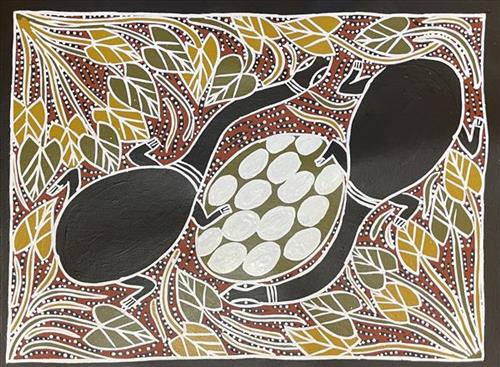
Ganalbingu – Banda (Long Necked Turtle)

The long necked turtle is a dreaming totem for the freshwater people, the Ganalbingu, whose country includes the World Heritage listed, Arafura Wetlands in Central Arnhem Land, Northern Territory

The Yolngu (people) of Arnhem Land originate from a spiritual source, fixed in a particular place in their land or the sea. These ‘Spiritual Reservoirs’ are often in the form of special waterholes made by Wangga (Creator Beings), long ago close to the beginning of time. These creator beings moved across the country side, shaping the land and implanting in each tract of country, the spiritual life force for the people who were to own it.

These creator spirits took many forms. When they gave the land to each group they also gave songs, dances, ceremony, the associated laws and language. The Creation story for Ganalbingu people took place near the middle section of the Glyde River where it becomes the Goyder River. Their land, Ngaliyindi, sits astride the Arafura Swamp in Central Arnhem Land. Some of their major Creative Beings include Banda (freshwater long neck turtle) and Yalman (water lilies).

111582231687


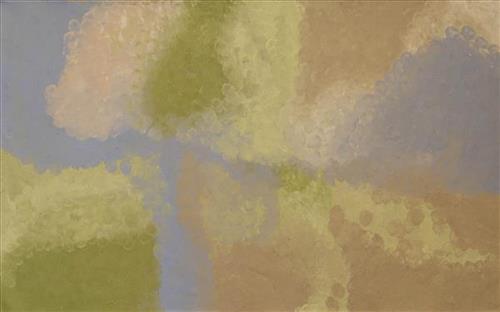
Wantili (Warntili, Canning Stock Route Well 25)

“Bugai always tells about Wantili (Warntili, Canning Stock Route Well 25) because she grew up around Wantili. Her family would travel between Wantili, Kaalpa, Juntu-juntu, Raarki, and Wuranu Wells along the Canning Stock Route. She paints around Wantili. She saw whitefellas there for the first time, Canning mob when they were travelling up and down the stock route with the bullock. She was a young girl walking around at Wantili. Big mob of people they been walking around there. Canning and his drovers were travelling, making the road. They were running away from those whitefellas, watching them from a long distance. She was a teenager when she was travelling around there with her four mothers and one daddy. They used to travel around in family groups, Bugai and Jakayu [Biljabu], and Jakayu’s nyupa (partner) Phillip Biljabu.” 

– Bugai Whyoulter, as translated by her grandson, Cyril Whyoulter


“I was just becoming a teenager, still travelling around with my mother and father. We were at Juntu-juntu, Wuranu, Raarki, Tiwa and Wantili. At Wantili we killed a cow, they were bringing cattle through from Kunawarritji … Wantili was a good place to make yakapiri (woven bark sandals).”

– Bugai Whyoulter as translated by Ngalangka Nola Taylor


Wantili, which forms the focus of much of Bugai’s work, is a large round jurnu (soak) and linyji (claypan) near Well 25 on the Canning Stock Route. The Wantili region is dominated by claypans surrounded by tuwa (sandhills), and Nyilangkurr, a prominent yapu (hill) is located close to the eastern edge of the claypan. Following rain the typically dry claypans are filled with water, with the overflow from nearby waterholes flowing to Wantili. At that time, Wantili becomes an important place for obtaining fresh water for drinking and bathing. Wantili is significant for the fact that at this site Kartujarra, Manyjilyjarra, Putijarra and Warnman people would all come together for ceremonies during the pujiman (traditional, desert dwelling) era. Many jiwa (stones used by women for grinding seeds) from these times can still be found there today.

Wantili lies within Bugai’s ngurra (home Country, camp). As described in her account, Wantili was one of the sites she knew intimately and travelled extensively with her family and other family groups during the pujiman period. At this time, Martu would traverse very large distances annually, moving seasonally from water source to water source, and hunting and gathering bush tucker as they went. Knowledge of water sources was critical for survival, and today Martu Country is still defined in terms of the location and type of water. Each of the hundreds of claypans, rockholes, waterholes, soaks and springs found in the Martu desert homelands is known by name, location, quality and seasonal availability through real life experience and the recounting of Jukurrpa (Dreaming) narratives. 

Wantili is also especially significant to Bugai as it was here that she saw whitefellas for the first time; drovers with their cattle travelling along the Canning Stock Route. The establishment of the route by Alfred Canning and his team in 1910 resulted in first contact with Europeans for many Martu, including Bugai and her family, then living a pujiman life in the desert. Encounters occurred between Martu, Europeans, and other Martu working as cattle drovers as they travelled and down the Stock Route from water source to water source. Increasingly, Martu followed the route to newly established ration depots, mission and pastoral stations. They were drawn to the route in search of food, by a sense of curiosity, or by loneliness. By the late 1950s and early 1960s, most of the desert family groups had left the desert. Eventually, these factors combined with an extreme and prolonged drought in the 1960s to prompt the few remaining pujiman to move in from the desert. Bugai returned to the Wantili area as a young woman, when she herself drove cattle along the Stock Route.

Culturally, Wantili is an incredibly important site, ‘where the creation started.’ (Cyril Whyoulter). In this creation story, the world was initially dark, and people were like rocks, with no arms or legs. Following the sun’s first rising, life-forms become increasingly complex while particular features in the land are created. Beyond these details much of the Jukurrpa narrative relating to Wantili is ngurlu (sacred, taboo), and only for Martu, but the site is open, and anyone can go there. 

Wantili is also one of the many sites featured in the epic Minyipuru (Jakulyukulyu, Seven Sisters) Jukurrpa story. Minyipuru is a central Jukurrpa narrative for Martu, Ngaanyatjarra, Pitjantjatjara and Yankunytjatjara people that is associated with the seasonal Pleiades star constellation. Relayed in song, dance, stories and paintings, Minyipuru serves as a creation narrative, a source of information relating to the physical properties of the land, and an embodiment of Aboriginal cultural laws. The story follows the movement of a group of women travelling all the way across the desert, beginning at Roebourne on the coast of Western Australia, as they are pursued by Yurla, a lustful old man. As the women travelled, they stopped to rest at many sites to eat, dance, rest and sing, on the way leaving behind an assortment of articles that became formations in the land, such as groupings of rocks and trees, grinding stones and seeds. The sisters rested at Wantili before throwing seeds, then continued their journey far to the east and beyond Martu Country, stopping at various sites through central and South Australia.