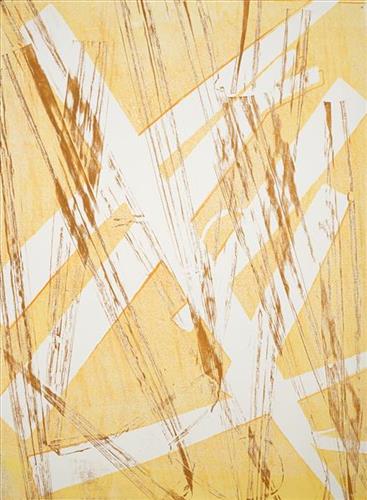
Art Centre notes: The artwork is a ‘pochoir’ print, or monoprint, printed on BFK Rives paper (100% cotton rag with strong archival properties). (The print covers the paper from edge to edge.)

377810582230151
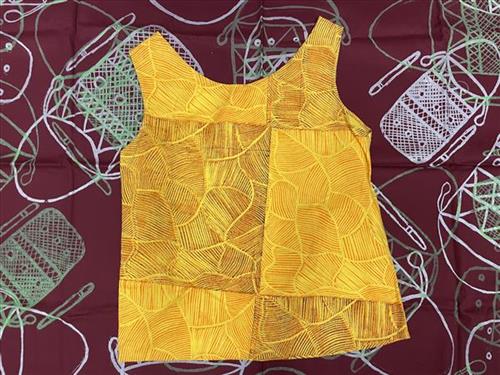
Kunkurra Top
hand made at Babbarra Designs Circa 2017

377810582230149
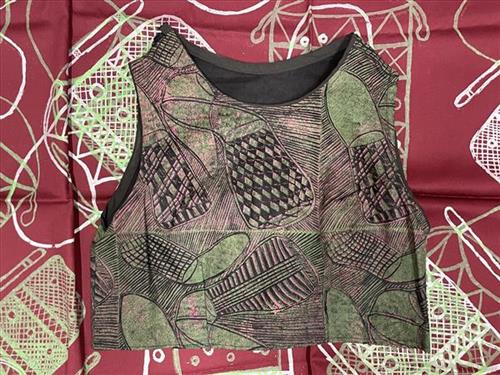
Dilly Bag
Hand made at Babbarra Designs Circa 2016

377810582230144
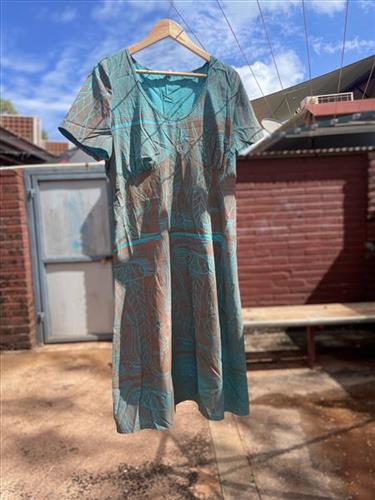
Djomi
This design depicts the story of the artist’s ancestral dreaming, the Djomi fresh water spirit mermaid.
The Djomi figure is a mermaid like spirit with fish tail that lives in the fresh water stream that flows out to the sea cliff near Maningrida. Djomi is a known to be a very powerful fertility symbol.
‘If you go there you can get pregnant easily. Djomi has babies, and they can give others babies too. The Djomi spirit is so powerful, that women can end up with multiple babies at once, twins or sometimes even more. The Djomi spirits lay eggs near the sacred freshwater stream in Maningrida. Inside the eggs are human babies as well as young Djomi.
Men do not go near that swamp, because Djomi is so powerful that men might get pregnant there too. So men, they are too scared of that Djomi. When we visit the Djomi freshwater spring, we can hear young Djomi crying. They sound like normal babies crying, those Djomi spirits. They are looking for a mother.
This Djomi is my dreaming, I got permission from my djunguys to paint this Djomi design. For me I always ask my djunguy permission to paint, because that is our cultural way.
This design also depicts the fresh water lily leaves, and seaweed from the base of the sea floor.

377810582230134
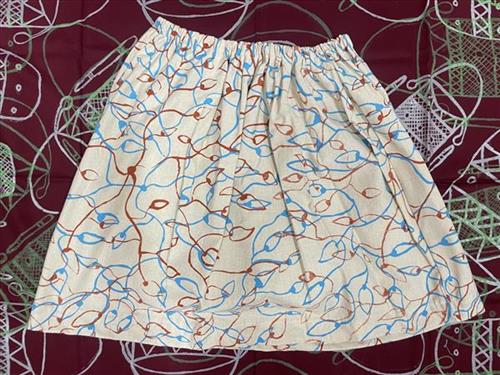
Mankotbe (Bush Onion)
Hand made skirt
Mankotbe (bush onion) grows under the ground, we follow the vine to dig it up. It is brown on the outside and white inside and we cook it on the fire, just like a potato. All the old people used to eat Mankotbe on my homeland. My grandmother showed me how to find that plant and the first time I ate so much my mouth got sore! You can’t be too greedy.
This design brings back good memories for me. I used to eat Mankotbe when I was young and living at my homeland Buluhkaduru. In those old times, my house was made of paper bark and sticks. If we wanted to come into town we had to walk, and it’s a long walk, so we would fill our dilly bags with sugar bag honey, Mankotbe and long yams to eat on the way. They were good times for me.
You can find Mankotbe any time of the year- the plant has big black leaves. When you find one onion, you know there is big mob around- they are always connected by a big long vine underground

377810582230130
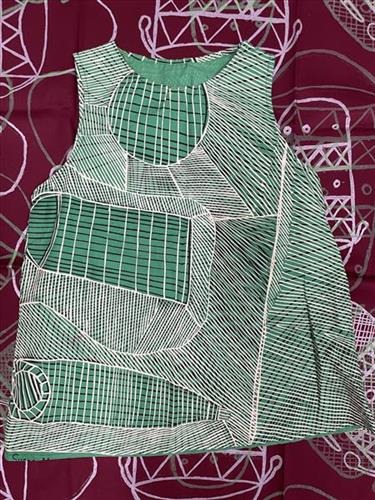
Ka-milemarnbun (Weaving Story)
The Kuninjku term ka-milemarnbun refers to the weaving and production of goods from pandanus leaves and natural fibres. This design specifically depicts the fish trap, basket and pandanus mat.
These three objects and ancestral spirits are significant to the artist as together they relate to her djang (dreaming). Fish traps are woven by hand using the milirl (burney vine, Trophis scandens) from the jungle, which is soaked overnight to make it soft. Fish traps are used by both saltwater and freshwater hunters. Billy-can baskets and pandanus mats are made from pandanus leaves, which are collected using long hooks, stripped, dried, boiled in natural dye, then woven.

377810582230128
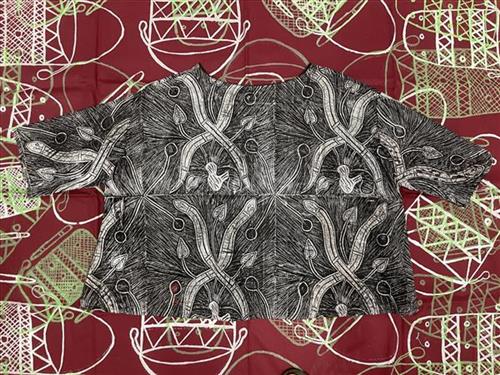
Wayuk
Hand made top
Wayuk (Waterlily) Nymphaea violacea.
The stem of wayuk is a popular bushfood and the beautiful flower is enjoyed across Arnhem Land.
This fabric was created using the linocut printing technique. The lino tile has been carved by the artist in Maningrida, and has been printed by hand using a variety of colours and layers. The linocut technique ensures each textile piece is a one-off, limited edition piece. Bábbarra Women’s Centre supports the economic independence of Indigenous women in the Arnhem Land community of Maningrida, Northern Territory, Australia. Designs created by the women at Bábbarra reflect strong cultural knowledge, which is passed down to younger generations through their textile design practice.
225682230029
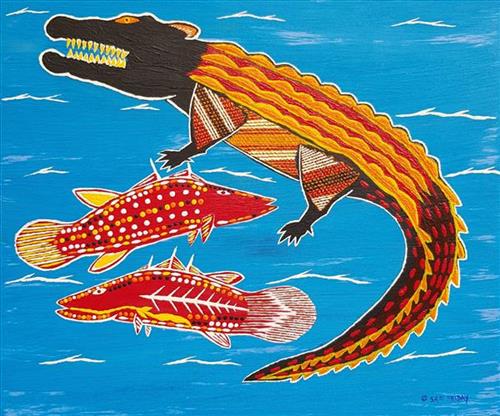
Kudi Ngadimunku – Barra from the dreamtime SF
When Kudi (Barra) was small, he grew up as a boy. He went out hunting with the other men and young boys for kangaroo, goanna, turtles, dugong and crocodile.
As a young boy, he went through initiation to be a young man. After that he was getting lazy and would make excuses not to go hunting with the men, saying I am too tired or I have a sore foot.
When the men left, he would go follow the woman and from a distance watch them get muscles, dig round for eggs, gather yams and other women’s business. He was curious about what the women got up to.
One day, one of the old ladies saw Kudi standing behind a bush looking at them. When the women got back to camp they told the old men about Kudi watching them.
The old men got together and told the magic man about Kudi and sing him into a young girl.
After that he was no longer a man he disappeared never to be seen again. He got big shame and jumped into the water. Kudi turned into a Barramundi fish.
Today you see Barra, at first it is a male, later in the years he turns into a female.
Story by Cedric Sam Friday

377810582230013
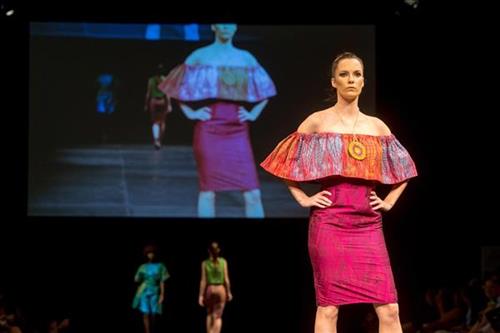
Spear Grass Top
DAAF 2016 Country to Couture Runway
1882226447
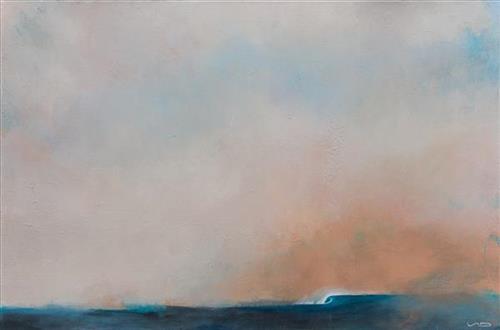
Ocean Dreaming
In the beginning, the Great Spirit of the Sea created the vast and endless ocean, a place of beauty and mystery. She painted the waters with her brush of foam and painted the sky with her brush of clouds. The waves became her canvas, and she used them to tell the stories of the Dreamtime.
The Dreamtime stories tell of the creation of the world and the adventures of the spirit beings. They are stories of magic and wonder, of love and loss, of joy and sorrow. And in my emotive abstract ocean painting, I have tried to capture the essence of these stories.
The swirling forms and vibrant colors are the spirits of the sea, dancing and singing on the waves. The brushstrokes are the trails they leave behind as they journey through the Dreamtime. And the emotions that the painting evokes are the feelings that the Great Spirit of the Sea wants to share with us, to remind us of the magic and mystery of the ocean, and of the Dreamtime stories that are told upon its waves.