Man-ngarre (Native Grasses)
Handmade Lino Print Waistcoat Circa 2016

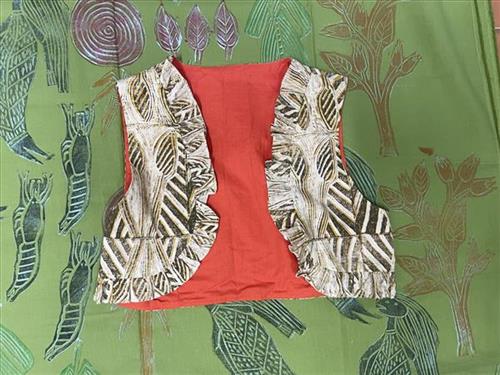
Handmade Lino Print Waistcoat Circa 2016

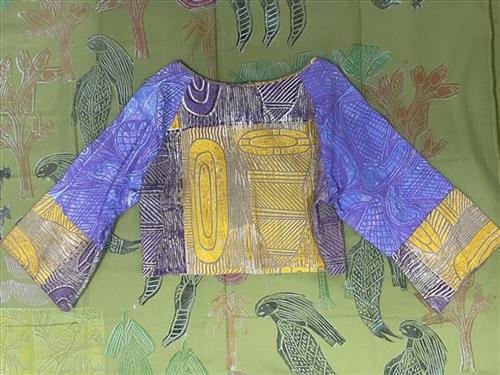
Circa 2016 – DAAF Runway

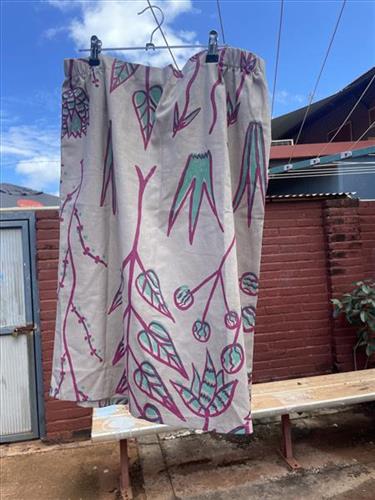
‘All that jungle around Mumeka, on the other side of the river.. that’s where we go looking for manme (bush food) like manyawok (cheeky yam) and karrbarda (long yam). The yawk yawk (young woman spirit) is holding a kunkaninj (digging stick), kun-madj (dilly bag) and all that manme.’ Jennifer Wurrkidj 2021
Hand made by Rut- Tee Designs 2023

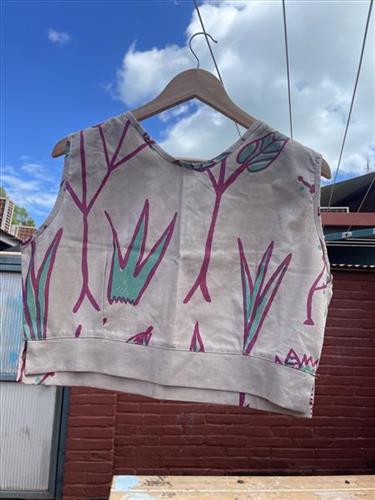
‘All that jungle around Mumeka, on the other side of the river.. that’s where we go looking for manme (bush food) like manyawok (cheeky yam) and karrbarda (long yam). The yawk yawk (young woman spirit) is holding a kunkaninj (digging stick), kun-madj (dilly bag) and all that manme.’ Jennifer Wurrkidj 2021
Hand made by Rut- Tee Designs 2023

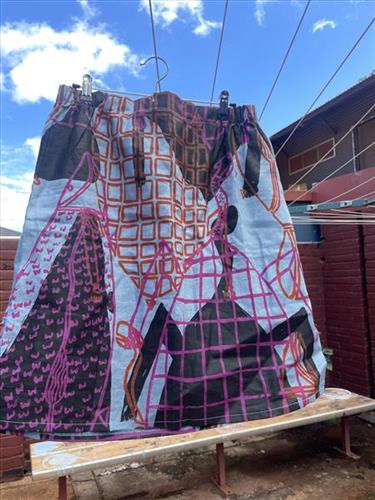
Jennifer is a Kuninjku artist from the Kurulk clan whose country lies around the outstation of Mumeka in central Arnhem Land. Jennifer works at Bábbarra Women’s Centre alongside other members of her family who are also accomplished artists too: her mother, Helen Lanyinwanga (now deceased), sister Deborah Wurrkidj and daughter Abigail Namundja. She is a niece of Australia’s most highly acclaimed bark painter, John Mawurndjul, and she is renowned, in her own right, for her bark paintings, hollow logs and carved sculptures.
This design depicts important manme (food) sources from freshwater environments on Jennifer’s country and the implements used to gather these items. The kunkaninjor digging stick featured in the design is used to dig for wayuk (waterlily) roots in billabongs, which are eaten fresh from the water or cooked on an open fire. The kunkaninj is also used to find and dig freshwater komrdawh (northern snake-necked turtle) that hibernate on the floodplains during the dry season.
Various fish species including the birlmu (barramundi), as shown here, are hunted with a spear or trapped inside a woven fish trap. This manme is carried within kunmadj (woven bags), which are made with fibres from the pandanus tree or sedge grasses, then enjoyed together by the family back at camp.
Hand made by Rut- Tee Designs 2023
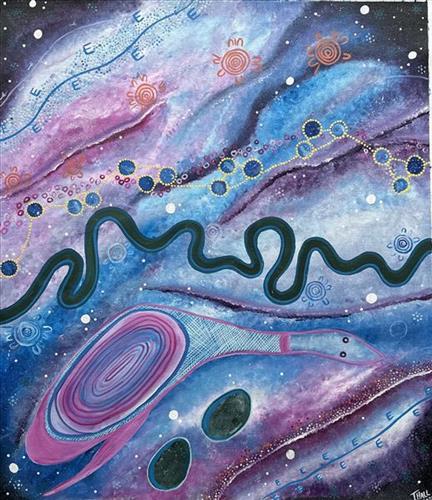
Winter time on the Bogan River, Emu in the sky telling us to stop collecting eggs. My people shown sitting together and all connected in the milky way. Celestial beings over the river. Totem make their way around the land.

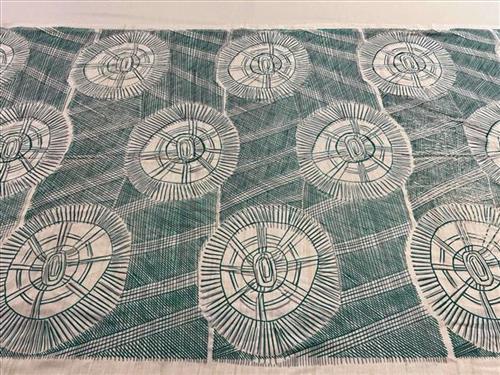
Deborah Wurrkidj is a Kuninjku artist from the Kurulk clan whose country lies around the outstation of Mumeka in central Arnhem Land. She is an accomplished artist working across mediums including painting, sculpture, weaving and textile design. For this design, Deborah Wurrkidj has depicted Marebu (woven pandanus mats).
Works in fibre from the Maningrida region are widely recognised as some of the finest in Australia. Artists confidently push the boundaries of fibre craft and cultural expression, adapting traditional techniques and forms to produce strikingly inventive and aesthetically exquisite artworks.
Artists weave many different kinds of mats. Conical mats were traditionally used to shield babies from mosquitoes. Long flat mats were used for blocking creeks so that fish would be diverted into fish traps. A small triangular mat made of pandanus fibre used to be worn by women during ceremonial gatherings, tied around their back and covering them at the front. Mats are also used for wrapping and rinsing food in water.
Artists usually use kundayarr, pandanus spiralis, to weave decorative round or oblong mats, as well as the less common triangular and conical shapes. Weaving is physically hard work, now done only by women. They colour the pandanus using natural dyes made from the roots, leaves or flowers of plants within the weaver’s clan estate.
The radial woven patterns of the finest round mats appear to vibrate with colour, sometimes regarded as an aesthetic manifestation of deep cultural meaning, as there is a significant spiritual dimension to pandanus mats.

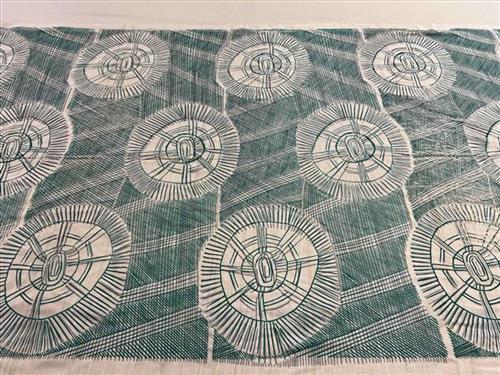
Deborah Wurrkidj is a Kuninjku artist from the Kurulk clan whose country lies around the outstation of Mumeka in central Arnhem Land. She is an accomplished artist working across mediums including painting, sculpture, weaving and textile design. For this design, Deborah Wurrkidj has depicted Marebu (woven pandanus mats).
Works in fibre from the Maningrida region are widely recognised as some of the finest in Australia. Artists confidently push the boundaries of fibre craft and cultural expression, adapting traditional techniques and forms to produce strikingly inventive and aesthetically exquisite artworks.
Artists weave many different kinds of mats. Conical mats were traditionally used to shield babies from mosquitoes. Long flat mats were used for blocking creeks so that fish would be diverted into fish traps. A small triangular mat made of pandanus fibre used to be worn by women during ceremonial gatherings, tied around their back and covering them at the front. Mats are also used for wrapping and rinsing food in water.
Artists usually use kundayarr, pandanus spiralis, to weave decorative round or oblong mats, as well as the less common triangular and conical shapes. Weaving is physically hard work, now done only by women. They colour the pandanus using natural dyes made from the roots, leaves or flowers of plants within the weaver’s clan estate.
The radial woven patterns of the finest round mats appear to vibrate with colour, sometimes regarded as an aesthetic manifestation of deep cultural meaning, as there is a significant spiritual dimension to pandanus mats.
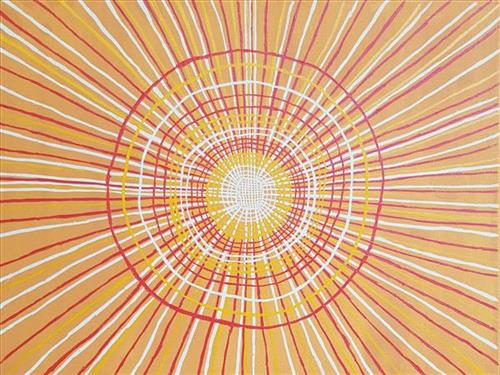
My painting depicts the Gunga, a woven Pandanus Mat.
I learnt how to weave by my mother. She taught me how to make baskets from pandanus using the coiling technique. I learnt how make string bags, dilly bags and woven mats during a workshop for junior rangers.
I’ve been mostly a weaver but now trying painting. We might have a go at weaving in Wujal Wujal.
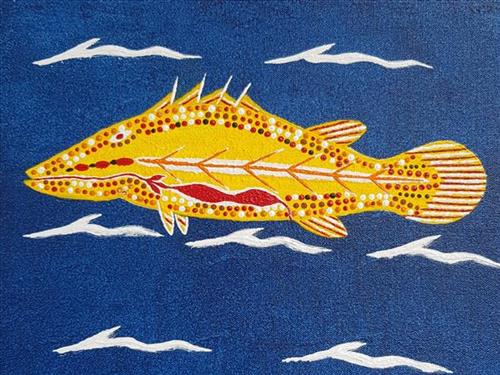
When Kudi (Barra) was small, he grew up as a boy. He went out hunting with the other men and young boys for kangaroo, goanna, turtles, dugong and crocodile.
As a young boy, he went through initiation to be a young man. After that he was getting lazy and would make excuses not to go hunting with the men, saying I am too tired or I have a sore foot.
When the men left, he would go follow the woman and from a distance watch them get muscles, dig round for eggs, gather yams and other women’s business. He was curious about what the women got up to.
One day, one of the old ladies saw Kudi standing behind a bush looking at them. When the women got back to camp they told the old men about Kudi watching them.
The old men got together and told the magic man about Kudi and sing him into a young girl.
After that he was no longer a man he disappeared never to be seen again. He got big shame and jumped into the water. Kudi turned into a Barramundi fish.
Today you see Barra, at first it is a male, later in the years he turns into a female.
Story by Cedric Sam Friday